

Top Agile Development Best Practices for Fast MVPs in 2025
Table of Contents
In the race to market, speed without direction is just a faster way to get lost. For startup founders and product leads, turning a brilliant idea into a functional Minimum Viable Product (MVP) is a critical first step. The challenge isn't just building quickly; it's about building the right product efficiently, ensuring it resonates with users and provides a solid foundation for future scaling. This is where a focused application of agile development best practices becomes your most significant competitive advantage.
Standard agile advice often feels too broad or theoretical for the high-stakes, resource-constrained environment of an early-stage venture. This guide cuts through that noise. We’ve distilled the agile framework into ten essential, actionable practices specifically adapted for rapid MVP teams. You won’t find vague theories here. Instead, this is a practical playbook designed to help you build, measure, and learn with maximum efficiency.
From structuring your daily check-ins for peak productivity to implementing a robust feedback loop, each strategy is broken down into concrete steps. We will cover how to leverage short sprints, continuous deployment, and user story mapping to maintain momentum and focus. You'll learn how to implement techniques like Test-Driven Development and Pair Programming to build quality directly into your product from day one. Whether you are a first-time founder, a CTO, or a small business owner, these proven methods will provide the clear framework needed to navigate the complexities of early-stage development. Let's dive into the strategies that will help you launch a successful MVP with confidence and precision.
1. Daily Stand-up Meetings
The daily stand-up, often called the daily scrum, is a cornerstone of agile development best practices. It's a short, time-boxed meeting, typically lasting no more than 15 minutes, designed to synchronize the development team's activities. The goal is rapid communication, not deep problem-solving. Each team member briefly answers three core questions: What did I accomplish yesterday? What will I work on today? What obstacles are impeding my progress?
This practice, popularized by Scrum pioneers like Jeff Sutherland and Ken Schwaber, is crucial for MVP teams. It fosters accountability, promotes transparency, and allows for the immediate identification of blockers that could derail a sprint. Companies like Spotify and Atlassian integrate stand-ups as a non-negotiable part of their agile workflows, ensuring their squads and teams remain aligned and proactive.
How to Implement Daily Stand-ups Effectively
For a rapid MVP team, a well-run stand-up is vital. It prevents minor issues from becoming major delays.
- Keep it Time-Boxed: Strictly enforce the 15-minute limit. This forces conversations to be concise and focused on progress, not technical debates.
- Stand Up Physically: If your team is co-located, the simple act of standing helps keep the meeting brief and energetic. For remote teams, cameras on is the virtual equivalent.
- Focus on Blockers: The most critical output of a stand-up is the list of impediments. The Scrum Master or team lead must ensure these are addressed immediately after the meeting, not during it.
- Take It Offline: If a discussion starts between two members that doesn't involve the whole team, politely interrupt and suggest they sync up afterward. This respects everyone's time.
This daily ritual is one of the most impactful agile development best practices because it builds a rhythm of communication and problem-solving. By quickly surfacing issues, the team can adapt its plan for the day, ensuring continuous momentum toward the MVP goals.
2. Sprint Planning
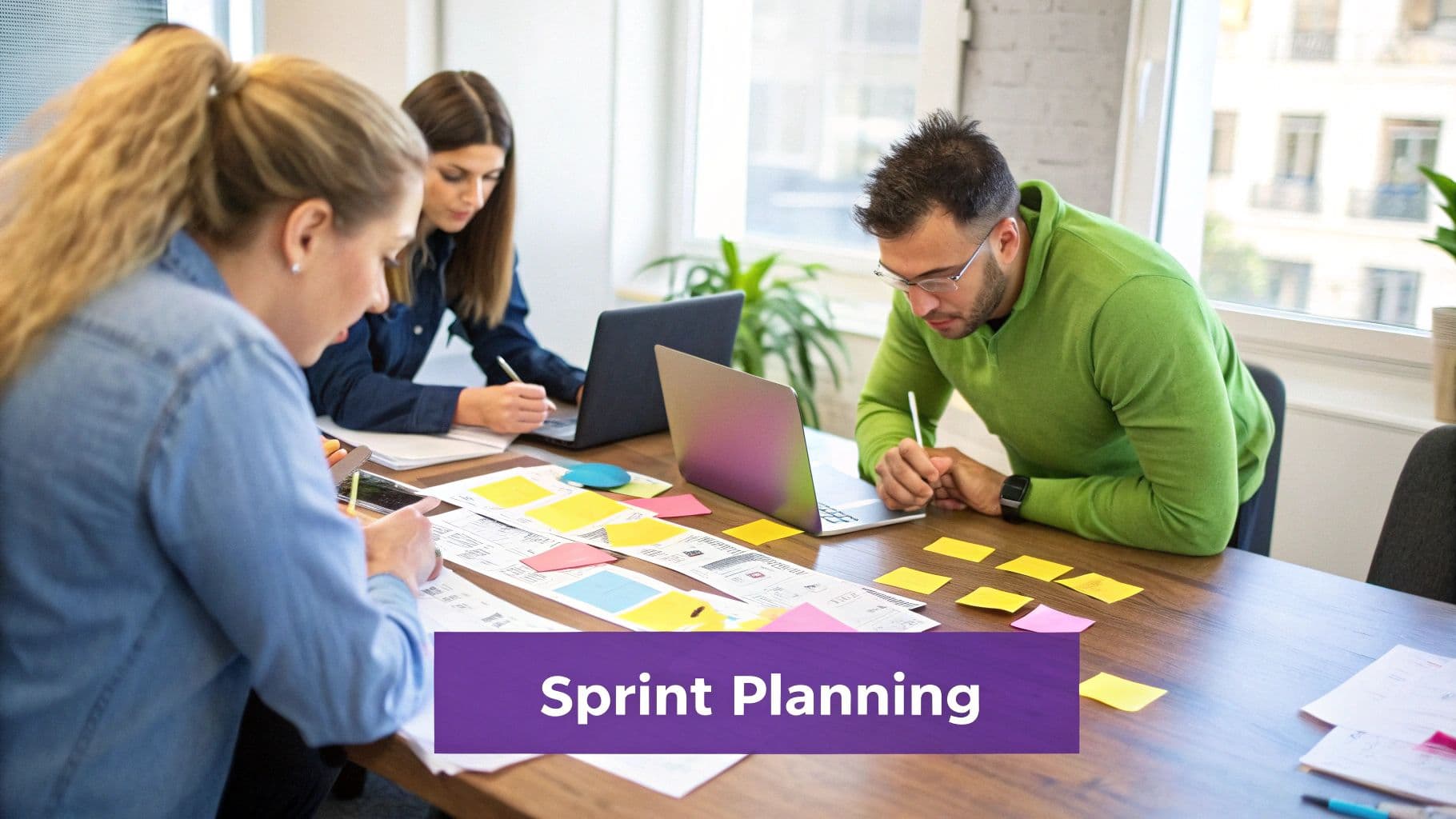
Sprint planning is the collaborative event that kicks off a sprint, making it a fundamental agile development best practice. It is a time-boxed meeting where the development team, Scrum Master, and Product Owner come together to select high-priority items from the product backlog. The team then defines a sprint goal and crafts a plan for delivering the work, creating a detailed sprint backlog. The core output is a shared commitment to a realistic set of deliverables for the upcoming iteration.
This process, a keystone of the Scrum framework championed by Jeff Sutherland and Mike Cohn, provides the focus needed for rapid MVP development. It ensures the team has a clear, agreed-upon objective and a well-defined plan to achieve it. Major tech companies like Google for Android development and Netflix for new streaming features rely on rigorous sprint planning to align their teams and ensure predictable delivery of value.
How to Implement Sprint Planning Effectively
For a fast-moving MVP team, effective sprint planning translates directly into focused execution and predictable progress. It sets the tone for the entire sprint.
- Groom the Backlog First: Arrive at the planning meeting with a well-prepared product backlog. Stories should be prioritized, estimated, and have clear acceptance criteria before the session begins.
- Use Historical Velocity: Don't guess your capacity. Use the team's average velocity (the amount of work completed in previous sprints) as a data-driven guide for how much work to pull into the new sprint.
- Break Down Large Stories: The team should break down selected user stories into smaller, more granular technical tasks. This uncovers hidden complexity and makes progress easier to track.
- Set a Realistic Sprint Goal: The goal shouldn't just be "complete these tickets." It should be a cohesive, valuable outcome, like "Users can now sign up and create a basic profile." This provides a unifying purpose.
Effective sprint planning is one of the most critical agile development best practices because it transforms a wish list (the product backlog) into an actionable plan. It fosters team ownership, clarifies expectations, and creates the roadmap for a successful sprint, which is essential for building an MVP quickly and efficiently.
3. Continuous Integration/Continuous Deployment (CI/CD)
Continuous Integration/Continuous Deployment (CI/CD) is a foundational practice in modern agile development, automating the process of building, testing, and releasing code. CI ensures that code changes from multiple developers are integrated into a single shared repository frequently. Each integration is then automatically verified by a build and test sequence. CD extends this by automatically deploying all code changes that pass the CI stage to a testing or production environment.
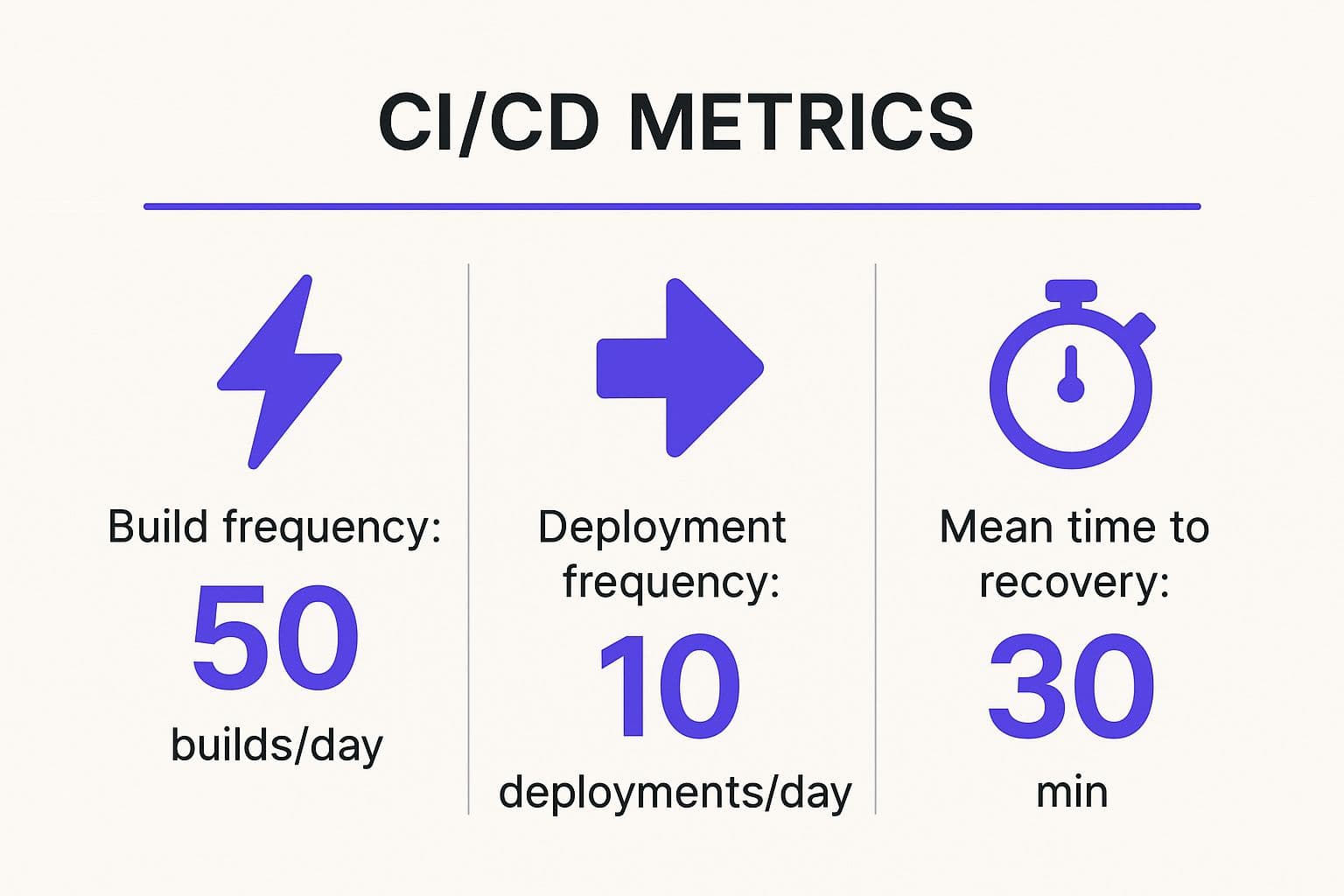
This automated pipeline, championed by thought leaders like Martin Fowler and Jez Humble, is what enables elite performers like Amazon to deploy code thousands of times a day. For an MVP team, CI/CD accelerates the feedback loop, reduces manual errors, and ensures that the product is always in a releasable state. The focus shifts from risky, large-scale deployments to small, frequent, and safe updates, making it one of the most critical agile development best practices.
How to Implement CI/CD Effectively
For a rapid MVP team, a solid CI/CD pipeline is the engine of velocity. It allows for quick iteration based on user feedback without sacrificing quality or stability.
- Start with CI First: Don't try to automate everything at once. Begin by setting up a simple CI server that automatically builds and runs unit tests on every code commit. This alone provides immense value by catching integration bugs early.
- Invest in Automated Testing: A CI/CD pipeline is only as reliable as its tests. Create a comprehensive suite of automated tests, including unit, integration, and end-to-end tests, to validate every change before it reaches users.
- Use Feature Flags: Deploying new features can be risky. Use feature flags (or toggles) to deploy code to production while keeping it hidden from users. This allows you to test in the live environment and release features with a simple switch flip, separating deployment from release.
- Ensure Fast Builds: The feedback loop must be fast. Aim to keep your entire build and test process under 10 minutes. Slow builds discourage frequent commits and delay the discovery of issues.
By embracing CI/CD, teams can confidently and frequently deliver value to users. This practice transforms releases from stressful, high-risk events into routine, low-impact activities, which is essential for the continuous improvement cycle at the heart of building a successful MVP.
4. Test-Driven Development (TDD)
Test-Driven Development (TDD) is a software development process that inverts the traditional coding sequence. Instead of writing functional code first, developers start by writing an automated test case that defines a desired improvement or new function. This initial test will inevitably fail because the code to pass it doesn't exist yet. This discipline forces developers to think clearly about requirements before writing a single line of implementation code.
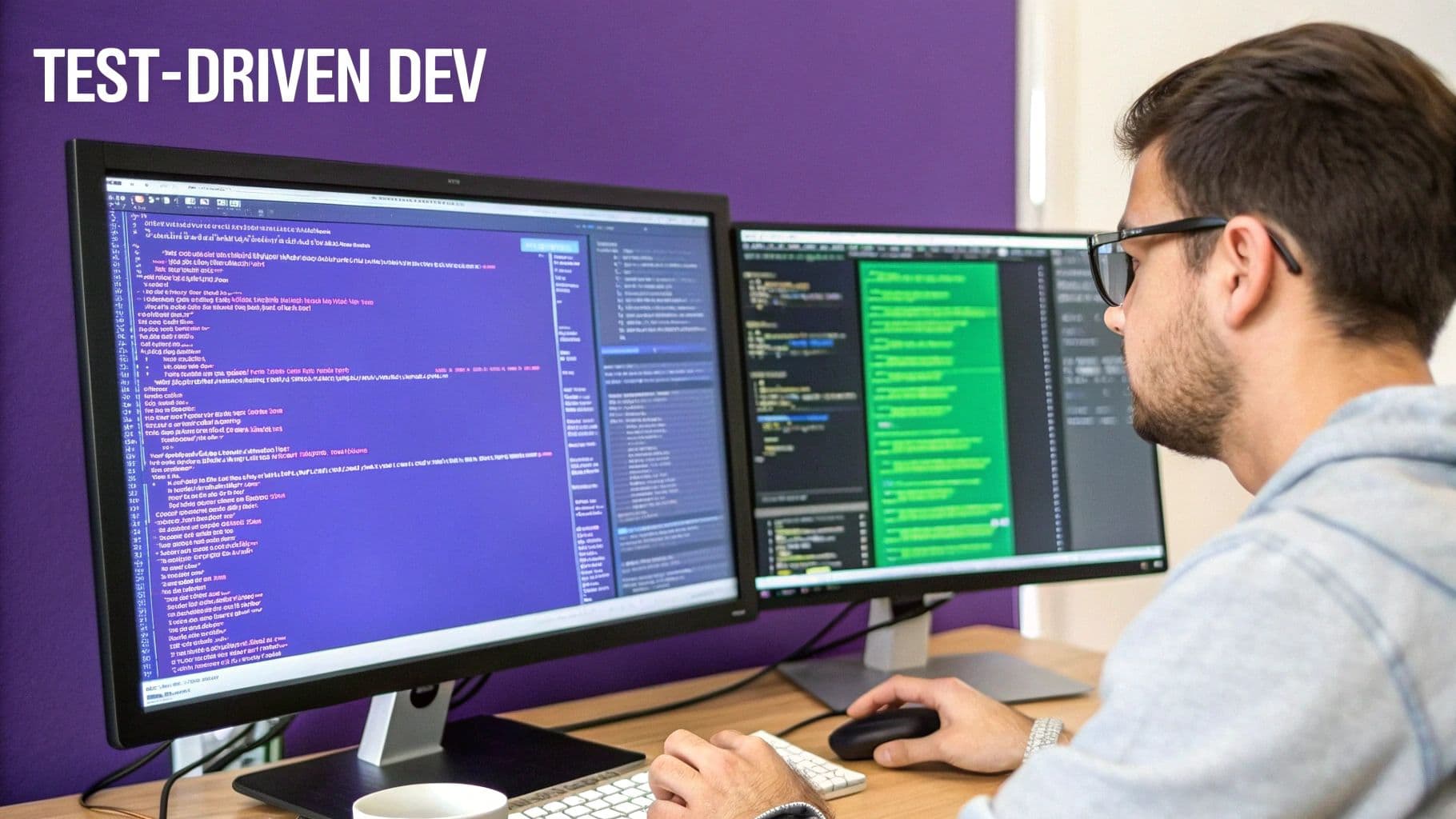
This practice, popularized by software pioneers like Kent Beck and Robert C. Martin, is one of the most powerful agile development best practices for building robust systems. It follows a simple, repeatable cycle: Red (write a failing test), Green (write the minimum code to pass the test), and Refactor (clean up the code while ensuring the test still passes). Companies like thoughtbot and Pivotal Labs integrate TDD into their core workflows to ensure high code quality and reduce bugs from the outset, which is critical for a stable MVP.
How to Implement Test-Driven Development Effectively
For a rapid MVP team, TDD might seem counterintuitive, but it actually increases development speed over time by reducing debugging and rework. It builds a safety net of tests that allows for fearless refactoring and feature addition.
- Start with the Smallest Test: Begin by writing a simple, small test for a tiny piece of functionality. Don't try to test the entire feature at once. This keeps the cycle fast and manageable.
- Write the Simplest Code: In the "Green" phase, resist the urge to write perfect or comprehensive code. The goal is to write only what is necessary to make the specific failing test pass.
- Refactor Relentlessly: The "Refactor" step is non-negotiable. This is where you improve the design, remove duplication, and enhance clarity without changing the external behavior, all while your tests provide a safety net.
- Use Descriptive Test Names: Name your tests to describe the expected behavior, not the implementation details. A test named shouldCalculateTotalWhenItemsAreAdded is far more useful than testCalculateMethod.
By embracing this cycle, teams build a living, executable specification of their system. This approach is a hallmark of disciplined agile development best practices, ensuring the MVP is not just built fast, but also built right and is ready for future scaling.
5. User Story Mapping
User Story Mapping is a collaborative, visual exercise that shifts the focus from a flat backlog to a rich, two-dimensional view of the user's journey. Instead of just listing features, teams map out user activities and tasks sequentially, creating a narrative flow. This powerful agile development best practice helps everyone understand the big picture, see how individual stories fit into the larger workflow, and prioritize what to build first to deliver a cohesive experience.
Popularized by author and consultant Jeff Patton, this technique is indispensable for MVP teams. It visualizes the entire product from the user's perspective, making it easier to identify the "minimum viable product" as a thin slice of essential functionality across the entire journey. Companies like Target have used story mapping to redesign mobile apps, ensuring the new experience holistically served customer needs from discovery to purchase.
How to Implement User Story Mapping Effectively
For a rapid MVP team, story mapping prevents building disconnected features and instead focuses on creating a valuable end-to-end user journey.
- Start with Goals and Activities: Begin by identifying the main goals your users want to achieve. Frame the "backbone" of your map with high-level user activities (e.g., "Find Product," "Add to Cart," "Checkout").
- Involve Diverse Stakeholders: Bring together developers, designers, product owners, and even sales or support staff. This cross-functional input ensures the map reflects both user needs and business realities.
- Focus on the Narrative: Under each activity, brainstorm the specific steps or user stories. Arrange them chronologically to tell the story of how a user interacts with your product.
- Slice for Releases: Once the full journey is mapped, draw horizontal lines to slice the map into releases. The first slice is your MVP, a set of stories that provides a complete, albeit simple, user experience.
By visualizing the product from the user's point of view, story mapping stands out among agile development best practices. It aligns the entire team on what to build and why, ensuring that the first release is not just viable but genuinely valuable.
6. Retrospectives
The retrospective is a critical ceremony in agile development best practices, serving as the team's dedicated time for continuous improvement. Held at the end of each sprint or iteration, this meeting is a structured reflection on the team's process. The core purpose is to collaboratively answer three questions: What went well? What didn't go so well? And what will we change for the next iteration? It's not about placing blame; it's about improving the system.
Pioneered by agile thought leaders like Norm Kerth, Esther Derby, and Diana Larsen, the retrospective empowers teams to own their processes. For instance, ING Bank reportedly improved its delivery speed by 20% by systematically implementing changes identified in retrospectives. Similarly, Spotify’s squads rely on this practice to refine their workflows, and Adobe has successfully used focused retrospectives to reduce technical debt, ensuring long-term product health.
How to Implement Retrospectives Effectively
For a rapid MVP team, effective retrospectives are the engine of evolution, turning lessons learned into immediate action and preventing the repetition of mistakes.
- Vary the Format: Avoid monotony by using different retrospective formats. Techniques like "Start, Stop, Continue," "Mad, Sad, Glad," or the "4Ls" (Liked, Learned, Lacked, Longed For) can keep the team engaged and surface different kinds of insights.
- Create Psychological Safety: Honest feedback is the lifeblood of a good retrospective. The facilitator, often the Scrum Master, must establish a blame-free environment where every team member feels safe to speak openly about challenges and failures.
- Focus on Actionable Items: The goal is improvement, not just discussion. Identify 2-3 specific, actionable, and measurable improvements the team can realistically implement in the next sprint. Assign an owner to each action item to ensure accountability.
- Follow Up Consistently: Begin each retrospective by reviewing the action items from the previous one. This creates a closed loop, demonstrates the value of the meeting, and builds a culture of genuine, continuous improvement.
This disciplined practice of reflection is one of the most powerful agile development best practices for any team. It ensures that with each iteration, the team doesn't just build more of the product; it gets better at building the product itself.
7. Definition of Done (DoD)
The Definition of Done (DoD) is a critical agile development best practice that acts as a formal, shared agreement on the criteria a product backlog item must meet to be considered complete. It's a comprehensive checklist that ensures every piece of work delivered by the team meets a consistent quality standard. The goal is to eliminate ambiguity and ensure that when a feature is marked "done," it is genuinely finished and potentially shippable.
This concept, central to the Scrum framework, provides the transparency needed for an MVP team to build with confidence. A strong DoD prevents "done but not really done" scenarios where work requires significant rework after the sprint. Tech giants like Google often include stringent criteria in their DoD, such as passing security reviews and meeting internationalization standards, to ensure new features align with their global quality benchmarks from day one.
How to Implement a Definition of Done Effectively
For a rapid MVP team, a clear DoD prevents technical debt and ensures the product is always in a state of releasable quality, even if not every feature is built yet.
- Make It Visible and Accessible: Your DoD is not a secret document. Post it prominently in the team's physical workspace or on a shared digital board (like Confluence or a Miro board). Everyone should be able to reference it easily.
- Start Simple and Evolve: Your initial DoD doesn’t need to be perfect. Start with a basic checklist (e.g., code written, peer-reviewed, merged to main, unit tests passed) and refine it over time based on retrospective feedback.
- Include All Aspects of Quality: A good DoD covers more than just functional code. It should include technical quality (code standards), user experience (UX/UI consistency), and non-functional requirements like performance and accessibility checks.
- Review and Adapt Regularly: The DoD is a living artifact. Use sprint retrospectives to discuss if the current DoD is working. Is it too strict and slowing you down? Is it too loose and letting defects through? Adjust it as the team and product mature.
Adopting a robust DoD is one of the most impactful agile development best practices because it creates a predictable and transparent development process. It empowers the team to push back on incomplete work and gives stakeholders confidence that "done" truly means done.
8. Cross-functional Teams
One of the most powerful agile development best practices is the principle of building cross-functional teams. Instead of siloing expertise into separate departments (design, development, QA), a cross-functional team contains all the necessary skills to move a product feature from concept to completion. This includes developers, testers, UI/UX designers, and sometimes even product owners or analysts, all working as a single, cohesive unit.
This structure, fundamental to frameworks like Scrum, eliminates handoffs and delays between different functional groups. By having every required skill within the team, communication flows faster, and decisions are made more quickly. Tech giants have famously adopted this model; Amazon's "two-pizza teams" are designed to be small and autonomous, while Spotify's "squads" operate as mini-startups with end-to-end responsibility for their specific feature area.
How to Implement Cross-functional Teams Effectively
For a rapid MVP team, being cross-functional is non-negotiable. It drastically reduces external dependencies and bottlenecks that can cripple speed.
- Assemble Holistically: When forming the team, ensure it includes all skills needed to deliver a complete, working slice of the product. Don't forget roles like QA and design from the outset.
- Encourage T-Shaped Skills: Foster an environment where specialists (the vertical bar of the 'T') also develop a broad knowledge base in other areas (the horizontal bar). A developer who understands design principles can collaborate more effectively.
- Establish Clear Roles, Flexible Execution: While everyone has a primary role (e.g., QA engineer), encourage members to step outside their comfort zone to help the team meet its sprint goal. A developer might help with testing, or a designer might assist with front-end code.
- Promote Shared Ownership: The entire team, not just individuals, owns the feature. Success or failure is a collective outcome, which encourages members to help each other overcome obstacles regardless of their official title.
Adopting this practice is a core tenet of agile development best practices because it optimizes for flow and minimizes waste. By breaking down organizational silos, teams can operate with the autonomy and speed required to build and iterate on an MVP efficiently.
9. Iterative Development with Short Sprints
Iterative development with short sprints is a fundamental practice in agile methodologies, breaking down large projects into small, manageable, time-boxed cycles. These iterations, typically lasting one to four weeks, are designed to produce a potentially shippable increment of the product. The core principle is to deliver value, gather feedback, and adapt the plan frequently rather than building the entire product in one long phase.
This approach, central to frameworks like Scrum and Extreme Programming, is a powerful engine for rapid MVP development. It drastically reduces risk by allowing teams to test assumptions and validate direction with real, working software at the end of each cycle. Major tech companies like Salesforce and Atlassian build their complex platforms using consistent two-week sprints, while Spotify has famously used one-week sprints for rapid experimentation, showcasing the versatility of this agile development best practice.
How to Implement Short Sprints Effectively
For an MVP team, mastering the rhythm of short sprints is key to maintaining momentum and responding to market feedback quickly.
- Keep Sprint Length Consistent: Choose a duration (e.g., two weeks) and stick with it. This consistency creates a predictable cadence for planning, execution, and review, which helps the team improve its estimation and delivery capabilities over time.
- Deliver Working Software: The primary goal of every sprint is to produce a demonstrable, working piece of the product. This isn't just "code complete"; it's tested, integrated, and valuable to a stakeholder.
- Protect the Sprint: Once a sprint begins, the scope should be locked. Shield the team from new requests or changing priorities mid-sprint to allow them to focus and meet their commitment. Urgent items can be queued for the next sprint.
- Focus on Finishing: Encourage a "stop starting, start finishing" mindset. It's better to have three features fully completed than ten features halfway done. Use a Kanban board to visualize work-in-progress and identify bottlenecks.
By embracing iterative development, teams can build, measure, and learn in rapid succession. This ensures the final product is not just built correctly, but more importantly, that the team is building the right product for the market.
10. Pair Programming
Pair programming is an agile software development technique where two developers collaborate on a single workstation. This practice involves one developer, the "driver," who actively writes code, while the other, the "navigator," observes, reviews each line of code as it's typed, and thinks strategically about the bigger picture. The roles are meant to be fluid, with frequent switching to keep both participants engaged and fresh.
This method, a core practice of Extreme Programming (XP) championed by Kent Beck, is more than just having two sets of eyes on the code. It's a powerful tool for producing higher-quality code with fewer defects from the outset. Companies like Pivotal Labs and thoughtbot have built their engineering cultures around pair programming, using it to solve complex problems, accelerate knowledge transfer, and maintain high standards across their teams. This approach is one of the most effective agile development best practices for reducing bugs and improving design quality in real-time.
How to Implement Pair Programming Effectively
For a rapid MVP team, pairing can significantly accelerate the development of critical or complex features while simultaneously upskilling the entire team.
- Switch Roles Regularly: To prevent fatigue and maintain high engagement, the driver and navigator should switch roles often, perhaps every 30-60 minutes. This ensures both developers contribute to the hands-on coding and the high-level strategy.
- Pair for Complexity: Use this practice strategically. It's most valuable for tackling complex algorithms, critical business logic, or unfamiliar parts of the codebase. It might be overkill for simple, routine tasks.
- Foster Knowledge Transfer: Intentionally pair a senior developer with a junior one. This is one of the fastest ways to onboard new team members and spread domain knowledge, reducing knowledge silos and bus factor.
- Take Frequent Breaks: Pairing is mentally intensive. Encourage short, regular breaks to help both developers recharge and maintain focus. The Pomodoro Technique works well here.
By integrating pair programming, teams can build more robust and well-thought-out features from the start. This collaborative practice embodies the agile principles of communication and continuous feedback, making it an indispensable technique for teams committed to building a high-quality MVP.
Agile Development Best Practices Comparison
| Practice / Item | Implementation Complexity 🔄 | Resource Requirements ⚡ | Expected Outcomes 📊 | Ideal Use Cases 💡 | Key Advantages ⭐ |
|---|---|---|---|---|---|
| Daily Stand-up Meetings | Low 🔄 - Short, daily 15-min meetings | Low ⚡ - Entire team participation daily | Improved communication, early blocker identification 📊 | Synchronizing team progress, quick issue spotting | Transparency, accountability, quick problem resolution ⭐ |
| Sprint Planning | Medium 🔄 - 2 hours per week per sprint | Medium ⚡ - Full Scrum team involvement | Clear sprint backlog, team commitment 📊 | Sprint preparation, workload estimation | Direction, focus, alignment, scope control ⭐ |
| CI/CD | High 🔄 - Requires automated pipelines | High ⚡ - Tooling and infrastructure needed | Faster releases, improved code quality 📊 | Frequent code integration and deployment | Rapid feedback, reduced errors, faster time to market ⭐ |
| Test-Driven Development (TDD) | High 🔄 - Writing tests first | Medium ⚡ - Developer discipline required | Better code quality, regression protection 📊 | Complex codebases, requirements clarity | Higher test coverage, design improvement, maintainability ⭐ |
| User Story Mapping | Medium 🔄 - Visual and collaborative | Low-Medium ⚡ - Stakeholder involvement | Prioritized backlog with user value focus 📊 | Release planning, user journey understanding | Shared understanding, better prioritization ⭐ |
| Retrospectives | Low 🔄 - Regular sprint-end meetings | Low ⚡ - Whole team participation | Actionable improvements, continuous process growth 📊 | Team reflection, process improvements | Continuous improvement, engagement, communication ⭐ |
| Definition of Done (DoD) | Low-Medium 🔄 - Checklist creation and upkeep | Low ⚡ - Team-wide understanding required | Clear quality criteria, consistent done status 📊 | Ensuring work completeness and quality | Reduced ambiguity, quality consistency ⭐ |
| Cross-functional Teams | Medium 🔄 - Team structure organization | High ⚡ - Diverse skill sets needed | Faster delivery, end-to-end feature ownership 📊 | Independent feature teams, reduced external dependencies | Collaboration, ownership, faster delivery ⭐ |
| Iterative Development (Sprints) | Medium 🔄 - Time-boxed 1-4 week cycles | Medium ⚡ - Regular planning and reviews | Early value delivery, better adaptability 📊 | Frequent feedback, risk mitigation | Reduced risk, better predictability, stakeholder satisfaction ⭐ |
| Pair Programming | High 🔄 - Two developers sharing tasks | High ⚡ - Two developers per task | Improved code quality and knowledge transfer 📊 | Complex tasks, critical code, learning opportunities | Continuous review, collaboration, fewer bugs ⭐ |
Build Better, Faster: Integrating Agile Practices into Your MVP Workflow
The journey from a promising idea to a market-ready Minimum Viable Product (MVP) is not a linear path; it's a dynamic, iterative cycle of building, measuring, and learning. The ten agile development best practices we've explored provide a comprehensive toolkit, not just a rigid set of rules. They are the essential components of a high-performing engine designed for speed, adaptability, and, most importantly, value creation. From the daily pulse of stand-up meetings to the reflective insights gained in retrospectives, each practice serves a distinct purpose in de-risking your development process and focusing your team's energy where it counts the most.
By embracing these principles, you shift your team's mindset from simply "writing code" to "solving problems." You move away from building in a vacuum and toward a state of continuous dialogue with your end-users, ensuring the product you build is the product they actually need. This is the core promise of agile, a promise that is especially critical for MVP teams where resources are finite and time is of the essence.
Turning Theory into Tangible Results
Adopting these practices is not about checking boxes; it's about fostering a culture of continuous improvement. The real power of agile is unlocked when these individual elements work in concert, creating a flywheel effect that accelerates your progress.
- Daily Stand-ups and Sprint Planning provide the rhythm and foresight for your team.
- CI/CD and TDD build a foundation of technical excellence and automated quality assurance.
- User Story Mapping ensures you are always building the right features for the right reasons.
- Retrospectives and a clear Definition of Done create a culture of accountability and relentless optimization.
- Cross-functional Teams, Pair Programming, and Short Sprints are the structural components that enable true collaboration and rapid feedback.
Individually, each of these is a potent tool. Together, they form an operational framework that transforms how your team conceives, builds, and delivers software. The goal is to create a system where momentum builds with each sprint, turning uncertainty into clarity and assumptions into validated learning.
Your Actionable Path Forward
Mastering these agile development best practices is a journey, not a destination. To begin integrating them effectively, start small and be deliberate. Don't try to implement everything at once. Instead, identify your team's most significant pain point and select a practice that directly addresses it.
- Start with Retrospectives: If you don't know where the problems are, this is the place to start. A single, well-facilitated retrospective can unearth critical bottlenecks and provide a clear, team-driven mandate for what to improve next.
- Define Your "Done": Create a clear, shared Definition of Done (DoD). This simple act of alignment can dramatically reduce ambiguity, prevent half-finished work from moving forward, and improve the overall quality of your output.
- Visualize the Work: Implement a simple Kanban board or use User Story Mapping to make the workflow visible to everyone. This transparency is often the first step toward identifying inefficiencies and fostering a sense of shared ownership.
The value of mastering these agile concepts extends far beyond building a single MVP. It equips your organization with the resilience and adaptability needed to thrive in a competitive market. You learn to pivot faster, respond to user feedback more effectively, and ultimately build products that have a lasting impact. By embedding these practices into your team's DNA, you are not just building a product; you are building a product-development machine capable of sustained innovation and growth. This is how you win not just the first launch, but the long game.
The journey from idea to MVP is challenging, but you don't have to navigate it alone. Iglu Digital specializes in operationalizing these agile development best practices to transform visions into tangible, market-ready products with the scope and the price agreed before we start. If you're ready to accelerate your path to market with a team that lives and breathes agile, see how our proven approach can bring your concept to life at Iglu Digital.