

A Founder's Guide to Cloud-Based Development Services
Table of Contents
At its heart, cloud-based development means you're building software using tools and infrastructure that live on the internet, not in your office closet. Instead of buying and managing your own physical servers, you essentially rent everything you need—computing power, storage, databases, and development tools—from a provider like Amazon Web Services (AWS) or Google Cloud. This completely changes the game, letting you build, test, and launch your applications far more quickly and efficiently.
What Are Cloud-Based Development Services
Imagine you needed electricity for your house. The traditional, on-premise way of doing things would be like building your own personal power plant in the backyard. It's a massive, expensive, and slow upfront investment. You'd have to buy the generators (servers), install the wiring (networks), and hire a crew just to keep the lights on—even when you’re only using a fraction of the power.
Cloud-based development flips that idea on its head. It’s like plugging into the national power grid. You get instant access to all the electricity you could ever want, you only pay for what you actually use, and someone else handles all the maintenance. That's the essence of cloud computing: on-demand access to a massive, shared pool of resources delivered right to you over the internet.
This shift from owning to renting frees up your most critical resources—cash and people. It's why the global cloud services market is absolutely booming, with projections showing growth from USD 721.87 billion in 2025 to an incredible USD 2.73 trillion by 2034. You can dig deeper into these numbers over at Precedence Research.
The Core Difference: On-Premise vs. Cloud
The real distinction comes down to responsibility and speed. When you run your own infrastructure on-premise, you own everything, which also means you're responsible for everything—the good, the bad, and the broken. With the cloud, the provider takes care of the physical hardware, so you can focus on building your product.
This diagram from AWS does a great job of showing how the cloud centralizes all those essential resources—servers, storage, databases—and makes them available on demand.

This model is what allows a two-person startup to access the same powerful, world-class infrastructure as a Fortune 500 company, without the eye-watering price tag.
For founders and CTOs trying to make their runway last while getting to market faster, this difference is everything. Let's break down the comparison a bit more clearly.
On-Premise vs Cloud-Based Development At a Glance
The table below offers a straightforward look at how these two models stack up against each other on the factors that matter most to a growing business.
| Factor | On-Premise Development | Cloud-Based Development |
|---|---|---|
| Initial Cost | Very high (hardware, software, facilities) | Low (pay-as-you-go, no upfront hardware costs) |
| Scalability | Difficult and slow (requires buying new hardware) | Easy and fast (scale up or down in minutes) |
| Maintenance | Your team is responsible for all upkeep and repairs | The cloud provider handles all physical maintenance |
| Speed to Market | Slower due to long setup and procurement times | Much faster, with instant access to resources |
| Accessibility | Limited to physical location or complex VPNs | Accessible from anywhere with an internet connection |
As you can see, the cloud offers a level of agility and financial flexibility that's nearly impossible to achieve with a traditional on-premise setup.
Gaining a Competitive Edge for Your Startup
When you're running a startup, every single decision needs to give you an edge. Moving to cloud-based development isn't just a tech upgrade—it's a core business strategy. It directly shapes how you compete, innovate, and ultimately, grow. This shift changes your financial structure, boosts your product's performance, and frees up your team to build faster and smarter.

Think of it as gaining access to a powerful ecosystem of tools and infrastructure that, just a few years ago, would have been completely out of reach for any early-stage company.
Financial Agility with Pay-As-You-Go Models
The most immediate win is swapping huge upfront hardware costs (CapEx) for a predictable monthly bill (OpEx). Instead of sinking your precious seed money into physical servers that start losing value the second you turn them on, you pay only for what you use.
This model is a lifesaver for managing cash flow. Your spending scales directly with your user base and revenue, which gives you incredible financial flexibility. It's a key principle for building a durable business, a concept we dive into in our guide to the Lean Startup methodology. You can then reinvest that freed-up cash into what really matters: product development, marketing, and hiring the best people.
Effortless Scalability for Unpredictable Growth
Picture this: your app gets a huge shout-out, and your traffic suddenly explodes by 10,000% in an hour. With old-school on-premise servers, this dream scenario instantly turns into a nightmare. Your system would crash, and there’s no way you could buy and set up new hardware fast enough to handle the load.
This is where the magic of cloud scalability comes in. Cloud infrastructure is built to be elastic.
- Automatic Scaling: You can set up your system to automatically fire up more computing power when traffic spikes and then scale back down when things quiet down. You don't have to lift a finger.
- Global Reach: Cloud providers have data centers all over the world. This means you can easily deploy your application closer to your users, cutting down on lag and giving them a much better experience, no matter where they live.
- Reliability: These providers build in layers of redundancy to minimize downtime, making sure your app stays online even when things go wrong.
Having the ability to handle viral growth on a moment's notice means you'll never miss a huge opportunity because your tech couldn't keep up.
Focus on Innovation, Not Infrastructure
Your engineering team's time is your most precious resource. Every hour they spend patching servers, configuring databases, or wrestling with hardware is an hour they're not spending on building the features that make your product special.
Cloud providers offer a whole suite of managed services, from databases and analytics to AI and machine learning tools. By using them, you're essentially outsourcing all the tedious backend management. This lets your team focus their brainpower where it truly counts: creating an amazing user experience and solving your customers' biggest problems. The result? You innovate faster and get your product to market in a fraction of the time.
Empowering Distributed Teams and Collaboration
Finally, cloud development services are tailor-made for today's remote-first world. Your development environments, codebases, and project management tools all live in a central, accessible place.
This means every team member, whether they're in the same office or on opposite sides of the globe, is working from the same playbook. This kind of seamless collaboration smooths out the entire development process, boosts productivity, and lets you build a world-class team without being limited by geography.
Choosing Your Cloud Service Model
Stepping into the world of cloud development can feel like trying to decipher a secret language of acronyms. But don't let that intimidate you. Picking the right service model is one of the most important first steps you'll take, as it dictates how much control you have versus how much of the heavy lifting your cloud provider handles.
To make this simple, let's stick with a classic analogy: making a pizza. Each cloud model is just a different way to get that pizza, depending on how much of the cooking you want to do yourself. Getting this right from the start ensures your tech stack actually supports your team's skills and your company's goals.
The image below gives you a great visual of how these models relate to each other.
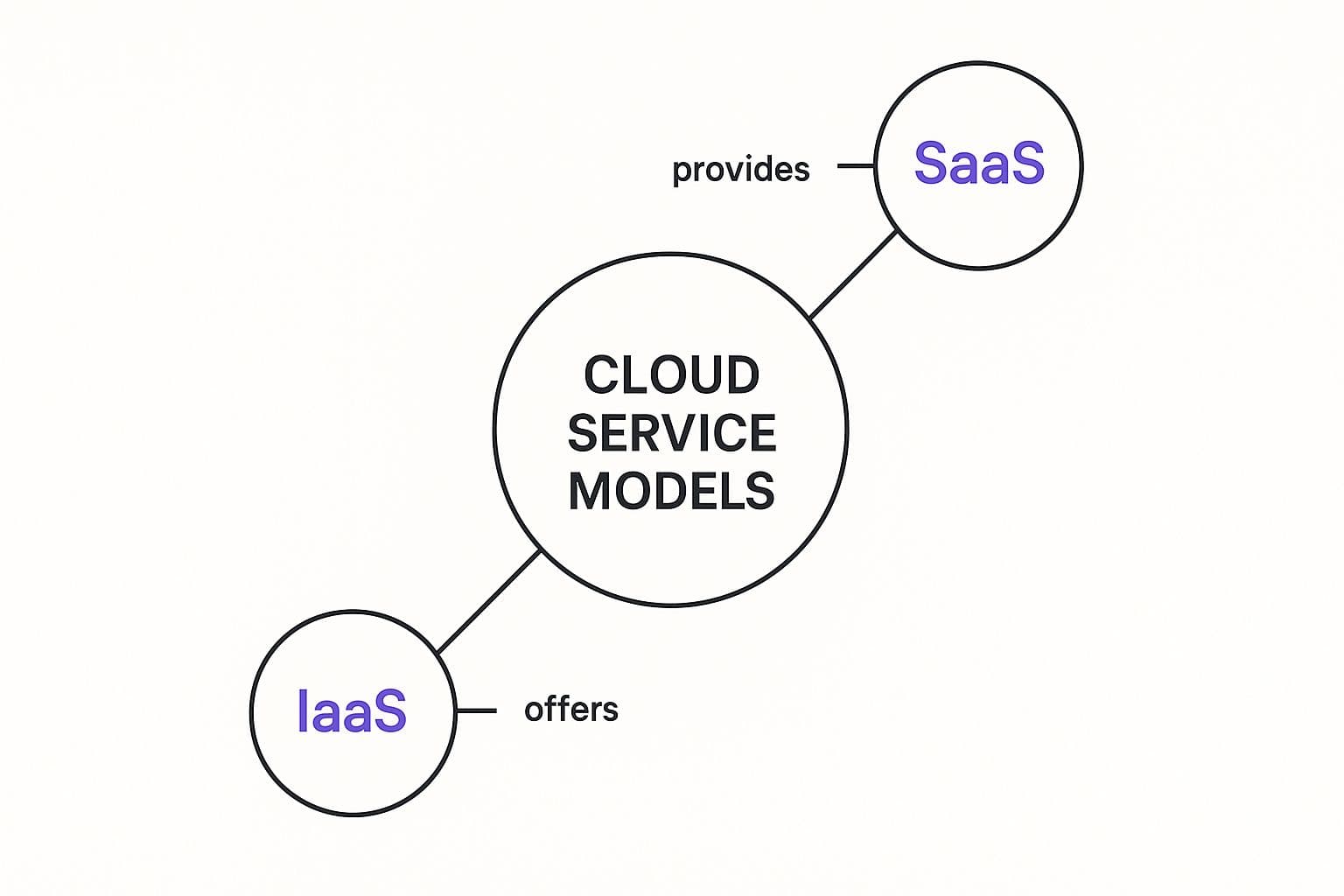
As you can see, each model builds on the last, offering a different balance of management and control for your development work.
IaaS: The DIY Kitchen
Infrastructure as a Service (IaaS) is the ground floor. Think of it as renting a fully-equipped professional kitchen. You get the oven (servers), the gas hookup (networking), and the walk-in fridge (storage), but that’s it. You have to bring all your own ingredients—the operating system, the databases, and, of course, your application code.
With IaaS, you have maximum control over every single component. This is perfect for teams with serious technical chops who need to build a highly customized system from scratch.
- You Manage: The application itself, your data, the runtime, middleware, and the operating system.
- Provider Manages: The physical servers, storage, and networking hardware.
- Best For: Startups that need absolute control over their environment or have unique infrastructure needs that don't fit a standard mold.
PaaS: The Take-and-Bake Pizza
Platform as a Service (PaaS) is like getting a take-and-bake pizza. The provider has already made the dough, spread the sauce, and sprinkled on the cheese. Your job is to add the good stuff—your unique toppings (your code)—and pop it in the oven.
PaaS hides all the messy underlying infrastructure, letting your developers get straight to what they do best: building and running your application. This can radically accelerate your development timeline.
This focus on efficiency is fueling explosive growth in specialized cloud services. The market for cloud-based data management, for instance, was valued at 43.8 billion in 2024** and is expected to balloon to **173.6 billion by 2030. This trend, highlighted in market analysis from Grand View Research, shows just how much businesses are relying on managed platforms to do the heavy lifting.
SaaS: The Hot-and-Ready Delivery
Software as a Service (SaaS) is the most hands-off model of all. This is the pizza delivered right to your door, hot and ready to eat. You don't think about the kitchen, the ingredients, or the cooking—you just open the box and enjoy.
Familiar tools like Google Workspace, Slack, or Salesforce are all SaaS products. As a startup, you might not be building a SaaS product from day one, but you'll absolutely be using them to run your company. Understanding how it works is key to picking the right vendors.
- You Manage: Pretty much just your user account and your data within the app.
- Provider Manages: Everything else. The application, the infrastructure, all the updates and maintenance—it's all on them.
- Best For: End-user applications and business tools. This isn't for your custom development, but for the software that supports it.
Ultimately, your choice here is a trade-off between control and convenience, which has a direct line to your budget. It’s a similar logic to choosing a pricing model for your own development work, which we break down in our comparison of Time & Material vs. Fixed Price contracts. The best approach always depends on how predictable and defined your project is.
Seeing Cloud Development in Action
It’s one thing to talk about cloud services in the abstract, but it’s another to see them solve real-world problems. Let’s move past the theory and look at a few scenarios where startups are using the cloud not just as infrastructure, but as a genuine strategic advantage. Each story shows how a specific cloud capability can tackle a common startup headache head-on.

These examples aren't hypotheticals; they’re a playbook for how founders and CTOs are building, scaling, and competing without ever touching a physical server.
The E-Commerce App Handling Viral Traffic
Imagine a startup, "StyleSphere," selling curated fashion boxes. For months, their traffic is predictable. Then, one afternoon, a top influencer features their product, and website visits explode by 5,000%. With a traditional, on-premise server, this dream scenario would instantly become a nightmare—a crashed site and thousands of lost sales.
But StyleSphere built its backend on a cloud platform, using auto-scaling and a managed database. Here’s what happened instead:
- Elastic Compute: As traffic surged, the cloud provider automatically spun up more virtual servers to handle the load. No one had to flip a switch.
- Managed Database: Their database scaled its capacity on the fly, so checkouts stayed fast and error-free even at peak demand.
- Automatic Scale-Down: When the rush subsided, the system automatically scaled back down. StyleSphere only paid for the extra horsepower when they actually needed it.
This kind of elasticity is the heart of cloud development. It lets you handle massive success without a massive upfront investment in hardware that just sits idle 99% of the time.
The Health-Tech Startup Deriving Insights from Data
Now, think about "CardiaCare," a startup with an app that monitors patient heart health through wearable devices. They face a huge challenge: securely processing and analyzing millions of sensitive data points every single day to spot potential health risks. Building a compliant, on-premise data center for this would cost millions and take years.
Instead, CardiaCare uses cloud-based development services to create a secure and scalable analytics pipeline.
Their cloud-native setup looks something like this:
- Secure Data Ingestion: A cloud service reliably and securely collects streaming data from thousands of wearables.
- Compliant Data Lake: All patient data goes into an encrypted, HIPAA-compliant cloud storage service.
- Powerful Analytics Engine: They run complex queries with a serverless analytics tool, paying only for the computations they run to find life-saving insights.
This approach didn't just save them a fortune; it slashed their time-to-market, getting a valuable health solution into the hands of users much faster.
The FinTech Company Fighting Fraud with AI
Finally, let’s look at "FinSecure," a startup launching a new digital payment platform. Their biggest hurdle is earning user trust, which means stopping fraud in its tracks. Developing a sophisticated, real-time fraud detection engine from scratch is a monumental task that demands deep AI expertise and huge computing power.
FinSecure sidestepped this entirely by plugging into a pre-trained machine learning API from a major cloud provider. When a transaction happens, FinSecure’s app simply sends the data to the cloud AI service. In milliseconds, the service analyzes it against complex fraud patterns and sends back a risk score. This lets FinSecure instantly block shady transactions, protecting its users and its reputation.
This is a perfect example of how cloud-based development services make advanced tech like AI accessible to everyone, not just the giants. This trend is fueling incredible growth, with the global cloud computing market projected to swell from 943.6 billion in 2025** to nearly **2.4 trillion by 2030. You can dig deeper into these numbers and the role of AI in this industry analysis from Techjury.
Selecting the Right Cloud Provider
Choosing a cloud provider is a lot like laying the foundation for a house. Get it right, and you've built a solid base for growth. Get it wrong, and you’ll be dealing with cracks and costly repairs for years. While the tech world often buzzes about the big three—Amazon Web Services (AWS), Microsoft Azure, and Google Cloud Platform (GCP)—the best choice for your startup isn't about picking the most popular name.
This decision has to be about your specific needs. It's a strategic move that can give you a serious competitive edge, arming you with the right tools to build, scale, and innovate faster than the big guys. A poor fit, on the other hand, can quickly lead to crippling technical debt, surprise bills, and a product that can’t keep up.
Beyond the Brand Name
First things first: you have to look past the marketing hype. Dig into what each provider actually offers and, more importantly, how those services map directly to your product roadmap and business goals.
Don't just go with the flow. You need a structured way to compare your options. I always advise founders to create a simple scorecard to grade each provider on the criteria that matter most to their business. This keeps the decision grounded in data, not just industry chatter or a single flashy feature.
Analyzing Cost Structures and Startup Programs
For any startup, cash is king, and cloud bills can get out of hand fast if you're not paying attention. You absolutely have to get into the weeds of each provider's pricing.
- Pay-As-You-Go Rates: What are the baseline costs for the things you'll use every day, like compute power, storage, and data transfer?
- Reserved Instances & Savings Plans: If you have predictable workloads, committing to a longer-term plan can slash your costs by up to 70% or even more.
- Startup Credits: This is a game-changer for early-stage companies. All the major players offer huge credit packages, often giving you tens of thousands of dollars in free services to get you off the ground.
Evaluating the Service Ecosystem
A cloud provider isn't just a place to rent servers. It's a whole ecosystem of powerful tools that can shortcut your development time and give you capabilities you couldn't build yourself.
Think about where your product is heading in the next two or three years. Do you see a future with advanced AI and machine learning? Are you building an IoT device that needs specialized management services? Is your entire business model built on heavy-duty data analytics?
The key is to pick a provider whose strengths align with your long-term vision. For instance, Google Cloud is famous for its muscle in data analytics and Kubernetes. AWS offers an unbelievably deep and mature suite of services for just about anything you can dream up. Azure really shines in the enterprise world and with its hybrid cloud solutions. Making the right match now saves you from a painful and expensive migration later.
Assessing Performance, Reliability, and Security
At the end of the day, your customers need a product that is fast, reliable, and secure. Your cloud provider is the bedrock of that promise.
- Performance and Uptime: Check out their Service Level Agreements (SLAs). What uptime percentage do they actually guarantee? And what happens if they don't meet it?
- Global Reach: Where are your users? Having data centers close to them is critical for reducing latency and giving them a snappy, responsive experience.
- Security and Compliance: This is completely non-negotiable. Make sure the provider has the compliance certifications your industry requires (like HIPAA for healthcare or PCI DSS for payments). You need robust tools for access control, threat detection, and data encryption to protect your—and your users'—data.
To help structure your thinking, I've put together a checklist of the key questions you should be asking.
Cloud Provider Selection Checklist
Use this table as a starting point to create your own scorecard. It will force you to compare providers on the factors that truly matter for a growing startup, ensuring you make a well-informed, strategic decision.
| Evaluation Criteria | Questions to Ask | Why It Matters for Startups |
|---|---|---|
| Cost & Startup Credits | What startup credits are available? What are the pay-as-you-go rates for core services (compute, storage, bandwidth)? Are there significant discounts for long-term commitments? | Extending your financial runway is critical. Maximizing credits and understanding the TCO (Total Cost of Ownership) prevents budget overruns. |
| Service Ecosystem | Does the provider excel in areas vital to my roadmap (e.g., AI/ML, data analytics, IoT)? How mature and extensive is their service catalog? | A strong ecosystem alignment accelerates development and avoids the need for costly future migrations. |
| Scalability & Performance | How easily can I scale resources up or down? What uptime is guaranteed in the SLA? Where are their data centers located relative to my target users? | Your infrastructure must grow with your user base without a drop in performance. Low latency is key to a good user experience. |
| Developer Experience & Tooling | Is the documentation clear and comprehensive? Is the management console intuitive? How strong is the API and CLI support for automation? | A smooth developer experience boosts productivity and reduces friction, allowing your team to ship features faster. |
| Security & Compliance | Does the provider hold necessary industry certifications (e.g., HIPAA, PCI DSS, SOC 2)? What built-in security tools are provided for access control, threat detection, and encryption? | A breach can be an extinction-level event for a startup. Robust, built-in security is non-negotiable for building customer trust. |
| Support & Community | What levels of technical support are offered and at what cost? How active and helpful is the community (forums, user groups, tutorials)? | When things go wrong (and they will), quick access to expert help is invaluable. A strong community can solve problems that documentation can't. |
Treating this decision with the seriousness it deserves will pay dividends down the line, setting your startup on a path for sustainable, scalable growth.
Implementing Smart Cloud Development Practices
Moving to the cloud is a great first step, but just being there isn’t the whole game. The real edge comes from using cloud-based development services smartly. Nailing down the right practices from the very beginning is what separates the startups that scale from those that get buried in technical debt, security holes, and out-of-control bills.
Think of it less like writing code and more like building a resilient, efficient, and secure engine for your business. When you establish a solid operational foundation early, you're building a system that fuels growth instead of getting in its way.
Embrace DevOps and Automation Immediately
For any startup today, DevOps isn't just a buzzword—it's the only way to operate. It’s all about breaking down the walls between your development and operations teams to ship features faster and more reliably. The engine that drives this whole thing is automation, specifically a CI/CD pipeline.
- Continuous Integration (CI): This is the habit of developers merging their code changes into a central place multiple times a day. Every time they do, an automated build kicks off and a battery of tests runs, catching bugs almost as soon as they’re written.
- Continuous Deployment (CD): Once the code aces all the automated tests in CI, it’s automatically pushed live to your users. This simple step gets rid of manual deployment headaches and radically shortens the time it takes to get new ideas into the market.
By getting CI/CD right from the start, your team can push updates with confidence, creating a powerful feedback loop with your customers.
Prioritize Security from Day One
In the cloud, you can't afford to treat security as an afterthought. It has to be baked into your development process from the ground up. A single oversight can tank customer trust and bring your startup to its knees. The good news is, cloud providers give you powerful tools to build a fortress.
Start with locking down who can access what. Use Identity and Access Management (IAM) tools to enforce the principle of least privilege—meaning people only get access to the absolute minimum they need to do their jobs. And make data encryption a non-negotiable rule. Encrypt everything sensitive, both at rest (when it's sitting on a server) and in transit (when it's moving across the internet).
Master Cost Optimization Strategies
The cloud's pay-as-you-go model is a dream for flexibility, but it can quickly turn into a nightmare of surprise bills if you're not paying attention. Keeping a close eye on your spending is absolutely critical to protecting your runway.
First things first: set up billing alerts and dashboards. You need real-time visibility into what you're spending. Next, use monitoring tools to hunt down and shut off idle or underutilized resources. Paying for servers you aren't using is literally setting money on fire.
As you scale, look at your usage patterns. For the parts of your infrastructure that are always running, you can lean on options like AWS Savings Plans or Google's Committed Use Discounts. These can slash your bills by over 60%—a massive saving for any startup.
Got Questions? Let's Talk Cloud
Jumping into cloud development always brings up a few key questions, especially when you're a founder or CTO trying to make the right call for your startup's future. Let's tackle some of the most common ones I hear.
Is the Cloud Really Secure Enough for My Startup's Data?
Absolutely. In fact, top-tier cloud providers like AWS, Google Cloud, and Azure have security infrastructures that are far more robust than what most startups could afford to build themselves.
The key is understanding the "shared responsibility model." Think of it like this: the provider secures the building (the physical data centers, networks, and hardware), but you're responsible for locking your own office door. That means it's on you to manage who has the keys (user access), encrypt your sensitive files, and set up proper security protocols within your own environment. With tools like Identity and Access Management (IAM) and multi-factor authentication, you can create a fortress around your application.
How Do I Keep Costs from Spiraling Out of Control?
This is a huge one for startups, and the answer is to be proactive, not reactive. You can't just swipe a card and hope for the best. The first step is to use the pricing calculators every major provider offers. Get a realistic estimate before you commit.
Once you're up and running, set up billing alerts immediately. These are your early warning system, notifying you when you're about to cross a budget threshold. Don't let a surprise bill eat into your runway.
Also, look into their cost-saving options. For services you know you'll be using long-term, programs like AWS Savings Plans or Google's Committed Use Discounts can slash your monthly spend significantly.
Should We Use a Single Cloud Provider or Go Multi-Cloud?
For 99% of startups, the answer is simple: stick with one provider. Pick one, get really good at it, and build from there. It keeps your architecture clean, your team focused, and your operations manageable.
A multi-cloud strategy sounds sophisticated, but it adds a massive layer of complexity. You're suddenly juggling different security models, billing systems, and management tools. That's a headache you don't need when you're trying to find product-market fit. Leave the multi-cloud setups for large enterprises with dedicated teams. Master one platform first, and only consider adding another when you have a very specific, compelling business reason to do so.
Ready to turn your idea into a market-ready product without the typical delays and overhead? Iglu Digital specializes in building and launching MVPs with the price fixed before we start, letting you test your concept with real users faster. Transform your vision into reality by visiting us today.