

Custom Software Development for Startups Guide
Table of Contents
When you're just getting started, off-the-shelf software seems like the obvious choice. It's a quick fix. But for a startup with big ambitions, it's like trying to win a Grand Prix in a family sedan. Sure, it gets you on the road, but it was never built for the performance you need to actually win the race. This is exactly why custom software development for startups often becomes a critical move, not just a nice-to-have.
Why Off-the-Shelf Software Often Fails Startups
Think about it this way: you wouldn't buy a one-size-fits-all toolkit for a highly specialized job. You might get a hammer and a screwdriver, but the one precise instrument you actually need to solve your customer’s problem is nowhere to be found. That’s the core frustration so many founders run into with generic, pre-packaged software.
These off-the-shelf solutions are built for the average user, not for your specific niche. They often come loaded with features you'll never touch, which just slows things down and creates a clunky, confusing experience for your users. You end up paying for bloat while missing out on the very features that could make your startup stand out.
The Hidden Cost of Generic Solutions
The initial appeal is always the low upfront cost and instant access. But that "benefit" can quickly morph into a hidden tax on your growth. As your user base grows or your business model pivots, you’ll inevitably smack into a wall.
Suddenly, the software can't scale with your traffic, it won't integrate with a new tool that's vital for your operations, or it lacks the specific automation your team is crying out for. These limitations force you into clunky workarounds, kill innovation, and put a very real ceiling on your startup's potential.
Choosing between a pre-built product and a custom solution is a common crossroads for founders. Here’s a quick breakdown to help you see the differences side-by-side.
Custom vs Off-the-Shelf Software: A Startup's Dilemma
| Feature | Custom Software | Off-the-Shelf Software |
|---|---|---|
| Functionality | Built precisely for your unique needs. No more, no less. | Generic features for a broad audience; may include bloat. |
| Scalability | Designed to grow with your user base and business goals. | Limited. Can lead to performance issues as you scale. |
| Integration | Seamlessly connects with your existing and future tech stack. | Often difficult or impossible to integrate with other tools. |
| Competitive Edge | Creates a unique user experience that sets you apart. | You're using the same tools as everyone else. |
| Initial Cost | Higher upfront investment. | Low initial cost or monthly subscription. |
| Long-Term ROI | Higher. Eliminates workarounds and unlocks growth. | Lower. Hidden costs from limitations and inefficiency. |
| Control & Ownership | You own the source code and have full control. | You are dependent on the vendor for updates and support. |
While a custom build requires more investment upfront, it's an investment in your startup's future, giving you the foundation to grow without constraints.
The Inevitable Growth Ceiling
This growing need for personalized, scalable solutions is exactly why the custom software development market is exploding. Forecasts show the market is set to surge past $896 billion by 2029, largely driven by demands for scalability and security that generic tools just can't provide. You can find more insights about the rise of custom software development and its rapid market growth.
Pre-packaged solutions almost always fall short in areas that are absolutely crucial for a startup's survival and success:
- Limited Scalability: They simply aren't engineered to handle a sudden flood of new users or data, leading to crashes and slowdowns right when you’re gaining momentum.
- Poor Integration: Trying to make one piece of generic software talk to another can feel impossible, creating data silos and manual work for your team.
- Lack of Competitive Edge: If you're using the exact same software as your competitors, how can you possibly offer a truly different and better experience?
In the end, these platforms force you to fit your vision into their box. A startup needs the complete opposite: technology that bends to your vision. Grasping this is the first step toward understanding why a custom-built solution is a cornerstone of any resilient, high-growth company.
Why Build Custom Software? The Strategic Payoff
Opting for custom software is a lot like having a master architect design your headquarters. You could rent a generic office and try to make it work, but it'll never be a perfect fit. Or, you could build something from the ground up that's molded perfectly to your team's workflow, your company culture, and your grand vision for the future. That’s what a bespoke solution does—it becomes your competitive superpower.

A custom-built application is so much more than just lines of code. It's a strategic asset, purpose-built to give you a sharp edge in the market. It lets you create features that solve your customers' biggest headaches in ways your competitors, stuck with off-the-shelf tools, can only dream of.
Building Your "Defensible Moat"
The single biggest advantage is creating a defensible moat around your business. When you build custom software, you own the intellectual property (IP). This isn't just a technical detail; that IP becomes a core asset, boosting your company's valuation and making it incredibly difficult for others to copy what you do.
Think about a fintech startup that develops its own algorithm for assessing risk. That unique tech, baked right into their custom platform, is their secret sauce. No competitor using a generic lending platform can touch its accuracy. That's a clear, sustainable advantage. You're not just running a business anymore; you're building an asset with real, long-term enterprise value.
This trend is playing out on a massive scale. The global custom software development market was valued at around $41.25 billion in 2024 and is expected to rocket forward at a compound annual growth rate of 23.9% through 2034. This explosive growth shows just how many founders are turning to custom builds to get ahead.
Finding That Perfect Product-Market Fit
Off-the-shelf software often feels like a straitjacket. You're forced to bend your business model to fit its limitations. Custom development flips that script entirely. You build your product directly from customer feedback, letting their needs guide every decision. You're no longer at the mercy of a third-party vendor's roadmap—your customers are in the driver's seat.
This tight feedback loop means every feature you add delivers genuine value. The end result? A product that users actually love, which leads to better engagement, lower churn, and customers who become your biggest fans. You have the freedom to design unique user experiences that simply aren't possible with a pre-packaged solution.
Engineering for Scale from Day One
One of the worst things that can happen to a growing startup is being held back by its own technology. A custom solution is built with your future in mind. The entire architecture is designed to handle more traffic, more data, and more complexity as you grow.
Here’s what that looks like in practice:
- Performance Under Pressure: The system is built to handle huge spikes in users without crashing or slowing down, which is crucial during those make-or-break growth periods.
- A Flexible Foundation: As your business evolves, you can add new features or integrate other tools without getting stuck in a rigid, outdated system.
- Smarter Spending: You aren't paying for bloated features you'll never use. Instead, you can invest in infrastructure exactly when you need it, keeping your costs in check as you scale.
This kind of forward-thinking ensures your technology is an engine for growth, not an anchor. For any early-stage company, getting this right is non-negotiable. See how we approach building custom solutions for startups that are designed to scale.
Understanding the Software Development Lifecycle
For a lot of founders, the path from a great idea to a polished, market-ready product feels like a complete mystery. The good news? Custom software development isn’t chaos. It follows a surprisingly structured and predictable path.
Think of it like building a custom home. You’d never start pouring a foundation without a detailed blueprint, right? The same logic applies to software. This roadmap, known in the industry as the Software Development Lifecycle (SDLC), is what brings order to the creative process.
This framework is how we translate your vision into a working product, step by logical step. The graphic below lays out the core phases you'll go through, from that initial spark of an idea to a fully functioning application your customers can use.
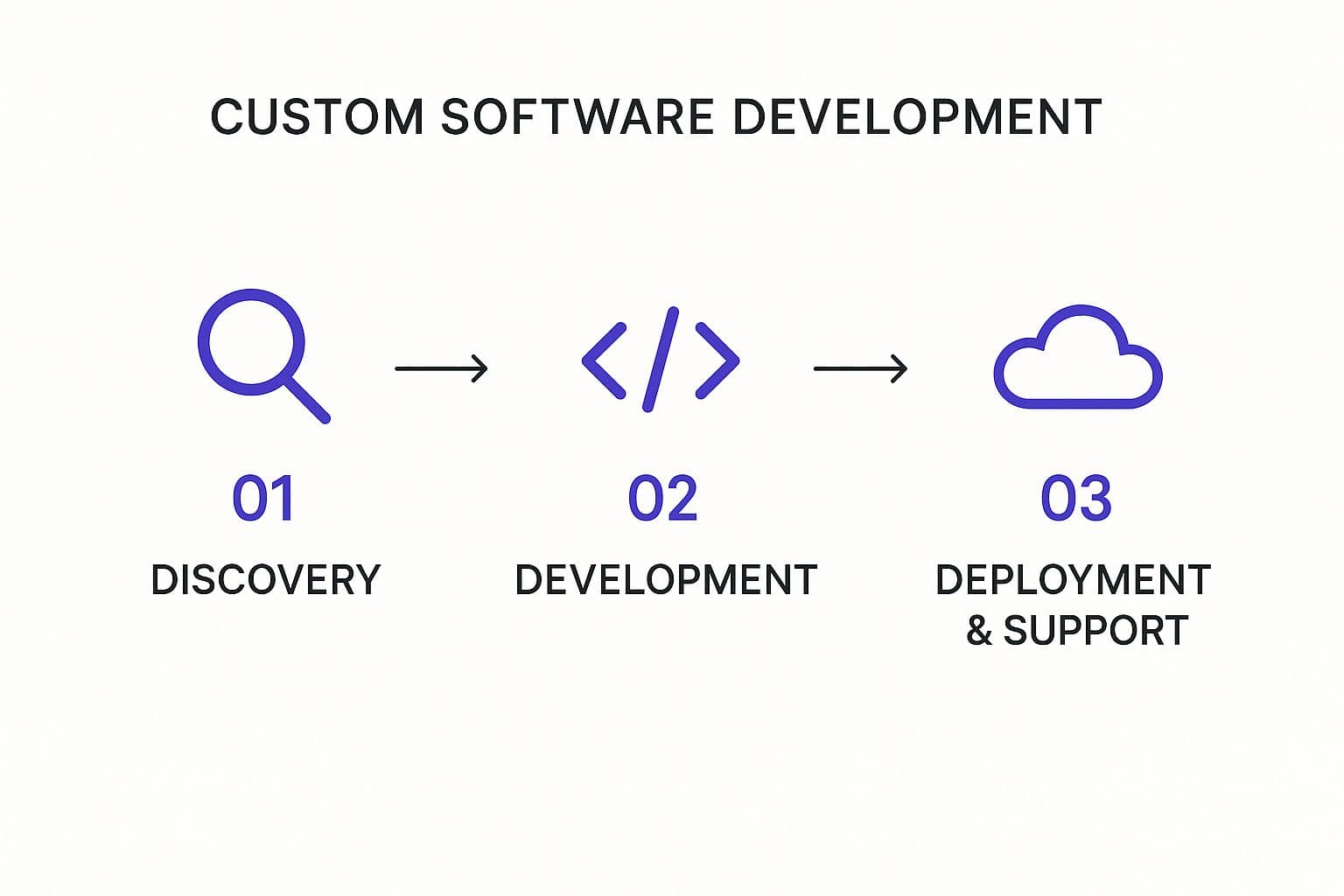
As you can see, each stage builds directly on the one before it, ensuring we methodically turn an abstract concept into a tangible, high-quality piece of software.
Phase 1: Discovery and Strategy
This is the blueprinting phase. Long before anyone writes a single line of code, the most important work gets done right here. The entire goal is to nail down the problem you're solving, who you're solving it for, and precisely how your software will make their lives better. This means digging deep into market research, seeing what competitors are doing, and defining who your ideal users are.
Trying to skip this stage is one of the most common—and expensive—mistakes a startup can make. A rock-solid discovery phase makes sure you’re building something the market actually wants, which saves an incredible amount of time and money later. It’s all about aligning your business goals with the technical plan.
This process lays the groundwork for everything that comes next, from defining the project's scope to deciding which features to build first.
Phase 2: Design and Prototyping
With the blueprint in hand, it's time to create the 3D model. The design and prototyping phase is where your vision starts to feel real for the first time. We typically start with wireframes—simple, black-and-white layouts that act as a skeleton for the app, mapping out user journeys and where everything goes on the screen.
From there, our designers flesh things out into high-fidelity mockups, which bring the app to life with colors, fonts, and branding. The final piece is usually an interactive prototype, which is a clickable, but non-functional, version of the application. This lets you and potential users actually click through the app and give critical feedback before any heavy-duty development begins. You can dive deeper into the power of this approach in our guide to rapid prototyping techniques.
Phase 3: Agile Development
Now, construction begins. Nearly every modern software team uses an Agile methodology, which is just a fancy way of saying we build the software in small, manageable chunks called “sprints.” A typical sprint lasts about two weeks and has a clear goal: complete a small batch of the most important features.
For startups, this approach is a game-changer.
- Flexibility: It’s easy to pivot or adjust based on new feedback or changing market conditions. You’re never locked in.
- Transparency: With regular demos and check-ins, you always know exactly where things stand. No surprises.
- Speed: You get a working piece of your product in your hands much, much faster than with old-school methods.
Instead of waiting months for a single “big reveal,” you get to see, touch, and test new functionality every couple of weeks.
Phase 4: Testing and Deployment
Finally, it’s time for the final inspection and to hand over the keys. During the Quality Assurance (QA) phase, testers put the software through its paces. They hunt for bugs, check for performance slowdowns, and test for any security holes. Their job is to make sure the app works perfectly on different devices, browsers, and operating systems.
Once the software passes every test with flying colors, it’s deployed to a live server, making it available to your first group of users. But the work doesn’t stop at launch. Ongoing maintenance is just like the regular upkeep on a new home—we monitor performance, squash any bugs that pop up, and plan for future updates to keep your product running smoothly and securely for years to come.
Starting Smart with a Minimum Viable Product
So, you have this huge, game-changing vision for a product, but your budget is still finding its feet. How do you bridge that gap? The answer is one of the most powerful tools in a startup's arsenal: the Minimum Viable Product (MVP). It's a strategy that flips the script, prioritizing learning from real users over launching a "perfect," feature-heavy product on day one.
A lot of people hear "MVP" and think it means a buggy, half-baked version of the final app. That couldn't be more wrong. An MVP isn’t about building less; it’s about building smarter. Think of it as a focused experiment designed to test your biggest idea with the smallest investment of time and money.
The point isn't to ship half a product. It's to build a complete, working product that solves just one critical problem for a very specific group of early customers.
The Skateboard to Car Analogy
Let’s say your ultimate goal is to build a car—a complex, polished solution for getting around. The old, broken way of thinking would be to build it piece by piece. First, you'd spend months perfecting a single wheel, then an axle, then the chassis. A year or two later, you might finally have a car, but your user has been stuck waiting with no way to get anywhere. Even worse, you might discover they actually wanted a motorcycle all along.
The MVP approach is completely different. You focus on solving the core problem—"I need to get from Point A to Point B"—with the simplest thing that works.
- The Skateboard (Your MVP): You start by building a skateboard. It’s basic, for sure, but it gets the job done. It solves the immediate problem, and you can get it into your user's hands almost instantly. Now the magic happens: you get real feedback. Is it fast enough? Is it too hard to balance?
- The Scooter (Iteration 2): Based on that feedback, you add a handlebar for better control and stability. Presto, you've built a scooter. It’s a direct response to a user's pain point, making your product immediately more valuable.
- The Bicycle (Iteration 3): People like the scooter, but they want to go faster and farther. So, you add pedals, gears, and a proper seat, turning it into a bicycle. Each step is a complete, usable product that’s better than the last.
- The Car (Your Final Product): Eventually, armed with a deep understanding of what your users actually value—speed, comfort, safety—you finally build the car. You've arrived at your grand vision, but you did it without wasting a dime on features nobody asked for.
This cycle of building, shipping, and learning ensures you’re always delivering real value and using actual customer behavior to guide your next move.
Defining Your MVP's Core Features
Getting an MVP right comes down to ruthless prioritization. Your first release simply cannot be everything to everyone. The whole point is to zero in on the single, most important problem you solve and build only what’s necessary to fix that. For a deeper dive into this early stage, our guide on how to start a tech startup is a great place to get your bearings.
To figure out your core feature set, you have to ask some tough questions:
- What is the #1 problem my user is facing? Get laser-focused here.
- What is the absolute bare-minimum functionality needed to solve that one problem?
- Who are my "early adopters"? These are the people who are so desperate for a solution they’ll happily overlook a lack of polish just to get their hands on it.
- Which features can we absolutely, positively live without for the first launch? Be brutally honest and cut anything that isn't mission-critical.
By keeping your scope incredibly tight, you get to market faster, save your precious cash, and—most importantly—kickstart the feedback loop with real customers. That loop is the engine of a startup. It's how you turn your initial guesses into a market-tested product that people will actually pay for. It’s the smartest way to start building.
How to Choose the Right Development Partner
Picking a partner to build your custom software is one of the biggest calls you'll make as a founder. This isn't just about hiring someone to crank out code. You’re looking for a team that can help you build your vision from the ground up. The right group will feel like an extension of your own, someone who’s just as invested in seeing you succeed. The wrong one? Well, they can burn through your budget, torpedo your timeline, and leave you with a product that nobody wants.

To make a smart choice, you have to look past the slick portfolios and shiny websites. It’s about digging in and asking the right questions—the kind that show you who a team really is and whether they have the chops to keep up with your startup's pace.
Evaluating Technical Expertise
First thing's first: you need to check their technical skills. But just hearing "we're good at coding" is meaningless. You need a partner who has real, hands-on experience with the specific tech stack you need and, just as importantly, in your industry. A team that's already built five fintech apps will know the security and compliance headaches inside and out, something a generalist agency might stumble over.
When you're talking to potential partners, get specific:
- "Have you built something with features like X, Y, and Z before?" You want to see if they have direct experience with your core needs, whether that’s real-time data streaming, a complex payment gateway, or rock-solid user authentication.
- "Show us some work you've done in our industry." This proves they get your audience and the unique problems your market faces.
- "How do you think about scalability and performance?" Their answer here is telling. You want to hear them talk about building an architecture that can grow with you, not just one that works on day one.
Getting granular like this ensures they don't just have the skills, but the relevant experience to handle your project's specific challenges from the get-go.
Assessing Communication and Process
A brilliant team that can't communicate is a liability. For a startup, speed and agility are everything, and that only happens with transparent, frequent, and clear communication. The best partners are masters of project management, especially with Agile methods that keep the project chugging along in predictable, organized sprints.
Look for a partner who treats the process as a true collaboration. They should feel more like strategic advisors than simple order-takers. You want a team that will push back on your assumptions, suggest better ways to solve a problem, and ultimately make you feel like you’re in control of the entire build.
Understanding Your Sourcing Options
The global talent pool is deeper than ever. There are now an estimated 28.7 million software developers worldwide, which means startups have incredible access to specialized skills. You can tap into this massive resource through a few different models, and each has its own set of trade-offs. You can dive deeper into the global software development landscape to get a better feel for the market.
Here’s a quick rundown of your main choices:
| Option | Pros | Cons |
|---|---|---|
| Freelancers | Great for small tasks and very flexible. | Hard to manage, no team synergy, and risky for your core product. |
| In-House Team | Fully integrated into your company culture with total control. | Extremely expensive (salaries, benefits), hiring is slow, and high overhead. |
| Development Agency | Instant access to a skilled, cohesive team; easy to scale; cost-effective. | Finding the right cultural fit is crucial; requires careful vetting. |
For most startups trying to move fast and be smart with their cash, working with a dedicated agency hits the sweet spot. It gives you all the firepower of an experienced team without the financial weight and recruiting nightmares of building one from scratch. It’s a strategic move to get your MVP to market without breaking the bank.
Your Top Questions About Startup Software Development, Answered
Alright, so you’ve got a handle on the process, but what about the nitty-gritty? It's completely normal to have questions swirling around the practical side of things. Building custom software is a major investment of time and money, and it’s smart to get clear on costs, timelines, and what happens after you pop the champagne on launch day.
Think of this section as the straight-talk Q&A session after the big presentation. We'll tackle the most common questions we hear from founders, giving you direct, no-fluff answers to help you move forward with confidence.
How Much Does Custom Software For A Startup Really Cost?
This is always question number one, but the honest answer is: it depends. There's no flat rate because the cost is tied directly to complexity, the number of features, and the location of your development team. It’s like asking how much a house costs—a cozy cabin and a sprawling mansion have very different price tags.
Generally, a well-defined Minimum Viable Product (MVP) for a new startup lands somewhere in the 50,000 to 250,000 ballpark. A simple mobile app with a few core functions might sit at the lower end of that range. On the other hand, a complex SaaS platform with features like AI-powered recommendations or real-time data processing will naturally climb higher.
The single best way to control that initial investment is to be ruthless about your MVP scope. Focus your budget on solving one critical problem for your first wave of users, and leave the "nice-to-haves" for later.
A few other things that will move the needle on cost:
- Design Intricacy: A highly bespoke user interface with slick animations will cost more than a clean, functional design built on standard components.
- Third-Party Integrations: Need to connect to Stripe for payments or Google Maps for location data? Each API integration adds a bit more time and cost.
- Technology Stack: The specific languages and frameworks used can influence the cost of developers, depending on their market demand.
Before you sign anything, make sure you get a detailed, phased quote from any potential partner. It should break down the costs for each stage—from discovery and design through to development, testing, and launch.
What Is A Realistic Timeline For Building Custom Software?
Just like cost, the timeline is a direct reflection of your project's scope. A tightly focused MVP can often be designed, built, and launched in 3 to 6 months. That’s a pretty realistic window for getting your core product into the hands of real users so you can start gathering that all-important feedback.
If you’re planning a more mature, feature-rich application, you should budget 6 to 12 months or even longer. The more moving parts you add, the more time it takes to build, test, and polish everything to a high standard.
This is where an Agile development approach really shines. By breaking the project into small, two-week "sprints," your team can deliver working pieces of the software consistently. It keeps the momentum going and ensures you see tangible progress every step of the way.
Should We Hire In-House Or Outsource Development?
This is a big strategic fork in the road, and the right path depends on your startup’s budget, runway, and long-term goals. There's no one-size-fits-all answer, but for most early-stage companies, one option usually makes more sense.
Building an in-house team gives you maximum control and embeds developers directly into your company culture. The downside? It’s a slow, expensive process. You’re on the hook for hefty salaries, benefits, recruitment fees, and the months it can take to find the right people. For a startup that needs to move fast, that can be a killer.
Outsourcing to a development agency, on the other hand, gives you instant access to a team of specialists who have done this all before. It's almost always more cost-effective upfront because you sidestep all the overhead of full-time hires. Plus, it gives you the flexibility to scale the team up or down as your needs evolve.
For most startups focused on speed and capital efficiency, outsourcing is the way to go. It lets you concentrate on strategy, fundraising, and marketing while a trusted partner handles the technical heavy lifting.
What Happens After The Software Is Launched?
Launch day feels like the finish line, but it’s really just the starting gun. The long-term success of your software is determined by what you do next. A continuous cycle of support, maintenance, and iteration is what separates a product that fizzles out from one that grows into a thriving business.
This post-launch work really boils down to three key areas:
- Support and Maintenance: This is the non-negotiable foundation. It means keeping an eye out for bugs, ensuring servers are running smoothly, and applying security patches to protect your platform and your users' data.
- User Feedback and Analytics: With real people using your product, you can finally start collecting gold-standard data. This means tracking how people behave in the app, gathering direct feedback, and analyzing key metrics to understand what’s resonating and what’s falling flat.
- Product Roadmap Iteration: All those insights from users and analytics feed directly back into your product roadmap. This data-driven approach ensures you're prioritizing features that solve real problems—the kind people are happy to pay for.
A great development partner doesn't just build it and bail. They'll stick around, offering a clear support plan and acting as a strategic advisor to help you make sense of the data and scale your product as you grow. This ongoing partnership is the real engine of sustainable growth.
Ready to turn your idea into a market-ready product without the typical delays and uncertainty? At Iglu Digital, we specialize in building and launching MVPs for startups with the scope and the price agreed before we start. Transform your concept into a tangible, scalable software solution with us.