

Estimating Software Development Time: Proven Strategies to Succeed
Table of Contents
Let's be honest: estimating how long a software project will take is one of the toughest, most dreaded tasks in the industry. It often feels less like a science and more like a shot in the dark. We start with a plan, full of optimism based on past wins, but those initial timelines rarely account for the curveballs a new project always throws. The result? Frustrating delays and blown budgets.
Why Is Software Estimation So Hard, Anyway?

If you've ever felt like you're staring into a crystal ball when asked for a timeline, you're in good company. The entire process is riddled with uncertainty and natural human biases that can lead even the most experienced teams down the wrong path. What looks simple and straightforward on a whiteboard rarely stays that way once you start writing code.
A huge part of the problem is our own brains. We're all susceptible to optimism bias—that little voice that tells us this time, things will go perfectly. We remember the smooth parts of the last project and conveniently forget the late-night debugging sessions and the completely unexpected roadblocks.
This mental trap is made worse by the very nature of software. We're not building a physical bridge where the materials and physics are known quantities. We're creating complex systems out of pure logic. Every single project comes with its own set of "unknown unknowns"—the problems you don't even know exist until you're knee-deep in them.
The "Simple Task" That Isn't
Here’s a real-world analogy that perfectly captures the issue. Someone asks you to install a new washing machine. You've done it before, so you confidently say, "Sure, 10 minutes, tops."
But then you get to the new house and reality hits:
- The builder never drilled a hole for the power cord.
- The drill you brought isn't strong enough for the wall.
- The water hoses you have are too short for the new plumbing layout.
- There's a protective cap on the water tap that's screwed on impossibly tight.
- The drainage spigot is sealed shut and needs to be drilled out.
Suddenly, your 10-minute task has snowballed into a four-hour nightmare with multiple trips to the hardware store. This is exactly what happens with software. A "simple" task like integrating a new payment API can uncover undocumented edge cases, outdated dependencies, or conflicts with your existing code, turning a two-day job into a two-week marathon.
The Never-Ending Ripple of Shifting Requirements
Then there's the classic challenge of "scope creep." It's natural for stakeholders to refine their ideas as they see the product come to life. This leads to new feature requests and changes to existing ones. While these adjustments often add real value, they throw a wrench into the original plan and make those initial estimates obsolete. Each new requirement doesn't just add a single block of work; it creates ripples of complexity throughout the entire system.
The data has been telling this story for decades. The famous CHAOS Report from The Standish Group has consistently shown a harsh reality. One of its early, eye-opening findings revealed that only 16% of software projects were actually completed on time and on budget. The average project schedule was overrun by a staggering 120%—meaning most projects took more than double the time originally planned. You can explore more about these historical estimation challenges and see how they still echo in today's practices.
These numbers aren't just trivia; they highlight a persistent, fundamental problem. Acknowledging these core issues—from our own cognitive biases to the unpredictable nature of code—is the first, most critical step. Only when we face why estimating software development time is so incredibly difficult can we start building better, more realistic processes that lead to success.
Now that we've dug into why estimating software development is so tough, it's time to shift gears from the "why" to the "how." Moving beyond a simple finger-in-the-air guess requires a solid toolkit of practical, proven methods. These techniques give you a framework, helping to turn abstract ideas into something you can actually forecast. They are the true building blocks of any reliable estimation process.
The secret isn't finding one magic method, but knowing which one to pull out for the right situation. A quick, high-level estimate might be all you need for an initial budget talk. But for mapping out a detailed feature, you've got to get much more granular.
Let's walk through some of the most effective techniques I've seen teams use successfully day in and day out.
Analogous Estimation: The Quick Comparison
At its core, analogous estimation is making an educated guess based on what you've done before. It's the most straightforward method out there and perfect for those early-stage conversations when you're working with more questions than answers. Think of it as a top-down approach: you look at a new project and compare it to a similar one from your past.
Imagine a startup founder wants to build an MVP for a new social media app. Your team recently built a photo-sharing app that, while different, had a similar underlying structure. That project took three months. Using that as your baseline, you might forecast this new MVP will also take about three months, maybe tacking on or shaving off a few weeks based on any obvious differences in complexity.
Its biggest selling points are speed and simplicity. The catch? Its accuracy is completely hitched to how "analogous" that past project really is. As we saw with the washing machine example earlier, even small, hidden differences can completely derail a timeline.
Three-Point Estimation: Embracing Uncertainty
The Three-Point Estimation technique is powerful because it formally accepts that you don't have a crystal ball. Instead of giving one single number, your team comes up with a range built on three different scenarios. This forces you to think through what could go right and what could go wrong, painting a much more honest picture.
The three points you'll define are:
- Optimistic (O): The absolute best-case scenario. This is the dream run where everything clicks into place, and you hit zero unexpected roadblocks.
- Pessimistic (P): The worst-case scenario. This is when Murphy's Law pays a visit—significant problems pop up, and if something can go wrong, it does.
- Most Likely (M): The most realistic outcome. This path assumes a normal amount of small hiccups and average team productivity.
With these three numbers, you can calculate a weighted average. A popular formula for this is the PERT analysis: (O + 4M + P) / 6. Notice how it gives more weight to the "most likely" outcome? This keeps the final estimate grounded in reality while still respecting the extremes. This approach is incredibly valuable for pricing, as it helps build a more reliable foundation for your costs. We explore how this impacts contracts in our guide to time and materials vs fixed-price models.
Story Points: Focusing on Effort, Not Hours
In the world of Agile development, Story Points have rightly become the standard for estimating work. Instead of getting bogged down trying to guess the exact number of hours a task will take—a notoriously difficult thing to do—teams assign a relative value to it. This pulls the estimate away from time and instead focuses on a blend of different factors.
A story point value is a mix of:
- Complexity: How mentally challenging is the work?
- Effort: How much actual "work" is there to do?
- Uncertainty: How many unknowns or risks are we dealing with?
You'll often see teams using a modified Fibonacci sequence (1, 2, 3, 5, 8, 13, 21…) for pointing. This non-linear scale is smart because it reflects that the jump in effort between an 8-point task and a 13-point one is vastly greater than the jump between a 2 and a 3.
For example, a team might agree that changing the text on a button is a "1-point" story. A simple login form could be a "3-pointer." But building out a complex, multi-step checkout with a brand-new payment integration? That could easily be a "13-point" story. The key is that the value isn't tied to a specific number of hours; it’s a relative measure against everything else in the backlog. This method is fundamental to estimating software development time accurately in any modern, iterative environment.
Alright, let's move beyond high-level guesses and gut feelings. When you're dealing with a large, complex project, a small miscalculation in your timeline can snowball into massive budget overruns and missed deadlines. This is where you need to get more scientific with your approach.
For teams ready to dial in their forecasting, two powerful, data-driven models stand out: Bottom-Up Estimation and Parametric Estimation. These methods shift the conversation from, "What does this feel like it will take?" to, "What does our data prove it will take?" It's a fundamental change in mindset, but one that pays off in accuracy.
This flow shows how breaking down a huge project into its smallest parts is the key to building a reliable timeline from the ground up.
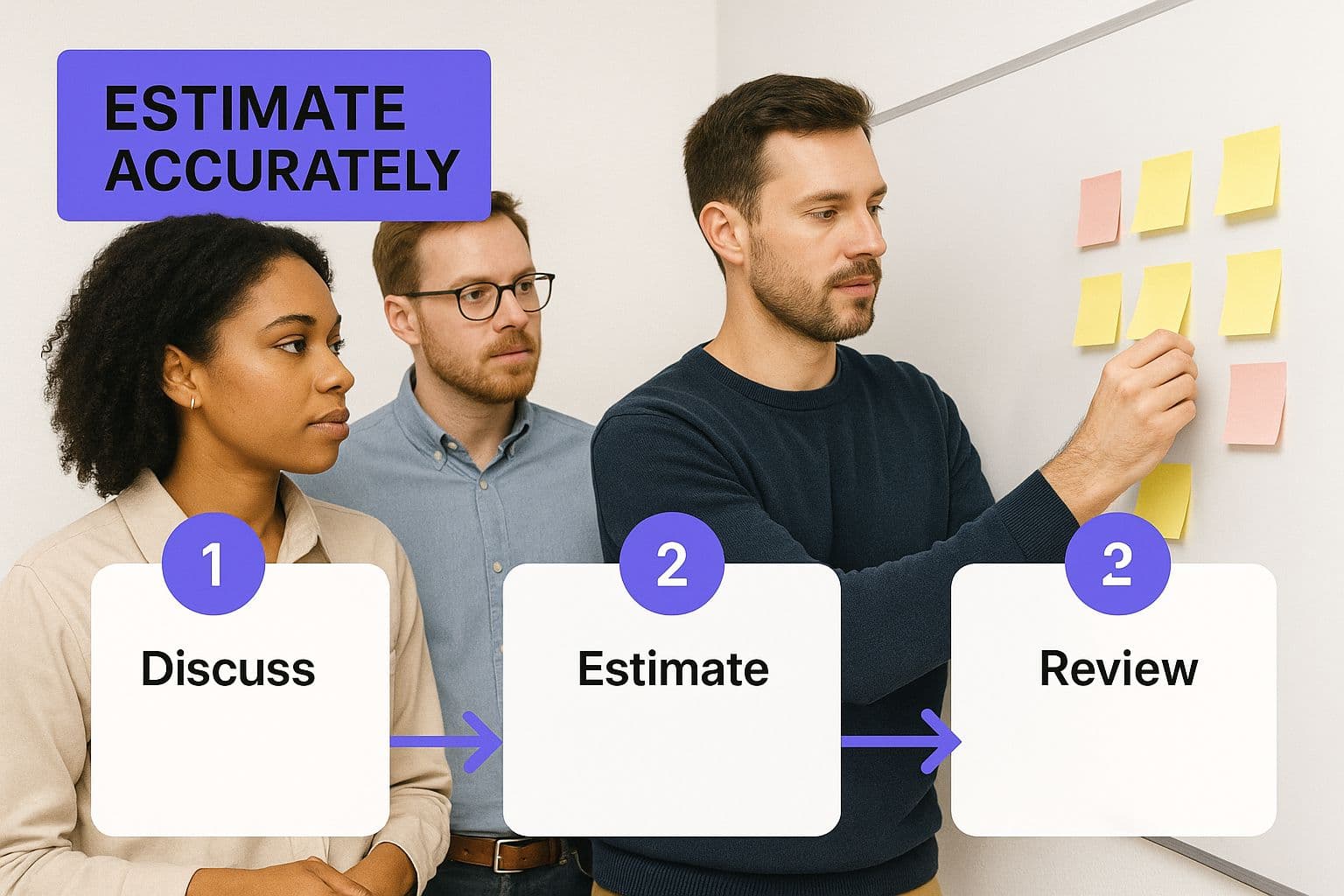
As you can see, this isn't a one-person job. It’s a collaborative deep-dive where every single component is assessed to build a timeline you can actually trust.
Deconstructing Complexity with Bottom-Up Estimation
Bottom-Up Estimation is as literal as it gets. You don't start with a big, top-level guess for the whole project. Instead, you start at the very bottom, breaking the entire project down into its most granular, individual tasks. This is the classic Work Breakdown Structure (WBS) put into practice.
Imagine you're building a "User Profile" feature. You wouldn't just guess "two weeks." You'd break it down into much smaller pieces of work:
- Design the UI mockups (8 hours)
- Develop the front-end components (16 hours)
- Build the database schema (6 hours)
- Create the backend API endpoints (20 hours)
- Write unit and integration tests (12 hours)
Once every tiny task has an estimate, you just add them all up. The total gives you a highly detailed, comprehensive project timeline. Among the different software project management methods, this is widely considered one of the most accurate ways to predict development time, especially for complicated projects.
While it takes a lot of upfront effort, it forces you to identify potential roadblocks early on. You can learn more about detailed estimation approaches that help minimize those nasty, unforeseen delays.
The major downside, of course, is the sheer amount of work involved. Creating a full WBS for a large-scale application can feel like a project in itself. If your requirements are still a bit fuzzy, you risk spending a ton of time estimating work that could change or get thrown out completely.
Using Historical Data with Parametric Estimation
Parametric Estimation takes a more statistical approach. Instead of breaking things down, you use historical data from your past projects to create a predictive model. It works by finding a key variable—a parameter—that has a direct, repeatable relationship with project duration, and then you apply that formula to your new project.
Think of it like building a house. Let's say you've learned from experience that your crew can install drywall at a rate of 20 hours per 100 square feet. If a new house needs 2,500 square feet of drywall, your estimate becomes simple math:
(2,500 sq ft / 100 sq ft) * 20 hours = 500 hours
This exact logic applies to software. Your parameter just changes. Instead of square feet, you might use:
- Function Points: A standardized unit for measuring business functionality.
- Number of Features: A simpler, though less precise, parameter.
- User Stories: A solid choice, but only if your team is consistent with sizing them.
For example, after analyzing a few completed projects, you discover your team delivers an average of 4 function points per week. If a new project is scoped at 48 function points, your parametric estimate is a straightforward 12 weeks. This brings quantitative rigor to the challenge of estimating software development time.
But here's the catch: the model is only as good as the data you feed it. This method demands a mature team that has been tracking metrics consistently over several projects. Without reliable, clean historical data, your "model" is just a fancier-looking guess.
Comparison of Advanced Estimation Methods
Both of these methods offer a huge leap in accuracy over basic guesswork, but they excel in different situations. The right choice depends entirely on your project's clarity, the data you have available, and the level of precision you need.
Here’s a quick breakdown to help you decide which path to take:
| Attribute | Bottom-Up Estimation | Parametric Estimation |
|---|---|---|
| Foundation | Work Breakdown Structure (WBS) | Historical project data and statistical models |
| Best For | Projects with well-defined, stable requirements | Projects similar to past work, with reliable data |
| Effort Required | High upfront effort to break down all tasks | Moderate, assuming data is already tracked and clean |
| Key Advantage | High accuracy and detailed visibility | Fast and scalable once the model is built |
| Main Drawback | Time-consuming; brittle if scope changes | Useless without high-quality historical data |
| Example Unit | Individual tasks (e.g., "Build API endpoint") | Scalable units (e.g., cost per feature, hours per function point) |
Ultimately, choosing between them isn't about which one is "better," but which one is the right tool for the job at hand. For a brand-new, unique project with a fixed scope, Bottom-Up is your safest bet. For the tenth e-commerce site your team has built, a Parametric model will likely give you a solid estimate much faster.
How to Plan for Project Uncertainty
Every project manager knows the feeling. That little pit in your stomach when a beautifully detailed plan collides with the messy, unpredictable reality of software development. No matter how precise your initial timeline is, you simply can't account for every twist and turn.
That's why a solid estimate is only half the battle. You have to actively plan for the unexpected. Just slapping a generic 20% buffer on your timeline and hoping for the best is a common but dangerous mistake. A far more professional approach is to systematically identify, quantify, and prepare for uncertainty. It’s about creating a resilient plan that can bend without breaking.
Building Your Risk Register
First things first: you need to get ahead of potential problems. Instead of letting issues sneak up on you, it’s your job to hunt them down. This starts with creating a risk register—a living document where you and your team list out every potential threat to the project's timeline. This isn't about doom and gloom; it's about smart preparation.
Pull your team into a room (or a video call) and brainstorm everything that could go sideways. Don't hold back. Think across a few key areas:
- People Risks: What happens if your lead backend developer gets sick or, worse, quits mid-project? Is there a single person who holds all the knowledge for a critical system component?
- Technical Risks: What if that third-party API you’re depending on has an unexpected outage or pushes a breaking change? What if a library you chose turns out to have a show-stopping bug?
- Scope Risks: Are the requirements crystal clear, or is there fuzzy language that could lead to major rework down the line? A rock-solid scope is the bedrock of any accurate estimate. For more on this, check out our guide on how to define project scope.
By writing these risks down, you drag them out of the shadows. They stop being vague anxieties and become concrete problems you can actually start solving.
Creating an Informed Contingency Buffer
With your list of potential risks in hand, you can now build a proper contingency buffer. This isn't some arbitrary number you pull out of a hat. It's a calculated block of time set aside specifically to handle the "known-unknowns"—all those risks you just identified.
For each risk on your register, you need to estimate two things:
- Likelihood: How likely is this to actually happen? Give it a percentage (e.g., 10%, 40%, 70%).
- Impact: If it does happen, how much of a delay will it cause? (e.g., 8 hours, 3 days, 2 weeks).
Let's walk through a real-world example. Imagine you're integrating with a third-party payment gateway known for its sparse documentation. You might estimate there's a 50% chance this will cause significant integration headaches. If it does, you figure it will add about 10 days of extra work.
Your calculated contingency for that single risk is 5 days (50% of 10 days). Run this calculation for every major risk on your list and add up the results. That total is your data-driven, defensible contingency buffer.
Planning for the Unknown-Unknowns
A contingency buffer is great for the risks you can see coming. But what about the ones you can't? These are the "unknown-unknowns," the truly unforeseeable problems. For these, you need a management reserve.
Think of this as a separate pot of time, typically a small percentage of the total project duration (around 5-10%), that is controlled by senior leadership. This isn't for predictable delays; it's an emergency fund for genuine, out-of-the-blue disasters that were impossible to predict. It's the final safety net that ensures one major surprise doesn't completely sink your launch date.
Essential Tools and Team Practices for Accurate Estimates
Even the best estimation technique will fall flat without the right tools and team culture to back it up. A brilliant model is useless if estimating is just a one-off task that everyone dreads. To get consistently accurate, you need to weave estimation into your team’s daily rhythm, turning it from a chore into an ongoing learning process.
This means getting away from clunky spreadsheets. Modern project management platforms like Jira or Asana are more than just task trackers; they are powerful feedback engines. Features like story point tracking, burndown charts, and velocity reports give you the hard data you need to see how your estimates are actually stacking up against reality, sprint after sprint.
This continuous feedback loop is the real secret sauce. It helps you answer the tough questions: Did we totally overestimate that last feature? Are we always underestimating UI work? By digging into this data, you stop guessing and start forecasting. Your estimates become grounded in your team's proven performance history.
Fostering a Culture of Collaborative Estimation
Tools are great, but your team's culture is what makes them work. The biggest mistake I see is when one person—usually a manager or a tech lead—cooks up the estimates all by themselves. It just doesn't work. The most reliable timelines come straight from the folks who will actually be writing the code.
You have to build a culture of shared ownership where developers feel safe enough to be brutally honest about a task's complexity or their own uncertainty.
One of the best ways to kickstart this culture is with collaborative exercises. These sessions make sure everyone’s expertise is heard and the final number is a genuine group consensus. A classic for a reason is Planning Poker.
Here’s the gist of how it works:
- A product owner walks the team through a user story or task.
- The team then pokes holes in it, asking questions to really understand the scope and potential gotchas.
- Each person privately picks a card with a number (usually in story points) that represents their estimate.
- On the count of three, everyone flips their card over.
If the estimates are all in the same ballpark, you can quickly agree on a number and keep moving. But when there are big gaps—one developer shows a "3" and another shows a "13"—it forces a vital conversation. The developer with the high estimate might know about some hidden technical debt, while the one with the low estimate might see a clever shortcut. That dialogue is where the magic happens, uncovering risks and bad assumptions before you’ve written a single line of code.
The Power of Data in Team Practices
Beyond the collaborative sessions, solid data habits are crucial. This is where you can start blending in more statistical methods, like parametric estimation. This technique uses mathematical models on your own historical data to predict timelines. It looks for relationships between variables—like effort, duration, and the number of features—to create a formula for forecasting.
For example, your team might analyze past projects and find it takes you, on average, 12 hours per API endpoint. You can then use that rate to estimate a new project with 10 endpoints. While it takes more upfront effort to gather the data, the predictions are often far more reliable than just making a gut-call comparison. If you want to go deeper on the math, you can explore detailed guides on project cost estimation.
Getting this right just requires your team to be diligent about tracking their work. It doesn't have to be a burden; a few consistent practices can make all the difference:
- Track Velocity: Always measure how many story points your team knocks out per sprint. This figure becomes your most trustworthy predictor of what you can achieve in the future.
- Log Hours (If You Must): While story points are better for estimating effort, sometimes you need to track actual hours for billing or financial forecasting. This can also reveal where your team’s time is really going.
- Run Real Retrospectives: Use your sprint retros to talk openly about estimation accuracy. Ask "Why did that 5-point story take as long as an 8-pointer?" and use the answers to get smarter for the next planning session.
When you combine the right tools with a culture that is open, collaborative, and data-driven, you completely change the game. Estimation stops being a source of stress and becomes a strategic tool that helps your team deliver fantastic software, predictably and on time.
Common Questions About Software Estimation
Even with the best techniques in your toolkit, some questions about software estimation just keep coming up. These are the real-world, in-the-trenches challenges that every team runs into. Let's dig into a few of the most common sticking points and give them some practical, no-nonsense answers.
How Do You Estimate a Project with Many Unknowns?
When you’re staring at a project brief that’s more question marks than solid requirements, trying to nail down a single, precise number isn't just difficult—it's irresponsible. The trick is to embrace the uncertainty, not fight it.
Your best bet is to start with a range. A technique like Three-Point Estimation is perfect for this. It immediately frames the conversation around possibilities (optimistic, pessimistic, and most likely scenarios) instead of false certainties. This helps manage stakeholder expectations from day one.
Next, you need to actively shrink those unknowns. You can do this with:
- Research Spikes: These are small, time-boxed tasks (think a day or two) where a developer investigates a specific technical puzzle. For example, "Can we integrate with this third-party API, and what are its performance limitations?" A quick spike gives you real data, not just a guess.
- Prototypes: Building a quick, throwaway prototype can validate an entire user flow or a complex interface concept. It’s a powerful way to get tangible feedback and clarify requirements.
You can learn more about the strategic value of these early discovery steps in our guide comparing an MVP vs a prototype.
What Is the Single Biggest Estimation Mistake?
I've seen this one sink more projects than any other: having one person create the estimate in a vacuum. It's often a manager or a lead who isn't actually writing the code, and they hand down a timeline from on high. This is a classic recipe for disaster.
This top-down approach completely discounts the invaluable, ground-level knowledge of the developers. They’re the ones who know the tricky parts of the codebase, the hidden technical debt, and the subtle complexities that turn a "simple" task into a week-long ordeal.
The only estimates worth a damn are the ones built on collaboration. Using a group method like Planning Poker forces a conversation and ensures every developer’s expertise is heard. The real magic isn't in averaging the numbers; it's in the discussion that happens when one developer votes a "3" and another votes an "8." That's when you uncover hidden risks and assumptions. This process also creates a powerful sense of ownership—the team is committed to a timeline they helped build.
How Often Should We Re-Estimate a Project?
Think of your estimate as a weather forecast, not a stone tablet. It’s a snapshot in time based on the information you have now, and it needs to be updated as conditions change.
For teams practicing Agile, this is already part of the natural rhythm. Your velocity—how much work your team consistently completes in a sprint—is a real-world data point that automatically refines future projections. Every single sprint planning meeting is essentially a chance to re-estimate based on the latest reality.
If you’re on a more traditional, long-term project, it's smart to schedule formal re-estimation points at major milestones. You should absolutely revisit the timeline whenever something significant changes—a major scope addition, a nasty technical surprise, or a change in the team. As a general rule, take a fresh look at the overall forecast at the end of each major phase. This keeps your timeline honest and helps you avoid unpleasant surprises later on.
Ready to turn your idea into a tangible product without the estimation guesswork? At Iglu Digital, we specialize in building and launching your MVP for a price fixed up front. Get your market-ready product built fast.