

How to Choose Technology Stack for Your MVP Success
Table of Contents
Picking a tech stack isn't just about chasing the latest, trendiest frameworks. That's a rookie mistake. The real art is matching the tools to the job—specifically, your project's core needs, your growth plans, and the skills your team already has.
Before you even think about a specific technology, you have to get brutally honest about what your MVP absolutely must do. Get that wrong, and you'll end up with a stack that fights you every step of the way.
What Are You Actually Building? Defining Your MVP's Core
Let’s be clear: you can’t choose the right tools until you have a rock-solid blueprint of what you're building. This isn't just about a list of features. It's about knowing the one or two things your product does to solve a real problem for a real user. A vague plan is a one-way ticket to a mismatched stack, which means wasted money and a mountain of technical debt.
Think of it like this: you wouldn't start building a house by picking out paint colors. You start with the foundation and the floor plan. Your core requirements are that floor plan, guiding every single technical decision you make.
Nail Down the Non-Negotiables
First, you need to isolate the features that are absolutely essential for your MVP to even work. If you had to launch with only a handful of functions, what would they be? What's the one action a user has to be able to complete for your product to have any value?
For example, if you're building an e-commerce MVP, your non-negotiables are probably:
- Finding a product.
- Putting it in a cart.
- Checking out securely.
That’s it. Fancy features like user reviews, AI-powered recommendations, or a complex loyalty program can all wait. Focusing on the essentials keeps your initial tech choices sharp and laser-focused on what actually matters.
Think Ahead About Data and Performance
Next up, you have to consider the kind of data you'll be handling and the performance you'll need. Is your app going to be flooded with user-generated photos and videos? Or does it need to process complex calculations in the blink of an eye?
A social media app, for instance, needs a stack built for handling complex relationships and pulling data quickly. A financial analytics tool, on the other hand, needs raw computing power for rapid calculations.
Different industries also have wildly different demands. Think about sectors like healthcare, finance, or telecom, which are swimming in massive amounts of data. The telecom industry alone is expected to generate $4.7 trillion in value from AI by 2035, which means they're all-in on stacks that can handle high-performance computing and lock-down data security. You can find more insights on these AI adoption trends and see how they're shaping technology choices. It all comes back to a simple truth: the right stack is the one that fits the unique puzzle of your business.
Planning for Scalability and Performance

It’s a classic startup mistake: you build for your first 100 users, and it works beautifully. But what happens when you hit 1,000? Or 10,000? A tech stack that can't handle growth quickly turns from an asset into a major liability. The last thing you want are system crashes and agonizingly slow load times right as your product starts taking off.
Thinking about scalability from the get-go isn't about over-engineering your MVP. It's about making smart, deliberate choices that won't paint you into a corner later. Let's be clear: performance is a core feature, and today's users have zero patience for apps that feel slow or unreliable.
Imagine launching a new e-commerce platform. A simple, monolithic database might be perfectly fine for the first few weeks. But fast-forward to your first Black Friday sale. Without a clear scaling strategy, that same database is likely to crumble under the traffic spike, costing you revenue and damaging your brand's reputation.
Vertical Scaling vs. Horizontal Scaling
So, how do you prepare for growth? It starts with understanding the two fundamental ways to scale a system. Your tech stack will inherently favor one over the other.
- Vertical Scaling (Scaling Up): Think of this as upgrading your hardware. You add more CPU, more RAM, or faster storage to a single server. It’s like swapping out the engine in your car for a more powerful one. While it's often simpler to manage initially, you'll eventually hit a physical and financial ceiling.
- Horizontal Scaling (Scaling Out): This is about adding more machines to your network. Instead of one super-powerful server, you have a fleet of standard ones that work together to distribute the load. It's more complex to set up but offers far greater flexibility, resilience, and almost limitless potential to grow.
For a B2B SaaS tool with a steady, predictable growth in users, horizontal scaling is almost always the better long-term bet. As new companies sign up, you can simply spin up new servers to ensure performance stays snappy for everyone. A single, vertically scaled server, no matter how powerful, would eventually become a bottleneck.
Choosing a Scalable Architecture
The technologies you pick are only half the battle; the architecture you build on top of them is what truly dictates your ability to scale. Modern application design has moved far beyond the old, rigid "all-in-one" approach for this very reason.
For example, a microservices architecture is a popular choice for complex applications. It involves breaking your product down into a collection of small, independent services. Each one can be developed, deployed, and scaled on its own. This means your payments team can update the billing service without any risk of breaking the user authentication service. To get a better sense of the options, it's worth exploring different software architecture design patterns to see what fits your vision.
Another powerful option is serverless computing. Platforms like AWS Lambda or Google Cloud Functions let you run your code without managing any servers at all. The cloud provider automatically provisions resources in response to traffic. This model is incredibly cost-efficient and scales almost infinitely, making it perfect for products with unpredictable workloads, like a tool for running viral social media contests. The key is ensuring your entire stack, from the database to the programming language, is compatible with this modern way of building.
Does Your Team Actually Know How to Use It?
It’s easy to get starry-eyed over shiny new tech. We've all been there, reading about some groundbreaking framework on Hacker News and thinking, "This is it." But let’s be brutally honest: the most powerful technology stack on the planet is dead weight if your team can’t build with it efficiently.
When you're racing to get an MVP to market, the single biggest predictor of success isn't performance benchmarks or scalability charts—it's your team's existing, hands-on expertise. Building with familiar tools is always faster.
Think about it. If your developers are Python veterans, they'll launch a solid product with Django in a fraction of the time it would take them to stumble through a completely new JavaScript ecosystem. The learning curve for a new technology isn’t just a few days of online courses. It’s a long, painful process of discovering best practices, common gotchas, and all the unwritten rules that only come with experience. That "ramp-up" period can easily tack on weeks, or even months, to your timeline—a death sentence for a startup that needs to validate an idea now.
This calls for a frank assessment of your team’s collective skills. Don't just look at their job titles. What technologies do they genuinely enjoy working with and have a deep command of? Are they JavaScript wizards who live and breathe the Node.js ecosystem? Or are they masters of the battle-tested LAMP stack? When you align your choice with their strengths, you start building on day one, not day thirty.
The Hiring and Talent Pool Equation
Of course, it’s not just about your current team. You have to think about who you’ll need to hire next. The availability of developers is directly tied to a technology's popularity and maturity.
Opting for a mainstream stack like MERN (MongoDB, Express, React, Node.js) immediately gives you access to a massive global talent pool. There are millions of JavaScript developers out there, making it far easier and more affordable to find and onboard new talent. In many markets, you can fill a role for a skilled JavaScript developer in just 2-3 weeks.
On the flip side, choosing a niche technology might offer a unique technical edge, but it can create a serious hiring bottleneck. Fewer experts mean a longer, more expensive, and more competitive search. You have to weigh the theoretical benefits of that niche tool against the very real business cost of a key role sitting vacant while your product roadmap stalls. For most MVPs, the pragmatic choice is a technology with a large and vibrant community of developers.
Technology Stack Comparison Based on Team Skills
To make this more concrete, let's look at how this plays out with a few popular stacks. Your team's background will dramatically influence how quickly you can move with each of these.
| Stack | Primary Languages | Typical Team Expertise | Hiring Pool Size | Development Speed for MVP |
|---|---|---|---|---|
| LAMP | PHP (often with Laravel), MySQL | Strong in traditional web development, WordPress, or backend systems. | Very Large | Fast, especially for content-heavy or e-commerce sites. |
| MERN | JavaScript (Node.js, React) | Experts in modern, single-page applications and real-time features. | Extremely Large | Very fast for building interactive UIs and rapid prototyping. |
| Python/Django | Python, Django/Flask | Skilled in data science, AI/ML, or building complex backends quickly. | Large & Growing | Exceptionally fast for backend logic and data-heavy apps. |
As you can see, the "fastest" stack really depends on who's building with it. A team with deep PHP experience will likely find LAMP the quickest path to launch, while a group of front-end specialists will fly with MERN. The key is to match the tool to the talent, not the other way around.
Calculating the Total Cost of Ownership

When you're picking a tech stack, it’s easy to focus on the upfront build cost. But that’s a rookie mistake. What you're really doing is making a long-term financial decision. The initial price tag is just the tip of the iceberg; the real costs are lurking below the surface. To avoid getting blindsided by budget overruns later, you need a clear picture of the Total Cost of Ownership (TCO). This means accounting for every single expense that keeps your app alive and kicking.
This isn't just theory—it's a massive, real-world problem. Tech stacks are getting more complicated, with about 43% of enterprises saying theirs are more complex than just three years ago. This complexity breeds waste. One report found that companies burned an average of $104 million in a single year from underused tools. You can read more about these costly tech stack complexity issues to see just how high the stakes are.
Open Source vs. Proprietary Software
One of the first forks in the road you'll encounter is whether to go with open-source or proprietary software. Each path has its own financial implications.
Open-source stacks like LAMP or MERN are incredibly appealing because the software itself is free. That's a huge win for a cash-strapped MVP. But "free" is rarely ever truly free. You pay for it in other ways.
- The Price of "Free": With open-source, you’re on the hook for everything. Setup, configuration, security patches, and all ongoing maintenance fall squarely on your team's shoulders. Those tasks translate directly into developer hours, which is a very real cost.
- The Price of a License: Proprietary software, on the other hand, comes with explicit licensing or subscription fees. While you're writing a check for the software, that fee often buys you dedicated support, which can significantly lighten your internal team's maintenance workload.
The Hidden Costs You Can't Ignore
Beyond the software itself, a whole host of other expenses make up your TCO. First-time founders, laser-focused on just getting to launch, often overlook these. But it's these ongoing costs that will determine if your project is financially sustainable long after you've celebrated your first users.
Make sure you're thinking about these factors:
- Hosting and Infrastructure: Where will your app live? A cloud provider like AWS offers flexibility, but costs can spiral with traffic and data storage. Managed hosting might be simpler but less customizable. Even serverless, which seems cheap for low-volume apps, can get surprisingly expensive as you scale.
- Developer Salaries: The people who build and maintain your stack are your biggest ongoing expense. A developer skilled in a popular stack like JavaScript may command a different salary than an expert in a more niche language. You have to factor this into your hiring roadmap for the long haul.
- Maintenance and Updates: Your app needs constant care and feeding. This isn't optional. It includes applying security patches, squashing bugs, and updating libraries before they become a technical debt nightmare. A good rule of thumb is to budget 15-20% of your initial development cost annually just for maintenance.
The best way to get a handle on this is to build a simple financial model. Project these expenses out over one to three years. This exercise forces you to align your technology choice with your financial runway, ensuring the stack you choose can support you not just at launch, but for years to come. This kind of strategic thinking is a core part of a strong product-market fit validation.
Considering Community Support and Ecosystem Health
A technology stack is never just about the code itself. It’s also about the people behind it—the global community of developers, the quality of the documentation, and the wealth of third-party tools that spring up around it. The health of this ecosystem can mean the difference between fixing a show-stopping bug in minutes or wasting days on a problem no one else seems to have encountered.
When you commit to a technology, you're really placing a bet on its community. Think of a vibrant community as your ultimate safety net. When you hit a wall, a quick search on Stack Overflow or a dedicated subreddit often turns up a solution from someone who’s already navigated that exact challenge.
This support goes way beyond Q&A forums. A strong ecosystem gives you access to countless high-quality, pre-built libraries and packages. There’s no need to build a complex payment gateway from the ground up when a battle-tested, secure library already exists. Tapping into these resources is a massive shortcut that accelerates your development timeline and conserves your budget.
Gauging a Technology's Long-Term Viability
Beyond immediate troubleshooting, you have to think about the future. It can be tempting to jump on the newest, shiniest framework, but it's a huge risk if it fizzles out in a year. A technology that gets abandoned by its creators will leave you with a pile of technical debt and a product that's nearly impossible to maintain or evolve.
So, how do you spot a technology with real staying power? Look for these signals:
- Corporate Backing: Is a major player like Google, Meta, or Microsoft actively investing in it? Their support is often a powerful indicator of stability and long-term commitment.
- Update Frequency: Dive into its release history on a platform like GitHub. You want to see consistent, meaningful updates, which show the technology is being actively improved and secured.
- Adoption Rates: Is the technology on an upward trend, or is it losing steam? Resources like the Stack Overflow Developer Survey offer a fantastic glimpse into what developers are actually using and excited about.
This forward-thinking approach is more critical than ever. Global IT spending is projected to grow by 9.3%, and spending on AI specifically is expected to skyrocket at a 29% compound annual growth rate. This influx of cash means modern stacks must be ready for an AI-centric world.
With 64% of tech companies planning to boost their IT budgets, the pressure is on to choose stacks that are not just solid today but also flexible enough for tomorrow's innovations. You can dig deeper into how these financial trends are shaping technology decisions to get a sense of the larger landscape. Picking a stack with a healthy, growing ecosystem is your best bet for ensuring your project doesn't get left in the dust.
Making the Final Call with Confidence

Alright, you’ve done the hard work. You've looked at scalability, cost, your team's skills, and the community support available. Now comes the moment of truth: pulling all that analysis together to make a choice that isn't just a gut feeling.
To move past those endless "but what if..." debates, I always recommend a simple but powerful tool: a scoring matrix. It’s a straightforward way to turn subjective opinions into a more objective decision.
Fire up a spreadsheet and list your potential tech stacks down the first column. Across the top row, list out the factors that matter most to you. Good starting points are Scalability, Total Cost, Team Fit, Community Support, and Time-to-Market. This kind of structured thinking is a cornerstone of any solid agile product development process because it forces you to base decisions on data, not just preference.
Next, you need to assign a weight to each of these criteria. This is where your unique project priorities come in. Is getting to market before a competitor the single most important thing? Then "Time-to-Market" gets the highest weight. If you're building a system for a highly regulated industry like healthcare, you might add "Security" as a factor and give it top billing.
Seeing It in Action
Let’s walk through how this plays out in the real world. Imagine two very different startups trying to decide between the MERN stack and a Python/Django setup.
- Startup A (Fintech): Their entire business hinges on heavy data processing and future AI-driven features. For them, Scalability and Community Support (specifically for AI and data science libraries) are paramount. In their scoring matrix, Python/Django would almost certainly come out ahead.
- Startup B (Social App): They need to build and iterate on a slick user interface as fast as possible. They’d weigh Time-to-Market and Team Fit—assuming they have a JavaScript-heavy team—most heavily. In this scenario, MERN is the clear winner.
Using a matrix like this transforms a potentially messy, emotional decision into a documented, logical process. It gives you a clear, defensible reason for your choice that you can share with your team, investors, and any other stakeholders, getting everyone aligned and ready to build.
Common Questions About Choosing a Tech Stack
Even with the best-laid plans, a few nagging questions always seem to surface when you’re on the verge of picking your tech stack. Let's tackle some of the most common ones I hear from founders, so you can move forward confidently and avoid those "what if" moments down the road.
Is My Tech Choice Just a Fad?
It's a valid concern. You don't want to build your entire product on a technology that fizzles out in a year. So, how do you spot a trend versus a technology with real staying power?
Look for tangible signs of life. A major corporate backer is a huge green flag. Think about Meta's support for React—that kind of sponsorship signals stability and long-term investment.
Beyond corporate support, poke around the developer community. A healthy, thriving ecosystem on platforms like GitHub and Stack Overflow is your best indicator. Fads are often flashy but lack the deep, established community and consistent release cycles of a mature technology.
This decision tree helps visualize how different project needs can point you toward the right stack.
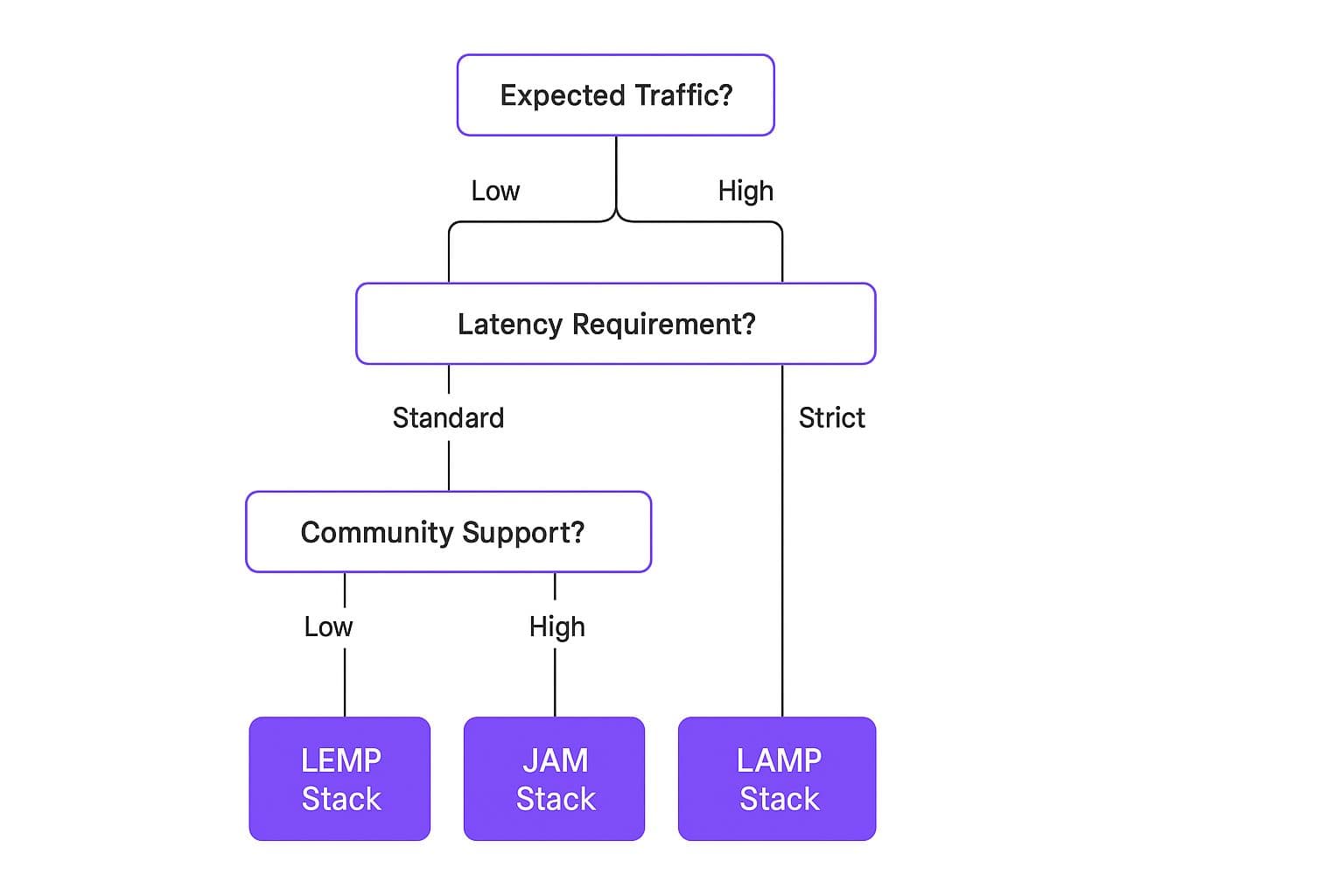
As the graphic shows, there’s no single "best" stack. The ideal choice is always a direct reflection of your project's unique demands for traffic, performance, and team support.
Monolithic or Microservices for an MVP?
For most MVPs, a monolithic architecture is the way to go. It's hands-down simpler and faster to get off the ground. Your main goal right now is to validate your core concept as quickly and cheaply as possible, and a monolith lets you do just that.
You can always break things apart and refactor into a microservices architecture later on, once your app gains traction and your team grows. Starting with microservices from day one often adds a layer of complexity that will slow you down when speed is your most valuable asset.
Open-Source or Proprietary Tech?
This one is usually a straightforward choice for a new product. Open-source technology is almost always the best starting point for an MVP. It's cost-effective (usually free), incredibly flexible, and backed by massive global communities.
Proprietary software can be tempting with its promises of specialized features and dedicated support, but it comes with strings attached—namely, licensing fees and the very real risk of vendor lock-in. For a startup focused on lean, rapid validation, the practical benefits of open-source are hard to beat.
Feeling stuck turning your great idea into a real product? The team at Iglu Digital specializes in building and launching market-ready MVPs for a price agreed before a line of code is written. We can help you navigate these technical decisions and bring your vision to life. Learn how we do it.