

How to Pitch to Investors and Secure Funding

Table of Contents
A killer investor pitch doesn’t start with a fancy slide deck. It begins way before that, with the unglamorous but absolutely essential work of building a rock-solid foundation. This is where you lay the groundwork, digging deep into research, honing your story, and getting crystal clear on your own business model.
Think of it this way: doing this prep work is what turns your pitch from a hopeful ask into an irresistible investment opportunity.
Building Your Foundation Before the Pitch

Before you even think about your "ask," the real work begins. This is your pre-flight checklist, and skipping it is like trying to build a skyscraper without blueprints. So many founders jump straight into designing their deck, obsessing over fonts and graphics. But investors care far more about the substance behind the style.
They’re looking for proof that you’ve done the homework to de-risk their potential investment. This preparation phase is where you show you’re not just a founder with a cool idea, but a strategist who truly understands the market and your place in it.
Know Who You Are Pitching
The number one rule of pitching? Know your audience. Cold. Pitching to the wrong investor is the fastest way to hear "no," and it wastes everyone's time. You have to go deeper than a firm's homepage—dig into their portfolio, read about their recent investments, and understand their core investment thesis.
Your goal is to find genuine, undeniable alignment. Before you even draft an email, ask yourself these questions:
- Industry Focus: Do they live and breathe SaaS, deep tech, or CPG? Finding an investor with domain expertise means they'll "get" your value proposition in a heartbeat.
- Stage of Investment: Are they a pre-seed fund writing those first crucial checks, or a Series B firm that needs to see proven traction? Pitching out of stage is a rookie mistake.
- Check Size: Does their typical investment match what you need? Asking for 500k** from a fund that usually writes **10M checks just shows you haven't done your research.
- Geographic Preference: Do they only back companies in Silicon Valley, or are they open to investing anywhere?
Getting these answers first saves you from meetings that were doomed from the start and lets you tailor your story to what that specific investor actually cares about.
Before you spend hours customizing a pitch, run your target investors through a quick alignment check. It's a simple way to make sure you're focusing your energy where it has the best chance of paying off.
Investor Alignment Checklist Before You Pitch
| Alignment Factor | What to Look For | Why It Matters |
|---|---|---|
| Industry & Sector | Look at their portfolio companies. Do they understand your market? | An investor with domain expertise can provide valuable strategic guidance, not just cash. |
| Investment Stage | Check their recent funding announcements. Are they investing in Pre-seed, Seed, Series A? | Pitching to a firm that doesn't invest at your stage is an immediate disqualifier. |
| Typical Check Size | Review their fund size and past investments on sites like Crunchbase. | You need to find a partner whose financial firepower matches your current and future needs. |
| Geographic Focus | Read their website's FAQ or portfolio page. Do they have a regional mandate? | Many funds prefer to invest locally to provide hands-on support. |
| Portfolio Synergy | Are there potential partners or competitors in their portfolio? | Good synergy can add value, but investing in a direct competitor is often a deal-breaker for them. |
This checklist isn't about finding a perfect match on every single point, but it's a powerful filter. A "yes" to most of these questions means you've found a genuinely qualified lead worth pursuing.
Define Your Core Narrative
Your pitch isn't just a dry list of features and projections. It's a story—a compelling story about the future you're building. This narrative needs to weave together why you, why this team, and why this idea are the perfect combination for success, right now. You’re building an evidence-backed case that makes your company's win feel inevitable.
To build a narrative that holds up under scrutiny, you need to know your business inside and out. A fantastic tool for this is a business model canvas. We have a comprehensive business model canvas template that helps you map out everything from key activities to revenue streams in one place. Gaining that clarity is the first step to crafting a believable and powerful story.
In today's funding environment, this level of preparation is non-negotiable. In the first quarter of 2025 alone, global venture capital investment hit $126.3 billion. But here's the catch: that massive pool of capital was spread across a record low of just 7,551 deals.
This trend is clear: investors are making fewer, bigger bets on the most promising startups. Your well-researched foundation and sharp narrative are what will set you apart and prove you're one of the companies worthy of that concentrated capital.
Crafting a Pitch Deck That Tells a Story

Think of your pitch deck as the visual script for your startup's journey. It’s not a dry collection of slides packed with data; it’s the tool you use to guide an investor from being merely curious to being genuinely convinced. The decks that truly land follow a logical, compelling arc that makes your solution feel inevitable.
Forget about rigid, one-size-fits-all templates. While the core elements don't change much, the real magic is in how you weave them into a coherent narrative. Let's walk through building that story, slide by slide, focusing on the psychology that makes a deck resonate.
Opening with a Problem They Can't Ignore
Every great story needs a conflict. For your pitch, that conflict is the problem your startup exists to solve. Your job is to make an investor feel that pain point so acutely they’re leaning forward, waiting for you to reveal the answer.
Don't just state the problem—illustrate it. Use a relatable story, a shocking statistic, or a personal anecdote to bring it to life.
For instance, instead of a flat statement like, "Small businesses struggle with inventory management," try painting a picture: "Meet Sarah. She owns a local boutique and loses $10,000 in sales every year because she can't track her stock, forcing her to turn away customers who are ready to buy."
This simple shift makes the problem tangible and human. You've created an emotional hook that cold facts and figures just can't match.
Presenting Your Solution as the Hero
After setting the stage with a compelling problem, your solution makes its grand entrance as the hero of the story. This is where you introduce your product or service, but the key here is absolute clarity and simplicity. Ditch the technical jargon and the exhaustive list of features.
Instead, zero in on your core value proposition. How does your solution directly fix the pain you just so vividly described? Your explanation should be so straightforward that an investor could immediately turn around and explain it to their partners in 30 seconds. That's the real test of your messaging.
For many early-stage companies, the solution is still taking shape. This is where investing in custom software development for startups can be a game-changer. It turns a great idea into a tangible prototype or MVP that investors can actually see and interact with, making your solution far more believable and powerful.
Sizing the Opportunity and Your Go-To-Market Plan
Okay, the investor gets what you do. Now, you need to show them just how big this could be. This means defining your market size—TAM, SAM, and SOM. But please, don't just slap a few massive numbers on a slide and move on. Explain how you got those numbers and why your initial target market (your SOM) is the perfect beachhead for your invasion.
This flows naturally into your go-to-market strategy. How are you actually going to reach those first crucial customers? Investors need to see a credible, actionable plan, not just wishful thinking.
Your plan should clearly outline:
- Initial Channels: Are you using content marketing, direct sales, strategic partnerships? Why are these the right fit for your audience?
- Customer Acquisition: What are the concrete steps you'll take to attract and sign up your first users?
- Sales Cycle: Briefly, what does the journey from a curious lead to a paying customer look like?
This shows you've thought beyond just building a cool product; you're thinking about how to build a real business.
Proving You're the Team to Win
The final act of your pitch is all about building rock-solid confidence. You need to convince them that your team is the one to make this vision a reality and that you have a smart plan to navigate the competitive waters.
Start with your team. Introduce them by focusing on directly relevant experience. Highlight past wins, deep domain expertise, and anything that makes this specific group of people uniquely qualified to solve this problem. Investors often say they bet on the jockey, not the horse. This is your chance to prove you've got the best jockeys in the race.
Next, you have to talk about the competition. Never, ever say you have no competitors—it just tells investors you haven't done your homework. Instead, use a competitive matrix to show you understand the landscape and to clearly pinpoint your unique advantages. Is it better technology, a smarter business model, or a killer feature that others lack?
Finally, you bring it all home with your financial projections and "the ask." Your numbers should be ambitious but rooted in the assumptions you’ve already laid out. State clearly how much money you're raising and, more importantly, exactly how you'll use that capital to hit specific, measurable milestones over the next 18-24 months. Frame the ask not as a request for cash, but as an invitation to join you on an incredible journey to capture a massive opportunity.
Mastering Your Pitch Delivery and Presence

You can have the most buttoned-up pitch deck in the world, but it's only half the equation. The best data and sharpest slides will fall completely flat if your delivery doesn't have conviction. This is where you, the founder, become the most important part of the pitch.
Let's be clear: investors don't just back ideas; they back founders. Your presence, your passion, and your ability to command a room are what separate a good pitch from a truly memorable one. It’s how you prove you're the leader who can weather the storms that are inevitably coming.
The Art of Storytelling in Your Pitch
Facts and figures are vital, but they don't inspire people to write checks. Stories do. The real magic happens when you weave your data into a compelling narrative that sticks with an investor long after you've walked out the door.
So instead of just stating your market size, tell the story of a real customer whose problem you’re solving. Don't just list your team's impressive credentials; share a quick anecdote about a past challenge they crushed that proves their grit. This simple shift turns dry data points into something an investor can actually connect with.
Here are a few ways to bake storytelling into your delivery:
- The Origin Story: Briefly share that "aha!" moment that started it all. A little bit of authentic passion goes a long way in building an immediate connection.
- The Customer as the Hero: Frame your target user as the hero of the story. They face a huge challenge (the problem), and then they find a secret weapon (your solution) that helps them win.
- Paint a Picture of the Future: Describe what the world looks like once your company succeeds. Make it a future they absolutely want to be a part of.
A narrative doesn't replace your data; it gives it a soul. It makes your mission feel urgent and your success feel inevitable.
Commanding the Room with Body Language and Tone
Often, what you don't say is just as powerful as what you do. Your non-verbal cues scream confidence—or a lack of it. Investors are reading you just as much as they're reading your slides, so taking conscious control of your presence is a game-changer.
Practice standing tall, making deliberate eye contact with everyone around the table, and using open, natural gestures. Keep your arms uncrossed, stop fidgeting, and try not to stare at your slides the whole time. You want to project calm authority and a genuine excitement for what you're building.
Your voice is just as important. A flat, monotone delivery can make even the most explosive growth metrics sound boring. Vary your pace and pitch to keep the room engaged. Use strategic pauses to let key points land and give investors a moment to really digest the important stuff.
Remember, the goal is to connect, not just to present. If you see confused looks, that's your cue to simplify an explanation. If you see people nodding along, you know you've hit on something that resonates.
Time Management and Preparing for Tough Questions
Nothing signals a well-prepared founder like impeccable time management. If you’re given 30 minutes, your actual presentation should clock in at around 15-20 minutes. This shows you respect their time, but more importantly, it leaves a huge chunk of time for a solid Q&A session.
The Q&A is not an afterthought; it’s where the real evaluation begins. This is your moment to show you know your stuff inside and out, walk them through your thought process, and turn their skepticism into excitement. Get ready for the tough questions about your market, your competition, and especially your financials.
Have concise, evidence-backed answers ready to go. And if you don't know something? It's perfectly fine to say, "That's a great question. We don't have the final data on that yet, but here's how we're approaching it." Honesty and a clear thought process are far more impressive than a fabricated answer.
Knowing how to pitch investors also means understanding what drives them. With corporate venture capital contributing to 36% of total VC deal value, many investors are looking for strategic angles, not just financial returns. According to a global venture capital outlook, this trend is growing. Being ready to discuss potential corporate synergies during the Q&A can be a massive advantage.
When you master your delivery, you're not just presenting a business plan; you're presenting yourself as a capable, investable partner.
Fielding the Tough Questions from Investors
Think of your presentation as the opening act. The real make-or-break moment is the Q&A that follows. This is where investors lean in, drop the pleasantries, and decide if they're truly interested. It’s your chance to step away from the script and show them you have a deep, real-world grasp of your business, your market, and your vision.
Every question, especially a tough one, is a golden opportunity. It’s an invitation to prove you’ve thought through the hard parts and are ready for what’s coming. When you see it this way, the Q&A stops feeling like an interrogation and starts feeling like a productive conversation about building something great.
Knowing What's Coming: The Big Question Categories
Investors almost always circle back to the same core themes. They’re pressure-testing your assumptions to see if your plan can withstand scrutiny. If you’re ready for these categories, you’ll never be completely blindsided.
Your job is to have solid, data-backed answers ready for these areas:
- Market & Competition: They will absolutely poke holes in your market size claims and want to know who you’re up against. Be ready to defend your TAM/SAM/SOM calculations and explain precisely what makes you different—and why that difference is so hard to copy.
- The Team & Your Plan to Win: Expect questions about your team's background. Why are you the only people on the planet who can pull this off? They'll also probe for gaps in expertise, so have a plan for how you'll fill them.
- Financials & Key Metrics: This is where the rubber meets the road. You must know your numbers cold. Be fluent in your customer acquisition cost (CAC), lifetime value (LTV), burn rate, and monthly recurring revenue (MRR). More importantly, you need to explain the assumptions driving every single number in your financial model.
A simple visual can often tell a powerful financial story.
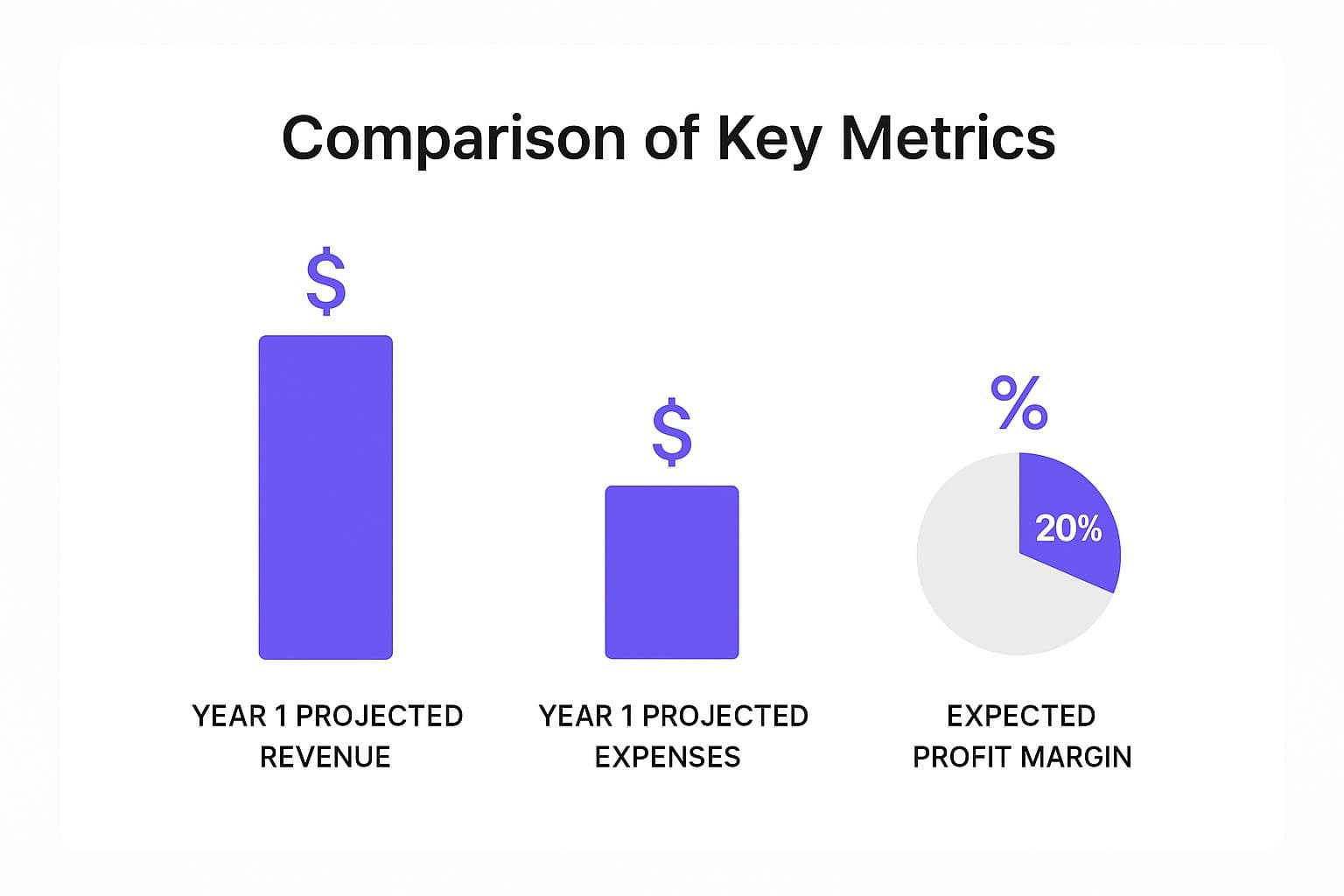
Something like this makes it instantly clear that you've planned for early costs but have a model designed for healthy profit margins as you scale.
Responding to Investor Objections
Investors are paid to be skeptical. Hearing "no" or facing a tough objection isn't a failure; it's part of the process. Understanding the real concern behind the question is key to turning a skeptic into a believer.
Here’s a breakdown of common objections and a framework for how to handle them.
Common Investor Objections and How to Respond
| Common Objection | Underlying Concern | Strategic Response Framework |
|---|---|---|
| "Your market seems too small." | Scalability & Return Potential: Can this ever be a billion-dollar company? | Acknowledge the niche, then reframe. "You're right, we're starting with a focused beachhead market where we can dominate. Our data shows this entry point gives us the credibility to expand into these two larger, adjacent markets valued at $X billion." |
| "What's stopping a big competitor from crushing you?" | Defensibility: Do you have a real, sustainable competitive advantage? | Focus on your unique strengths. "They could try, but our advantage isn't just one feature. It's our deep community integration, our proprietary dataset, and our team's specific domain expertise, which would take them years to replicate." |
| "Your financial projections seem too optimistic." | Realism & Founder Awareness: Do you understand the challenges ahead? | Ground your numbers in reality. "We're certainly ambitious, but these projections are built bottom-up from our early traction. They're based on our current conversion rate of X% and a proven CAC of $Y. We've also modeled a more conservative scenario." |
| "The team seems to be missing key expertise." | Execution Risk: Can this specific team actually build this company? | Show foresight and a plan. "That's a fair point. Our founding team is strong in product and marketing. That's why our first key hire, post-funding, will be a CTO with experience scaling B2B SaaS platforms. We're already talking to a few strong candidates." |
The goal isn't to "win" the argument but to show you're a thoughtful, strategic leader who has already considered these challenges.
Handling Curveballs and Outright Skepticism
Sooner or later, you'll get a question from left field—the dreaded curveball. The point isn’t to have a perfect answer for everything. It’s to show how you think on your feet.
First, just breathe. It’s perfectly fine to pause and say, “That’s a great question. Let me think about that for a second.” This shows confidence, not weakness. It proves you’re being thoughtful, not just reciting a script.
If you don't have a direct answer, fall back on your process. If asked about a hypothetical future threat, you could say, “We haven’t mapped out that specific scenario yet. But our core operating principle is to stay obsessively close to our customer data. We’d use that feedback loop to adapt, just as we have before.”
When you feel that wall of skepticism, resist the urge to get defensive. A great tool here is the “Feel, Felt, Found” method. For example: “I understand why you feel that the market is too crowded. We felt the same way when we started our research. But what we found after interviewing 100 potential customers is that no one is serving this specific niche, and they’re desperate for a solution.”
The Surprising Power of "I Don't Know"
One of the most impressive things you can say in a pitch is, “That’s a great point. I don’t have the data on that yet, but here’s how we’re going to find out.”
It feels wrong, but trying to fake an answer is a fatal error. Investors have heard it all, and they can spot a bluff from a mile away. Once you lose that credibility, the meeting is over, even if you’re still in the room.
Admitting you don’t know everything shows you have self-awareness and intellectual honesty—two critical traits in a founder. It tells them you’re coachable and more committed to finding the right answers than just having all the answers. This is how you build the trust that forms the bedrock of a great investor relationship.
Your Post-Pitch Follow-Up Strategy
You’ve delivered the pitch, answered the tough questions, and shaken hands. But make no mistake—the pitch isn’t over just because you left the room. What happens next is often where the real decision gets made.
A smart, professional follow-up strategy can be the single thing that separates you from the dozens of other founders in an investor’s inbox. This isn’t about pestering them. It's about maintaining momentum and proving you’re a founder they can count on. How you navigate this delicate period speaks volumes about how you’ll run your business.
The Immediate Thank-You Note
This one’s non-negotiable. Send a thank-you email within 24 hours of your meeting. It's a simple act of courtesy that shows you respect their time and gives you one last chance to reinforce your message while it's still fresh in their mind.
Keep it short, personal, and to the point. Your email should hit three key marks:
- Offer genuine thanks for their time and the insightful questions they asked.
- Reiterate your core mission in a single, powerful sentence.
- Address anything specific that came up, providing quick answers or attaching documents they requested.
For example, if an investor drilled down on your user acquisition model, you could add a line like, "I really enjoyed our discussion on customer acquisition. As a follow-up, I wanted to share a bit more detail on our pilot campaign, which achieved a $15 CAC." It proves you were listening and are already on top of things.
Managing the Follow-Up Cadence
Okay, you’ve sent the thank-you note. Now what? The waiting game can be brutal, but you need a plan to stay on their radar without becoming a nuisance.
If a week goes by with radio silence, it’s perfectly fine to send a gentle check-in. The secret here is to always lead with new value, not just an empty ask for an update.
Think about small but meaningful wins you can share. For instance:
- "Just wanted to share a quick update—we've just signed on two new design partners this week."
- "We just pushed a new feature live based on early user feedback, and the engagement is up 20%."
- "Following our conversation, I thought you might find this article on our market interesting."
Each of these little updates proves your team is executing day in and day out. You're not just a slide deck; you're a living, breathing company that's de-risking itself with every small victory. In the current fundraising climate, demonstrating real progress is everything. To get a better sense of what VCs are looking for, it's worth reading up on the current venture capital industry dynamics from Stout.
Handling Different Investor Responses
You’re rarely going to get a straight "yes" or "no" right away. Learning to read the room and react appropriately is a skill every founder has to master.
The Enthusiastic "Yes" Fantastic news! This is what you were working for. Shift gears immediately and clarify the next steps. Ask about their internal process, what materials they need for due diligence, and what their timeline looks like. Be professional, be excited, and be incredibly responsive.
The Dreaded "Maybe" or Silence Welcome to the most common response in venture capital. A "maybe" or complete silence usually means they're interested but not yet fully convinced. This is where your value-add follow-ups come in. Keep sending those progress updates every couple of weeks. If you have a working product, nothing is more powerful than showing real data and user growth. Understanding the benefits of a minimum viable product will help you frame these updates for maximum impact.
The Clear "No" It stings, but rejection is just part of the game. Your response here defines your professionalism. Thank them again for their time and consideration. If you feel there's a good rapport, it's okay to ask if they’d be willing to share one piece of feedback to help you strengthen your pitch. A graceful exit keeps the door open—you never know when your paths will cross again.
Pitching to Investors: Your Questions, Answered
Stepping into the world of venture capital can be intimidating. As you gear up to pitch, you'll find that the same questions pop up time and time again. Knowing the answers ahead of time is a huge confidence booster and helps you walk into that room ready for anything.
Let's cut through the noise. Here are some straight-up answers to the questions I hear most often from founders trying to get their pitch right.
How Long Should My Investor Pitch Be?
Aim for 15-20 minutes. Seriously.
Most investor meetings are blocked for an hour, but you absolutely do not want to talk for the entire time. Leaving a good 30 minutes or more for questions and discussion is crucial. It shows you respect their time, and honestly, the Q&A is often where the real magic happens.
Your goal isn't to drone on about every single feature. It's to tell a compelling story that gets them excited and makes them want to know more. Think of your pitch as the movie trailer, not the full feature film. You can always have a detailed appendix ready for the deep-dive questions.
What Is the Biggest Mistake Founders Make When Pitching?
Hands down, the most common—and most damaging—mistake is not doing your homework on the investor. I've seen it happen too many times: a founder pitches their consumer app to a VC who only invests in B2B enterprise software. It's an instant credibility killer.
This isn't just a minor slip-up; it tells the investor you haven't bothered to do the basic research. It wastes their time and yours. Before you ever send an email, you need to understand their investment thesis, look at their portfolio, and know their typical check size.
How Should I Handle a Pitch Rejection Gracefully?
First, understand that hearing "no" is part of the game. It’s not a personal attack or a final verdict on your company's potential. How you handle it says a lot about you as a founder.
Always respond with professionalism and gratitude. Thank them for their time and consideration. If you felt a genuine connection during the meeting, it's perfectly fine to ask for a single piece of feedback that could help you improve.
Here’s a quick game plan for a graceful exit:
- Say thank you: It's simple, but it matters.
- Ask for one takeaway: A question like, "Was there one area of our business that gave you the most pause?" can yield incredibly valuable insight.
- Never argue: Don't get defensive or try to change their mind. It’s their capital, their decision. Just listen, learn, and move on.
Leaving a good impression keeps the door open. That same investor might be a great fit for your next round, or they might know someone who's perfect for you right now. Professionalism always pays dividends.
Ready to turn your idea into a tangible product that will wow investors? The team at Iglu Digital specializes in building market-ready MVPs with the price fixed before we start, giving you the traction you need to make your pitch undeniable. Learn more and get started at https://iglu.dev.