

Your Guide to Outsourced Product Development
Table of Contents
Think of it this way: you have a brilliant idea for a house, but you're not an architect or a builder. You wouldn't just hire a few people to lay bricks and hope for the best. You'd bring in a trusted firm to handle everything—from drawing up the blueprints to hanging the last picture frame.
That's the core idea behind outsourced product development. It's a strategic partnership where you hand over the entire journey of creating your product to an external, expert team. They take care of it all: the initial concept, design, development, launch, and even the support that comes after.
What Is Outsourced Product Development, Really?

Outsourced product development (OPD) goes far beyond just hiring a few freelance coders for a specific task. It's a much deeper, more integrated relationship. Your OPD partner essentially becomes a dedicated extension of your company, bringing specialized skills, proven workflows, and a team focused exclusively on making your product vision a reality.
This is fundamentally different from other models you might have heard of, like staff augmentation. With staff augmentation, you're essentially "renting" a developer to temporarily join your existing team. With OPD, you're not just borrowing a skill set; you're delegating the responsibility for an entire outcome. The partner firm manages the project, navigates the technical hurdles, and is ultimately accountable for delivering a polished, market-ready product.
The Strategic Value of a True Partnership
Choosing to go the OPD route is a major strategic decision, and it’s usually driven by goals that go well beyond just getting code written. Companies embrace this model to get a real competitive advantage.
Here’s how:
- Faster Time-to-Market: An external team, fully dedicated to your project, can often build and launch much faster than an in-house team that's juggling a dozen other priorities.
- Access to Specialized Expertise: You get immediate access to top-tier talent in fields like AI, blockchain, or complex mobile development without going through a long and costly recruitment cycle.
- Focus on Your Core Business: It frees you and your team up. Instead of getting bogged down in development details, you can concentrate on what you do best—strategy, marketing, sales, and building customer relationships.
This isn't just a niche strategy; it's a massive trend. The global IT outsourcing market, which OPD is a huge part of, is on track to blow past $591 billion by 2025. This explosive growth points to a fundamental shift in how businesses operate, increasingly trusting external partners to handle their entire software development needs. You can dig into more data on this market expansion to see the drivers behind it.
Comparing Development Models: In-House vs Staff Augmentation vs OPD
To really understand where OPD fits in, it helps to see it side-by-side with other common ways of building software. Each approach has its place, and knowing the differences is crucial for picking the right one for your goals.
This table breaks it down.
| Aspect | In-House Team | Staff Augmentation | Outsourced Product Development (OPD) |
|---|---|---|---|
| Responsibility | You manage the entire project and team internally. | You manage the project; the provider supplies talent. | The partner manages the project and delivers the outcome. |
| Cost Structure | High fixed costs (salaries, benefits, infrastructure). | Variable costs based on hourly or monthly rates per hire. | Often a fixed price or retainer for the entire project. |
| Strategic Value | Full control and deep institutional knowledge. | Fills skill gaps and adds capacity to an existing team. | Provides end-to-end expertise and accelerates market entry. |
As you can see, the choice isn't just about who writes the code. It's about how much control you want to retain, what kind of costs you're prepared for, and whether you need a few extra hands or a dedicated partner to take the wheel.
The Strategic Benefits of Outsourcing Your Product

When you look past simple task delegation, you start to see the real strategic power of outsourced product development. It’s about more than just getting work done; it’s a business strategy built on three powerful pillars: unlocking major cost savings, hitting the market faster, and tapping into a worldwide pool of innovation. The impact goes far beyond a single line item on your budget.
This approach is quickly becoming a go-to strategy for smart companies. The market for software development outsourcing is exploding, with projections showing it will blow past $806 billion by 2029. This isn't just a trend; it's a fundamental shift in how businesses grow. You can dig into the factors driving this market expansion on 10pearls.com.
Unlock True Cost Efficiencies
The most immediate benefit everyone thinks of is cost savings, but the real story goes much deeper than just lower salaries. When you build an in-house team from scratch, you're hit with a mountain of hidden overhead costs that often don't become obvious until you’re already buried in them.
A great outsourcing partner helps you sidestep these financial traps. The true value isn't just in the rates but in avoiding all the associated costs of:
- Recruitment: Say goodbye to expensive recruiter fees, endless interview rounds, and time-consuming onboarding.
- Infrastructure: Forget about buying new computers, paying for software licenses, or leasing more office space.
- Benefits and Training: Your partner manages payroll, benefits, and the ongoing professional development of their experts.
Accelerate Your Speed to Market
In a world where everyone is racing for attention, being first is a massive advantage. Outsourced product development is like a launch booster for your project, capable of shrinking your timeline from years down to just a few months. How? An external partner gives you a dedicated, ready-to-go team that can work alongside your internal crew.
Think of it like building a bridge from both sides at once. While your team is busy with high-level strategy and talking to customers, your outsourcing partner is already writing code and building the technical foundation. This gets rid of internal delays and the constant stop-and-start that happens when in-house teams are forced to juggle too many priorities. For a startup, that speed can mean everything, helping you grab market share before a bigger, slower competitor even notices you.
This fast-paced cycle is especially powerful when you're getting the first version of your product out the door. You can learn more about this lean approach in our guide on what a minimum viable product is and how it helps you test ideas without breaking the bank.
Access a Global Innovation Engine
Let’s be realistic. What if you need a top-tier AI specialist or a veteran blockchain developer, but only for a six-month project? Finding and hiring someone like that for a short-term gig is a nightmare—it’s slow, impractical, and incredibly expensive. This is where outsourcing really changes the game, giving you instant access to a global talent pool.
You can plug into specialized skills that are either impossible to find or way too costly in your local market. A fintech startup, for instance, could partner with a firm that has years of experience building secure payment systems, all without needing to make a long-term hire.
This on-demand access to elite talent means you can build a more sophisticated, feature-rich, and competitive product. Innovation stops being a fixed overhead cost and becomes a flexible resource you can scale up or down as needed.
How to Navigate Common Outsourcing Risks

While the upside of outsourced product development is huge, jumping in without a map of the potential pitfalls is asking for trouble. Let's be honest: handing over a critical part of your business to an outside team comes with its own set of risks. The good news? With a bit of foresight and the right strategy, these challenges are not just manageable—they're entirely avoidable.
Most of the horror stories you hear boil down to a few key fears: losing control of the project, fighting through communication breakdowns, and, of course, protecting your intellectual property. The secret isn't to cross your fingers and hope for the best. It's about building a partnership from the ground up that's designed to prevent these problems before they even start. A great partner will want to tackle these concerns with you right from the beginning.
Maintaining Control and Visibility
One of the biggest anxieties I see is founders feeling like they've given away the steering wheel. When your development team is thousands of miles away, how do you really know if the project is staying on track and aligned with your vision? The answer is all about creating a rhythm of transparency and shared ownership.
This isn't about micromanaging every little detail; it's about staying perfectly aligned. Here’s how you build a solid framework for control that works for everyone:
- Set a Rhythm for Check-ins: Make daily stand-ups or weekly sprint reviews a non-negotiable part of your routine. These are your essential touchpoints for seeing what’s done, clearing up any roadblocks, and making sure everyone is still aiming for the same target.
- Use Transparent Project Management Tools: Don't settle for email updates. Insist on shared access to a platform like Jira, Trello, or Asana. This gives you a live, unfiltered look at the project's pulse—what's in the backlog, who's working on what, and how things are progressing.
- Define Clear Success Metrics: Before a single line of code is written, agree on what success actually looks like. Use measurable Key Performance Indicators (KPIs) to track things like development velocity, the number of bugs, and how well the team is hitting deadlines. It takes the guesswork out of performance.
With these feedback loops in place, you’re no longer wondering what’s happening. You’re in a position of informed oversight, ensuring the project never strays from its course.
Bridging Communication and Cultural Gaps
Clear communication is the absolute lifeblood of any outsourced project. When your teams are separated by different time zones and cultural norms, small misunderstandings can easily snowball into major delays. It’s a well-known fact that poor communication costs businesses millions every year in failed projects and lost productivity.
To get ahead of this, you need a communication plan from day one.
- Establish a Primary Point of Contact: Designate one dedicated project manager on your side and one on theirs. This funnels all communication through a single channel, preventing mixed signals and confusion.
- Document Everything: A conversation is not a commitment. Make sure every important decision, feature request, and piece of feedback is captured in writing, whether it's in an email or your project management tool.
- Be Mindful of Cultural Differences: A little awareness goes a long way. Understand different communication styles, working hours, and public holidays. A good partner will be open about their company culture, and you should do the same to build mutual respect.
Protecting Your Intellectual Property
"Will someone steal my idea?" This is often the first and most urgent question, and for good reason. Your intellectual property (IP) is the core of your business. Protecting it isn't just a legal box to tick; it's the foundation of trust in your outsourcing relationship.
Thankfully, securing your IP is a pretty straightforward process when you have the right legal safeguards.
- Start with an NDA: Before you even think about sharing the details of your vision, make sure a rock-solid Non-Disclosure Agreement (NDA) is signed. This is your non-negotiable first step with any potential partner.
- Confirm Ownership in the Contract: Your main contract must have an ironclad clause that clearly states that 100% of the work product and all resulting IP belongs to you and you alone. No ambiguity, no exceptions.
- Choose Reputable Partners: Stick with established firms that have a public track record and strong internal security. Ask them directly about their data protection protocols and how they secure everything from their network to their code repositories.
Your Step-by-Step Product Development Roadmap
Working with an outsourced product development partner can feel like a leap of faith, but a good one will lead you through a structured, predictable process. Forget any ideas of a chaotic scramble to the finish line. Think of it more like a well-planned expedition, complete with clear phases, milestones, and deliverables that everyone understands from the start.
This roadmap breaks down the entire journey into five distinct stages. Each one builds on the last, taking your initial idea and methodically turning it into a real, market-ready product. Understanding this flow takes the mystery out of the process and empowers you to be a proactive, informed partner.
Here's a high-level look at how these stages fit together.
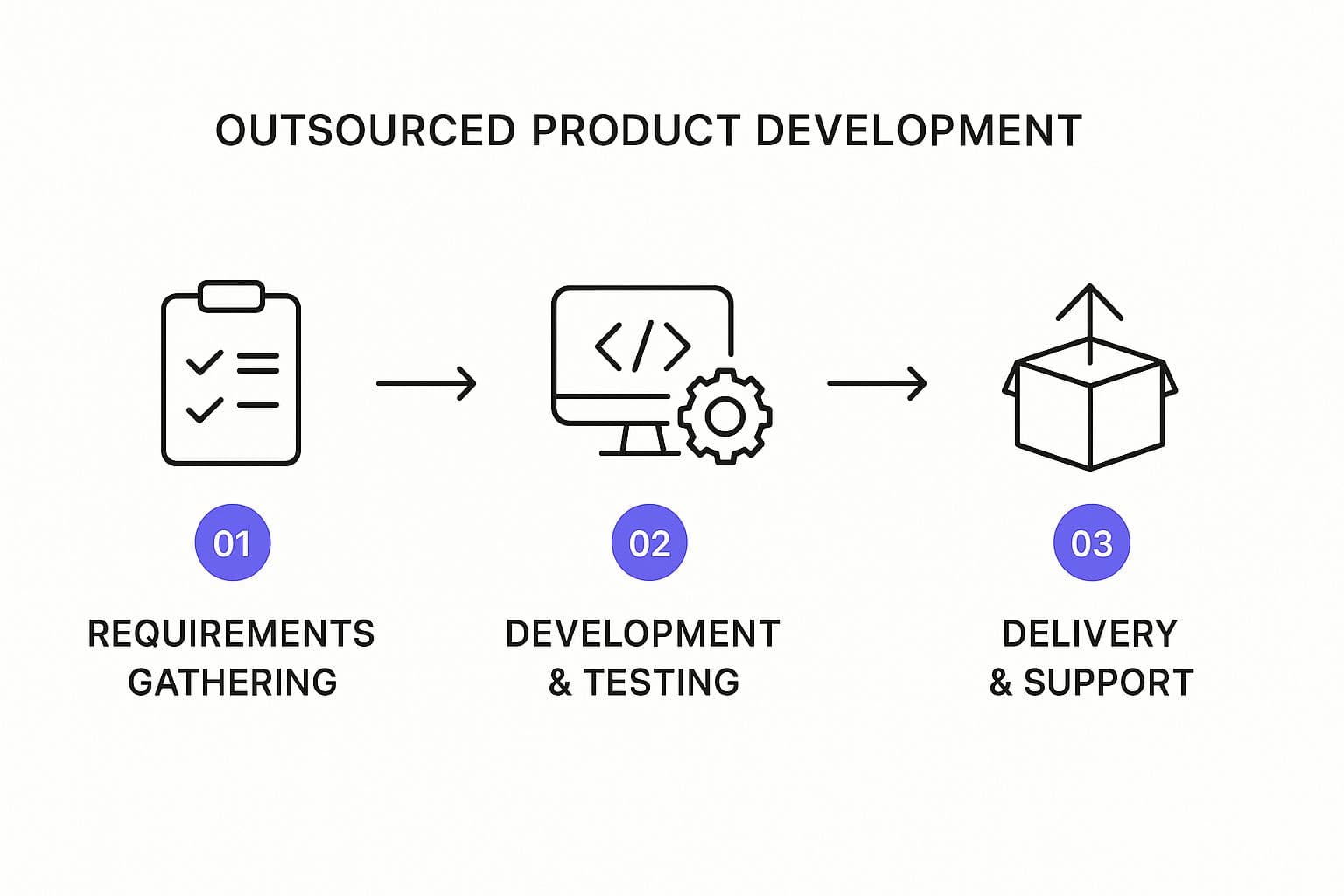
This visual simplifies the journey, showing how we move from initial requirements into a cycle of building and testing, before finally getting to the launch and ongoing support.
Phase 1: Discovery and Strategy
This first phase is, without a doubt, the most important. This is where we put your idea under a microscope to build a rock-solid foundation for the whole project. The goal here is to move from a rough concept to a concrete plan that everyone can get behind. It's all about nailing down the "why" and "what" before we ever start thinking about the "how."
Some key activities you'll see in this stage are:
- Market and User Research: Getting to know your target audience, checking out the competition, and really defining the core problem your product is built to solve.
- Business Goal Alignment: Making sure the product vision lines up perfectly with your bigger business goals, whether that's boosting revenue, improving efficiency, or breaking into a new market.
- Scope Definition: Pinning down the core features and functionality. This is often where we prioritize what’s absolutely essential for the first version to keep the project focused and avoid "scope creep" down the road.
The main takeaway from this phase is a detailed project plan or a product requirements document. This becomes our single source of truth, outlining every goal, feature, and technical need.
Phase 2: UI/UX Design and Prototyping
With a clear strategy in hand, we shift our focus to how the user will actually experience your product. This is where your idea starts to get a face. The aim is to create a design that not only looks great but feels intuitive and effortless for your specific audience.
The design process usually follows a few key steps:
- Wireframing: We start with low-fidelity, blueprint-like sketches of each screen. This helps us map out the basic structure and layout.
- UI/UX Design: Next comes the high-fidelity visual design. We develop the color schemes, typography, and interactive elements that give your product its distinct look and feel.
- Prototyping: We then build a clickable, interactive prototype that mimics the real user experience. This allows you and potential users to give early feedback and helps us iron out any usability kinks.
By the end of this phase, you’ll have a finalized, approved design and an interactive prototype that gives you a genuine feel for the final product.
Phase 3: Agile Development and Engineering
Now it’s time to build. In the development phase, the engineering team takes the approved designs and turns them into a living, breathing piece of software. Most modern development teams, including ours, use an Agile methodology. This just means the work is broken down into small, manageable cycles called "sprints," which keep the project moving forward at a steady, predictable pace.
During this stage, your partner will handle everything from the front-end (what the user sees and interacts with) to the back-end (the server, database, and all the logic that makes it work). If you're looking to launch quickly, the concept of a Minimum Viable Product (MVP) is crucial here. To get a better handle on this, check out our guide on how to build an MVP to test your idea with actual users.
Phase 4: Rigorous Quality Assurance
Building and testing aren't two separate steps—they happen in tandem. As developers finish features, a dedicated Quality Assurance (QA) team is already working to find and squash bugs, confirm everything works as it should, and make sure the product performs well under pressure.
Key QA activities include things like:
- Functional Testing: Making sure every single feature works according to the project plan.
- Performance Testing: Checking the product’s speed, responsiveness, and stability when lots of people are using it.
- Security Testing: Proactively looking for and fixing potential security holes to keep user data safe.
A thorough QA process is non-negotiable. It’s what ensures you launch a polished, professional product that earns user trust from day one.
Phase 5: Deployment and Maintenance
The final phase is the launch! Your outsourcing partner will manage the entire deployment, from setting up the server infrastructure to pushing the code live for your first users.
But the work doesn't stop there. Post-launch support is a critical part of the relationship. This ongoing partnership includes:
- Monitoring: Keeping a close watch on the application's performance and stability.
- Maintenance: Quickly fixing any new bugs that pop up and applying necessary security updates.
- Iteration: Using real user feedback and data to plan future improvements and new features.
This ensures your product stays healthy, secure, and continues to evolve to meet the ever-changing needs of your users.
Choosing the Right Outsourcing Partner
Picking a partner for your outsourced product development is probably the single most important decision you'll make in this entire journey. This isn’t just about looking at a portfolio or comparing hourly rates. You're entrusting your vision to another team, and the stakes are incredibly high.
Think of it like choosing a co-pilot for a transatlantic flight. You wouldn’t just check if they have a license. You’d want to know if they've flown your specific aircraft, navigated through storms, and if they communicate clearly when things get turbulent. That's the level of scrutiny needed here.
Evaluate Technical Expertise and Industry Fit
First things first, you need to look past the marketing claims. A company saying they "build great apps" is meaningless. You have to dig deeper. If your product needs a specific tech stack, you need to see proven, hands-on experience with it. Building a data-heavy AI application? Ask to see case studies where they’ve explicitly used Python, PostgreSQL, and AWS to solve similar problems.
Just as critical is their experience in your industry. A team that has already built five successful fintech platforms inherently understands the world of compliance, security, and user expectations you live in. They know the lingo, which cuts down on misunderstandings and really speeds things up.
- Technical Alignment: Do they have senior developers who are genuine experts in your required languages and frameworks?
- Industry DNA: Have they actually launched products in your market? Do they get your customer’s specific problems?
- Process Maturity: Can they walk you through a clear development process, like Agile or Scrum, with well-defined roles and routines?
Getting this right ensures you’re not just hiring coders, but a strategic team that can add value from day one.
Assess Communication and Cultural Alignment
Great code isn't enough to make a partnership work. Communication is the glue that holds everything together, and it's where many outsourcing relationships fall apart. Before you sign any contracts, you have to get a real feel for how the team talks, handles disagreements, and works together.
Get straight to the point with your questions:
- What does your day-to-day communication look like? (e.g., daily stand-ups, weekly demos)
- Which project management tools do you use to keep things transparent?
- How many of our working hours will overlap?
- Can we talk directly with the developers, or is everything filtered through a project manager?
Clear, constant communication is non-negotiable. It’s the bedrock of a successful project.
Red Flags to Watch For
Knowing what to look for is only half the battle; you also need to know what to avoid. Some warning signs are subtle, but they often hint at bigger problems that could derail your project down the road.
Be cautious of any potential partner who:
- Offers a Vague Proposal: If their plan is fuzzy on milestones, deliverables, or a detailed cost breakdown, that’s a huge red flag.
- Uses High-Pressure Sales Tactics: A good partner is focused on making sure it’s a great fit, not just closing a deal. If they rush you, their priorities aren’t aligned with yours.
- Is Reluctant to Provide References: Any solid firm will be proud to have you speak with their clients. If they hesitate, there’s usually a reason.
- Cannot Explain Their Process Clearly: If they can't walk you through how they handle development, QA, and deployment in simple terms, it suggests they don’t have a mature process.
The move toward using external teams is a massive global trend. Projections show the average global spend on IT outsourcing will climb to nearly $156.92 per employee by 2025, showing just how vital these partnerships have become. You can find more IT outsourcing trends at Zealousys.
Choosing the right partner is the cornerstone of a successful product launch. By thoroughly vetting their technical skills, cultural fit, and communication style—especially when you're just starting out—you set yourself up for a truly collaborative and effective relationship. Our detailed guide on MVP development for startups offers more strategies for navigating this crucial first stage.
Your Top Outsourcing Questions Answered
Even with a solid plan, it's natural to have questions when you're thinking about outsourced product development. Getting straight answers to these common worries is the best way to feel confident about taking the next step. Let’s dive into the big questions we hear most often from founders and project leads.
What’s the Real Cost of Outsourcing?
There's no one-size-fits-all answer here. The final price tag depends entirely on what you're building. Think about the project's complexity, the tech stack involved, the size of the team you'll need, and even where your partner is located. A straightforward mobile app will naturally cost less than a sprawling enterprise system with complex integrations.
The pricing model also makes a big difference:
- Fixed-Price: This works well when you have a crystal-clear scope and know exactly what features you need from day one.
- Time & Material: This model gives you the flexibility to adapt and evolve, which is perfect for projects where requirements might change as you go.
Any partner worth their salt won't just throw a number at you. They'll insist on a proper discovery phase to really dig into your needs. This initial work is what makes their estimate realistic and ensures everyone is on the same page.
How Can I Keep My Idea Safe?
Protecting your intellectual property is absolutely crucial, and thankfully, it's a standard part of the process. Your first step, before you share any sensitive details, is signing a comprehensive Non-Disclosure Agreement (NDA). This is your foundational legal protection.
What Do I Actually Do as the Client?
Your role is anything but passive. You are the product visionary and a critical team member. Your main job is to steer the ship—you set the vision, give clear and consistent feedback after each development sprint, and make the tough decisions about what features get built and in what order.
Honestly, your active involvement is one of the biggest factors in a project's success. When you're engaged, the final product is far more likely to be exactly what your business needs.
Ready to turn your idea into a market-ready product without the typical delays? The team at Iglu Digital specializes in building high-quality MVPs on a fixed price, agreed up front. Transform your concept into a tangible product today.