

Top Proof of Concepts Examples That Transformed Industries
Table of Contents
Every revolutionary product, from the smartphone in your pocket to the cloud services powering our digital lives, started as a bold, unproven idea. The crucial bridge between a visionary concept and a market-ready reality is the Proof of Concept (PoC). A PoC isn't just a prototype; it's a strategic validation exercise designed to answer one critical question: "Is this core idea technically feasible and viable?"
By isolating and testing a project's foundational assumptions, a successful PoC de-risks innovation, attracts crucial investment, and lays the essential groundwork for future development. It moves an idea from a theoretical "what if" to a tangible "it works." This focus on validation is what separates high-impact projects from costly failures.
In this article, we'll dissect 8 transformative proof of concepts examples that not only demonstrated feasibility but fundamentally reshaped their respective industries. We will explore the strategic objectives behind each PoC, the specific tactics used to validate them, and the actionable lessons you can apply to your own innovative projects. You will learn not just what they did, but how they did it, providing a replicable blueprint for turning your bold ideas into business realities.
1. Tesla's Electric Vehicle Technology
Tesla, Inc. revolutionized the automotive industry by treating its initial products as strategic proof of concepts examples to validate a radical hypothesis: that electric vehicles (EVs) could outperform and be more desirable than their gasoline-powered counterparts. Instead of competing on eco-friendliness alone, a crowded and often niche market, Tesla's core objective was to prove technical and market viability by shattering negative stereotypes associated with EVs, such as poor performance and limited range.
The 2008 Tesla Roadster was the cornerstone of this strategy. It wasn't just a car; it was a high-performance demonstration. By achieving supercar-level acceleration (0-60 mph in 3.7 seconds) and a range of over 200 miles, it single-handedly proved that electric propulsion was not a compromise. This PoC targeted a niche of wealthy early adopters, using a premium price point to fund further R&D and establish brand prestige.
Strategic Breakdown
Tesla's approach was a masterclass in sequential validation. Each vehicle served as a PoC for the next, progressively de-risking the company's long-term vision of making EVs accessible to everyone.
- Roadster (2008): Proved high-performance EVs were technically possible and desirable to a niche luxury market.
- Model S (2012): Validated that a premium, all-electric sedan could compete with established luxury brands like BMW and Mercedes-Benz, proving broader market appeal.
- Model 3 (2017): Demonstrated the feasibility of producing a mass-market EV at a lower price point, completing the "secret master plan" and proving scalability.
The following timeline illustrates Tesla's phased approach to proving market viability, starting with a high-performance niche and expanding to the mass market.
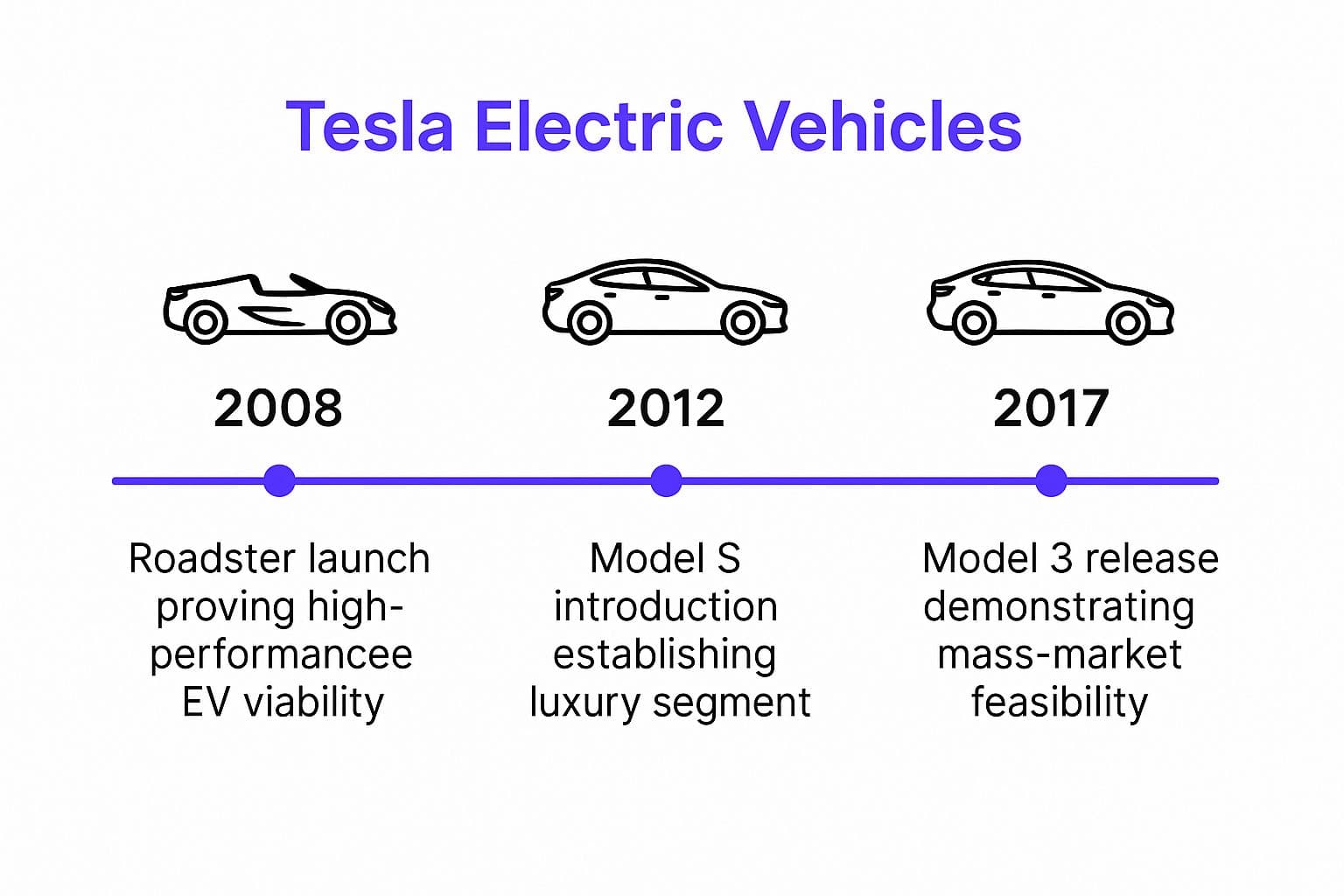
This visual timeline highlights how each model built upon the success of its predecessor, systematically proving the business case for electric vehicles at different market tiers.
Actionable Takeaways
For founders and product leaders, Tesla’s journey offers a powerful blueprint for launching disruptive technology.
- Focus on Superior Performance: Identify a key metric where your innovation can decisively beat the incumbent solution. For Tesla, it was acceleration and performance, not just eco-credentials.
- Use a Premium PoC to Fund Scale: Start with a high-margin niche product to build brand capital and fund the R&D needed for a mass-market offering.
- Build the Ecosystem: Tesla didn't just sell cars; it built the Supercharger network. Your PoC may need to include a plan for the supporting infrastructure required for it to succeed.
2. Netflix's Streaming Video Service
Netflix’s bold pivot from its dominant DVD-by-mail business to an unproven streaming model serves as one of the most powerful proof of concepts examples in modern business. The company’s core objective was to validate a critical hypothesis: that consumers would prefer the convenience of on-demand digital streaming over physical media, and that the internet infrastructure could reliably support it on a mass scale. This was a direct challenge to its own highly successful business model.

The initial 2007 "Watch Now" feature was a carefully contained PoC. It was offered at no extra cost to existing DVD subscribers, leveraging a built-in user base to test the service. By starting with a limited library of just 1,000 titles, Netflix could test and refine the technical delivery, user experience, and content licensing models without jeopardizing its primary revenue stream. The initial success of this feature proved the core concept of internet television, paving the way for its global dominance.
Strategic Breakdown
Netflix's PoC strategy was methodical, focusing on validating technology and consumer behavior before committing fully. It was a controlled experiment to see if the future they envisioned was viable.
- Initial Launch (2007): Proved technical feasibility by streaming a limited content library to existing subscribers. This validated that the underlying technology worked and that a segment of users would adopt it.
- Expansion to Devices (2008-2010): Validated market reach by expanding from PC-only to game consoles, smart TVs, and mobile devices. This proved streaming wasn't just a niche for computer users but a mainstream entertainment solution.
- Original Content (2013): With House of Cards, Netflix launched a PoC to prove that streaming services could create and own high-quality, award-winning content, transforming them from distributors into production powerhouses.
Actionable Takeaways
Netflix's transition provides invaluable lessons on how to innovate from a position of strength and navigate industry disruption. For a deeper dive into how this compares with other launch strategies, you can read more about minimum viable product examples on iglu.dev.
- Leverage an Existing Customer Base: Test your PoC on a captive audience. Offering the initial streaming service to DVD subscribers gave Netflix instant feedback without high customer acquisition costs.
- Start with a Constrained Offering: You don't need a perfect, full-featured product. Netflix’s initial 1,000-title library was enough to prove the concept and gather data for future content acquisitions.
- Focus on the Core User Experience: The initial service was simple but effective. It prioritized a seamless "click and play" experience, which was the core value proposition over waiting for DVDs.
3. Airbnb's Peer-to-Peer Accommodation Platform
Airbnb's creation is one of the most celebrated proof of concepts examples, validating a then-radical idea: that people would willingly pay to sleep in a stranger's home. The core objective was not just to create a booking website but to test and prove the fundamental hypothesis that technology, specifically a well-designed platform, could build sufficient trust between strangers to create a viable, scalable alternative to the traditional hotel industry. Their initial PoC aimed to solve a very specific, localized problem, thereby demonstrating the broader potential of the peer-to-peer accommodation model.
The legendary story of renting out air mattresses in their San Francisco apartment during a sold-out design conference in 2007 was the ultimate lean PoC. It was not a feature-rich platform; it was a simple webpage with photos that proved a critical assumption: people would choose an authentic, local experience over conventional lodging if the barrier to trust could be overcome. This small-scale experiment validated the core concept with minimal investment, paving the way for a global hospitality revolution.

Strategic Breakdown
Airbnb's strategy was a masterclass in behavioral validation. The focus was less on technology and more on proving that a human-centric platform could engineer trust and facilitate transactions between two distinct user groups: hosts and guests.
- Initial PoC (AirBed & Breakfast): Validated the core demand during a hyper-specific event (a design conference), proving that at least a niche group of users was open to the concept.
- Professional Photography Initiative: A crucial second PoC that tested a new hypothesis: that higher-quality listings would significantly increase bookings. They went door-to-door in New York City taking professional photos, which doubled weekly revenue and proved the importance of platform-led quality control.
- Expansion to Entire Homes: This phase moved beyond just "rooms" to validate the market for renting entire properties, directly competing with vacation rental sites like VRBO and proving the model's scalability and broad appeal.
This visual timeline highlights the key trust-building initiatives that turned a quirky idea into a global hospitality giant.
Actionable Takeaways
For founders building two-sided marketplaces, Airbnb provides a clear roadmap for establishing trust and creating liquidity from scratch.
- Go Analog to Solve Digital Problems: The founders personally photographed apartments and met with early hosts. Don't be afraid to do things that don't scale initially to understand and solve core user problems.
- Engineer Trust Mechanisms: Your platform's primary job is to make strangers comfortable transacting with each other. Invest in profiles, reviews, secure payments, and customer support from day one.
- Focus on a Unique Value Proposition: Airbnb didn't just offer a cheaper room; it offered a unique, local experience. Your PoC should highlight a value that incumbents cannot easily replicate.
4. Apple's iPhone Multi-Touch Interface
Apple's 2007 iPhone launch was one of the most impactful proof of concepts examples in technology history. The company's primary objective was to validate a daring hypothesis: that a sophisticated, gesture-based multi-touch interface could entirely replace the physical keyboards and styluses that dominated the mobile landscape. The core PoC was not just the device itself, but the radical user experience it enabled.
The original iPhone was a demonstration of viability. By delivering a fluid, intuitive interface controlled by simple gestures like pinch-to-zoom and swipe-to-scroll, Apple proved that complex computing power could be made accessible and delightful for mainstream consumers. This PoC effectively destroyed the prevailing industry belief that powerful mobile devices required cumbersome physical inputs, setting a new standard for human-computer interaction.
Strategic Breakdown
Apple’s strategy focused on proving the superiority of a software-driven interface over hardware-centric designs. The PoC was executed sequentially, with each product expanding the validated territory of touch-based computing.
- iPhone (2007): Proved a full multi-touch screen was not only viable but superior for a smartphone, creating a new market category.
- iPad (2010): Validated that the same touch-first paradigm could scale to a larger tablet format, successfully creating another new device category for content consumption and light productivity.
- Industry Adoption: The success of the iPhone and iPad forced competitors like Google (Android) and Microsoft (Windows) to adopt similar touch-centric interfaces, validating Apple's concept at a global scale.
The success of this approach hinged on flawlessly executing the software and hardware integration, a process that relies heavily on effective prototyping. For those looking to replicate this level of innovation, understanding the principles of iterative design is crucial. You can learn more about the process of developing and testing such interfaces through rapid prototyping.
Actionable Takeaways
Apple's introduction of the multi-touch interface provides a timeless lesson in how to redefine a market by rethinking the core user interaction model.
- Prioritize Intuitive Design: Base your interface on natural human gestures. Apple's success came from making technology feel like an extension of the user's hand.
- Design for Your Input Method: The iPhone's interface elements were designed for fingers, not a precise stylus. Ensure your PoC's design is optimized for its primary input method.
- Provide Immediate Visual Feedback: Every touch and gesture on the iPhone received an immediate, tangible on-screen reaction. This feedback is critical for building user confidence and making the interface feel responsive and alive.
5. Amazon's Cloud Computing Services (AWS)
Amazon Web Services (AWS) represents one of the most transformative proof of concepts examples in modern technology, born from an internal need to manage its own complex infrastructure. The core hypothesis was radical: could computing infrastructure, a capital-intensive asset, be offered as a scalable, on-demand utility? The objective was to prove that businesses would willingly rent computing power, storage, and databases instead of owning and managing physical servers.
Amazon's initial services, such as Simple Storage Service (S3) and Elastic Compute Cloud (EC2), were the tangible proof. They weren't just internal tools; they were foundational PoCs designed to validate the market for "infrastructure-as-a-service." By offering these core components with a pay-as-you-go model, AWS demonstrated that startups and enterprises alike could launch and scale digital products faster and more cheaply, effectively proving that computing could be treated like electricity.
Strategic Breakdown
AWS’s success stemmed from proving a series of interconnected concepts that completely redefined IT. Each service validated a new piece of the cloud computing puzzle, de-risking the massive investment required and building momentum for widespread adoption.
- Internal PoC (Early 2000s): Proved that Amazon’s own retail business could run more efficiently on a standardized, service-oriented infrastructure. This validated the technical feasibility.
- External Launch (2006): Validated the core market hypothesis that external companies, particularly startups, would pay for on-demand computing resources to avoid capital expenditure.
- Enterprise Adoption (Late 2000s): Demonstrated that even large, risk-averse enterprises like Netflix would migrate their entire operations to the cloud, proving the model’s reliability, security, and scalability.
This phased validation started with an internal problem, expanded to an external offering for early adopters, and ultimately captured the mainstream enterprise market.
Actionable Takeaways
For founders looking to create a new market category, the AWS playbook offers a powerful strategy for turning an internal solution into a global platform.
- Start with Core Utilities: Identify the most fundamental, high-pain-point components of a larger problem. For AWS, it was storage (S3) and compute (EC2).
- Embrace Transparent, Utility-Based Pricing: A pay-as-you-go model lowers the barrier to entry, allowing your PoC to be tested by the widest possible audience with minimal financial risk.
- Build an Ecosystem, Not Just a Product: Provide comprehensive documentation, APIs, and tools that empower others to build on top of your platform. Success is multiplied when your customers succeed.
6. Uber's Ride-Sharing Mobile App
Uber's launch fundamentally challenged the heavily regulated taxi industry with a simple but powerful hypothesis: that a seamless mobile app could connect passengers with readily available drivers, creating a more efficient and user-friendly transportation market. These early efforts served as crucial proof of concepts examples to validate that consumers would trust and adopt a technology-driven, peer-to-peer ride-hailing service. The core objective was to prove market viability by demonstrating that convenience, powered by a smartphone, was a more compelling value proposition than the traditional taxi model.
The initial "UberCab" service in San Francisco was the key experiment. It was not just a taxi alternative; it was a premium, on-demand black car service summoned with a single tap. This PoC targeted tech-savvy professionals and early adopters who valued speed and a frictionless experience. By proving that this niche would pay a premium for convenience, Uber validated its core technology and user experience, which was essential before attempting to scale the model to a broader, more price-sensitive audience.
Strategic Breakdown
Uber’s strategy was a textbook case of proving a disruptive model in a single market before expanding. It focused on validating two critical assumptions: user adoption and driver supply, before tackling regulatory hurdles and global scale.
- UberCab (2010): Proved that a mobile-first, on-demand interface could successfully create a market for premium rides, validating the core technology and user demand in a controlled, high-value environment.
- UberX (2012): Validated the peer-to-peer model by allowing non-professional drivers to use their own cars. This proved the concept could scale rapidly by unlocking a vast supply of drivers and offering a lower price point.
- Global Expansion: Demonstrated that the model was replicable across different cities and cultures, proving the business's potential for global market dominance, as later seen with competitors like Lyft and Didi Chuxing.
Actionable Takeaways
Uber's initial launch provides a clear roadmap for founders aiming to disrupt established industries with a technology-first solution.
- Nail the Core Loop: Uber's PoC succeeded because the "request, ride, and pay" loop was seamless. Focus your initial product on perfecting one simple, high-value interaction.
- Launch in a Concentrated Market: Test your hypothesis in a single, dense urban area where you can quickly validate demand and supply dynamics before attempting to expand. San Francisco provided the perfect testbed of tech-savvy users and traffic congestion.
- Prioritize the User Experience: Uber’s initial success was not just its algorithm but its slick, easy-to-use interface. A superior user experience can be the deciding factor in proving your concept's value against entrenched incumbents.
7. Bitcoin's Blockchain Technology
Bitcoin emerged in 2009 not just as a new currency, but as one of the most transformative proof of concepts examples in modern history. Its core objective, outlined in Satoshi Nakamoto's white paper, was to prove a radical hypothesis: that secure, peer-to-peer digital transactions could occur without a trusted central authority like a bank or government. The PoC aimed to solve the "double-spending problem" for digital assets, demonstrating that a decentralized, cryptographically secured ledger could maintain integrity and scarcity.
The Bitcoin network itself was the demonstration. The mining of the first "genesis block" on January 3, 2009, initiated a live, functioning system that validated the core principles of blockchain technology. It proved that a distributed network of participants, governed by consensus rules (Proof-of-Work), could create and validate a permanent, immutable record of transactions. This PoC targeted cryptographers, cypherpunks, and early digital libertarians, establishing the technical viability of a system previously considered impossible.
Strategic Breakdown
Bitcoin's success as a PoC laid the groundwork for the entire Web3 and digital asset industry. Its validation of decentralized trust has been replicated and expanded upon, proving the technology's flexibility beyond simple currency.
- Bitcoin (2009): Proved that a decentralized, trustless peer-to-peer electronic cash system was technically feasible and could prevent double-spending.
- Ethereum (2015): Served as a subsequent PoC, validating that blockchain could support more than just transactions. It introduced "smart contracts," proving the viability of decentralized applications (dApps).
- Corporate & State Adoption: The adoption of Bitcoin as a reserve asset by companies like MicroStrategy and as legal tender by El Salvador validated its viability as a macroeconomic tool and store of value, proving its market and institutional appeal.
Actionable Takeaways
Bitcoin’s journey from a niche white paper to a global financial asset provides a powerful lesson in proving a concept that fundamentally redefines an industry's core assumptions.
- Solve a Core Theoretical Problem: Bitcoin didn’t just offer an alternative; it solved a long-standing computer science challenge (the Byzantine Generals' Problem). Focus your PoC on a critical, unresolved pain point.
- Incentivize Participation: The Bitcoin protocol used mining rewards (new bitcoins) to incentivize participants to secure the network. Design your PoC with built-in incentives that encourage adoption and network effects.
- Embrace Open-Source Principles: By making the code open-source, Bitcoin invited scrutiny, collaboration, and innovation. An open PoC can build trust and accelerate the development of an entire ecosystem around your core idea.
8. SpaceX's Reusable Rocket Technology
SpaceX fundamentally disrupted the aerospace industry by treating its reusable rocket technology as one of the most ambitious proof of concepts examples ever attempted. The core objective was to prove a seemingly impossible hypothesis: that orbital-class rocket boosters could be landed, refurbished, and flown again, drastically cutting the cost of access to space. This PoC directly challenged the decades-old paradigm of disposable rockets, which made spaceflight prohibitively expensive.
The first successful landing of a Falcon 9 booster in December 2015 was the pivotal moment. This wasn't just a technical achievement; it was a powerful demonstration that the physics and economics of reusable rocketry were sound. By proving this core concept, SpaceX invalidated the industry's long-held assumption that rockets were single-use machines, paving the way for a commercially viable space transportation model.
Strategic Breakdown
SpaceX's strategy was built on iterative testing and relentless vertical integration. Each launch, whether a success or a fiery failure, served as a data-gathering exercise to refine the landing and recovery process, de-risking the ultimate goal of routine reusability.
- Falcon 9 (First Landing, 2015): Proved that a rocket booster could perform a controlled vertical landing after an orbital-class launch, validating the core technical concept.
- Falcon Heavy (2018): Demonstrated that the concept could be scaled, featuring the simultaneous landing of two side boosters. This proved the robustness and reliability of the landing systems.
- Commercial Crew Program: Validated that reusable rockets were safe and reliable enough for human spaceflight, earning the trust of NASA and cementing SpaceX's market leadership.
- Starlink Constellation: Showcased the economic power of reusability by enabling the rapid, low-cost deployment of thousands of satellites, something economically impossible with disposable rockets.
Actionable Takeaways
SpaceX's journey from audacious idea to industry standard provides a powerful model for tackling high-stakes, capital-intensive innovation. This approach is particularly relevant for startups aiming to disrupt established markets. Learn more about how startups can apply these disruptive principles.
- Embrace Iterative Failure: Treat early attempts not as pass/fail events but as data collection missions. SpaceX's early landing failures ("rapid unscheduled disassemblies") provided crucial telemetry to achieve eventual success.
- Design for Reusability from Day One: Don't try to retrofit an old system. SpaceX designed the Falcon 9 with recovery and refurbishment in mind, influencing everything from materials science to engine design.
- Build Comprehensive Telemetry: To learn from every test, you need robust data. SpaceX's ability to analyze every millisecond of flight and landing attempts was key to its rapid progress.
Proof of Concept Examples Comparison
| Example | 🔄 Implementation Complexity | 💡 Resource Requirements | 📊 Expected Outcomes | 💡 Ideal Use Cases | ⭐ Key Advantages |
|---|---|---|---|---|---|
| Tesla's Electric Vehicle Tech | High – advanced battery and motor systems | Significant – battery, infrastructure | Establishes EV viability, luxury & mass market | Premium performance EVs, mass-market adoption | Superior acceleration, premium positioning |
| Netflix's Streaming Service | Moderate to high – cloud & streaming tech | High – CDN, content production | Mass adoption of on-demand streaming | Digital media distribution, personalized content | Instant access, global scalability |
| Airbnb's P2P Accommodation | Moderate – app, trust & payment systems | Moderate – user verification & insurance | New sharing economy, scalable accommodation model | Peer-to-peer rentals, local experiences | Cost-effective, diverse options, income generation |
| Apple's iPhone Multi-Touch | High – novel touch interface tech | Moderate to high – hardware + ecosystem | Revolutionized mobile UI, mass adoption of touch | Mobile devices, intuitive gesture interaction | Intuitive UX, larger screen area |
| Amazon AWS Cloud Computing | High – scalable, API-driven infrastructure | Very high – global data centers, software | On-demand cloud resources, utility computing | Cloud services, scalable IT infrastructure | Rapid scaling, cost reduction, global reach |
| Uber's Ride-Sharing App | Moderate – real-time GPS & matching algos | Moderate – mobile apps, payment systems | Efficient transportation marketplace | On-demand rides, urban mobility | Convenience, safety features, economic opportunity |
| Bitcoin Blockchain Technology | High – cryptography & consensus mechanisms | High – mining infrastructure | Decentralized digital currency, secure transactions | Decentralized currency, censorship-resistant payments | No intermediaries, transparency, global access |
| SpaceX's Reusable Rocket Tech | Very high – rocket tech & autonomous landings | Very high – aerospace hardware & testing | Reduced launch costs, commercial space viability | Space launch, commercial satellite deployment | Cost reduction, launch frequency, environmental gain |
Your Idea's Next Step: From Concept to Validation
As we've explored through these transformative proof of concepts examples, a powerful, unifying thread emerges. From Tesla's audacious bet on desirable electric vehicles to Bitcoin's revolutionary blockchain, each groundbreaking innovation began not with a fully-formed empire, but with the focused, strategic validation of a single, critical assumption. They didn't try to build everything at once; they isolated their riskiest hypothesis and ruthlessly tested its viability.
This laser-focused approach is the essence of efficient innovation. It’s a methodology that strips away the noise, conserves precious resources, and directly confronts the one question that matters most: "Will this core idea actually work?" The success of these giants wasn't just about having a brilliant idea; it was about having the discipline to prove that idea on a small, manageable scale before committing to a larger vision.
Key Takeaways from World-Changing PoCs
Reflecting on the journeys of companies like Airbnb, Uber, and SpaceX, several key principles stand out for any aspiring entrepreneur or innovator:
- Isolate the Core Risk: Your first PoC should not test your entire business model. It should target the single biggest "what if" that could derail your project. For Airbnb, it was trust between strangers. For SpaceX, it was the physics of a vertical rocket landing. Identify your make-or-break assumption and design a test exclusively for it.
- Embrace 'Manual' and 'Wizard of Oz' Methods: Early validation doesn't always require complex code. Airbnb's founders used their own apartment and a simple website. A "Wizard of Oz" PoC, where you manually perform the service on the backend, can effectively test user demand for an automated service without building the complex automation first.
- Data Overrides Opinion: A successful PoC provides undeniable evidence. Apple didn't just believe a multi-touch interface was better; they built a prototype that proved its intuitive power. Your goal is to gather concrete data, whether it's user engagement, technical performance metrics, or successful task completion, to silence skepticism and justify further investment.
Your Actionable Path Forward
For founders, CTOs, and product managers, the lessons from these proof of concepts examples are directly applicable. The journey from a validated concept to a Minimum Viable Product (MVP) is your critical next step. This is where you evolve from proving "if" something can work to building the first version of "what" it will be for your first users.
This transition requires a different, yet equally strategic, mindset. It involves adding a user interface, focusing on a core user journey, and preparing to gather real-world feedback. The goal is to create a tangible product that delivers value to a niche audience, allowing you to learn, iterate, and grow based on actual user behavior, not just internal assumptions. Mastering this progression from PoC to MVP is how you build momentum and turn a validated idea into a viable business.
Ready to turn your validated concept into a market-ready product? The journey from a PoC to a functional MVP requires speed and expertise. Iglu Digital specializes in transforming innovative ideas into high-quality MVPs with the scope and the price agreed before we start, helping you get to market faster and start gathering crucial user feedback. Build your MVP with Iglu Digital and take the next decisive step in your entrepreneurial journey.