

Understanding Software Development Costs

Table of Contents
Trying to pin down the cost of software development can feel like asking, "How much does a car cost?" The answer is always, "It depends." A simple app might start at 25,000**, but a complex, enterprise-level system can easily climb past **200,000. There's just no single price tag. Instead, the final cost is a unique blend of your project's size, the features you need, its overall complexity, and the team you bring on to build it.
What Determines Software Development Costs

Before we get into the weeds, let's get a clear picture of what actually drives these costs. Think of it like building a house. A simple cabin has a completely different budget than a custom-built mansion, right? It's the same with software. A basic app is worlds apart from an intricate enterprise system. Your project's final price isn't just a random number; it's a direct reflection of the time, resources, and expertise needed to bring your idea to life.
This section is your guide to the core components that shape the final bill. We'll demystify the numbers and set the stage for the more detailed breakdowns that follow, making sure you have a solid, practical understanding of how to approach your budget from the get-go.
Understanding the Cost Spectrum
The financial investment needed for a software project can vary wildly. For example, a Minimum Viable Product (MVP) to test a concept often starts around 25,000**. A medium-sized cloud computing project, on the other hand, typically lands somewhere between **70,000 and $100,000. This huge range is exactly why having a detailed plan is so critical. You can explore more insights on how projects are priced over at Netclues.
To really make sense of this, let's look at the key variables that cause these massive price differences:
- Project Scope and Size: This is the big one. More features, more screens, and more user roles all translate directly into more development hours. It's the single most significant cost driver.
- Design and Complexity: A simple design using a pre-built template is far cheaper than a completely custom user interface (UI) packed with slick animations and a user experience (UX) backed by deep research.
- Technology Stack: The specific programming languages, frameworks, and databases you choose matter. Costs can shift based on how many developers are available with that expertise and whether there are any licensing fees involved.
- Team Composition and Location: Who is building your software and where are they located? The size of the team, the seniority of its members, and their geographic location all have a major impact on hourly rates and the project's bottom line.
Ultimately, getting a handle on these foundational elements is the first step toward creating a realistic budget. It empowers you to make informed trade-offs between features, your timeline, and the total cost, setting your project up for success from day one. When you grasp these core concepts, you can have much more effective conversations with potential development partners and perfectly align your project goals with your financial reality.
To help put these numbers into context, here’s a quick look at what you can generally expect for different types of projects.
Software Project Cost Spectrum At a Glance
| Project Type | Typical Cost Range | Estimated Timeline |
|---|---|---|
| Simple App/MVP | 25,000 – 75,000 | 2–4 Months |
| Mid-Sized Application | 75,000 – 250,000 | 4–9 Months |
| Large-Scale Custom Software | 250,000 – 750,000 | 9–18 Months |
| Enterprise-Grade System | $750,000+ | 18+ Months |
Keep in mind these are ballpark figures. The real cost will always depend on the specifics we've just discussed, but this table gives you a solid starting point for what to expect.
Core Factors That Shape Your Final Budget
Trying to pin down the "why" behind a software development price tag is a bit like dissecting a complex recipe—every single ingredient, and how you combine them, affects the final result. If we move past the vague answers, a few core factors really pull the levers on your final budget. Getting a handle on these is the first step to making smart decisions and keeping costs in check.
The biggest cost driver, without a doubt, is the project's size and complexity. A larger app with more screens, different user roles, and a long list of features will naturally chew up more development hours. Think of the difference between adding a simple contact form to a website versus building a real-time, collaborative document editor. One is a task for an afternoon; the other is a massive engineering effort.
This isn't just about the number of features, but the complexity of the logic behind them. A standard email and password login is straightforward. An AI-powered recommendation engine that learns from user behavior to suggest products? That's a whole different ballgame. It demands specialized machine learning skills, heavy data processing, and a ton of testing, all of which drive up the final cost.
The Impact of Project Complexity and Features
The features you decide on are the very building blocks of your software, and each one comes with a price. The more you add, and the more intricate they get, the higher that price will climb.
It helps to think of features in tiers:
- Basic Features: These are the non-negotiables for most apps—things like user sign-ups, static "About Us" pages, or a simple search bar. They're foundational and relatively quick to implement.
- Intermediate Features: This is where you start adding more value. Think payment gateway integrations with services like Stripe or PayPal, social media logins, or user profiles. These often involve connecting to outside services, which adds another layer of work.
- Advanced Features: Now we're in the big leagues. This includes custom-built algorithms, real-time data streaming for a live chat, video processing, or deep integrations with clunky enterprise systems. These require senior-level experts and a serious time investment.
This image gives a pretty clear picture of where the money typically goes across a project's lifecycle.
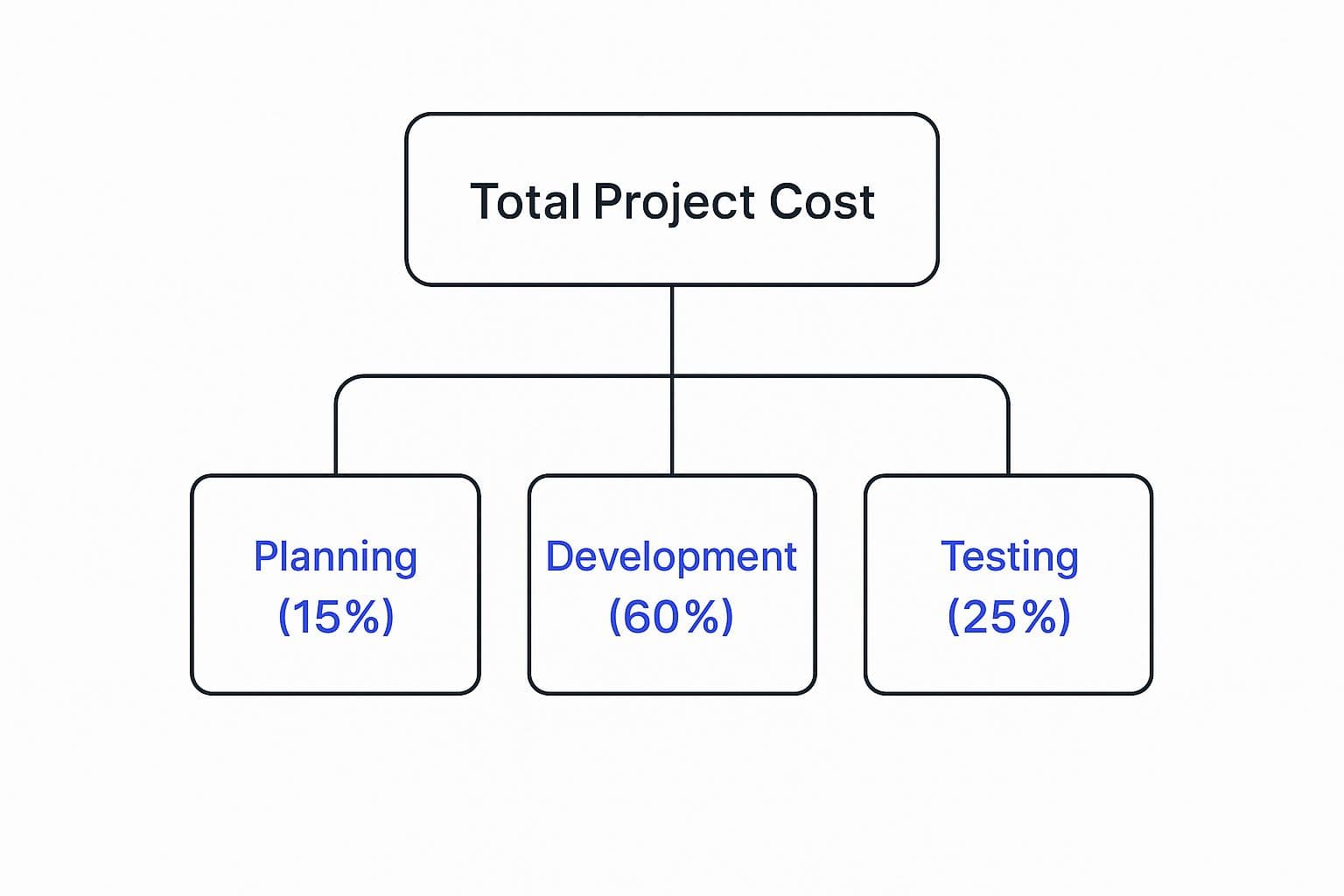
As you can see, the actual "build" phase is the hungriest part of the budget, which really drives home why the complexity of your features is such a critical factor.
UI/UX Design and Technology Stack Choices
It's not just what the software does, but how it looks and feels. The intricacy of your UI/UX design plays a huge role in the cost. A clean, simple design built with standard components is far more affordable than a completely custom interface loaded with unique animations and slick interactive elements. A top-tier user experience doesn't just happen; it's the result of extensive research, prototyping, and testing, all of which add hours to the clock.
Then there’s the technology stack—the collection of programming languages, frameworks, and databases that form the software's backbone. Some technologies are open-source and free to use, which is great. Others come with hefty licensing fees.
The talent pool for a given technology also matters. If you choose a niche or brand-new framework, you'll likely pay a premium for developers because there are fewer of them available. This is a key strategic decision, especially when you think about who will maintain the software down the road. If you need some help navigating this, our guide on how to hire software developers is a great place to start.
Integrations and Data Management
Finally, almost no modern software lives on an island. The need for third-party integrations is another major cost factor. Your app will probably need to "talk" to other services for processing payments, running analytics, displaying maps, or handling customer support tickets.
Each of these connections requires developers to work with an API (Application Programming Interface), and they can range from dead simple to mind-numbingly complex. A basic integration might be a quick job, but trying to connect with a legacy corporate system could turn into a whole separate project. The more systems your software needs to communicate with, the more time and money it will take.
How Team Structure and Location Impact Price

Beyond the technical specs and feature lists, the "who" and "where" of your development team are two of the biggest levers you can pull to control your project's budget. The decisions you make here can cause your final software development costs to swing dramatically. Choosing the right team model is a strategic move that requires balancing cost, communication, and control.
Your first major decision is whether to build an in-house team or outsource the work to a specialized agency. An in-house team gives you maximum control and becomes a core part of your company culture. But it also comes with the high overhead of salaries, benefits, and recruiting. Outsourcing, on the other hand, gives you instant access to a pool of vetted talent without the long-term financial strings attached.
This decision immediately leads to the next critical factor: geography. Where your developers are physically located has a direct and powerful impact on their hourly rates.
The Geography of Talent: Onshore, Nearshore, and Offshore
Think of developer rates like real estate. A small apartment in San Francisco costs exponentially more than a spacious house in a smaller city. The exact same principle applies to software development talent. The local cost of living and market demand create massive differences in hourly rates across the globe.
This is where the concepts of onshore, nearshore, and offshore come into play. Each model presents a different mix of trade-offs between cost, convenience, and collaboration.
- Onshore: This just means hiring developers within your own country. You get seamless communication, no time zone headaches, and a shared cultural context. The downside? You'll be paying the highest rates, especially if you're in a major tech hub like the US or Western Europe where rates can easily top $100 per hour.
- Nearshore: This involves outsourcing to developers in neighboring countries that share a similar time zone. For a company in the US, this often means looking to Latin America. The biggest wins here are significant cost savings and minimal time zone friction, which keeps day-to-day collaboration smooth.
- Offshore: This model means partnering with a team in a distant country, perhaps in Eastern Europe or Southeast Asia. Offshore development offers the most substantial cost savings, with rates in some regions being just a fraction of onshore prices. While the price tag is tempting, you have to be ready to manage significant time zone differences and potential cultural nuances.
So, which model is right for you? It all comes down to your project's priorities. If your budget is tight and the scope is crystal clear, an offshore team could be a perfect fit. But if you need constant, real-time collaboration for a fast-moving project, the higher cost of an onshore or nearshore team might be a worthwhile investment.
Comparing Hourly Rates Across Regions
To put this into perspective, the difference in cost is staggering. A senior developer in North America might command an hourly rate of 100-200. In stark contrast, a developer with comparable skills in Eastern Europe could charge between 45-75 per hour. This isn't a reflection of quality; it's a simple function of local economics.
Here’s a breakdown of typical hourly rates to really illustrate the financial impact of your team’s location:
| Region | Typical Hourly Rate (USD) | Key Advantages | Key Considerations |
|---|---|---|---|
| North America (Onshore) | 100 - 200+ | Same time zone, cultural fit | Highest cost |
| Western Europe (Onshore) | 80 - 150 | High skill level, good overlap | High cost, strict regulations |
| Latin America (Nearshore) | 50 - 90 | Time zone alignment, strong talent | Moderate cost, some variability |
| Eastern Europe (Offshore) | 45 - 75 | Excellent technical skills, great value | Moderate time zone difference |
| Asia (Offshore) | 30 - 60 | Most affordable rates | Significant time zone challenges |
As you can see, outsourcing can slash your labor costs by 50-70% or even more. For a project estimated at 1,000 development hours, choosing an offshore team over an onshore one could be the difference between a 150,000** project and a **50,000 one. That level of savings can be a game-changer for a startup or any business trying to get the most out of its budget.
Proven Methods for Estimating Project Costs

Trying to estimate software development costs can feel like guessing the number of jellybeans in a jar. But you don't have to rely on guesswork. Over the years, the industry has developed several reliable methods that bring structure and sanity to the process.
Think of these as different tools in a toolbox. Each one is designed for a specific job, and knowing which one to use at the right time is key. Let's walk through the most common techniques, using a familiar example—building a new food delivery app—to see how they work in the real world.
The Rough Order of Magnitude or Ballpark Estimate
First up is what we call the Rough Order of Magnitude (ROM), or more casually, a ballpark estimate. This is your back-of-the-napkin calculation. It isn't meant to be exact; its job is to give you a wide financial range, say 50,000 to 150,000, so you can quickly decide if an idea is even worth pursuing.
You’d use this method right at the beginning, when your project is just a concept. It leans heavily on the development team's gut feeling and experience from similar jobs.
For our food delivery app, we'd list the big ideas: user profiles, restaurant listings, search, and an ordering system. An experienced team could look at that and, based on past e-commerce apps they've built, give you a rough number in a matter of hours. The obvious downside? It's not precise. The final cost can, and often does, shift as you nail down the details.
Feature-Based or Value-Based Pricing
Once you have a clearer picture of what you want to build, you can graduate to Feature-Based Pricing. This is exactly what it sounds like: you break the entire project down into individual features and estimate the cost for each one.
This approach gives you a much clearer, itemized breakdown of where your money is going. It's perfect once you have a well-defined scope because it connects every dollar spent to a tangible deliverable.
Let's break down our food delivery app this way:
- User Registration & Login: A fairly standard feature, maybe 40 hours of work.
- Restaurant Search with Filters: This is more complex, so let's pencil in 80 hours.
- Shopping Cart & Checkout: This needs payment integration, a heavy lift at around 120 hours.
- Real-Time Order Tracking: An advanced feature requiring a good 150 hours.
Add up the hours for every single feature, multiply by the team's hourly rate, and you get a much more solid budget. This process also helps you prioritize. If the total is too high, you can easily see which features—maybe a complex loyalty program—can be pushed to a later version. To see this method explored further, check out our guide on how much does building an app cost.
The Time and Materials Model
What if your project is innovative, and you know the scope will change? For that, there's the Time and Materials (T&M) model. This is the most flexible way to work and a cornerstone of agile development. Instead of agreeing on a fixed price upfront, you pay for the actual time the team spends working on your project, plus any direct costs.
T&M is the go-to for complex projects where you expect to learn and adapt as you go. It lets you pivot based on user feedback or new market opportunities without having to renegotiate a contract every time you change your mind.
With our food delivery app, a T&M approach would mean paying the team for their work in short cycles, or "sprints." After each two-week sprint, you'd review the progress, give feedback, and help set the priorities for the next one. This gives you incredible control.
The trade-off, of course, is budget uncertainty. If you don't manage it carefully, costs can run away from you. Success with T&M hinges on trust, constant communication, and a strong partnership with your development team.
Beyond the Build: Uncovering Hidden and Ongoing Software Expenses
Launching your software is a massive achievement, but it's not the finish line. In fact, it's just the starting point of your real financial commitment.
Think of it like buying a new house. The purchase price is the big, upfront number everyone focuses on, but then you have property taxes, insurance, utilities, and inevitable repairs. Software is exactly the same. The moment your app goes live, a whole new set of expenses kicks in.
The True Cost of Keeping Software Alive
Software isn't a "set it and forget it" asset. It's a living, breathing thing that needs constant attention to stay healthy. This ongoing work is what we call software maintenance, and it covers everything from squashing bugs to patching security holes and making sure your app doesn't break when a new version of iOS comes out.
A good rule of thumb is to budget 15-20% of your initial development cost for annual maintenance. So, if your initial build was 25,600**, you should plan on spending around **4,800 or more each year just to keep it running smoothly and securely. This isn't optional—it's the cost of staying in business. For a deeper dive into these numbers, this ManekTech analysis offers some great industry benchmarks.
This maintenance budget typically breaks down into a few key areas:
- Corrective Maintenance: Fixing the bugs and glitches your users inevitably find after launch.
- Adaptive Maintenance: Keeping your software compatible with the outside world—think new operating systems, browser updates, and API changes.
- Perfective Maintenance: Refining the experience based on user feedback. This could be small UI tweaks or performance improvements that aren't technically bugs but make the product better.
- Preventive Maintenance: This is the proactive work, like cleaning up code or updating libraries, that stops future problems before they start.
Budgeting for Day-to-Day Operations and Growth
Beyond pure maintenance, your software has regular operational bills to pay just to keep the lights on and attract new users. These recurring costs are predictable and absolutely need a line item in your long-term financial plan.
Here are some of the most common ongoing costs you need to prepare for:
- Server Hosting: Your app has to live somewhere. Whether you're on a cloud platform like Amazon Web Services (AWS) or a dedicated server, this is a monthly bill that will likely grow as your user base expands.
- Third-Party API Subscriptions: Modern apps are built on the shoulders of giants. If you use services for payments (Stripe), maps (Google Maps Platform), or messaging (Twilio), you'll be paying for them on a monthly or per-use basis.
- Future Feature Development: Your launch-day product is just the beginning. To stay competitive, you'll need a steady budget for building and releasing new features. A smart way to manage this is by launching with a focused feature set first. You can read more about the benefits of a Minimum Viable Product to see how this approach saves money and reduces risk.
- Marketing and User Acquisition: Great software doesn't just sell itself. You need an ongoing budget for marketing, advertising, and community building to bring people in the door and keep them coming back.
To help you keep track of these essential ongoing costs, here’s a quick checklist of what to expect after your initial development is complete.
Post-Launch Cost Checklist
| Expense Category | Typical Cost Structure | Budgeting Tip |
|---|---|---|
| Annual Maintenance | 15-20% of initial development cost | Treat this as a non-negotiable fixed cost. Set this money aside from day one. |
| Server & Hosting | Monthly subscription (often usage-based) | Start with a flexible cloud plan that can scale. Monitor your usage closely to avoid surprise bills. |
| Third-Party Service Fees | Monthly subscriptions or pay-as-you-go | Audit your API usage quarterly. Are there cheaper alternatives or more efficient ways to use the service? |
| New Feature Development | Project-based or ongoing retainer | Prioritize features based on user feedback and business goals, not just a wish list. |
| Marketing & Sales | Monthly budget or % of revenue | Track your Customer Acquisition Cost (CAC) religiously to ensure your marketing spend is profitable. |
| Technical & Customer Support | Per-agent salaries or tiered subscription | Invest in good documentation and self-service options to reduce the load on your support team. |
By looking beyond the launch and planning for these ongoing expenses, you’re not just building software—you’re building a sustainable business. This foresight is what separates the apps that fizzle out from the ones that thrive for years to come.
Still Have Questions About Software Costs?
Even with a detailed guide, the financial side of software development can feel like a moving target. It’s natural to have lingering questions pop up as you start to map out your own project. Let's tackle some of the most common ones we hear from founders and project managers.
Think of this as a quick-fire round to clear up those final "what-if" scenarios, making sure you're fully prepared for the financial journey ahead.
How Can I Lower My Development Costs Without Getting a Cheap Product?
Cutting costs is on everyone’s mind, but you can’t afford to sacrifice the quality of your final product. The trick is to be strategic, not just cheap.
The single most effective way to do this is by starting with a Minimum Viable Product (MVP). Seriously. This isn't just a buzzword; it's a discipline that forces you to zero in on the absolute core features that solve a real user problem. All the "nice-to-haves" can wait. This simple focus prevents you from burning cash on features your first users might not even care about.
Another huge lever is your team structure. As we've covered, outsourcing to a nearshore or offshore team can slash your hourly rates without compromising on talent. A top-tier team in Eastern Europe or Latin America can often produce the same quality code as a San Francisco-based team for a fraction of the price.
Here are a few more practical tips:
- Lean on Open-Source Tech: Why pay hefty licensing fees? Choosing well-supported open-source languages and frameworks is a massive cost-saver.
- Work in Agile Sprints: Developing in short, iterative cycles gives you constant feedback. This helps you spot flawed ideas or misunderstandings early, before they turn into expensive rework down the line.
- Over-Communicate: A crystal-clear project brief and regular check-ins are your best weapons against scope creep and wasted hours. Miscommunication is a budget killer.
What’s the Real Difference Between Fixed Price and Time & Materials?
Picking the right contract model is a huge decision that directly shapes your budget and your ability to adapt. The two main flavors are Fixed Price and Time & Materials (T&M), and they’re built for very different situations.
A Fixed-Price contract is exactly what it says on the tin: you agree on one total price for a very specific scope of work. It’s perfect for projects where the requirements are set in stone and unlikely to change. The big win here is budget predictability. The downside? It’s rigid. If you suddenly realize you need to change a feature, you’re looking at a new negotiation and a formal (and often costly) contract amendment.
On the flip side, a Time & Materials (T&M) contract is all about flexibility. You pay the development team for the actual hours they work and any resources they use. T&M is a godsend for complex or innovative projects where you know things will evolve as you go. It lets you pivot based on market feedback, but the trade-off is less budget certainty upfront. Your choice really boils down to one question: how well-defined is your project from day one?
Why Are the Cost Estimates I’m Getting So Different?
It's baffling, right? You send the same project brief to three different agencies and get quotes that are tens of thousands of dollars apart. This huge variance in software development costs almost always boils down to a few key things.
First and foremost is agency location. We can't stress this enough. Hourly rates in North America can be 3-4 times higher than in Latin America or Asia for developers with comparable skills. It’s the single biggest factor.
The team’s experience and seniority also make a massive difference. A quote from an agency full of senior architects and lead engineers will naturally be higher than one from a team of mostly junior developers. But remember, those senior folks often work faster and write cleaner code, which can actually save you money on bug-fixes and maintenance later on.
Finally, different agencies can interpret your project brief in wildly different ways. One team might see a feature as a simple 20-hour task. Another might envision a more robust, 80-hour version with more complexity under the hood. This is why you must always ask for a detailed breakdown. Get them to show you the hours estimated for each feature. It’s the only way to compare apples to apples and understand what you're really paying for.
Ready to turn your idea into a market-ready product without the guesswork? At Iglu Digital, we specialize in building high-quality MVPs for a price fixed up front. Find out how we can help you launch faster and smarter at https://iglu.dev.