

What Is Agile Development Methodology Explained Simply
Table of Contents
So, what is the Agile development methodology, really? At its heart, it’s a way of building things—most famously, software—that embraces change and focuses on delivering value step-by-step.
Think of it this way. Instead of trying to create a massive, perfect plan upfront and then locking it in for months or even years, Agile breaks the work down into small, digestible chunks. Teams work in short cycles, building, testing, and getting feedback along the way. This allows them to pivot quickly and ensures the final product is what people actually want and need.
The Core Idea Behind Agile
To really grasp the Agile mindset, let’s use an analogy.
Imagine you're part of a team building a huge, custom LEGO castle. The traditional way to do this would be like getting a giant, thousand-page instruction manual. You'd have to follow every single step in perfect order, and you wouldn't see the finished castle until the very last brick was snapped into place. What happens if, halfway through, someone realizes a round tower would be much cooler than a square one? Too bad. It's too late to change the plan.
Now, let's try it the Agile way. You still have the same big goal—build an epic castle—but you don't start with a rigid manual. Instead, you begin by building just one small, functional part, like the drawbridge. After a week or two, you show it to everyone. They can see it, touch it, and give you real feedback. "The drawbridge is great, but could we make it a bit wider?"
You take that feedback, make the adjustment, and then move on to the next piece, maybe the gatehouse. This cycle of building a small piece, showing it off, and adapting based on feedback continues. The final castle might look a little different than the initial sketch, but it will be a much better castle because it evolved based on real-time collaboration.
That, in a nutshell, is the essence of Agile. It’s less about a strict set of rules and more about a flexible, collaborative mindset.
Breaking Down Complexity
Agile’s true power comes from this incremental approach. Instead of treating a huge project as one single, overwhelming task, it’s sliced into smaller, more manageable pieces of working functionality. These pieces are built during short, focused periods called sprints or iterations.
At the end of each cycle, the team has produced a tangible, working part of the product that can be reviewed and tested. This delivers some immediate and powerful advantages:
- Early Feedback: You get to put a working part of the product in front of real users early and often. This is huge, as it stops you from spending months building something nobody actually wants.
- Adaptability is Built-In: When a great new idea pops up or market conditions shift, you can easily work it into the next cycle. You’re no longer stuck trying to overhaul a massive, fixed plan.
- Massively Reduced Risk: Finding and fixing a problem within a two-week sprint is a small hiccup. Finding that same problem right before the final launch can be a complete disaster.
A Focus on Collaboration and Delivering Value
Ultimately, Agile is about putting people and results ahead of rigid processes and exhaustive documentation. It’s built on the idea that developers, business stakeholders, and customers should work together closely throughout the entire project.
The real measure of progress isn’t how many pages of documentation you’ve written; it’s about delivering working software that provides genuine value to the user.
Agile vs Traditional Waterfall At a Glance
To see just how different this approach is, it helps to compare Agile directly with the more traditional "Waterfall" model. The Waterfall method is sequential, where each phase must be fully completed before the next begins—much like our rigid LEGO instruction manual.
The table below breaks down the fundamental differences in their philosophies.
| Aspect | Agile Methodology | Traditional (Waterfall) Methodology |
|---|---|---|
| Planning | Adaptive and iterative; plans evolve throughout the project. | Detailed and upfront; the entire project is planned from the start. |
| Project Structure | Broken into short cycles (sprints). | Divided into distinct, sequential phases (e.g., requirements, design, build). |
| Change | Welcomed and incorporated at any stage. | Discouraged; changes are difficult and costly to implement. |
| Customer Involvement | Continuous collaboration and feedback throughout. | Limited to the beginning (requirements) and end (delivery). |
| Delivery | Frequent delivery of small, working increments of the product. | One final delivery of the entire product at the end of the project. |
| Primary Goal | Customer satisfaction and delivering value quickly. | Completing the project on time and within the initial budget. |
As you can see, the two approaches are worlds apart. While Waterfall can work for projects with very stable and well-understood requirements, Agile's flexibility makes it far better suited for the dynamic and often unpredictable world of software and product development.
How the Agile Manifesto Reshaped Modern Work
To really get what agile is all about, we need to go back in time. Not that long ago, building software was a slow, painful process, largely dictated by rigid, step-by-step methods like the Waterfall model.
Picture this: you have to plan every single feature of a new product before a single line of code is written. This plan would become a massive document, hundreds of pages long, and once approved, it was basically set in stone. Designers would complete their part and toss it "over the wall" to the developers, who would then disappear for months, coding away in isolation with zero customer input. Testing? That happened right at the very end, just before launch.
As you can imagine, this caused some huge headaches. By the time a product finally saw the light of day, the market had often moved on and customer needs had changed. The final product frequently missed the mark entirely. Even worse, finding a major flaw late in the game was a disaster, sending budgets spiraling and causing many projects to fail outright. It was clear something had to give.
The Meeting That Changed Everything
This growing frustration was the backdrop for a pivotal meeting. In February 2001, seventeen software developers met at a ski resort in Snowbird, Utah. They were all fed up with the clunky, bureaucratic methods holding the industry back. Their goal wasn't to invent a brand-new process, but to identify the common threads that made their own lightweight, flexible approaches work so well.
These pioneers, including respected names like Kent Beck and Jeff Sutherland, were united by a single purpose: to find an alternative to the top-down, plan-heavy practices that caused so many delays and failures. You can dig deeper into the history of agile to get the full story behind this gathering.
What came out of that two-day summit was a document that would fundamentally alter how we work: the Manifesto for Agile Software Development.
A New Philosophy for Work
The Manifesto wasn't a rigid set of rules or a complicated framework. It was something much more powerful: a simple declaration of four core values and twelve supporting principles. It proposed a radical shift in thinking, emphasizing people and interactions over processes, and valuing working software more than comprehensive documentation.
This was more than a project management technique; it was a completely new mindset. It grew directly from the real-world challenges developers faced and took cues from concepts in lean manufacturing, like focusing on delivering value and cutting out anything that didn't.
By creating the Agile Manifesto, its authors gave teams a North Star—a philosophy that empowers them to be responsive, collaborative, and genuinely effective in a constantly changing world. Everything we think of as "Agile" today stands on the foundation they built.
The Four Values That Drive Agile Teams
The Agile Manifesto isn't just a dusty document from 2001; it’s the very compass that guides how modern teams build great products. It’s built on four core values that explain the why behind every Agile practice.
It's important to get this right: these values aren't about throwing out the concepts on the right side of the equation. Instead, they’re about shifting our priorities and giving more weight to the items on the left. Getting a handle on these values is the first real step to understanding what makes Agile click.
Let's break them down.
1. Individuals and Interactions Over Processes and Tools
At its heart, Agile is fundamentally about people. It’s about smart people talking to each other to solve tricky problems. Sure, processes and tools have their place—they can be incredibly helpful. But they should never replace a good, old-fashioned conversation.
Think about it. A developer hits a snag and needs clarity on a design. The rigid, process-driven way might involve logging a formal ticket, waiting for it to get assigned, and then waiting again for a written reply. That could take days. The Agile way? The developer just walks over to the designer's desk (or hops on a quick video call) for a five-minute chat. Problem solved.
This value is a powerful reminder that real breakthroughs happen when people connect, not when they follow a rigid script.
2. Working Software Over Comprehensive Documentation
This is probably the most misunderstood value of them all. It absolutely does not mean "no documentation." What it does mean is that our primary yardstick for success should be a product that actually works, not a 100-page manual for something nobody can use.
Imagine a team spending three months writing up flawless, detailed specifications for a new app feature. The documentation is a masterpiece, but not a single line of code has been written. An Agile team, on the other hand, would likely spend a two-week sprint building a simple, functional version of that feature. It might be rough around the edges, but it's real.
This relentless focus on delivering tangible value is a big reason why Agile projects have a 64% success rate, which is significantly higher than the 49% success rate seen in traditional Waterfall projects. You're building momentum with every small win.
3. Customer Collaboration Over Contract Negotiation
In old-school project management, the relationship with the customer often feels transactional. It’s all defined by a heavyweight contract signed at the very beginning. Once those terms are locked in, collaboration often grinds to a halt.
Agile completely flips that script. It sees the customer as an active, essential partner throughout the entire journey. Instead of trying to nail down every single requirement at the start, Agile teams work side-by-side with the customer in short, frequent cycles.
This constant feedback loop is gold. It ensures the team is always building what the customer truly needs, not just what was written down in a contract six months ago when we all knew a lot less.
4. Responding to Change Over Following a Plan
The final value really captures the soul of Agile. In a traditional project, change is the enemy. It's viewed as expensive, disruptive, and something to be avoided at all costs. But let’s be honest—in the real world, change is the only constant.
Agile doesn't just accept this reality; it welcomes it. When a competitor suddenly launches a game-changing feature or user testing reveals a flaw in your thinking, an Agile team has the power to pivot.
Because work is broken into short cycles (sprints), the team can easily adjust its priorities and change direction. This isn't a failure of the plan; it's a strength. It’s the difference between building a project that’s stuck on a fixed railway track and one that can actually be steered.
Applying the 12 Principles of Agile

If the four core values are Agile’s North Star, then the 12 supporting principles are the detailed map that gets you there. They’re the practical, on-the-ground instructions that translate the philosophy into day-to-day actions for your team.
Instead of just running down a checklist, it’s far more useful to see how these principles group together around a few core themes. This is where you really start to understand what being Agile feels like in a real project.
A Relentless Focus on the Customer
A big chunk of the Agile principles all point to the same, unwavering truth: everything you do is for the customer. This isn't just a nice-to-have slogan; it's a strategic directive that should guide every single decision the team makes.
Two principles really drive this home:
- Our highest priority is to satisfy the customer through early and continuous delivery of valuable software.
- Welcome changing requirements, even late in development. Agile processes harness change for the customer's competitive advantage.
What this means in practice is that a team’s job isn't to blindly follow a spec sheet. It's to be a true partner to the customer, constantly delivering working software they can see and touch. It also means being nimble enough to pivot when a better idea comes along—even if it's late in the game. The ultimate goal is a thrilled customer, not just a checked-off task list.
Creating a Sustainable and Excellent Workflow
Many people mistakenly think Agile is about working faster at all costs, leading to burnout. Nothing could be further from the truth. In reality, several principles are dedicated to creating a healthy, sustainable, and technically sound work environment. This is how teams maintain a consistent, high-quality pace over the long haul.
This is one of my favorite principles because it's so counterintuitive yet powerful. Think about it like packing for a trip. An amateur crams their suitcase with everything they might possibly need, making it a nightmare to carry. An expert packer, on the other hand, brings only the essentials, making the journey smooth and easy. The same goes for software. We focus on the simplest path to solve the immediate problem, deliberately avoiding complexity that we don't need right now.
Other principles that build on this theme include:
- Agile processes promote sustainable development. The sponsors, developers, and users should be able to maintain a constant pace indefinitely.
- Continuous attention to technical excellence and good design enhances agility.
- Working software is the primary measure of progress.
These ideas work together to ensure you never trade long-term health for short-term speed. A well-rested team writing clean code can adapt to change far better than an exhausted team fighting a tangled mess of complex software. You’re building a solid foundation for the future, not just rushing to the next deadline. This is what allows self-organizing teams—the heart of true agility—to thrive.
Choosing Your Agile Framework: Scrum vs. Kanban
So, you understand the core idea of Agile. That's the first and most important step. But knowing the philosophy is one thing; putting it into practice day-to-day is another entirely. This is where Agile frameworks come into play.
Think of it like this: Agile is the mindset—the "why" behind your approach. Frameworks like Scrum and Kanban are the specific systems—the "how" you actually get the work done. They give you the rules, roles, and routines needed to bring those Agile principles to life.
These two are, without a doubt, the heavyweights in the Agile world. According to one recent report, a staggering 87% of teams using Agile turn to Scrum. But Kanban is an incredibly powerful and popular alternative. The right choice isn't about which is "best," but which is the best fit for your team, your work, and the kind of rhythm you want to establish.
Scrum: The Structured Sprint
Scrum is all about structure and rhythm. It organizes work into fixed-length cycles called sprints. A typical sprint lasts two weeks, during which the team commits to finishing a specific batch of work they’ve pulled from their to-do list (the backlog). At the end of those two weeks, the goal is to have a finished, usable piece of the project ready to go.
It’s a bit like a relay race. Each sprint is one leg. The team grabs the baton (a chunk of prioritized tasks), runs their leg at a focused pace for that set distance (the two-week sprint), and then hands it off. There’s a clear start, a clear finish, and a tangible goal for each segment.
This time-boxed approach creates a predictable cadence. It naturally forces the team to slice large, intimidating projects into small, achievable pieces that can be fully completed in a short period.
Kanban: The Continuous Flow
Kanban takes a different road. Instead of working in fixed sprints, it’s built on the idea of continuous flow. There are no pre-defined time-boxes. Work isn't pushed onto the team in batches; instead, team members "pull" the next task from the backlog as soon as they have the capacity to start something new.
The perfect analogy is a well-run kitchen in a busy restaurant. Orders (tasks) come in and get posted on a board. The chefs (your team) don’t try to cook everything at once. They pull a new ticket only when a burner frees up. This keeps the kitchen humming along smoothly without getting overwhelmed, focusing everyone on moving individual orders through the system as efficiently as possible.
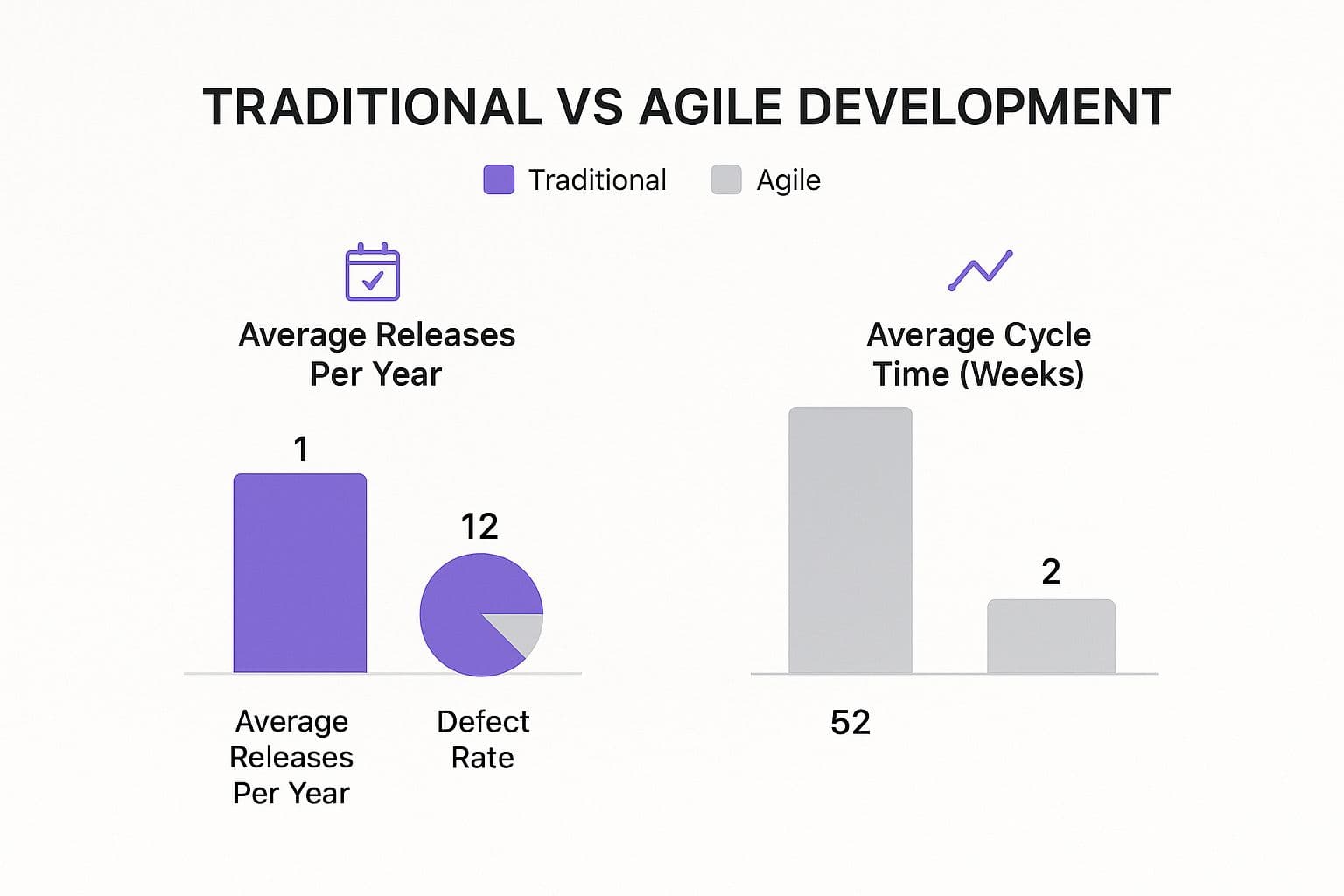
This image really drives home the point. Shifting to an Agile framework, whether it's the sprints of Scrum or the flow of Kanban, has a massive impact. You can see how it helps teams release working software more often, with higher quality, and in a fraction of the time compared to old-school methods.
Scrum vs. Kanban: A Head-to-Head Look
While both are rooted in Agile principles, their approaches can feel worlds apart in practice. The table below breaks down the fundamental differences to help you see which system might align better with your team's workflow and culture.
| Characteristic | Scrum | Kanban |
|---|---|---|
| Cadence | Fixed-length sprints (e.g., 2 weeks) with a defined start and end. | Continuous flow; no fixed iterations. Work is pulled when ready. |
| Roles | Prescribed roles: Product Owner, Scrum Master, Development Team. | No required roles; teams are encouraged to evolve what they need. |
| Key Metrics | Velocity (how much work is done per sprint). | Lead Time and Cycle Time (how long a task takes from start to finish). |
| Change | Changes are discouraged mid-sprint to protect the team's focus. | Changes can be made at any time as long as WIP limits are respected. |
| Release Cycle | At the end of each sprint. | Can release anytime a piece of work is complete. |
Ultimately, neither is a silver bullet. Scrum’s structure provides predictability and focus, while Kanban’s flexibility is ideal for environments where priorities shift on a dime.
So, Which Framework Is Right For You?
The "Scrum vs. Kanban" debate isn't about crowning a winner. It’s about making a smart choice for your specific situation.
- Go with Scrum if: You have a project with a fairly stable roadmap, your work can be broken down into sprint-sized chunks, and your team benefits from the clear deadlines and routines of daily stand-ups and sprint reviews.
- Lean towards Kanban if: Priorities change on you frequently, work arrives unpredictably (think IT support or content marketing), and your main goal is to create a super-efficient, flexible workflow.
Got Questions About Agile? Let's Clear Things Up.
As Agile has become the go-to approach for so many teams, a lot of questions—and a few myths—have popped up along the way. Whether you're a developer, a project manager, or a stakeholder trying to make sense of it all, it's easy to get tangled up in the terminology.
Let's cut through the noise and answer some of the most common questions about Agile. My goal here is to give you clear, straightforward answers you can actually use.
"Isn't Agile Just for Software Teams?"
This is probably the biggest misconception out there. While Agile was born in the software world, its core ideas are so powerful they've been adopted in just about every industry you can imagine.
The principles of breaking down big projects, focusing on customer feedback, and adapting as you go are universal. Today, you'll see Agile in action with:
- Marketing Teams: Using sprints to launch and test new ad campaigns, quickly learning what resonates with customers and what doesn't.
- Product Design: Creating and testing prototypes in short cycles, ensuring user feedback is baked into the design from the very beginning.
- HR Departments: Applying Agile to streamline hiring pipelines or improve the employee onboarding experience.
- Website Development: Building and launching a site piece by piece, starting with the most critical pages to gather data and user insights before a massive, all-at-once launch.
"Does Agile Mean There Is No Planning?"
Absolutely not. This myth comes from a misunderstanding of what "planning" looks like in an Agile environment. Agile doesn't mean "no plan"—it means no rigid, unchangeable plan that’s decided months in advance.
Traditional projects often start with a massive, detailed plan that becomes outdated almost as soon as the work begins. Agile flips that on its head.
Planning in Agile is a continuous activity. There’s always a high-level vision or a roadmap, but the detailed, nuts-and-bolts planning happens just in time—usually right before the start of each short work cycle (or sprint). This gives teams a massive advantage: they are always making decisions based on the latest information, feedback, and priorities, which makes the plan far more realistic and useful.
"Is Agile the Same as Scrum?"
Nope, but it’s an easy mistake to make. They are very closely related, but they aren't the same thing.
Here’s a simple way to think about it:
- Agile is the philosophy. It’s the set of core values and guiding principles—the "why" behind this way of working.
- Scrum is a specific framework for putting that philosophy into practice. It's a structured system with specific roles (like a Scrum Master), events (like Sprints and Daily Stand-ups), and artifacts.
Scrum is by far the most popular way to "do" Agile, with an estimated 87% of Agile teams using it. But it's just one framework. Kanban is another popular one. You can be Agile without using Scrum, but you can't really do Scrum without embracing the Agile mindset first.
Ready to turn your idea into a market-ready product with the speed and flexibility of Agile? Iglu Digital specializes in building high-quality MVPs with the scope and the price agreed before we start. We combine strategic planning with rapid, iterative development to get your vision into the hands of real users, fast.