

A Guide to Agile Methodology Meetings
Table of Contents
Agile meetings are the backbone of any successful project. They provide the structure and rhythm needed to keep things aligned, gather quick feedback, and continuously get better.
The Real Purpose of Agile Meetings
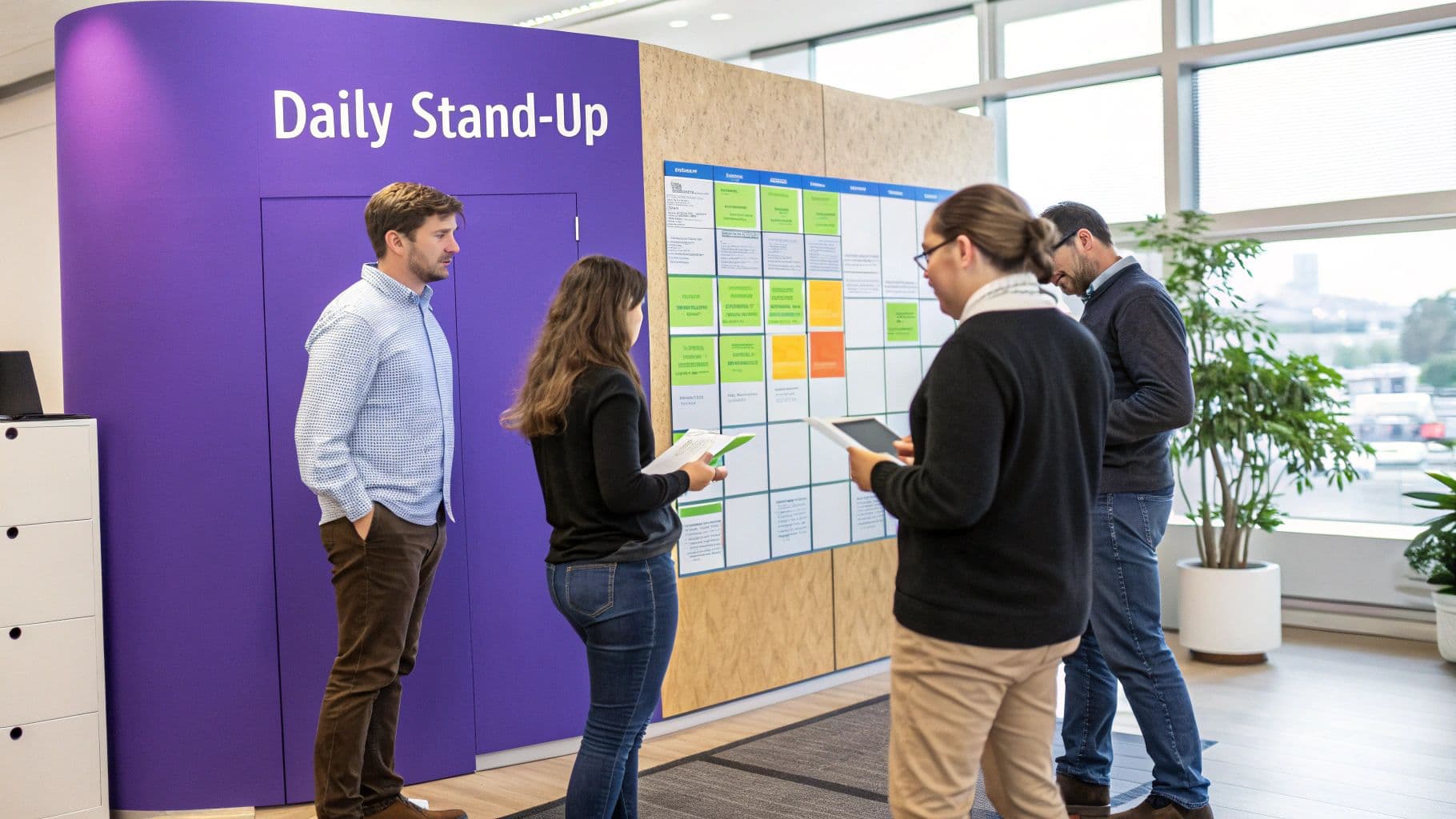
Let's be honest, nobody wants more meetings. The mere thought often conjures up images of wasted time and rambling conversations that go nowhere. But Agile meetings are designed to be the complete opposite. They aren't just another slot on the calendar; they're the essential heartbeat that keeps your project alive and moving forward with purpose.
Think of an Agile team as a band gearing up for a big show. Each meeting is a specific, focused rehearsal. The daily stand-up is the quick morning soundcheck, just to make sure every instrument is tuned. Sprint planning is where they hash out the setlist for the next performance. The sprint review is like playing that set for a small, trusted audience to get their reaction, and the retrospective is the post-show huddle where they talk about what rocked and what fell flat.
Every one of these structured touchpoints has a distinct job to do, all working together to create a workflow that’s both cohesive and incredibly adaptive. They are the built-in safeguards that stop a project from drifting off course.
Why These Meetings Are Different
Unlike those traditional, top-down status updates, Agile meetings are all about collaboration and active problem-solving. They create an environment where the entire team takes ownership of the outcome. In fact, research shows that organizations practicing Agile are twice as likely to succeed compared to those using older methods, largely because of the sharp, clear communication these ceremonies demand.
The whole point is to make communication intentional and predictable. Instead of random check-ins or disruptive shoulder-taps, everyone knows exactly when and where the important conversations will take place. This creates a reliable rhythm that helps the team:
- Maintain Alignment: Everyone is always on the same page about priorities and what "done" looks like.
- Drive Communication: Information flows freely and transparently between team members and stakeholders.
- Foster Improvement: The team regularly stops to reflect on how they work and finds ways to get better.
In the end, these meetings transform what could be dreaded check-ins into powerful moments that drive real value. They give teams the power to adapt to change on the fly, tackle roadblocks head-on, and consistently ship a product that customers actually want.
Your Guide to the Core Agile Meetings
Jumping into Agile can sometimes feel like you're learning a whole new language, complete with its own vocabulary for meetings, or "ceremonies." But these aren't just more meetings to clog up your calendar. They are the essential heartbeat of an Agile project, creating a steady rhythm of planning, doing, checking, and adapting.
There's a good reason this framework has become so popular. In fact, more than 70% of businesses around the world now use Agile practices to steer their projects. From tech startups to massive financial institutions, teams rely on these structured meetings to deliver better products faster and, crucially, to pivot when things change.
The Lay of the Land: Mapping Out the Meetings
To really get a handle on Agile, you need a clear map of its core meetings. Think of them as a series of connected pit stops in a race, each one with a specific job, a specific crew, and a clear goal. You wouldn't try to refuel during a tire change, and in the same way, each Agile meeting has a distinct focus.
Take Sprint Planning, for example. This is where the team huddles up to decide exactly what they can deliver in the upcoming sprint and how they'll get it done.
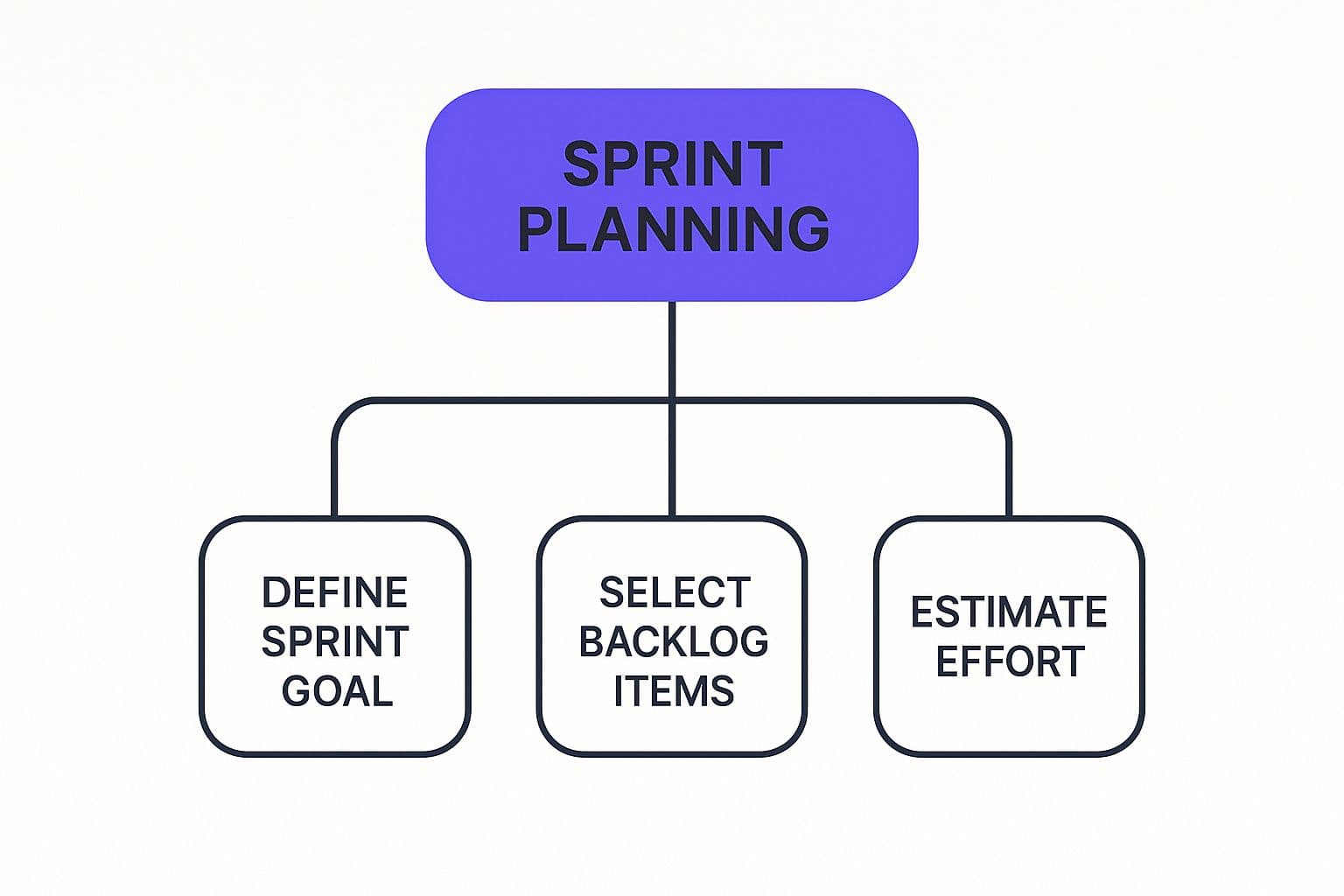
As the diagram shows, solid planning boils down to setting a clear goal, pulling the right work from the backlog, and sketching out a plan. This upfront collaboration is what sets the stage for a focused and productive sprint.
Before we get into the nitty-gritty of each meeting, let's start with a high-level overview. The table below gives you a quick snapshot of the four foundational Agile ceremonies. It's a handy reference for understanding who needs to be there, what they're trying to achieve, and how long it should take.
It's worth noting that while these are the most common meetings you'll encounter, there are many different agile methodology types, and some might have their own unique spin on these events.
Overview of Core Agile Methodology Meetings
Here’s a simple breakdown of the main meetings that power a typical two-week sprint.
| Meeting Type | Purpose | Key Attendees | Typical Duration (for a 2-week sprint) |
|---|---|---|---|
| Sprint Planning | Define the Sprint Goal and agree on the work to be completed. | Product Owner, Scrum Master, Development Team | 4 hours |
| Daily Stand-up | Sync up on progress, identify any blockers, and plan the next 24 hours. | Development Team (Scrum Master, Product Owner are optional) | 15 minutes |
| Sprint Review | Show what was built to stakeholders and get their feedback. | Full Scrum Team, Stakeholders | 2 hours |
| Sprint Retrospective | Reflect on the last sprint and decide on one or two improvements for next time. | Full Scrum Team | 1.5 hours |
This cadence of meetings ensures everyone stays aligned, the work stays on track, and the team gets a regular opportunity to both celebrate wins and iron out any wrinkles in their process.
How to Run an Effective Sprint Planning
Think of Sprint Planning as a strategic huddle before the big game, not just a meeting to fill up a to-do list. It’s where your team defines exactly what a "win" looks like for the upcoming sprint. Imagine a chef and their kitchen crew mapping out a multi-course dinner service. They don't just start grabbing ingredients at random; they agree on the menu, check their supplies, and figure out the best way to get every dish out on time.
The entire session boils down to answering two critical questions: "What can we deliver in this sprint?" and "How will we get that work done?" This meeting truly sets the stage for everything that follows, making it one of the most important agile methodology meetings you'll ever have. A poorly planned sprint is like setting sail without a map—you’ll definitely be busy, but you probably won't end up anywhere useful.
Ingredients for a Successful Session
You can't just show up to Sprint Planning and wing it. For this to work, the Product Owner needs to arrive with a well-groomed and prioritized Product Backlog. This means the items at the top are crystal clear, have enough detail, and are ready for the team to sink their teeth into.
At the same time, the team needs a realistic picture of its own capacity. Are there any public holidays coming up? Is anyone taking vacation? These factors have to be accounted for. For a standard two-week sprint, the planning session is usually time-boxed to about four hours. This gives everyone enough runway to collaborate properly without the meeting turning into a marathon.
Setting a Realistic Sprint Goal
The Sprint Goal is your North Star. It's a short, simple sentence that summarizes what the team is aiming to achieve. This provides incredible focus and makes it much easier to handle any unexpected trade-offs that pop up during the sprint. A great Sprint Goal is a powerful motivator.
Here’s a look at how the process usually plays out:
- Discuss the "What": The Product Owner kicks things off by presenting the highest-priority items from the Product Backlog. They’ll explain the "why" behind each one—the value it delivers to the user or the business.
- Estimate and Select: The Development Team then jumps in with clarifying questions and estimates the effort involved, often using story points. Based on their capacity, they pull items into the Sprint Backlog until they have a workload they feel confident they can complete.
- Define the "How": Finally, the team breaks down those selected backlog items into smaller, more concrete tasks. This creates a rough game plan, at least for the first few days of the sprint.
By carefully choosing what to commit to, the team creates a protective shield against last-minute additions. This intense focus is key if you want to learn how to avoid scope creep and ensure the sprint produces something genuinely valuable. When everyone walks out of that room, they leave with a shared commitment, not just a random list of assignments.
Mastering the Daily Stand-Up
Of all the agile methodology meetings, the Daily Stand-Up is probably the most famous—and the most misunderstood. It’s not a status report for a manager. It’s a quick, focused, 15-minute sync for the development team.
Think of it like a daily huddle in sports. The players get together on the field to quickly align, adjust their game plan, and call out anything stopping them from scoring. That’s the stand-up in a nutshell.
The whole point is to create transparency and flag roadblocks immediately. By touching base for a few minutes every day, the team builds a shared picture of where the work is. This simple habit prevents nasty surprises and makes sure no one struggles with a problem alone for too long.
The Classic Three Questions
Traditionally, the stand-up revolves around three direct questions that each team member answers.
- What did I accomplish yesterday? This isn't about listing every single task. It's about sharing progress that moves the team closer to the Sprint Goal.
- What will I work on today? This clarifies what's next and naturally highlights where team members can pair up or help each other out.
- What is blocking my progress? This is the most crucial part. It’s a direct call for help, surfacing issues for the Scrum Master and the team to swarm on right after the meeting.
These questions are designed to keep things moving. The goal is not to solve big problems on the spot. If a discussion needs more than a minute, you "park" it for a separate follow-up conversation with only the people who need to be there.
Best Practices for an Effective Stand-Up
It takes real discipline to keep this meeting tight and effective. But it's worth it. This kind of quick-sync communication is a key reason why organizations using Agile are twice as likely to succeed compared to those stuck in Waterfall. In fact, over 40% of DevOps professionals say this kind of visibility is a must-have for success. You can dig into more stats about Agile's impact from recent industry reports.
To make sure your stand-ups are always valuable, stick to a few ground rules:
- Same Time, Same Place: Consistency is everything. Holding the meeting at the same time and in the same spot (whether it's a physical room or a virtual link) turns it into a simple, automatic habit.
- Keep It to 15 Minutes: Protect the timebox at all costs. If conversations start to drift or go too deep, it's the Scrum Master's job to gently guide everyone back on track.
- Focus on the Sprint Goal: Every update should connect back to the team's shared mission for the sprint. Is what you're saying helping the team get closer to that goal?
When you master this simple but powerful ceremony, your team will build momentum, tackle problems head-on, and stay perfectly aligned on the path to delivering great work.
Sprint Review vs Sprint Retrospective
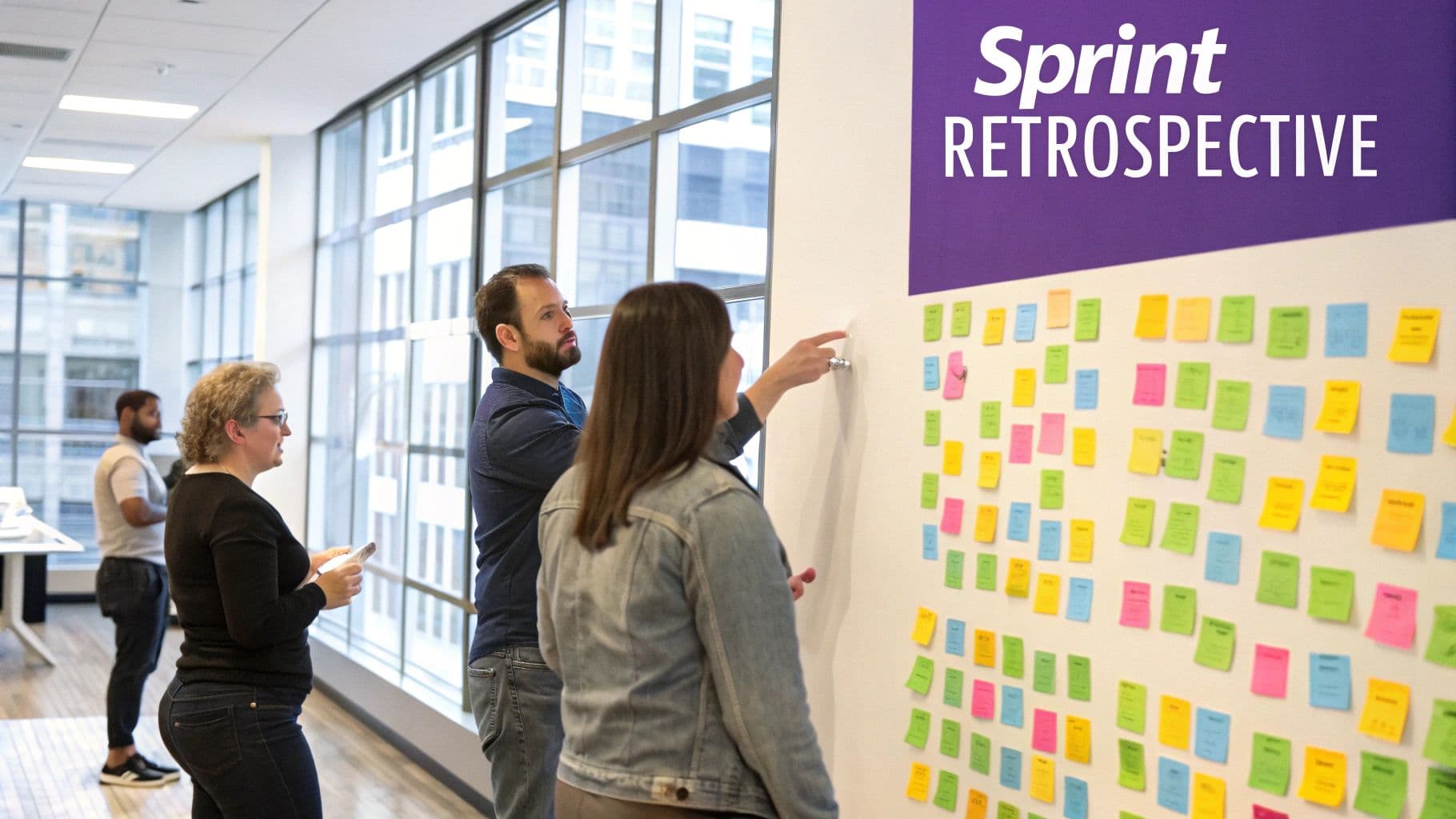
When a sprint winds down, two critical meetings happen back-to-back: the Sprint Review and the Sprint Retrospective. It’s a common rookie mistake to lump them together, but they have completely different jobs. Mixing them up really waters down the value you get from each one.
The easiest way to keep them straight is to remember their focus. One looks outward at the product, while the other looks inward at the team. Getting this right is absolutely essential for locking in the "inspect and adapt" rhythm that makes Agile work.
The Sprint Review: What Did We Build?
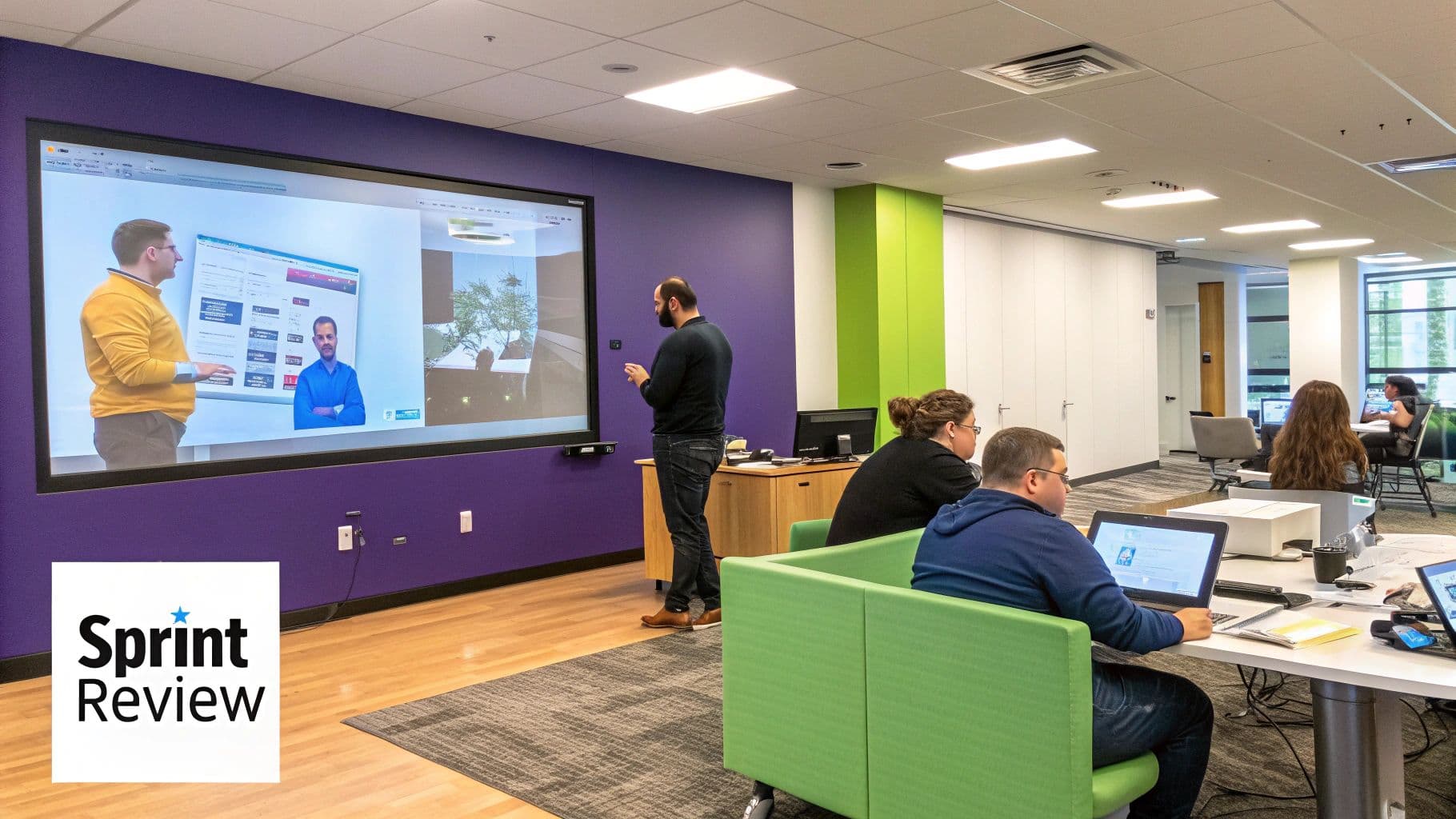
Think of the Sprint Review as "demo day." This isn't some formal, slide-heavy presentation; it's a hands-on, informal session where the Scrum Team shows everyone what they actually finished during the sprint.
The whole point is to get honest feedback from stakeholders on the new piece of the product. This isn't just a show-and-tell. It's a crucial checkpoint where stakeholder input directly shapes what the team tackles next. The meeting is all about answering one big question: “What did we get done?”
Here’s what a great Sprint Review looks like:
- Focus on the Product: The star of the show is the working software. It's tangible, usable, and ready for feedback.
- Stakeholder Collaboration: Their insights are gold. This is where you find out if what you built actually solves their problem and delivers business value.
- Open Dialogue: The best reviews feel like a conversation. Stakeholders should feel comfortable asking questions, poking around in the new features, and talking about where the product should go next.
The Sprint Retrospective: How Did We Work?
Right after the Review wraps up, the team huddles for the Sprint Retrospective. This one is private—just for the Scrum Team. Stakeholders have left the room, and the conversation shifts from what we built to how we built it.
The Retrospective is a safe space for the team to get real about the sprint that just finished. It's time for an honest look at everything—the team dynamics, the tools, the workflow. The goal isn't to vent, but to find one or two specific, actionable improvements the team can make in the very next sprint. This cycle of continuous improvement is what turns good teams into great ones.
A simple but powerful way to structure this discussion is the "Start, Stop, Continue" format:
- Start: What new things should we try in the next sprint to get better?
- Stop: What got in our way or just didn't work? Let's stop doing that.
- Continue: What went really well? Let's make sure we keep doing it.
This framework guides the conversation toward concrete outcomes. The team picks a few key items and adds them right into the next Sprint Backlog, making improvement a formal part of their work. The Retrospective answers the question, "How can we work better together next time?" By dedicating time to look in the mirror, the team takes charge of its own growth.
Fine-Tuning Your Backlog Refinement Process
Backlog refinement isn't technically one of the "official" agile methodology meetings you’ll find in the Scrum guide, but honestly, it’s the secret weapon of truly high-performing teams.
Picture a top chef getting ready for a busy dinner service. They don't wait for the first order to come in before they start chopping onions. They spend the afternoon prepping every single ingredient. That prep work is what makes the actual cooking fast, smooth, and almost effortless. That's exactly what backlog refinement does for your sprint.
Think of it as an ongoing activity, not just a one-off meeting. It's all about continuously reviewing, detailing, and prioritizing everything in the Product Backlog. When you invest time here, Sprint Planning transforms from a long, confusing slog into a sharp, focused huddle where real decisions get made. The goal is simple: make sure the items at the top of the backlog are crystal clear and ready to be pulled into a sprint at a moment's notice.
What Happens During Refinement?
Good refinement isn’t just one thing; it's a few core activities that turn a messy wish list into a clear, actionable roadmap. By always looking ahead, the team can prepare for future work even while they're deep in the current sprint.
Here's what that prep work usually looks like:
- Adding Details and Acceptance Criteria: Vague ideas like "improve user dashboard" get fleshed out into concrete user stories with specific, testable requirements.
- Breaking Down Large Items: Huge, intimidating features (we often call these "epics") are sliced into smaller, bite-sized stories that can actually be finished within one sprint.
- Estimating Effort: The development team puts their heads together to estimate how much work is involved, often using story points to get a handle on complexity and size.
- Prioritizing the Backlog: The Product Owner continuously reorders items based on customer value, risk, and dependencies, making sure the most important work always bubbles to the top.
This proactive habit also helps connect the dots between technical work and business goals. More and more, teams are focusing on outcome-based metrics like lead time and deployment frequency during their ceremonies. It’s a way to tie development work directly to things that matter, like customer satisfaction.
In fact, the adoption of hybrid Agile approaches has jumped from 20% to over 31.5%, as teams mix and match principles to find what works for their unique situation. You can find more great insights on the evolution of Agile practices at easyagile.com.
At the end of the day, a healthy, well-groomed backlog is the bedrock of any successful Agile process. It’s what gives your team the confidence, clarity, and shared understanding they need to walk into every new sprint ready to win.
Common Questions About Agile Meetings
Even with the best game plan, things can get a little messy when you start running agile methodology meetings. The theory is great, but the real world always throws a few curveballs. Let's tackle some of the most common hurdles teams run into.
Think of this as your go-to troubleshooting guide. We'll walk through the typical "what if" scenarios that can throw a meeting off course and give you clear, practical advice to get things running smoothly again.
What if the Daily Stand-Up Runs Too Long?
This is probably the most common agile hiccup. If your stand-ups are dragging on, it’s almost always because the team has slipped into problem-solving mode instead of just syncing up. Remember, the Daily Stand-Up is there to align the team and flag roadblocks, not to fix them on the spot. That’s why it has a strict 15-minute timebox.
When stand-ups consistently go over time, the Scrum Master needs to gently guide the team back on track. Here’s how:
- Introduce a "Parking Lot": The moment a deeper conversation begins, step in and say, "This is a great discussion, let's put it in the parking lot for after stand-up." Jot the topic on a whiteboard and figure out who needs to stick around to hash it out.
- Refocus on the "Why": Remind everyone that the goal is a quick alignment, not a full-blown resolution. Stick to the three core questions to keep the updates sharp and concise.
How Do We Handle Stakeholder Feedback in a Sprint Review?
Getting feedback during a Sprint Review is fantastic, but it can be a challenge when it's critical or points to a big change of plans. The trick is to welcome all feedback as valuable data, not as an immediate, non-negotiable to-do list.
The Product Owner is the key player here. Their job is to:
- Listen and Clarify: Always start by thanking the stakeholder for their input. Then, ask clarifying questions to make sure the entire team understands the core of the feedback.
- Capture it in the Backlog: Let them know that all new ideas and feedback are captured in the Product Backlog. This action shows their contribution is valued without derailing the team's current focus.
- Prioritize Later: Reassure the stakeholder that the new item will be reviewed and prioritized against everything else during the next backlog refinement session.
This approach honors the stakeholder's perspective while protecting the team from the chaos of scope creep. To get a better handle on the lingo, our guide on essential agile methodology terms is a great resource. Speaking the same language makes these conversations so much easier.
Ready to turn your idea into a market-ready product? At Iglu Digital, we specialize in building high-quality MVPs with speed and precision. Launch your vision with us.