

Mastering Agile Methodology Terms

Table of Contents
When you first step into the world of Agile, it can feel like learning a new language. You'll hear terms like Sprints, User Stories, and Backlogs thrown around, and it's essential to get a handle on them quickly. This shared vocabulary is the glue that holds Agile teams together, ensuring everyone from developers to stakeholders is on the same page.
Decoding the Language of Agile Development
Getting a grip on Agile terminology isn't just about memorizing buzzwords. It's about embracing a different way of thinking—one that prioritizes collaboration, incremental progress, and constant learning. Without a common understanding of these core concepts, teams often run into misaligned expectations and friction, which slows everything down. Think of this glossary as your field guide, giving you clear definitions and real-world context for the language of modern product development.
More and more organizations are moving to these kinds of dynamic workflows, making fluency in Agile a must-have skill. The market growth really tells the story.
This isn't just a trend; it's a clear signal that understanding and implementing Agile practices is vital for staying competitive.
Why a Shared Vocabulary Matters
Having a consistent set of agile methodology terms is the bedrock of effective teamwork. When a Product Owner talks about grooming the Product Backlog or a Scrum Master leads a Sprint Retrospective, it’s crucial that everyone in the room is working from the same dictionary. This alignment pays off in a few key ways:
- Eliminates Ambiguity: It cuts through the noise and ensures every team member knows exactly what their role is, what the tasks are, and what the project goals are.
- Improves Collaboration: It fosters a smoother environment where developers, designers, and business stakeholders can communicate clearly during important meetings like the Daily Scrum or Sprint Planning.
- Accelerates Onboarding: New hires can get up to speed much faster because the processes and language are clearly defined and consistently used.
At the end of the day, this shared language is what makes frameworks like Scrum and Kanban actually work. It lets the team focus on what truly matters: delivering value to the customer. For 83% of companies going through an Agile transformation, this is their number one goal. You can dive deeper into these Agile adoption statistics and trends. This guide will get you speaking the language of Agile fluently.
To get started, let's break down some of the most fundamental concepts you'll encounter. This table is a quick cheat sheet for the core ideas that form the foundation of most Agile practices.
Quick Reference Core Agile Concepts
| Term | Brief Definition | Primary Use |
|---|---|---|
| Scrum | An Agile framework for managing complex projects, using fixed-length iterations called Sprints. | Organizing work for a cross-functional team to deliver value incrementally. |
| Sprint | A short, time-boxed period (usually 1-4 weeks) during which a specific amount of work is completed. | Creating a predictable rhythm for development and delivering a usable product increment. |
| User Story | A simple, informal description of a software feature written from the end-user's perspective. | Defining product requirements in a way that focuses on user value. |
| Product Backlog | A prioritized list of all features, functions, and requirements for a product. | Serving as the single source of truth for all work the team needs to do. |
| Kanban | A visual method for managing workflow, focused on continuous delivery and limiting work in progress. | Visualizing workflow, identifying bottlenecks, and improving flow efficiency. |
Having these five terms down is a great first step. They are the building blocks upon which almost everything else in the Agile world is built. As we go deeper, you'll see how they all connect to create a powerful system for building better products, faster.
Exploring Core Agile Principles

While the specific agile methodology terms give us the tools and events for our projects, the core principles are the "why" behind everything we do. Think of these foundational ideas as the mindset that makes Agile work, rather than just a checklist to follow. Getting these principles right is the key to successfully using any framework, whether it's Scrum, Kanban, or something in between.
It all goes back to the Agile Manifesto. A group of software developers got together in 2001 and laid out four key values that put people and flexibility ahead of rigid plans and processes.
The Agile Manifesto Values
The Manifesto is brilliant in its simplicity. It doesn't say the items on the right are worthless; it just says we value the items on the left more.
- Individuals and interactions over processes and tools
- Working software over comprehensive documentation
- Customer collaboration over contract negotiation
- Responding to change over following a plan
These four values are backed up by the 12 Agile Principles, which provide more direct guidance. They cover everything from delivering value to customers frequently and welcoming changing requirements to building projects around motivated, trusted teams. Together, the Manifesto and these principles are the bedrock of agile development.
One of the biggest shifts this mindset brought us is Iterative Development. Instead of trying to build an entire product in one massive, long-term effort, we build it in small, incremental cycles. Each cycle—often called a Sprint—produces a small, working, and potentially shippable piece of the larger product.
It's a complete departure from linear, "big bang" project management. It’s all about learning and adapting as you build.
Empirical Process Control
This leads us straight to another core concept: Empirical Process Control. It might sound a bit academic, but the idea is simple: you make decisions based on what you can see and test, not on what you planned months ago. This approach rests on three pillars: transparency, inspection, and adaptation.
Here’s a practical example. A team uses a Kanban Board to make their workflow visible to everyone (transparency). During their Daily Scrum, they talk about what's slowing them down (inspection). Based on that conversation, they decide to change how they handle a certain type of task to remove the bottleneck (adaptation).
This constant Feedback Loop is the engine that drives any good agile team. You build something, release it, see how it performs, and adjust your plan. By repeating this cycle over and over, teams can stay focused on what truly matters and build products that customers actually need and want.
Defining Agile Roles and Responsibilities

While principles and events give Agile its shape, it’s the people who actually make it work. Having clearly defined roles is essential, and understanding who does what is a fundamental part of mastering agile methodology terms. In Scrum, success really comes down to a small, cross-functional team where everyone knows their part.
These roles aren't just job titles; they create a delicate balance of focus and authority. You won't find a traditional project manager here. Instead, responsibility is shared across three key roles, which naturally encourages collaboration and a strong sense of ownership. Let's dig into who does what.
The Product Owner
Think of the Product Owner (PO) as the champion for the customer's needs and the final authority on the product itself. Their entire focus is on maximizing the value of the work done by the Development Team. They are the sole owner of the Product Backlog—the master to-do list for the project.
A typical day for a PO often involves:
- Talking with stakeholders to truly understand their needs and gather requirements.
- Writing and refining User Stories until they are crystal clear and ready for development.
- Constantly prioritizing the backlog to ensure the team is always working on what matters most for the business.
The PO is laser-focused on what gets built and why, but they trust the team to figure out how.
The Scrum Master
The Scrum Master is part facilitator, part coach, and part problem-solver. They are a servant-leader, not a boss, whose primary job is to make sure the team follows Agile principles and practices. A huge part of their role is removing any impediments or blockers that get in the team's way.
On any given day, a Scrum Master might be:
- Leading the Daily Scrum, making sure it stays short, sharp, and useful.
- Collaborating with the Product Owner to help keep the backlog in good shape.
- Shielding the team from external interruptions so they can stay focused on the Sprint Goal.
This role is absolutely vital for keeping the Agile process running smoothly. For a more detailed breakdown, our guide on the essential roles in Agile software development offers even more context.
The Development Team and Other Key Players
The Development Team is the group of professionals who do the actual work of building the product. This is a self-organizing, cross-functional crew that includes everyone needed to get the job done—engineers, designers, QA testers, you name it. They are collectively accountable for the quality of their output.
Beyond these core three roles, you’ll also hear about a few other key people:
- Stakeholders: Anyone with a vested interest in the product, such as customers, executives, or investors. They play a crucial role by providing feedback during the Sprint Review.
- Agile Coach: This person often works with several teams or even the entire organization to help them adopt and improve their Agile practices on a larger scale.
Agile roles are no longer confined to just software. The 17th Annual State of Agile Report found that Engineering and R&D teams now make up 48% of Agile users, which is a massive 16% increase from 2022. This shows just how much Agile is expanding into other areas like marketing and operations. You can discover more insights about Agile adoption trends on Notta.ai.
Understanding Key Agile Artifacts
In Agile, "artifacts" aren't dusty relics. They're the practical, tangible tools and documents that make work visible, track progress, and keep everyone on the same page. Think of them as the living, breathing outputs that a team uses to understand the work, make informed decisions, and show what they've actually accomplished. Getting these core agile methodology terms right is fundamental to a successful project.
These artifacts serve as the project's single source of truth. They ensure the team and stakeholders share a clear, up-to-date understanding of what's being built and where things stand. Crucially, they aren't static documents set in stone; they are designed to evolve right along with the project.
The Product Backlog
The Product Backlog is the master wish list for the entire product. It’s a dynamic, prioritized list of everything the product needs—features, requirements, fixes, and other enhancements. The Product Owner is the sole person responsible for owning, managing, and prioritizing this critical artifact.
Think of it as the product's roadmap, meticulously ordered by importance. The items sitting at the top are the highest priority and should be broken down into clear, detailed tasks, ready for the team to tackle in the near future. Items further down the list are less defined and can wait for more detail as they climb the priority ladder.
This list is never really "finished." It’s constantly updated based on market shifts, user feedback, and new insights. This ongoing process of adding details, estimates, and priority to the backlog items is called Product Backlog Refinement (you might also hear it called backlog grooming).
The Sprint Backlog and Increment
During Sprint Planning, the team pulls a chunk of high-priority work from the top of the Product Backlog. This is the work they believe they can complete in the upcoming Sprint, and this collection of items becomes the Sprint Backlog. It’s essentially the team's game plan for that specific Sprint, detailing the tasks needed to hit the Sprint Goal.
While the Product Owner owns the Product Backlog, the Sprint Backlog is owned and managed entirely by the Development Team. It gives them a real-time snapshot of the work in progress.
At the end of the Sprint, the tangible result of all that effort is the Increment. This is the sum of all the Product Backlog items completed during the Sprint, integrated with the work from all previous Sprints. Every Increment must be in a usable, "Done" state, which means it meets the team’s pre-agreed Definition of Done.
Visualizing Progress with Charts
Agile teams rely on visual tools to make their progress transparent, and a couple of the most common are Burndown and Burnup charts. These simple graphs offer a quick, at-a-glance summary of how the team is tracking over time.
- A Burndown Chart shows the amount of work left to do in a Sprint or release. The vertical axis represents the work (usually in story points), and the horizontal axis represents time. In a perfect world, you'd see a steady downward line as the team knocks out tasks.
- A Burnup Chart tracks how much work has been completed while also showing the total project scope. It has two lines—one for completed work and another for the total work—which makes it easy to see if scope has been added.
These charts are fantastic for fostering transparency and helping teams predict whether they're on track to meet their goals. They turn abstract concepts like "progress" into a clear picture, sparking important conversations and adjustments along the way.
A Guide to Agile Events and Ceremonies

Contrary to what some might think, Agile projects aren't a chaotic free-for-all. They're actually built around a series of recurring meetings, which we call events or ceremonies. These aren't your typical, mind-numbing status updates. Each one has a very specific purpose that supports transparency, inspection, and adaptation—the three pillars that Agile is built on.
These ceremonies give the team a predictable rhythm, creating dedicated time for planning, syncing up, and reflecting on how things are going. You can think of them as the heartbeat of a Sprint, providing the steady pulse that keeps work moving forward. Getting a handle on these core agile methodology terms is essential if you want to be an effective member of a Scrum team.
The Sprint
The Sprint is the very container for all the other events. It's a time-boxed period, usually lasting between one and four weeks, where the team's goal is to create a "Done," usable, and potentially shippable piece of the product.
As soon as one Sprint ends, the next one begins. This creates a continuous cycle of development that gives the team a consistent cadence, which in turn makes planning and forecasting far more reliable.
Sprint Planning
Every Sprint kicks off with Sprint Planning. This is a hands-on, collaborative session where the whole Scrum Team gets together to figure out what they can deliver in the upcoming Sprint and how they'll actually get that work done.
- Who's there? The Product Owner, the Scrum Master, and the entire Development Team.
- How long? It’s time-boxed. For a one-month Sprint, the meeting is capped at eight hours, but for shorter Sprints, the planning session is proportionally shorter.
- What comes out of it? The team decides on a Sprint Goal—a single, clear objective for the Sprint. They also create the Sprint Backlog by pulling high-priority items from the Product Backlog. This meeting is a make-or-break moment for any software project; a well-defined sprint is the foundation of a solid implementation plan for software.
Daily Scrum
You've probably heard of the Daily Scrum, often called the daily stand-up. It's a quick, 15-minute sync-up for the Development Team. The point is to check progress toward the Sprint Goal and adjust the plan for the next 24 hours. This isn't a problem-solving meeting; it's about raising flags and identifying roadblocks.
To keep it brief and focused, each team member usually answers three core questions:
- What did I do yesterday that helped us move closer to the Sprint Goal?
- What will I do today to help us meet the Sprint Goal?
- Are there any impediments blocking me or the team?
Sprint Review and Retrospective
Once the Sprint is over, two crucial events wrap things up: the Sprint Review and the Sprint Retrospective.
The Sprint Review is an informal meeting where the Scrum Team shows off the work they just completed—the Increment—to stakeholders. This is a vital feedback loop. The conversations and insights that come out of this session almost always shape the Product Backlog for the Sprints to come.
The Sprint Retrospective, on the other hand, is just for the Scrum Team. It’s a chance to look back on the Sprint and talk honestly about what went well and what didn't. The goal is never to place blame but to find real opportunities to improve their process, tools, and teamwork.
To get the conversation flowing, teams often use simple frameworks:
- Start, Stop, Continue: What should we start doing? What should we stop doing? What should we keep doing?
- Mad, Sad, Glad: What frustrated, disappointed, or pleased team members during the Sprint?
This ceremony is what fuels continuous improvement, allowing the team to turn lessons learned into actionable changes for the very next Sprint.
Decoding Planning and Estimation Terms
In any Agile project, effective planning and estimation are what give us a sense of predictability. Now, just because Agile is all about embracing change doesn't mean we throw planning out the window. Far from it. We just use specialized techniques to forecast work, manage stakeholder expectations, and keep a steady, sustainable pace. Getting a handle on these core agile methodology terms is crucial if you want to contribute meaningfully to the process.
At the very core of Agile planning is the User Story. This isn't some dense technical spec; it's a simple, plain-language explanation of a feature told from the user's perspective. The whole point is to keep the team laser-focused on the value we're delivering, not just the technical task at hand.
From Epics to User Stories
Most user stories follow a familiar pattern: "As a [type of user], I want [some goal] so that [some reason]." This structure is brilliant because it constantly reminds the team who they're building for and why it matters. A classic example would be: "As a logged-in customer, I want to save items to a wishlist so that I can easily find them later."
But let's be realistic—not every idea starts out that small and neat. When you're dealing with a big, chunky feature that you know will take more than a single sprint, you've got an Epic. Think of an epic as a big container for a major initiative, something like "Implement a new user rewards program." To make that beast manageable, you break it down into a series of smaller, bite-sized user stories. This epic-to-story hierarchy is how teams chip away at massive ideas without getting overwhelmed.
Connecting these day-to-day tasks back to the bigger picture is where the product roadmap comes in. Knowing how to create a product roadmap is a fundamental skill that links what the team is building today with the company's long-term goals.
The Art of Estimation
Once the stories are defined, the team needs to figure out how much effort they'll take. Instead of getting bogged down in hours and days, many Agile teams use Story Points. This is a relative unit of measure—it’s not about time, but about the total effort required to get a story completely done. Story points account for complexity, uncertainty, and the sheer volume of work involved. A story estimated at 2 points should feel like roughly half the effort of a story estimated at 4 points.
So, how do you assign these points? A popular, consensus-driven technique is Planning Poker. In a planning session, each team member has a set of cards with point values. For a given story, everyone privately chooses a card representing their estimate. On the count of three, everyone reveals their card. If the estimates are all over the place, it sparks a crucial conversation about why they differ, leading to a shared understanding and, eventually, an agreed-upon estimate.
This collaborative process is incredibly valuable. Over several sprints, the team can track its Velocity—the average number of story points completed per sprint. This metric becomes a powerful tool for forecasting, helping the team predict how much work it can realistically commit to in the future.
This diagram illustrates the flow of a typical sprint planning meeting, from goal-setting to breaking down the work.
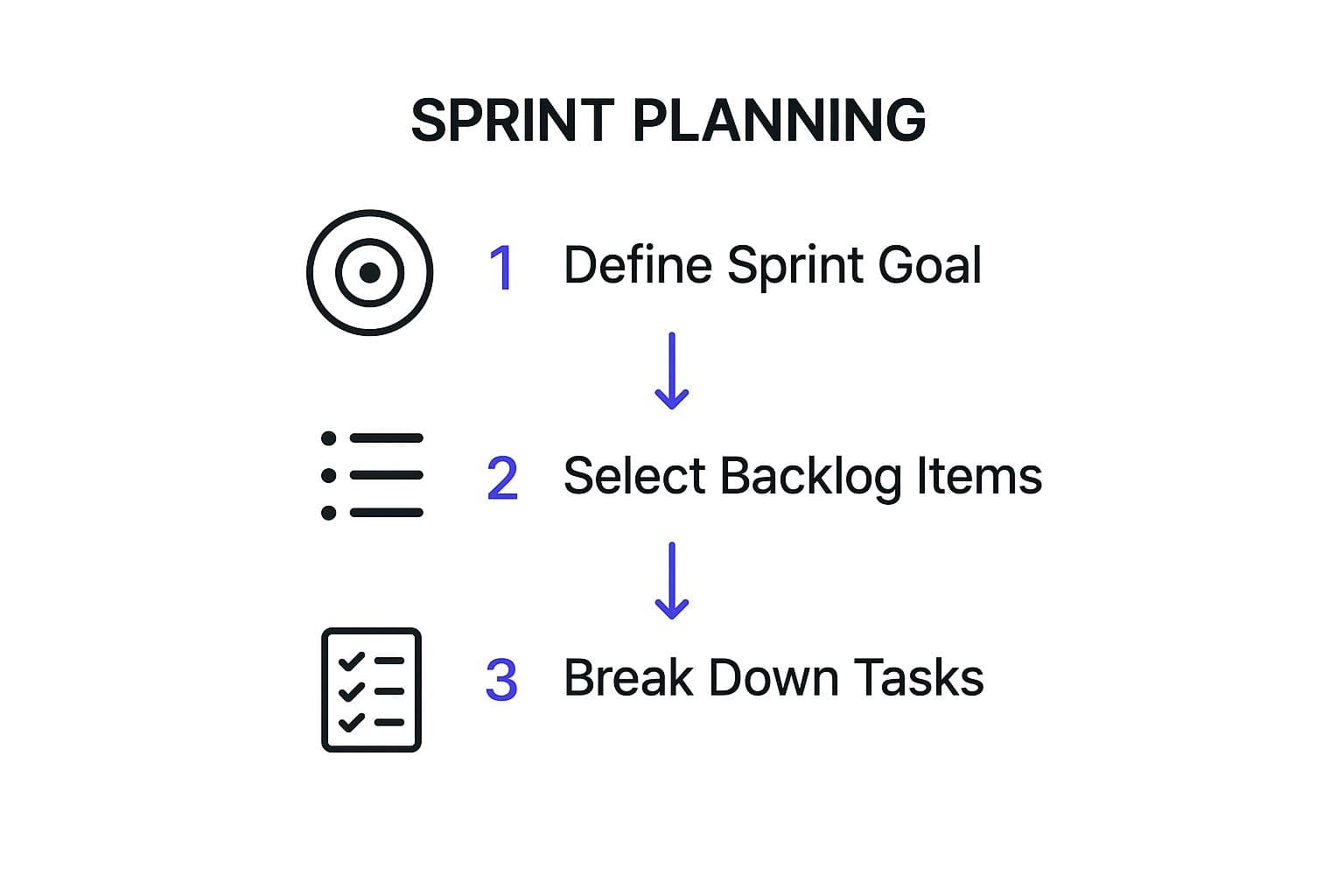
It's this logical flow—from defining a clear sprint goal to selecting and deconstructing the work—that makes Agile estimation and planning so effective.
Every team approaches estimation a little differently, and the terms can sometimes get jumbled. Here’s a quick breakdown of the most common techniques to help clarify when and why you’d use each one.
Comparing Estimation Techniques
| Term | Measures | Best For | Common Mistake |
|---|---|---|---|
| Story Points | Relative effort (complexity, risk, volume) | Estimating user stories in a product backlog for sprint planning. | Equating story points directly to a fixed number of hours. |
| Planning Poker | Consensus-based story points | Getting the whole team aligned on the effort for a specific story. | Letting one person's opinion dominate the discussion instead of fostering true consensus. |
| Velocity | Average story points completed per sprint | Forecasting future sprint capacity and long-term release planning. | Treating it as a productivity target or comparing velocity between different teams. |
| T-Shirt Sizes | Rough relative size (XS, S, M, L, XL) | High-level, early-stage estimation for large epics or initial roadmap items. | Using it for detailed sprint planning where more precision is needed. |
Ultimately, the goal of any estimation technique isn't to be perfectly accurate down to the last minute. It's about creating a shared understanding of the work ahead and building a predictable rhythm for the team.
Agile Terms in Action: A Sample Sprint
So, how do all these terms actually fit together in the real world? Let’s walk through a hypothetical one-week sprint for a team building a new mobile app.
It all starts with Sprint Planning. This is where the rubber meets the road. The Product Owner comes to the meeting with the highest-priority items from the Product Backlog. After some discussion, the whole team agrees on a Sprint Goal: "Implement a basic user login and registration flow."
With that goal set, they pull the relevant User Stories from the main backlog into their Sprint Backlog. This smaller, focused list is their to-do list for the week. Once that's locked in, the sprint is officially underway.
The Daily Rhythm of a Sprint
Every morning, the team huddles up for their Daily Scrum. This isn't a long, drawn-out status report; it's a quick, 15-minute sync to make sure everyone is on the same page. As they work, team members move their task cards across a visual Kanban Board—from "To Do" to "In Progress" and eventually to "Done"—making progress visible to everyone at a glance.
Let's say on Wednesday, a developer gets stuck. A third-party authentication service isn't working as expected. This is a classic blocker, and they bring it up immediately in the next Daily Scrum. The Scrum Master’s job is to jump on this, clearing the path for the developer so the team's Velocity isn't compromised. This proactive problem-solving is what keeps a small issue from derailing the entire Sprint Goal.
This kind of smooth collaboration hinges on a strong Agile culture. It's not just about process; it's about mindset. In fact, research from JCURV shows that a healthy Agile culture can improve commercial performance by a whopping 237%. Interestingly, this varies globally. While 85% of organizations in North America say they use Agile, their cultural effectiveness is rated at just 32%—a stark contrast to African organizations, which are rated at 79%. You can dig deeper into these findings on Agile cultural effectiveness.
Closing the Loop with Feedback
As the week wraps up, the team holds two final, crucial meetings. The first is the Sprint Review. Here, they demo the working login and registration feature—their new Increment—to key Stakeholders. This is a chance to show real progress and get immediate, valuable feedback, which the Product Owner will use to adjust the Product Backlog for the next sprint.
The very last thing they do is the Sprint Retrospective. This meeting is just for the team. It’s a candid chat about what went well, what was a struggle (like that mid-week blocker), and what they can do better next time. They’ll pinpoint one or two concrete improvements to focus on in the next sprint. This cycle of planning, doing, showing, and reflecting is what continuous improvement is all about, and it's the very heart of Agile.
At Iglu Digital, we live and breathe this rapid, iterative process. We specialize in turning your big idea into a market-ready MVP with the scope and the price agreed before we start, giving you a tangible product with core functionality and design to start testing, learning, and growing. Launch your MVP with us.