

How to Create a Product Roadmap: Expert Tips & Strategies
Table of Contents
A product roadmap is more than just a list of features and deadlines. It’s the story of where your product is going and, more importantly, why it's headed in that direction. It’s a high-level, visual summary that maps out the future, connecting day-to-day tasks to the big-picture goals.
Defining Your North Star Product Vision

Before you can even think about timelines or features, you need a solid foundation. This starts with defining your product's core purpose—its "North Star." This vision is the compass that guides every single decision, making sure every ounce of effort is pushing in the same direction. Without it, you’re just building stuff, not creating real value.
This vision can't exist in a bubble; it has to be directly tied to the company's larger business goals. If the company wants to boost market share by 20%, your product vision needs to clearly explain how it’s going to make that happen. This connection is what turns a simple project plan into a genuine strategic tool.
Gathering Critical Stakeholder Insights
Great ideas rarely come from isolation. To build a vision that actually resonates, you need to pull in perspectives from across the business. Think of it as assembling a puzzle—each department holds a unique piece.
- The Sales Team: These folks are in the trenches. They hear every objection, every feature request, and every comparison to a competitor. Their insights are pure gold for understanding what the market actually wants.
- The Marketing Department: They’re tuned into market trends, brand perception, and what the competition is up to. They’ll help you position your product to make the biggest splash.
- Engineering Leads: This is your reality check. They know what’s possible, what’s difficult, and what the true technical costs are. Bringing them in early avoids a lot of pain and unrealistic planning down the road.
- Customer Support: No one understands user frustration better. This team knows exactly where the product is clunky, confusing, or just plain broken. Their feedback points directly to high-impact improvements.
This kind of cross-functional input is the bedrock of a grounded strategy. For a deeper dive into this, check out our complete guide on building a https://iglu.dev/blog/product-strategy-framework.
Before you can synthesize these perspectives, you need to systematically collect them. The table below outlines the essential inputs for building your strategic foundation and who to get them from.
Key Inputs for Your Strategic Foundation
| Input Type | Primary Source | Purpose |
|---|---|---|
| Market Gaps & Feature Requests | Sales & Marketing Teams | To identify immediate revenue opportunities and competitive differentiators. |
| User Pain Points & Feedback | Customer Support & User Research | To understand real-world user struggles and prioritize high-value fixes. |
| Technical Feasibility & Constraints | Engineering & Development Leads | To ground the roadmap in reality and account for technical debt. |
| Business Objectives & KPIs | Executive Leadership | To ensure the product vision directly supports the company's financial goals. |
| Competitive Landscape | Marketing & Product Teams | To position the product effectively and anticipate market shifts. |
Gathering this information is the first step. The real work begins when you start to connect the dots between what everyone wants and what the business truly needs.
Transforming Perspectives into a Unified Direction
Once you've collected all this feedback, your next job is to sift through it all and find the signal in the noise. You’re looking for common themes, filtering out one-off requests, and tying everything back to those big business objectives.
This is where the tough calls are made. For example, Sales might be pushing for a niche feature to close a huge deal, but Engineering is warning you about the massive technical debt it would create. Your role is to balance that short-term win against the long-term health and strategy of the product. This discipline is what prevents scope creep and keeps the team focused.
This strategic alignment is more critical than ever, especially as teams move toward more agile and dynamic planning. In North America, the market for product roadmap software is surging, a trend fueled by this shift. Modern development requires tools and processes that can adapt on the fly, making a clear, shared vision the essential anchor that keeps everyone grounded.
Grouping Ideas into Strategic Themes

Alright, you’ve done the hard work of capturing a vision and collecting a mountain of input. Now what? You’re probably staring at a backlog that looks like a chaotic jumble of brilliant ideas, must-do bug fixes, impassioned customer requests, and a few pet projects. It's messy.
Here’s the thing: a great product roadmap isn't just a list of all that stuff. It’s a compelling story about where you’re headed. To tell that story, you need to group those individual ideas into strategic themes. This is where you elevate the conversation from "what are we building?" to "what problem are we solving?"—and that's a much more powerful way to get everyone on board.
From Feature Lists to Customer Outcomes
We’ve all seen feature-based roadmaps. They’re tactical, specific, and almost immediately out of date. A list like "Add new dashboard widget," "Implement SSO," and "Update UI buttons" tells your team what to do, but it completely misses the why. This approach invites micromanagement and leaves zero room for creative problem-solving.
Now, let's reframe that. A theme-based approach bundles those same features under a much more strategic umbrella, like "Enhance Enterprise Security and Usability." Suddenly, you’re not just talking about widgets and buttons; you’re talking about a clear, valuable goal. This gives your team the autonomy to find the best solutions and helps stakeholders grasp the real value you’re delivering. As one product manager at Mural put it, looking at tasks this way makes priorities crystal clear.
This shift keeps everyone focused on delivering measurable improvements for the customer or the business, rather than just blindly shipping features off a checklist.
How to Identify and Define Your Themes
So, how do you find these themes? Start digging for patterns in your backlog. Sift through all that user feedback, the notes from sales calls, and the ideas from your last brainstorming session. You'll quickly start to see related suggestions clustering around a common user problem or a big business opportunity.
For example, you might find a dozen different requests for better reporting, easier data exports, and integrations with analytics tools. On their own, they’re just small tasks. But together, they form a powerful theme: "Empower Users with Actionable Data Insights."
As you start defining your themes, keep a few principles in mind:
- Center on the problem. Always articulate the user pain point or business need you're addressing.
- Be outcome-oriented. Describe the end result you want to achieve, not the features you plan to build.
- Keep them broad but clear. A theme needs to be high-level enough to cover multiple features but specific enough that your team knows what they’re aiming for.
Let's look at a quick comparison for a fictional project management tool to see how this plays out in the real world.
Theme-Based Roadmap Comparison
| Weak Approach (Feature List) | Strong Approach (Strategic Theme) |
|---|---|
| • Add @mentions• Create project templates• Implement task dependencies | Theme: Streamline Team CollaborationThis theme inspires your team to find the best ways to help people work together more efficiently, cutting down on friction in their daily communication. |
| • Build a mobile app• Add offline mode• Push notifications | Theme: Enable Productivity On The GoThis goal is all about giving users full power when they're away from their desks, making sure a critical update is never missed. |
The difference is night and day. A theme provides the why and encourages your team to think critically about how to solve the problem, rather than just building what’s on a list. It transforms your roadmap from a rigid set of instructions into a true strategic guide.
Choosing The Right Prioritization Framework
Once your strategic themes are in place, the real work begins: deciding what to build first. This is where so many roadmaps fall apart, buckling under the weight of competing priorities and strong opinions. To build a roadmap that actually delivers value, you have to move beyond gut feelings and adopt a structured, defensible process.
Prioritization isn't about finding a magic formula. It’s about adopting a consistent framework that forces your team to have the right conversations and make deliberate trade-offs. It brings much-needed clarity to the puzzle of balancing user needs, business goals, and technical reality.
The core challenge always comes down to balancing three things: business value, customer value, and the effort required to build it.
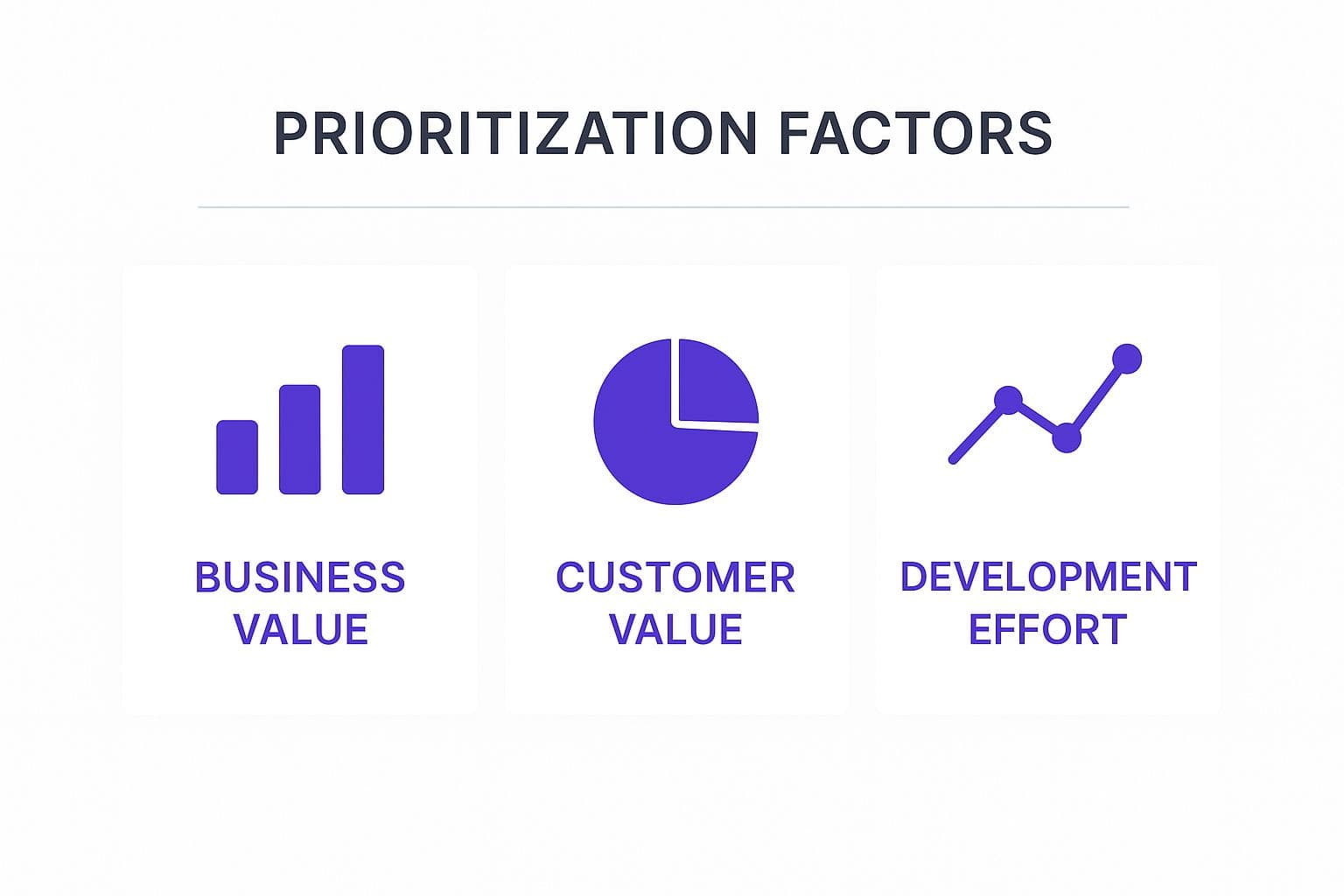
As you can see, the sweet spot is where you can deliver high value to both the business and your customers without burning out your development team. It’s a constant balancing act.
Applying The RICE Scoring Model
One of the most practical quantitative frameworks out there is RICE. It was developed by the team at Intercom and is designed to help you evaluate initiatives by scoring them across four factors: Reach, Impact, Confidence, and Effort. It’s perfect for teams who need a data-informed way to compare wildly different types of projects against each other.
Let’s walk through a real-world scenario. Imagine a B2B SaaS company trying to decide between two potential projects for the next quarter:
- Project A: A brand-new, AI-powered reporting dashboard.
- Project B: A redesign of the new user onboarding flow.
Using RICE, the team would score each one like this:
- Reach: How many users will this touch in a given period? The dashboard might reach 500 enterprise customers per month. The onboarding redesign, on the other hand, would impact all 2,000 new users who sign up each month.
- Impact: How much will this move the needle on our goals? The team uses a simple scale (e.g., 3 for massive impact, 0.25 for minimal). The dashboard gets a 3, while the redesign gets a 2.
- Confidence: How sure are we about our estimates? Expressed as a percentage. The team is 80% confident about the dashboard's potential but 100% confident the redesign will improve things.
- Effort: How many "person-months" will this take? The dashboard is a huge project needing 10 person-months. The redesign is much smaller, at just 4 person-months.
The final score comes from a simple formula: (Reach x Impact x Confidence) / Effort. Suddenly, a subjective debate becomes a clear, mathematical comparison, showing which project offers the most bang for your buck.
Leveraging The MoSCoW Method For Clarity
While RICE is fantastic for comparing different ideas, the MoSCoW method shines when you need to define the scope of a single project or release. It’s all about categorizing features into four distinct buckets.
- Must-have: These are the non-negotiables. Without them, the product is broken or simply doesn't launch.
- Should-have: Important features that add major value but aren't mission-critical for the initial release.
- Could-have: Nice-to-have improvements. These are the first to go if time or resources get tight.
- Won't-have (this time): Features that are explicitly out of scope for the current release, but might be considered later.
This framework is a lifesaver for managing expectations and stopping scope creep in its tracks. By getting everyone to agree on the "Must-haves," you create a solid baseline for your minimum viable product. To learn more about this approach, you can explore the benefits of a minimum viable product.
This need for structured planning has fueled incredible growth in the product roadmap software market, which was valued at around USD 1.5 billion in 2023. This isn't just a niche tool; it reflects a widespread understanding that strategic alignment is essential. Companies are actively seeking tools to help them collaborate better and ship products faster, as highlighted in market analysis from dataintelo.com.
To help you decide which framework might fit your team, here’s a quick comparison.
Comparing Popular Prioritization Frameworks
Choosing between frameworks like RICE and MoSCoW often comes down to what you're trying to prioritize. Are you comparing a list of different potential projects, or are you trying to define the scope of a single one? This table breaks down their core strengths.
| Framework | Best For | Key Benefit |
|---|---|---|
| RICE | Comparing a diverse set of unrelated ideas | Provides a quantitative score for objective, data-informed comparison |
| MoSCoW | Defining the scope of a specific project or release | Creates clear feature categories to manage scope and expectations |
Ultimately, which framework you pick is less important than the simple act of choosing one and using it consistently. Whether it’s RICE, MoSCoW, or another method, the goal is always the same: to replace chaotic, opinion-based debates with structured, data-informed decisions that get your whole team on the same page.
Visualizing and Building Your Roadmap

Alright, you've done the hard work of defining your strategy and prioritizing what matters. Now it's time to bring it all to life. This is where we move from abstract ideas to a concrete, visual plan—the actual roadmap document that will steer your team and sell your vision to stakeholders.
The format you pick is more important than you might think. A roadmap isn't a one-size-fits-all spreadsheet; its design has to be tailored to who's looking at it. What you show your executive team should look very different from what you share with your engineers. One needs a high-level, outcome-focused view, while the other needs more tactical detail. Get this wrong, and a beautiful roadmap can create just as much confusion as a bad strategy.
Choosing the Right Roadmap Format
Your first big decision is how to structure this thing. Are you going with a classic timeline full of dates, or something more flexible and theme-based? The right answer depends entirely on your audience and where your product is in its lifecycle.
For example, if you're coordinating a massive launch with marketing and sales, a detailed, feature-based timeline might be exactly what you need. But if you're trying to get buy-in from the leadership team, a high-level roadmap built around strategic themes will be far more effective. It focuses on the why, not the when.
Here are a few popular formats I've seen work well:
- Timeline-Based Roadmap: This is the classic approach, plotting initiatives across quarters or months. It’s perfect for communicating with external partners or other teams who have dependencies on your work.
- Theme-Based (Outcome-Oriented) Roadmap: My personal favorite for agile teams. You group work under big-picture goals or customer problems. This constantly reminds everyone why they're building something.
- Kanban-Style Roadmap: Think "To Do," "In Progress," and "Done." This format is incredibly flexible and gives a real-time snapshot of progress, making it great for keeping the internal team aligned.
In my experience, the best solution is usually a hybrid—using broad themes to guide the long-term vision and more specific timelines for what’s coming up next.
Embracing Flexible Time Horizons
This is where so many product managers trip up. They create a roadmap and commit to hard delivery dates for features that are six or twelve months away. This is a recipe for disaster. It creates false certainty, puts insane pressure on the engineering team, and leaves zero room to adapt when you learn something new.
A much better, more realistic approach is to use broad time horizons. This one simple change in language can completely reframe the conversation.
So, instead of promising that new reporting dashboard on "October 26th," you frame it within a flexible bucket. The most popular way to do this is the "Now, Next, Later" roadmap. It provides clarity without killing your agility.
- Now: What the team is actively building in the current cycle (think the next 2-4 weeks). This part is highly detailed and you should have high confidence in it.
- Next: What’s on deck for the near future (the next 1-3 months). These are well-defined initiatives, ready to be picked up.
- Later: What you're thinking about for the more distant future (beyond 3 months). This section should be intentionally vague, focusing on strategic problems we want to solve, not specific features.
This structure is a masterclass in managing expectations. Your dev team gets the immediate clarity they need, and stakeholders see the long-term vision, all without you having to make risky promises you can't keep.
Selecting the Right Tool for the Job
Once you've landed on a format, you need to decide where this roadmap will live. The tool you choose matters because it affects how easily you can create, share, and—most importantly—update your plan. You're aiming for a living document, not a static PDF that gets forgotten in a shared drive.
You've got plenty of options, from specialized software to simple spreadsheets.
| Tool Category | Popular Examples | Best For |
|---|---|---|
| Dedicated Roadmap Software | Aha!, ProductPlan, Roadmunk | Teams that need powerful features like prioritization scoring, idea management, and polished visuals for executive reports. |
| Project Management Tools | Jira, Trello, Asana | Teams who want their roadmap living right alongside their daily development backlog and workflows. |
| Flexible Collaboration Tools | Miro, Mural, Google Sheets | Teams who value maximum flexibility to design a completely custom roadmap and use it as a collaborative workspace. |
Honestly, there's no single "best" tool. I've seen a simple Trello board work wonders for a small startup, while a huge enterprise might get more value from a powerhouse like Aha!. The right choice is the one that fits into your team's existing flow and makes the roadmap easy for everyone to access and maintain. The less friction there is to update it, the more likely it is to stay relevant.
Getting Everyone on Board: How to Communicate Your Roadmap
A roadmap gathering dust in a shared drive isn't a strategy—it's just a file. For a product roadmap to have any real power, it needs to be a living, breathing communication tool. It's your job to get it out of the folder and into the hearts and minds of your team.
The goal isn't just to present a timeline of features. It's to tell a story. You need to connect the dots for everyone, showing them how a specific feature solves a real customer problem and pushes the entire business forward. When you do that, you're not just sharing a plan; you're building a shared vision.
Speak Their Language: Tailor Your Message
One of the biggest mistakes I see is product managers giving the exact same roadmap presentation to everyone. It just doesn't work. Your C-suite cares about different things than your engineers, and your communication has to reflect that.
- For the Leadership Team: Keep it high-level. They want to see the "why" behind the "what." Tie your roadmap themes directly to business goals like growing revenue, capturing market share, or boosting retention. Skip the granular details and focus on strategic impact.
- For Your Engineering Partners: They need context, not just a to-do list. Frame every initiative around the customer pain you're trying to solve. This empowers them to come up with brilliant technical solutions instead of just blindly building what's on the spec.
- For Sales and Marketing: They need ammunition. Translate features into tangible customer benefits and clear market differentiators. Arm them with the talking points they'll need for campaigns and sales calls. Be clear about launch windows so they can get their own plans in motion.
When you tailor the conversation, you make the roadmap relevant to each person's world. That’s how you build a powerful coalition of support.
This is a constant conversation, not a one-time announcement. It's no surprise that in a recent survey, 40% of product managers said stakeholders were the primary audience for their roadmaps. That fact alone highlights just how crucial clear, targeted communication is.
Set a Rhythm for Reviews and Updates
The most dangerous thing you can do is publish a roadmap and then treat it as finished. The market will change. You'll get surprising user feedback. A competitor will make a move. Your roadmap has to be a living document.
Establishing a regular review cadence is non-negotiable. For most teams, a quarterly review works perfectly. It aligns well with business planning cycles and forces you to pause and reassess your strategic themes.
In these meetings, you need to ask the hard questions:
- Are these priorities still the right ones to hit our goals?
- What did we learn from our customers over the last 90 days?
- Did anything in the competitive landscape just change the game?
This isn't just about shuffling priorities. It's about building a culture of transparency and adaptability. When your team knows the roadmap is revisited regularly, they learn to trust the process, even if their favorite project gets bumped.
Thankfully, modern tools are making this process much smoother. More and more companies are using dedicated product roadmap software to tap into AI-driven insights and bake customer feedback directly into their planning process. While they come with a cost, these platforms are quickly becoming table stakes. This agile mindset, often broken down into sprints, becomes even more effective when you start with a solid agile sprint planning template.
Common Roadmap Questions Answered
Even with a solid strategy in hand, roadmapping can feel like you're constantly putting out fires. Questions are inevitable. Let's walk through some of the most common ones I hear from product teams to help you keep your roadmap a tool for clarity, not a source of chaos.
How Often Should I Update My Product Roadmap?
For most teams, a quarterly review is the sweet spot. This cadence lines up nicely with how most businesses plan their quarters, giving you a natural break to pull your head up and make sure your product themes still align with the bigger company goals. It forces you to look at the forest, not just the individual trees.
That said, if you're in a cutthroat market where things change overnight, you might need to huddle up for a monthly check-in to stay on your toes. The key is to remember that your roadmap isn't set in stone; it's a living document. Major strategic shifts might happen quarterly, but you should feel empowered to make smaller tweaks based on fresh customer feedback or new data whenever it makes sense.
It's all about striking the right balance. You need a roadmap that's current and reliable, but you don't want to create so much churn that your development team gets whiplash.
What Is the Biggest Mistake to Avoid?
The number one trap I see people fall into is treating their roadmap like a Gantt chart—a rigid timeline of features with hard-and-fast deadlines. This approach is a recipe for disaster. It creates false promises, demoralizes teams when priorities (inevitably) change, and completely kills any opportunity for creative problem-solving.
Another huge misstep is building the roadmap in a vacuum. When a product manager locks themselves in a room and emerges with a plan that engineering, sales, and marketing have never seen, it’s a guarantee for misalignment and zero buy-in. Collaboration isn't a nice-to-have; it's the foundation of a successful roadmap.
Should My Product Roadmap Include Specific Dates?
This is a classic "it depends" situation, and the answer hinges entirely on who you're talking to and how far out you're looking.
For your internal dev team planning the next couple of sprints? Sure, specific target dates can be incredibly helpful for coordination.
But for that strategic roadmap you're sharing with the executive team or, heaven forbid, your customers? Avoid specific dates like the plague. Instead, think in broader horizons.
- Use quarters: "Q3," "Q4"
- Use themes: "Now," "Next," "Later"
Committing to a hard delivery date for something six or twelve months away is just asking for trouble. It erodes trust when you miss it and strips away all your agility.
Your goal is to provide clear direction, not make promises you can’t keep. A great roadmap builds confidence by showing intent and priorities, not by locking everyone into an inflexible schedule that’s probably wrong anyway. It’s about signaling the destination, not predicting the exact minute you'll arrive.
Ready to turn your product vision into reality without the guesswork? Iglu Digital specializes in building market-ready MVPs with the scope and the price agreed before we start, transforming your ideas into functional software with a clear, strategic roadmap. Start building with confidence.