

Your Guide to Product Strategy Frameworks
Table of Contents
A product strategy framework is the connective tissue between your company's big-picture vision and what your product teams do every single day. It’s a practical guide for making smart decisions, ensuring that every feature you build or market you enter actually serves a specific business goal.
Think of it less as a rigid set of rules and more as a reliable map for navigating the path to product success.
What Is a Product Strategy Framework

Imagine trying to build a house without a blueprint. You’d probably end up with a mess—rooms that don’t connect, a leaky roof, and a foundation that can’t hold the weight. A product strategy framework is that essential blueprint for your product. It stops you from building features based on hunches and anchors your entire process in a shared vision of where you’re going and why.
This framework is so much more than a document collecting dust on a server. It’s a living communication tool that gets everyone on the same page, from marketing to engineering to the C-suite. It forces you to answer the most important questions:
- Why are we building this? (This has to connect directly to the company's mission.)
- Who are we building it for? (This defines your ideal customer and their problems.)
- How will we succeed? (This spells out your unique advantage and the big moves you'll make.)
When these questions are answered clearly, your framework becomes a powerful filter. It empowers your teams to confidently say "no" to distractions and a resounding "yes" to the work that truly matters. It turns fuzzy goals into a concrete game plan.
From Ancient Battles to Modern Boardrooms
The core idea of "strategy" has been around forever, with its roots in ancient military planning. The word itself comes from the Greek strategos, which described a military general plotting to win a war. In the business world, this thinking was formalized by works like Alfred D. Chandler Jr.'s Strategy and Structure in 1962 and Michael Porter's Competitive Strategy in 1980.
But modern product strategy really began to take shape with books like Eric Ries’ The Lean Startup in 2011, which introduced the world to rapid learning and adaptation. More recently, John Doerr’s Measure What Matters in 2018 popularized OKRs, giving teams a way to link their strategy to tangible results. These influences moved product development away from rigid, long-term plans toward a more nimble, outcome-focused approach.
A Blueprint for Cohesive Action
At the end of the day, a product strategy framework is the single source of truth that guides every decision your team makes. It’s the critical bridge between your company's high-level ambitions and the actual product you ship.
Without this structure, teams drift into silos. Priorities clash, resources get wasted, and the user experience feels disjointed. A strong framework ensures everyone is rowing in the same direction, united by the shared goal of building a product that users love and that drives sustainable growth for the business.
Why a Framework Is Critical for Your Product
Picture a startup in full swing. The engineering team is cranking out features based on the cool new tech they just discovered. Meanwhile, the sales team is promising clients the moon to close deals, and marketing is busy promoting benefits that don't quite line up with what the product actually does. Everyone is working incredibly hard, but they're all pulling in different directions. This is what it looks like to operate without a strategic rudder, adrift in a sea of conflicting priorities.
A product strategy framework is what cuts through all that noise. It’s the unifying force that gives everyone a shared language and a clear lens for making tough calls, not just in the product team but across the entire company. It’s not just a document that gathers dust; it's a living commitment to a focused direction.
This kind of structure completely changes how teams work. Instead of battling each other for resources or attention, they start moving together toward a common goal. This cross-functional alignment is easily one of the most powerful benefits a framework delivers.
Driving Cross-Functional Alignment
When your product strategy is clearly defined and accessible, it becomes the single source of truth for the entire organization. The marketing team finally understands which customer pain points to highlight in their campaigns. The sales team knows the core value proposition to pitch. And the engineering team can confidently prioritize the features that actually deliver on that core promise.
The ripple effects are huge:
- Reduced Friction: You'll see fewer arguments over which projects are "more important" because the framework already provides the criteria for making those calls.
- Increased Efficiency: Teams stop wasting time and energy on initiatives that don't serve the larger strategic goals, freeing up resources for what truly matters.
- Cohesive Customer Experience: The entire user journey—from the first ad a customer sees to the features they use every day—feels consistent and intentional because it's all rooted in the same strategy.
A well-communicated product strategy framework boosts transparency with stakeholders and sharpens a company's focus, which almost always leads to a better shot at product success. By nailing down the unique value proposition and the target customer, it ensures everyone is building toward the same vision. You can explore a deeper dive into how this alignment strengthens product development in this essential guide to product strategy frameworks on datapel.com.
Empowering Faster, Smarter Decisions
Without a guiding framework, every significant decision can turn into a long, drawn-out debate. Should we chase a new market segment? Do we invest in paying down tech debt or build that flashy new feature everyone's talking about? These questions can easily lead to analysis paralysis, causing teams to stall and miss critical windows of opportunity.
A product strategy framework provides the necessary guardrails for these decisions. It gives product managers and team leads the confidence to say "no" to distractions and a firm "yes" to the projects that align with the long-term vision. This empowerment results in faster, more consistent decision-making at every level. For new companies, this speed is a massive competitive advantage, something central to the philosophy behind custom software development for startups.
Optimizing Your Resource Investment
Every company, from a two-person startup to a global enterprise, has to work with finite resources—time, money, and talent. One of the main jobs of a product strategy framework is to make sure those precious resources are invested, not just spent.
Think back to that chaotic startup. Their resources were spread thin across dozens of disconnected projects, delivering a low return on investment everywhere. A framework forces you to be deliberate about where you place your bets. It helps you focus your budget and your team's energy on the handful of initiatives that will actually move the needle, ensuring every dollar and hour of work contributes to building a successful, sustainable product.
The Core Components of an Effective Framework
While product strategy frameworks come in all shapes and sizes, the good ones are always built on the same foundational pillars. Think of these as the essential, non-negotiable ingredients for any successful product. No matter which model you choose, these five components must be crystal clear to create a strategy that’s solid, actionable, and easy for everyone to get behind.
These pieces don't exist in a vacuum; they work together. A fuzzy vision leads to confusing goals, and a poor understanding of the market results in misguided initiatives. Nail each of these, and you’ll have a powerful foundation for focused work and real growth.
Defining Your North Star: The Product Vision
Your product vision is the ultimate destination—the long-term, aspirational "why" that fuels everything you do. It’s a vivid picture of the future you’re trying to build for your users and the world. This isn't a goal with a deadline; it’s the North Star that keeps the team pointing in the same direction, especially when the path gets tricky.
A great vision statement is short, inspiring, and just a little bit audacious. It should answer the question: What positive change will our product create in five to ten years? For instance, a fintech app's vision could be "to make financial independence accessible to everyone." That's a lot more powerful than just "to be the #1 budgeting app."
Understanding the Landscape: The Market and Customer
Once you know where you're headed, you need a map of the terrain. This part is all about gaining a deep, evidence-based understanding of your target audience and the competitive environment. It’s time to swap out assumptions for hard facts.
- Your Customer: Who, really, are you building this for? This goes way beyond demographics. You need to uncover their deepest needs, nagging pain points, and what truly motivates them. What problem are they so desperate to solve that they'd gladly pay for a solution?
- The Market: What are your competitors doing right, and where are their blind spots? What larger trends could help or hurt your product? A sharp analysis here will reveal clear opportunities to stand out.
Making It Measurable: The Goals
If the vision is your far-off destination, goals are the key milestones you need to hit along the journey. These are the specific, measurable outcomes that prove your strategy is actually working. Vague ambitions like "increase user engagement" won't cut it. You need concrete targets that leave no room for debate.
This is where frameworks like Objectives and Key Results (OKRs) really shine. An objective might be "Become the go-to solution for small business accounting," while the key results would be measurable targets like "Achieve 40% market share in the SMB segment" or "Increase customer retention by 15% quarter-over-quarter." Goals like these connect the team's daily work directly to the big picture.
A great tool for mapping this out is the Business Model Canvas. It gives you a structured way to see all the moving parts of your strategy at a glance.
The canvas forces you to think through critical elements like Customer Segments, Value Propositions, and Revenue Streams. If you're ready to try it, starting with a good guide and a Business Model Canvas template can help organize your thoughts.
Placing Your Bets: The Strategic Initiatives
Strategic initiatives are the big bets—the high-level themes or projects you’ll pursue to hit your goals. This is not a laundry list of features; it's a set of broad focus areas. Think of them as the main highways on your map that you believe will get you to your next milestone fastest.
For example, to achieve that goal of increasing customer retention, your initiatives might look like this:
- Elevate the Onboarding Experience: Create a ridiculously smooth and helpful first-time experience that sets users up for success from day one.
- Build a Community Ecosystem: Foster a thriving user community to make the product stickier and encourage peer-to-peer support.
- Introduce Proactive Customer Support: Use data to spot users who might be struggling and offer help before they even think about leaving.
These initiatives are what guide your product roadmap, making sure every feature you build serves a larger strategic purpose. It's how you turn a random wishlist into a deliberate plan for winning.
Comparing Popular Product Strategy Frameworks
Once you get the hang of what goes into a product strategy framework, the next big question is, "Which one should I use?" There's no single magic bullet here. Think of these frameworks less like rigid instruction manuals and more like different lenses for your camera—each one is designed to bring a specific part of your product and market into sharp focus.
Choosing the right one really boils down to the problem you're trying to solve right now. Are you struggling to figure out why customers are choosing you over the competition? Or are you trying to decide which new feature will actually get people excited? Let’s walk through some of the most trusted frameworks to see how they work and where they really shine.
A well-chosen framework isn't just a thought exercise; it drives real results. Key metrics like user engagement, customer retention, and ultimately, revenue, all see a boost when a clear strategy is in place.
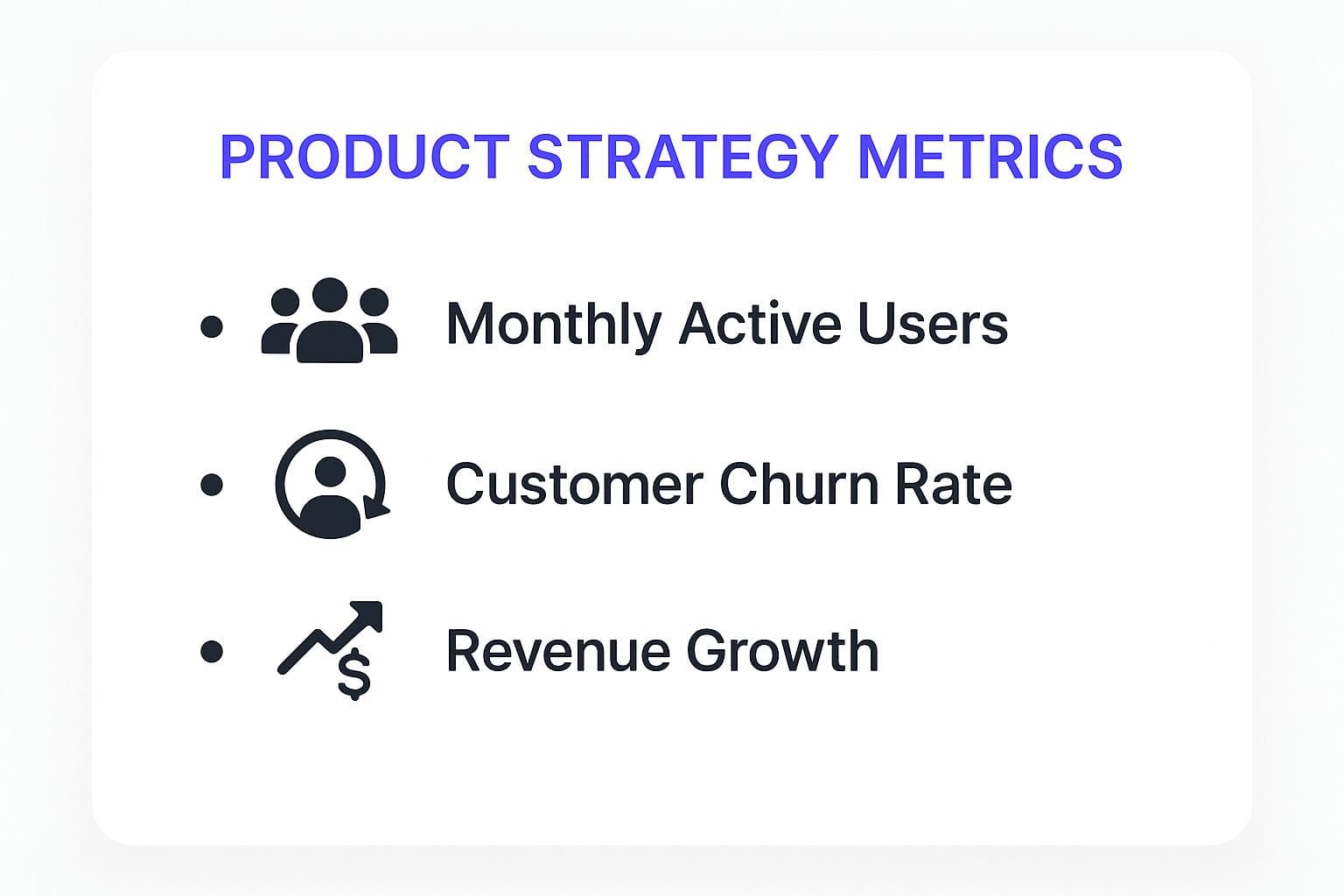
The data here shows a direct line from a focused strategy to tangible business outcomes. When you improve the user experience, financial growth tends to follow.
Jobs-to-be-Done for Deep Customer Motivation
The Jobs-to-be-Done (JTBD) framework, made famous by the great Clayton Christensen, is all about a fundamental shift in perspective. It asks you to stop focusing on what your product is and start obsessing over what your customers "hire" it to do. The idea is simple but profound: people don't buy products; they hire them to make progress in their lives.
Think about someone buying a milkshake during their morning commute. Are they just buying a sweet, cold drink? Not really. They're hiring it for a "job"—to be a tidy, one-handed breakfast that can keep them from getting bored on a long drive.
JTBD is brilliant for digging into the deep, often unspoken motivations that drive customer behavior. It helps you innovate beyond just adding another feature and allows you to discover entirely new opportunities.
- Best For: Uncovering root customer needs, spotting new market opportunities, and innovating outside of your current product category.
- Key Question: What progress is the customer trying to make, and how can our product help them get there better than anything else?
The Kano Model for Feature Prioritization
The Kano Model is a fantastic tool for prioritizing features based on how they impact customer satisfaction. It gets you past a simple "high vs. low priority" list and helps you understand the emotional reaction a feature is likely to cause.
The model sorts features into three buckets:
- Basic Needs: These are the features everyone just expects. If they're missing, people will be upset, but having them won't win you any awards (think: brakes on a car).
- Performance Needs: For these features, more is better. The better you do them, the happier your customers will be (think: better gas mileage).
- Delighters (Excitement Needs): These are the unexpected, awesome features that create true fans. Customers don't ask for them, but they are thrilled when they find them (think: a car that parks itself).
Using the Kano Model helps teams put their resources in the right places, making sure they nail the basics while still leaving room for those delightful touches that give them an edge.
The Business Model Canvas for a Holistic View
While it’s not just a product strategy framework, the Business Model Canvas is an essential tool for seeing the big picture. It shows you exactly how your product fits into the wider business ecosystem on a single, easy-to-understand page.
The canvas is broken down into nine building blocks, covering everything from your customer segments and value propositions to your revenue streams and key partners.
It's perfect for startups trying to map out their initial plan or for established companies looking to launch a new product or pivot their business. It keeps your product strategy grounded in a sustainable business reality.
Gibson Biddle's DHM Model for Competitive Edge
Developed by former Netflix VP of Product Gibson Biddle, the DHM (Delight, Hard-to-Copy, Margin-Enhancing) Model is all about building a long-term competitive advantage. It pushes you to think about how every strategic move contributes to a stronger, more defensible position in the market.
The model asks you to weigh your ideas against three simple but powerful criteria:
- Delight: How will this delight our customers in a way that’s unique and memorable?
- Hard-to-Copy: What makes this tough for our competitors to replicate? This could be your brand, unique tech, network effects, or economies of scale.
- Margin-Enhancing: How will this improve our profitability and long-term financial health?
This framework is especially valuable for mature products in crowded markets, as it forces teams to think beyond customer value and focus on building a durable, profitable business that can last.
Comparison of Popular Product Strategy Frameworks
To help you decide which tool to pull out of your toolkit, here’s a quick comparison of these popular frameworks. This table breaks down what each model is best at, so you can match the right approach to your current challenge.
| Framework | Primary Focus | Best For | Key Advantage |
|---|---|---|---|
| Jobs-to-be-Done (JTBD) | Customer motivation | Uncovering deep user needs and finding new market opportunities. | Shifts focus from features to outcomes, leading to more meaningful innovation. |
| Kano Model | Feature prioritization | Deciding which features to build based on their impact on user satisfaction. | Provides a clear structure for balancing essential needs with delightful extras. |
| Business Model Canvas | Business viability | Visualizing and stress-testing your entire business model in one place. | Ensures your product strategy is aligned with a sustainable financial plan. |
| DHM Model | Competitive advantage | Building a defensible and profitable market position for the long term. | Connects product initiatives directly to building a lasting competitive moat. |
Ultimately, choosing the right product strategy framework is about matching the tool to the task at hand. In many cases, the best product leaders find themselves using a combination of these models at different stages of a product's life.
How to Build Your Own Product Strategy Framework

Alright, let's move from theory to action. This is where a product strategy framework really comes alive. Building one isn’t about just filling in a template and calling it a day; it's an ongoing cycle of defining your path, testing your assumptions, and constantly refining your approach.
Think of yourself as an architect. You're not just following a standard blueprint. You're adapting it to the unique terrain of your market, your company, and your customers. This guide will walk you through constructing a framework from the ground up, turning those big ideas into a practical tool that actually drives results.
Start with Your North Star Vision
Before you can even think about a plan, you need a destination. Your product vision is that inspirational, long-term impact you want to have on your users' lives. It’s the "why" that ties everything together and keeps everyone rowing in the same direction.
Your vision statement should be ambitious but simple. For example, a health tech startup might aim "to empower individuals to take control of their proactive wellness." That single sentence sets the entire stage for every goal, feature, and decision that comes next.
Conduct Insightful Market and User Research
With your vision in place, it's time to bring your strategy back down to earth. Assumptions are the enemy of good strategy; data is your best friend. You need to dive deep to understand both the competitive landscape and the people you're building for.
- Market Analysis: Who are your direct and indirect competitors? What are they great at, where do they fall short, and what gaps have they left wide open for you?
- User Research: Go way beyond basic demographics. What are your customers' real problems? What truly motivates them? What needs do they have that no one else is meeting?
This research phase is absolutely foundational. It ensures you're solving a genuine problem for a specific group of people, which is a critical first step for any venture. For anyone just starting out, this discovery process is deeply connected to understanding how to start a tech startup.
Set Measurable Objectives and Key Results
Your vision is the destination, but your goals are the specific, measurable milestones you'll hit along the way. Vague ambitions like "improve user satisfaction" are impossible to act on. You need concrete targets that clearly define what success looks like.
This is where Objectives and Key Results (OKRs) are incredibly powerful. An Objective is what you want to achieve, and Key Results are how you’ll measure if you're getting there.
OKRs transform your high-level vision into a quantifiable game plan that the entire team can understand and rally behind.
Identify High-Impact Strategic Themes
Let’s be honest: you can't do everything at once. Strategic themes are the big, focused bets you’ll make to achieve your OKRs. These aren't just a list of features. They are broad areas of focus that will guide your entire product roadmap.
For instance, to hit the OKRs mentioned above, your strategic themes might be:
- Streamline Collaboration: Focus on building features that make teamwork for creative projects completely seamless.
- Enhance Visual Reporting: Create beautiful, intuitive dashboards that help agencies showcase progress to their own clients.
- Perfect the Onboarding Flow: Design a frictionless setup experience that’s tailored specifically to how an agency works.
These themes act as guardrails for your roadmap. They ensure every feature request is measured by how well it contributes to a larger, more important strategic goal.
Create a Rhythm for Review and Adaptation
A product strategy is not a document you write once and then file away. The market changes, competitors pivot, and customer needs evolve. Your strategy has to be a living, breathing thing that adapts right along with them.
The key is to establish a regular cadence for reviewing and updating your framework.
- Quarterly Strategy Reviews: Set aside dedicated time with key stakeholders to assess progress against your OKRs, scan the market for changes, and adjust your strategic themes for the quarter ahead.
- Monthly Check-ins: Hold lighter-weight meetings to track progress on key initiatives and knock down any immediate roadblocks your team is facing.
This loop of planning, executing, and learning is the engine that keeps a product strategy moving forward. It ensures your framework stays relevant, responsive, and remains a true guide for building a product that wins.
Got Questions About Product Strategy Frameworks? We've Got Answers.
As you start using a more structured approach for your product, you're bound to run into a few questions. That's completely normal. A product strategy framework isn't a silver bullet, and figuring out the finer points can feel a little tricky at first.
Think of this section as your go-to guide for those common "what about..." moments. We'll clear up the difference between a strategy and a roadmap, figure out a good rhythm for keeping your plan fresh, and talk about how to get your leadership team excited about this new way of working.
What’s the Difference Between a Product Strategy and a Product Roadmap?
This is, without a doubt, the question I hear most often. Getting this right is absolutely critical, so let's break it down.
Your product strategy is the high-level game plan. It’s the "why" behind everything you do. It clearly defines who your customers are, what problems you're solving for them, and how your product will win in a crowded market. It’s your north star.
Your product roadmap, on the other hand, is all about execution—the "what" and "when." It’s a visual, tactical plan that shows how you’ll bring that strategy to life over time. It translates your big strategic goals into a timeline of actual features, projects, and milestones.
One can't exist without the other. Your strategy has to come first, as it gives meaning and purpose to everything you put on your roadmap.
How Often Should We Revisit Our Product Strategy?
Your product strategy should never be a "set it and forget it" document. The market shifts, customer needs change, and new competitors pop up all the time. To stay ahead, you have to treat your strategy as a living, breathing guide.
In my experience, a two-part rhythm works best:
- Quarterly Strategy Reviews: Set aside dedicated time every three months for a proper check-in. Get your key stakeholders in a room to review progress against your OKRs, discuss what’s changed in the market, and make any necessary tweaks to your high-level plans for the next quarter.
- Continuous Monitoring: As a product leader, you need to have your finger on the pulse much more frequently—daily or weekly, even. This means keeping an eye on your key metrics, listening to new customer feedback, and tracking what your competitors are up to. This allows you to make small, quick adjustments on the fly.
This approach gives you the best of both worlds: you can react quickly to new opportunities while maintaining a steady, long-term direction.
How Do We Get Buy-In From Leadership and Stakeholders?
Getting everyone on board with a new product strategy can be tough, especially if they're used to just building a list of features. Earning that buy-in means you have to make the strategy real, collaborative, and directly connected to what the business actually cares about.
Here are a few tactics that have always worked for me:
- Bring Them In Early: Don't create the strategy in a silo and then spring it on everyone. Involve key stakeholders from the very beginning. Their insights are priceless, and when they help build it, they'll feel a sense of ownership.
- Speak Their Language: Connect every part of your strategy back to the metrics that matter to them. Show leadership exactly how your plan will drive revenue, cut down on churn, or capture more market share. Use real data from your research to justify your decisions.
- Make It Visual: Nobody wants to read a 20-page document. Use tools like a Business Model Canvas or a simple, clear slide deck to make your strategy easy to digest at a glance. Visuals are far more effective for getting a complex idea across and keeping everyone aligned.
- Show, Don't Just Tell: Start with a small, manageable project that perfectly illustrates the new strategy. When you deliver a quick win that proves the value of this approach, you'll find it’s much easier to get support for your bigger, bolder bets down the line.
At the end of the day, buy-in comes when people see that a product strategy framework isn't just more corporate paperwork. It’s a tool for making smarter decisions, focusing your team's energy, and delivering real results for the business.
Ready to transform your idea into a market-ready product with a clear, actionable strategy? Iglu Digital specializes in building high-quality MVPs with the scope and the price agreed before we start, helping you validate your vision and accelerate your path to market. Launch your product with us.