

Build vs Buy Software A Practical Decision Guide
Table of Contents
The core of the build vs buy software debate comes down to a fundamental choice: do you want a perfectly fitted, custom-tailored suit, or a great-looking one straight off the rack? Building software is like getting that bespoke suit—it costs more upfront and takes longer, but it's made just for you. Buying is the off-the-rack option; it’s ready to go immediately but might not fit every contour of your business perfectly.
For standard business functions where you just need to get the job done quickly, buying is often the right move. But for the unique, core processes that give you a real competitive edge, building a custom solution is where you can truly differentiate yourself.
Understanding The Build vs Buy Software Dilemma

The choice between developing your own software and licensing an existing one is more than a technical puzzle; it's a strategic crossroads. This decision ripples through your entire organization, affecting everything from your budget and operational speed to your long-term position in the market. Get it right, and you can supercharge your growth. Get it wrong, and you're looking at wasted time, money, and momentum.
The stakes are incredibly high. According to Forrester research, a staggering 67% of software projects fail, often because the initial build vs buy evaluation went sideways. This statistic isn't just a number—it’s a warning about the pressure involved in making the right call for your business. For a deeper dive into how these decisions play out, you can learn more about the impact of software choices from Tridenstechnology.com.
Defining The Core Concepts
Before we get into the weeds, let's make sure we're on the same page about what "build" and "buy" actually mean in this context.
- Building Software: This is the path of creating a completely custom, proprietary application from scratch. You call all the shots—designing, developing, and maintaining the software to fit your exact specifications and controlling its entire future.
- Buying Software: This route involves licensing a ready-made, off-the-shelf product. Typically, this is a Software-as-a-Service (SaaS) solution where you pay a subscription fee for access to a tool that a third-party vendor builds, maintains, and updates.
Build vs Buy At a Glance
To get a quick handle on the key differences, this table breaks down the fundamental trade-offs between building and buying. Think of it as a cheat sheet to reference as we explore each factor in more detail.
| Factor | Build (Custom Software) | Buy (Off-the-Shelf Solution) |
|---|---|---|
| Initial Cost | High (development, talent, infrastructure) | Low (subscription or license fees) |
| Time to Market | Slow (months to years) | Fast (days to weeks) |
| Customization | Unlimited (perfectly aligned with workflows) | Limited (constrained by vendor features) |
| Competitive Edge | High (creates a unique asset) | Low (competitors use the same tool) |
| Maintenance | Full responsibility (in-house or contracted) | Handled by the vendor |
| Control & IP | Full ownership of intellectual property | No ownership; data portability can be a risk |
| Risk Profile | Project failure, budget overruns, talent gaps | Vendor viability, security breaches, feature limits |
As you can see, there's no single "best" answer. The right choice depends entirely on your specific business goals, resources, and priorities.
Considering the 'Buy' Approach for a Quick Win
When speed is the name of the game, buying software is almost always the front-runner. Choosing a ready-made solution, like a Software-as-a-Service (SaaS) platform, is like moving into a fully furnished office. Everything is already set up, so your team can get to work right away.
This path is especially compelling when you’re trying to solve a common business problem. Think about essential functions like customer relationship management (CRM), HR platforms, or accounting software. These areas have established best practices, and off-the-shelf products are designed to meet those needs efficiently.
Opting to buy lets your organization completely sidestep the long, resource-intensive software development lifecycle. Instead of burning months or even years designing, coding, and testing, a team can be up and running in a few days or weeks. This speed translates directly into a faster return on investment because you're solving an immediate business problem without delay.
The Financial and Operational Perks
One of the biggest draws of buying software is predictable costs. Most SaaS solutions run on a subscription model—a straightforward monthly or annual fee. This turns a massive, risky capital investment into a steady, manageable operational expense that’s much easier for finance to budget around. It’s also worth noting that a study found 65% of total software costs actually come after the initial launch, from things like maintenance and support.
With a purchased solution, those ongoing headaches belong to the vendor. They handle all the updates, security patches, and bug fixes. This frees up your internal tech team to focus on projects that actually drive revenue for your core business. That’s a key insight: buying software isn't just about getting a new tool; it's a strategic move to reallocate your most valuable asset—your team's time.
Here’s a quick rundown of the operational advantages:
- Dedicated Support: You get access to a customer support team that lives and breathes the product.
- Continuous Updates: The vendor is paid to innovate, constantly rolling out new features and keeping the tech current.
- Proven Reliability: These platforms have been battle-tested by thousands of other users, which means you’re getting a stable, reliable tool from day one.
Understanding the Inevitable Trade-Offs
Of course, all that convenience comes at a price. The biggest compromise is customization. An off-the-shelf product is built for the masses, so its features and workflows might not perfectly match your company’s unique way of doing things. More often than not, you'll find yourself adapting your processes to fit the software, not the other way around.
Vendor lock-in is another serious issue to consider. Once you're deeply integrated into a platform, moving all your data and retraining your team on a new system can be an enormous undertaking. This dependence puts you in a tight spot if subscription fees suddenly jump or the vendor’s service starts to slip. In fact, research shows that companies trapped with a single vendor can end up paying 20% more for their IT services.
Finally, you’re handing over some control of your data security. While reputable vendors have strong security measures, your sensitive company information lives on their servers. This means you have to place a great deal of trust in their security protocols and their ability to comply with industry regulations, which introduces a layer of risk you have to actively manage.
Exploring The 'Build' Path For Competitive Advantage
While buying software gets you up and running quickly, the decision to build is a strategic play for a powerful, long-term competitive edge. This path means you’re creating a solution from scratch, making sure every single feature and workflow is a perfect match for your unique business needs. You're not just getting a tool; you're creating a proprietary asset no competitor can ever duplicate.
Companies usually go down this road when their core value is fundamentally tied to their technology. Think of a fintech firm with a one-of-a-kind lending algorithm, or a logistics company that has perfected its own routing system. In these cases, building is about protecting the "secret sauce." This approach delivers an unmatched level of customization, resulting in a tool that feels like a natural extension of your team.
Of course, this kind of control comes with serious responsibility. The 'build' path requires a massive upfront investment in talent, time, and money. It also means you’re on the hook for the entire product lifecycle—from the initial design and coding to all the ongoing maintenance, security patches, and future upgrades.
Gaining Unrivaled Control And Flexibility
The biggest reason to build your own software is the pursuit of a perfect fit. Off-the-shelf products are built for the masses, which often forces you to bend your processes to fit the software. Building flips that script entirely. You get to design a system that supports and even improves the way you already work.
That complete control extends to the product roadmap. You decide what features get prioritized, when to pivot, and how the application needs to scale as your business expands. You're never stuck waiting on a third-party vendor's development schedule or dealing with features that don't align with your goals.
This autonomy is a massive catalyst for innovation. If you spot a new market opportunity, you can point your development team directly at it and build the features needed to win. In a fast-moving industry, that kind of agility can be the difference between leading the pack and eating dust while competitors—stuck with off-the-shelf tools—wait for their software provider to catch up.
Owning Your Intellectual Property
One of the most significant strategic advantages of building is that you own 100% of the intellectual property (IP). The code, the design, and all the unique business logic baked into the software become a real, tangible asset on your company’s balance sheet. This IP can eventually be monetized, licensed, or simply used to create a huge barrier to entry for any would-be competitors.
This ownership is a critical long-term play. As your custom software grows and evolves, it becomes a treasure trove of business logic and invaluable data. Protecting this asset is non-negotiable. For a deeper dive, our guide on how to protect intellectual property lays out essential strategies for safeguarding the technology you’ve worked so hard to create.
Navigating The Challenges Of Building
For all its advantages, the path of building software is loaded with challenges that demand a clear-eyed assessment. The most obvious hurdles are the steep upfront cost and the long development timeline. While you can get a 'buy' solution running in a few weeks, a custom build can easily take months—or even years—to launch, which significantly delays your time-to-market.
On top of that, the entire burden of maintenance and security falls squarely on you. You'll need a dedicated in-house team or a trusted partner to handle bug fixes, patch security vulnerabilities, and roll out system updates. Industry data consistently shows that ongoing maintenance can eat up a huge portion of a software's total cost of ownership over its lifetime.
Finally, there's the raw risk of the project itself. Ambitious software projects are notorious for scope creep, budget overruns, or just flat-out failing to meet user needs. Pulling it off requires exceptional project management, a crystal-clear vision, and the technical firepower to make it happen. Deciding to build isn't just a financial choice; it's a commitment to becoming a technology company, at least for that part of your business.
Analyzing Cost, Time, and Strategic Impact
When it comes to the build vs. buy debate, the conversation almost always lands on two things: money and time. These aren't just numbers on a spreadsheet; they're the hard, measurable realities that shape your strategic options. You have to look past the sticker price to really understand what each path will demand from your business.
At first glance, buying software looks like the cheaper option. You're typically looking at a predictable subscription fee, which turns a potentially huge capital expense into a manageable operating cost. This makes budgeting a whole lot easier and keeps your cash free for other things.
But that's just the beginning of the story. The real metric to watch is the Total Cost of Ownership (TCO). Building a custom solution requires a big check upfront, but those costs tend to level out over time, mostly boiling down to maintenance and the occasional update. In contrast, those "manageable" subscription fees for a purchased tool add up, month after month, year after year. For long-term use, you might find you’ve spent far more on a subscription than you would have on a custom build.
The Financial Breakdown
Let's unpack the costs. Building your own software means you're paying for a lot more than just code. Think project managers, QA testers, server infrastructure, and the ongoing expense of keeping a talented tech team on payroll. For a deeper dive into these numbers, you can explore a full breakdown of the cost of software development.
Buying, on the other hand, rolls most of this into one fee. That subscription doesn't just grant you access; it also covers the vendor's responsibility for updates, security patches, and customer support.
Here’s how the financial and resource commitments stack up side-by-side.
Comparative Analysis: Cost, Time, and Resources
The table below offers a detailed look at the financial, time, and resource commitments you can expect when building custom software versus buying an off-the-shelf solution.
| Consideration | Build (Custom) | Buy (Off-the-Shelf) |
|---|---|---|
| Initial Outlay | High (development, infrastructure, talent acquisition) | Low (setup fees and first subscription payment) |
| Ongoing Costs | Variable (maintenance, hosting, salaries, security updates) | Predictable (monthly or annual subscription fees) |
| Resource Drain | High (requires dedicated developers, PMs, and IT staff) | Low (primary responsibility lies with the vendor) |
| Budgeting Model | Capital Expenditure (CapEx) | Operational Expenditure (OpEx) |
This comparison highlights the core financial difference: building is a major capital project, while buying becomes a regular line item in your operating budget.
Time to Market and Opportunity Cost
Money is one thing, but time might be the more critical factor. The time it takes to get your solution in front of users can make or break a project.
Building custom software is a marathon, not a sprint. We’re talking months, sometimes even years, from the first sketch to the final launch. An off-the-shelf solution can be up and running in days or weeks, giving you a powerful tool to address an immediate business need.
This gap in timelines introduces the painful concept of opportunity cost. While your team spends a year building the perfect tool, your competitor—who bought a ready-made one—has been out there for months, winning customers, collecting feedback, and cornering the market. That lost revenue and market share is a real, tangible cost of the "build" decision.
Getting to market faster by buying allows you to:
- Test ideas on the cheap: Validate a new process or market theory without sinking a fortune into custom development.
- Start making money sooner: Solve a customer problem and start collecting revenue right away.
- Focus your best people: Let your internal tech wizards work on your core, money-making products instead of getting bogged down building internal tools.
Ultimately, weighing cost and time is about clarifying your strategic priorities. If you’re playing the long game and building a unique, defensible asset that’s central to your business, the investment in a custom build is often worth it. But if you need speed, efficiency, and an immediate solution to a pressing problem, buying is the clear winner.
How AI Is Reshaping The Build vs Buy Decision
Artificial intelligence is completely rewriting the playbook for the classic build vs buy software debate. This isn't just about adding a new feature; AI acts as a massive force multiplier, changing the game on resources, timelines, and the strategic value of both paths.
For a long time, building your own software was a slow, expensive marathon. But now, AI-powered development tools are smashing that barrier. These platforms can write code, automate testing, and untangle complex workflows, making the "build" option a whole lot faster and more realistic than it used to be.
AI Is Supercharging The Build Option
You could say that AI is making software development more democratic. AI assistants are now baked into low-code and no-code platforms, giving teams with less technical experience the power to create surprisingly sophisticated applications. Suddenly, a custom solution isn't just for companies with a huge roster of engineers.
At the same time, AI has become an incredibly efficient partner for experienced developers. It takes over the tedious, repetitive coding tasks, flags potential bugs before they spiral into bigger problems, and just generally speeds up the entire development process. The bottom line? You get a faster, cheaper path to a custom-built solution that fits your business like a glove.
AI Is Boosting The Value Of Buying Software
AI is also making a huge impact on the "buy" side of the fence. Off-the-shelf software is no longer a static, one-size-fits-all tool. Today’s SaaS products are intelligent platforms that deliver incredible value from day one, often packed with powerful AI-driven features.
The image above shows just how deeply components like machine learning and natural language processing are now woven into modern software. These aren't just buzzwords; they power predictive analytics, smart automation, and personalized user experiences that would take a massive investment to develop in-house. For many businesses, buying a solution with this kind of AI already built-in is a shortcut to gaining advanced capabilities without the R&D headache.
The effect of this trend is hard to overstate. A recent survey found that 41% of tech leaders say generative AI is already shaping their company's software strategies. On top of that, AI-driven efficiencies can improve business outcomes by around 15%. This makes AI a critical factor to consider, no matter which path you take. You can find more insights on how AI is shaping software decisions on netguru.com.
This dual impact means the decision is no longer just about features and price tags. You have to think about how AI could turbocharge your own development efforts or how an off-the-shelf tool's embedded intelligence could give you an immediate edge over the competition. Your choice needs to be a forward-thinking one—something that works today and is ready for a future where AI is at the heart of everything.
A Practical Framework For Making Your Decision
The build-versus-buy debate can feel like a tug-of-war, with valid arguments pulling you in completely different directions. To get past the endless pros and cons, you need a clear-headed, structured way to think about the problem. This framework will help you do just that by breaking the decision down into a series of critical, practical questions about your own business.
By walking through these points one by one, a massive, complicated choice becomes a sequence of smaller, easier-to-answer questions. It’s a process designed to make you look at everything from your team’s skills to your long-term goals, ensuring you land on a decision you can stand behind.
Core Business Function Analysis
First up: is this software for a core or non-core business function? Core functions are the things that make you money and set you apart from the competition. Non-core functions are the necessary but standard operations, like payroll or accounting.
- Core Function: If the software is tied directly to your company's secret sauce, building it yourself is usually the right call. A great example is a proprietary trading algorithm for a hedge fund—you'd never find that specific, competitive edge in an off-the-shelf product.
- Non-Core Function: For everyday operational needs, buying is almost always smarter. Why build a CRM from scratch when a powerhouse like Salesforce has already perfected it? You’d just be reinventing the wheel.
This first question is often the most telling. If a process is what makes you unique, you should own the technology that drives it.
Customization and Workflow Uniqueness
Next, you need to be brutally honest about how unique your workflows really are. It's easy to think your way of doing things is completely special, but many processes are just slight variations on an industry standard. The real question is whether your workflows are genuinely bespoke and give you a significant efficiency boost.
If an existing solution can handle 80% or more of what you need with just a few tweaks, buying is the practical move. But if you have to completely shatter your team’s proven, effective processes to fit into a pre-built box, then a custom build is the only way to avoid kneecapping your own productivity.
This decision tree gives a quick visual on how these initial factors play off each other.
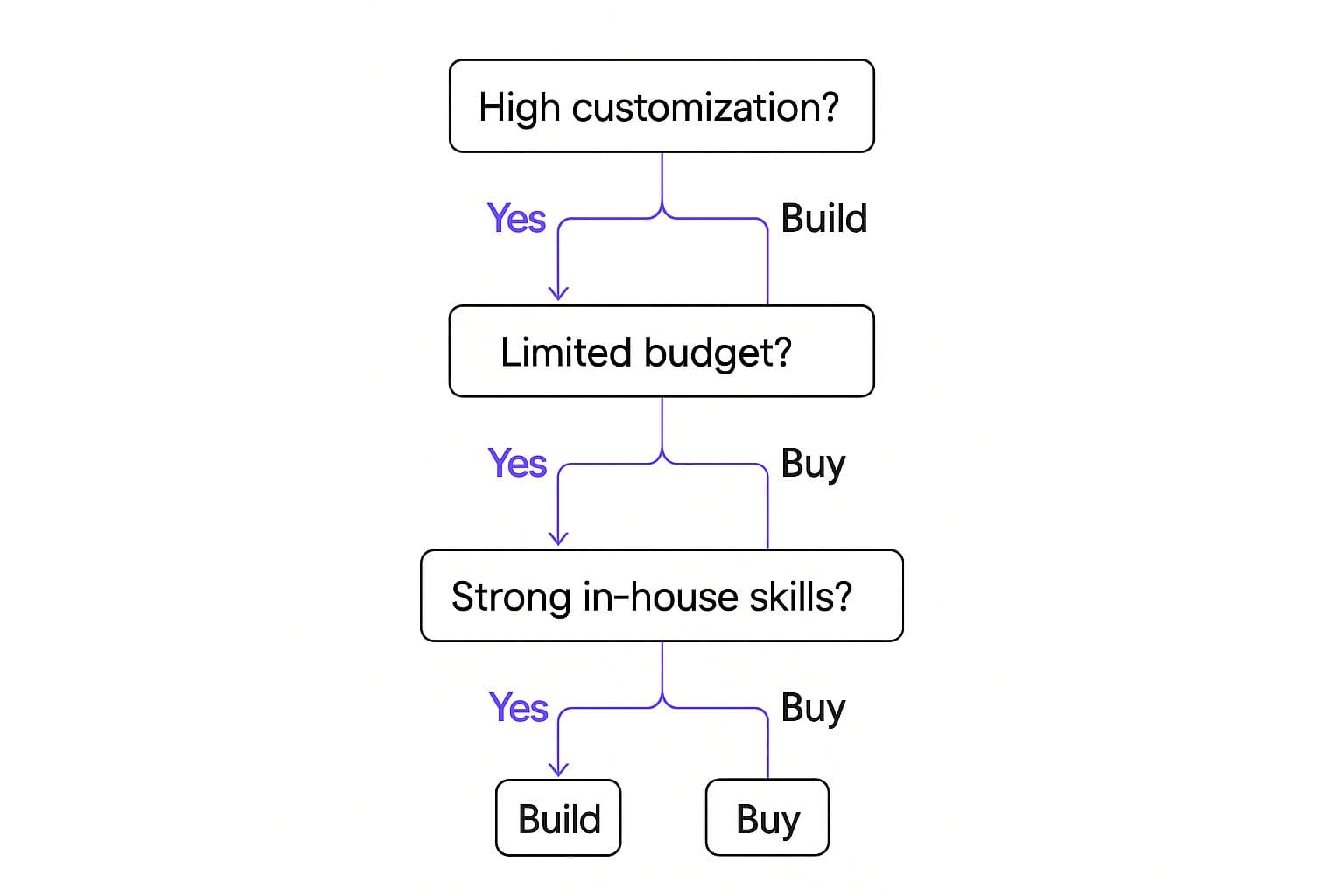
As you can see, a high need for customization immediately points you toward building. On the flip side, tight budgets and limited in-house skills will always push you back toward buying.
Resource and Capability Assessment
Finally, it’s time for a reality check on your internal resources. I'm talking about your budget, your timeline, and—most importantly—your team’s real-world technical skills. When you decide to build, you're not just building software; you're committing to becoming a software maintenance company for the long haul.
Ask yourself these three questions:
- Budget: Can you handle a large, upfront capital investment (Build), or does a predictable, recurring operational expense (Buy) make more sense for your finances?
- Timeline: Do you have the luxury of waiting months, or even years, for a custom solution to be ready? Or do you need something that can start delivering value right now?
- Talent: Do you have an experienced development team on hand? Not just to build the thing, but to maintain, secure, and update it for its entire lifespan?
Answering these questions honestly will give you the final pieces of the puzzle. Once you know what's most important, our guide on choosing a feature prioritization framework can help you map out the essential features, whether you're scoping a custom project or evaluating off-the-shelf tools.
Frequently Asked Questions
The build vs buy software debate isn't always straightforward. It's filled with "what ifs" and "it depends" scenarios unique to every business. Here are answers to some of the most common questions I hear from leaders trying to make the right call.
How Does Company Size Affect The Build vs Buy Decision?
Company size is a massive factor. It dictates your resources, appetite for risk, and what you prioritize strategically. What makes sense for a startup is often completely wrong for a large corporation.
- Startups: For early-stage companies, speed is everything. You need to get to market, test your idea, and get feedback yesterday. Buying an off-the-shelf tool is almost always the right move. It lets you launch fast, keep your cash burn low, and avoid getting bogged down in a development project before you've even validated your model.
- Mid-Sized Businesses: This is where things get interesting. Companies at this stage often blend their approach. They'll buy software for the standard stuff—think HR or accounting—but they'll build custom tools for the unique processes that give them an edge over the competition.
- Large Enterprises: With deep pockets and complex global operations, big companies are the most likely to build. A custom solution can be perfectly molded to their specific, often convoluted needs, integrate with ancient legacy systems, and become a proprietary asset that no competitor can copy.
When Is A Hybrid Build and Buy Approach Suitable?
A hybrid strategy can be the perfect compromise, giving you the immediate value of a pre-built solution alongside the tailored fit of a custom one. It’s the best option when an off-the-shelf product gets you about 80% of the way there, but the remaining 20% is absolutely critical.
A classic example is buying a major CRM platform but then building a custom module to link it with your homegrown inventory management system. You get all the battle-tested features of the big-name CRM while still supporting the specific workflows that make your business tick.
What Are The Hidden Costs Of Buying Software?
The monthly subscription fee is just the beginning. The Total Cost of Ownership (TCO) for purchased software is full of surprises that can blow up your budget if you aren't prepared. You have to look well beyond the price tag.
Keep an eye out for these common hidden costs:
- Data Migration: Getting your data out of old systems and into a new one is rarely a simple copy-paste job. It can be a messy, time-sucking project that requires expert help.
- User Training: Your team won't magically know how to use the new software. Expect a hit to productivity as they learn the ropes, plus the cost of any formal training sessions.
- Complex Integrations: Getting the new tool to talk to your existing tech stack (like your accounting or marketing software) can require custom code or pricey third-party connectors.
- Customization Fees: You can't change the core product, but vendors often charge a premium for even minor tweaks and configurations to make it work for you.
- Overage Charges: Go over your user, data, or API call limits, and you can get hit with some shockingly high fees.
If you know you need a custom solution for a core part of your business but can't afford a long, risky development cycle, Iglu Digital can help. We specialize in building and launching a market-ready MVP with the price fixed before we start, so you can turn your idea into a real product without the wait. Learn how we can accelerate your vision.