

Mastering Feature Prioritization Frameworks
Table of Contents
A feature prioritization framework is simply a structured way for product teams to figure out what to build next. It’s the process of ditching the guesswork and gut feelings for a clear, objective system. The goal? To make sure every precious minute and dollar goes toward features that actually deliver value to customers and the business.
Why Most Product Features Fail to Make an Impact

Think of your product team like a brilliant chef in a kitchen stocked with amazing ingredients—customer feedback, market research, stakeholder requests, and a flood of innovative ideas. Without a solid recipe, that chef is just throwing things together, hoping it turns into a Michelin-star meal. More often than not, you end up with a confusing mess nobody wants to eat.
This is precisely what happens when product teams work without a clear prioritization framework. They sink months of effort, countless hours of development time, and a ton of money into a new feature, only to see it completely ignored by users when it finally launches.
The Cost of Building Without a Plan
This isn't some rare cautionary tale; it's the reality for a lot of companies. Research shows that a staggering 70% of product features are rarely or never used. It’s a classic symptom of the 'feature factory' problem, where teams are just churning out work based on who shouts the loudest, not on what the data says.
A feature prioritization framework is the recipe that brings order to the chaos. It gives everyone a shared, objective system to sift through hundreds of competing ideas and make smart decisions.
When you start using a structured approach, you ensure your work directly supports key business goals and creates a better product. This simple shift is crucial for several reasons:
- Creating Alignment: It gets everyone—from engineering and marketing to sales and leadership—on the same page and working toward the same goals.
- Improving Transparency: Stakeholders can finally see why some features are at the top of the list while others are on the back burner. This cuts down on friction and keeps expectations realistic.
- Boosting User Satisfaction: When you focus on high-impact features, you’re solving real problems for your users. That’s the foundation of all great user experience design best practices.
At the end of the day, it's about breaking free from the "feature factory" mindset and adopting a disciplined, value-first development process. It's how you make sure every single release actually matters.
Digging into the Core Prioritization Models
Now that we understand why we need a system, let's get into the how. I'm going to walk you through three of the most effective and widely-used models out there. Each one gives you a different lens for looking at your feature list.
Think of them like different knives in a chef's roll. You wouldn't use a cleaver for fine dicing, and you wouldn't use a paring knife to break down a whole chicken. The right model really comes down to your team's style, how far along your product is, and what you’re trying to figure out.
The MoSCoW Method: Getting Clear with Categories
The MoSCoW method is all about creating immediate clarity. It's a simple but surprisingly powerful way to get everyone on the same page by sorting features into four straightforward categories. This makes it a fantastic communication tool, especially when you're trying to bridge the gap between technical and non-technical folks.
The name itself is an acronym that spells out the four buckets:
- Must-have: These are the absolute deal-breakers. If you ship without these, the product is essentially broken or doesn't fulfill its core promise.
- Should-have: These are important and add a ton of value, but the product can still launch without them. Think of them as high-priority items that you’ll tackle as soon as the must-haves are done.
- Could-have: These are the "nice-to-haves." They're good ideas but have a smaller impact on the core user experience. They’re usually the first to go if you're crunched for time.
- Won't-have: This one is crucial for keeping your project focused. It's a clear list of what you've all agreed not to work on for this specific release, which is your best defense against scope creep.
MoSCoW really shines in fast-paced agile settings where you need to make quick calls to define a Minimum Viable Product (MVP). For teams new to prioritization, its simplicity is a huge win. To get more familiar with the lingo, our guide on essential agile development terms is a great place to start.
The RICE Model: Making Decisions with Data
Where MoSCoW brings qualitative clarity, the RICE model brings the numbers. Developed by the product team at Intercom, this framework forces you to swap gut feelings for a calculated score, giving you a more objective way to rank your features.
It's a quantitative model that has you evaluate each feature against four factors:
- Reach: How many people will this feature impact in a given timeframe?
- Impact: How much will this feature move the needle on our main goal (e.g., conversion, adoption)? This is usually scored on a scale from 0.25 (minimal) to 3 (massive).
- Confidence: How sure are we about our estimates for Reach and Impact? This is a percentage (50% = low confidence, 80% = medium, 100% = high).
- Effort: How much time will this take from our product, design, and engineering teams?
You plug these into a simple formula: (Reach x Impact x Confidence) / Effort. The higher the final score, the higher the priority.
This simple infographic below does a great job of showing the core difference between the RICE and MoSCoW approaches.
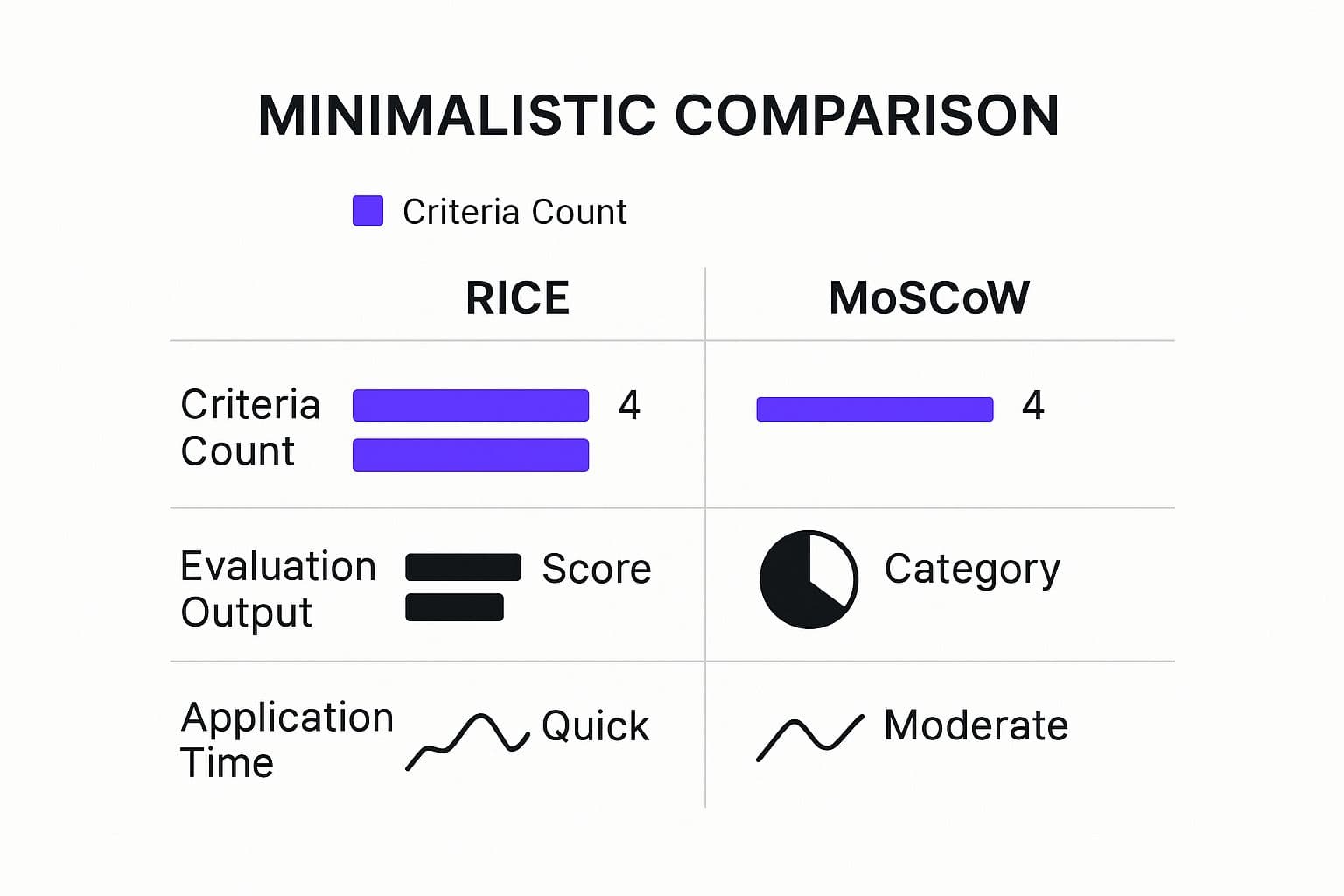
As you can see, MoSCoW gives you clear, qualitative buckets, while RICE delivers a specific score. This makes RICE a bit more time-consuming, but the data-backed clarity is often worth the effort.
The Kano Model: Focusing on Customer Delight
Finally, let's talk about the Kano Model. This framework flips the script and looks at prioritization entirely through the eyes of your customer. Developed by Professor Noriaki Kano, it’s all about understanding the emotional response a feature will trigger in a user.
It helps you separate the features that just meet expectations from the ones that genuinely delight people.
The model sorts features into three core types:
- Basic Features: These are the things users just expect to be there. Think of brakes on a car. No one gets excited that a car has brakes, but they'd be furious if it didn't. Their absence causes dissatisfaction, but their presence doesn’t impress anyone.
- Performance Features: For these, more is better. Think gas mileage. The better the mileage, the happier the customer. Satisfaction here is linear—the more you invest, the more satisfied users become.
- Excitement Features (Delighters): These are the surprise-and-delight moments. They are the unexpected extras that create a "wow!" reaction and can set you apart. Users don't know to ask for them, so their absence isn’t a problem, but their presence creates loyal fans.
Using the Kano Model ensures you're not just building a functional product, but one that creates an enthusiastic and loyal user base by strategically including those moments of delight.
Comparing Key Feature Prioritization Frameworks
To help you decide which framework might fit your needs, here's a quick side-by-side comparison of the three models we've just covered. Each has its own strengths and is best suited for different situations.
| Framework | Primary Method | Best For | Key Benefit |
|---|---|---|---|
| MoSCoW | Qualitative Categorization (Must, Should, Could, Won't) | Quick alignment, MVP definition, and clear communication with stakeholders. | Simplicity and speed. Easy for anyone to understand. |
| RICE | Quantitative Scoring (Reach, Impact, Confidence, Effort) | Data-driven teams, comparing dissimilar ideas, and removing personal bias. | Objectivity. Forces evidence-based decisions. |
| Kano | Customer Satisfaction Analysis (Basic, Performance, Delighters) | Understanding user needs deeply, identifying competitive differentiators. | Customer-centricity. Focuses on what delights users. |
Ultimately, seeing them laid out like this highlights that there's no single "best" framework. The right choice is the one that best aligns with your team's goals, available data, and the kind of product decisions you need to make right now.
The Strategic Benefits of a Formal Framework

Let's be honest. Without a clear system, product decisions often come down to gut feelings, internal politics, or simply who shouts the loudest. Adopting a formal prioritization framework is how you move past that chaos and start making choices based on solid data and strategy.
This isn't just about making a list. It’s about creating a shared understanding across the entire company. When your engineering, marketing, and leadership teams all use the same scorecard to weigh new ideas, departmental silos begin to break down. Suddenly, everyone is speaking the same language, pulling in the same direction, and aligned on why one feature is being built now while another waits.
Driving Tangible Business Results
A good framework has a direct, measurable impact on your return on investment (ROI). It forces every team to connect their work back to a real business goal. This simple act of justification ensures your most precious resources—time and money—are spent on features that actually move the needle on growth, customer happiness, or market position.
This is where effective resource allocation in project management comes into play. It's not just about managing a budget; it's about making smart, strategic bets with confidence. A framework gives you the clarity to make those tough calls.
This clarity doesn’t just feel good—it creates real momentum. Teams are more focused and motivated when they can see a direct line from their daily work to the company's big-picture goals.
Ultimately, a framework is more than just a process. It’s a tool that brings predictability, alignment, and a laser focus on value to your product development cycle. The result is a stronger, more resilient organization that consistently delivers features that truly matter to both the business and its customers.
How to Choose the Right Framework for Your Team
Picking a feature prioritization framework isn't about finding the one "best" method. It's about finding the right key for your team's specific lock. The perfect framework should feel like a natural extension of how you already work, bringing clarity and confidence to your decisions, not burying you in spreadsheets and process.
Think about it: a scrappy startup racing to get its MVP out the door operates in a totally different universe than a massive enterprise tweaking a product with millions of users. One needs to move fast and make decisive calls, while the other has to justify every engineering hour with hard data. Forcing a complex, number-crunching model on a team that just needs to ship is a surefire way to kill momentum.
Start by Looking in the Mirror
Before you even glance at a framework, you need to get real about where you stand. What’s your team's situation right now?
For a young team just trying to get a V1 out, a simple and direct approach like the MoSCoW method is often a godsend. It forces you to have clear, tough conversations about what’s a Must-Have versus a Should-Have, aligning everyone from the CEO to the junior dev without getting lost in the weeds of complex scoring. Its beauty is in its simplicity.
But what if your team is swimming in data and constantly has to defend its roadmap to skeptical stakeholders? That’s where a quantitative model like RICE really shines. It forces you to put numbers behind your gut feelings about reach, impact, and effort. It’s perfect for organizations where "show me the data" is the company mantra.
And if your main goal is to blow your customers' minds? Then the Kano Model is your secret weapon. It completely reframes the conversation away from just "what should we build?" to "how will this make our users feel?". It helps you pinpoint those game-changing features—the ones that turn casual users into raving fans and give you a real competitive edge.
A Quick Checklist for Making the Call
Don't overthink it. Grab your team and run through these questions. Your answers will point you directly to the framework that makes the most sense for you.
- What stage is our company in? Early-stage startups usually thrive with simpler models like MoSCoW. More established companies might need the rigor of RICE or Weighted Scoring to manage complexity.
- How old is our product? Are you trying to define a brand-new MVP, or are you looking for ways to innovate on a mature product? The Kano model is fantastic for finding differentiation in a crowded market.
- What data do we actually have? Be honest. If you can’t confidently estimate metrics like reach or impact, a data-heavy framework like RICE will be more frustrating than helpful.
- What’s our team’s vibe? Are you a collaborative, whiteboard-loving crew, or are you more analytical and data-driven? Play to your strengths.
- Who are we trying to convince? Pick a framework that spits out a result your key stakeholders can easily understand. If they don’t trust the process, they won’t buy into the plan.
Answering these questions as a team will do more than just help you pick a framework. It will clarify your priorities and give everyone the confidence to build the right thing, right now.
Putting Your Framework Into Action

Picking a framework is a great start, but the real magic happens when you bring it to life. A framework on paper is just a theory; its true power is unlocked when you weave it into your team's everyday workflow, turning abstract ideas into tangible decisions. It's not about adding complicated steps, but about being deliberate in how you approach your roadmap.
It all starts with getting organized. You need to capture every single idea—from customer support tickets, executive lightbulb moments, and user suggestions—and get them all into one place. Whether you use a dedicated project management tool or a simple spreadsheet doesn't matter as much as having a central backlog. Without it, you're guaranteed to lose brilliant ideas in the chaos.
Establish Your Evaluation Criteria
Once you have your master list of ideas, you need a consistent way to evaluate them. What does "good" actually look like for your product right now? Your criteria should be a direct reflection of your most critical business goals.
If you’re laser-focused on acquiring new users, for example, then factors like market appeal and potential reach should carry the most weight. But if your main goal is to keep the customers you already have, you'll want to prioritize features that boost engagement and user satisfaction.
A world-class example of this is how Google uses OKRs (Objectives and Key Results). They constantly realign their feature development with their big-picture goals. By reviewing priorities every quarter against measurable outcomes, Google ensures its teams are always building what matters most. This method forces a healthy balance between what users want (desirability), what your team can build (feasibility), and what makes sense for the business (viability). For more on how top companies tackle this, check out the insights on eleken.co.
Lead Effective Prioritization Meetings
With your ideas logged and your criteria set, it's time to bring everyone to the table. Think of this meeting as a collaborative workshop, not a lecture. The product manager is there to guide the conversation, making sure everyone gets a say and that the discussion stays grounded in the framework you've all agreed on.
This is where you collectively score, rank, and sort each feature using your chosen model. When the whole team participates in the scoring, it creates a powerful sense of shared ownership over the final roadmap.
Communicate and Iterate on Your Roadmap
The meeting might be over, but you're not done yet. The final pieces of the puzzle are communication and continuous improvement.
- Communicate the Decisions: Don't just send out a new list. Proactively share the updated priorities and, more importantly, explain the why behind them. Referencing the framework and the data you used builds trust and keeps everyone aligned.
- Update the Product Roadmap: Your newly prioritized list needs to be reflected in your official product roadmap. This is what makes the plan real and actionable for the entire company.
- Schedule Regular Reviews: A roadmap is a living document, not a stone tablet. Markets shift, new data emerges, and customer needs change. Set a regular rhythm—maybe monthly, maybe quarterly—to revisit your backlog and make sure your priorities are still pointing you in the right direction.
Common Questions About Feature Prioritization
Even with the perfect framework in hand, you're going to hit some tricky situations. That's just part of the process. Knowing how to navigate these common bumps in the road is what separates a smooth-sailing product team from one that’s constantly getting stuck.
Let's walk through a few of the questions I hear most often from product managers.
How Often Should We Revisit Our Priorities?
This is a big one, and the honest answer is: it depends on your team's pulse.
If you're running in an Agile environment, it's smart to take a quick look at your priorities at the beginning of every sprint. This usually means a check-in every two to four weeks. It keeps the team grounded and focused on what truly matters right now.
For the bigger picture—your strategic product roadmap—a quarterly review is a great rhythm. This gives you enough time to see real progress but keeps you nimble enough to react to new customer feedback, a sudden market shift, or a bold move from a competitor. But remember, these are just guidelines. If a game-changing user insight or a critical bug pops up, don't wait for the next scheduled review. Jump on it immediately.
What Is the Biggest Mistake Teams Make?
The single biggest trap I see teams fall into is treating their chosen framework like gospel. They plug in the numbers, get a RICE score or a MoSCoW bucket, and assume that’s the final word. It's not.
These frameworks are conversation starters, not decision-making machines. They’re designed to give you a common language and a data-informed starting point. But teams get into real trouble when they let a number on a spreadsheet overrule their collective experience and business sense.
The real magic happens when you combine the objective outputs of a framework with the rich, qualitative insights your team brings to the table. That blend of data and human expertise is where the best product decisions are born.
How Do You Handle Stakeholder Disagreements?
First, remember that disagreements are a good thing. They mean people care. When stakeholders have different ideas about what should come next, a solid framework is your best friend for navigating the conversation.
It helps you shift the debate away from a subjective battle of wills ("I think my feature is more important!") to an objective discussion ("Which of these features best serves our agreed-upon goals?").
When you feel the tension rising, bring everyone back to your framework. Use it as your anchor.
- Encourage stakeholders to make their case using the framework's terms.
- Ask clarifying questions like, “Can we walk through the data you used for that Impact score?”
- Or, you might ask, “How does this proposed feature fit our definition of a Must-Have?”
This simple pivot changes the entire dynamic. What could have been a heated argument becomes a collaborative problem-solving session, ensuring that every final decision is tied directly back to the strategy everyone has already bought into.
Ready to turn your idea into a market-ready product without getting bogged down in endless prioritization debates? At Iglu Digital, we specialize in building functional, user-focused MVPs with the scope and the price agreed before we start, ensuring your most critical features get to market fast. Let's build your vision together.