

How to Build MVP: Create a Successful Product on a Budget
Table of Contents
Before you can build a Minimum Viable Product (MVP), you have to get laser-focused. It all starts by defining the single, most critical problem your product is designed to solve. From there, you identify the absolute core features needed to address that problem and build only those.
This isn't about launching a perfect product; it's about launching a learning tool. The entire strategy is built around one goal: validating your core idea with real users before you sink significant resources into it.
Why an MVP Is Your Smartest First Investment
Let's cut right to it. A Minimum Viable Product isn't about shipping something cheap or unfinished. It's a calculated, strategic process designed to answer one crucial question: Does anyone actually want this?
So many founders get trapped by their passion. They spend months, sometimes years, building a feature-packed product in a vacuum. They finally launch, full of hope, only to be met with market indifference. It's a classic, and often fatal, mistake.
The MVP approach completely flips that script. Instead of building on assumptions, you build to test them.
Your MVP as a Learning Machine
Think of your first release not as a final draft but as a scientific experiment. The immediate goal isn't profit or a massive user base. The goal is validated learning. You're essentially building a machine to gather hard data directly from the people you want to serve.
This mental shift is everything. Every single feature, design choice, and line of code should be there to test a specific hypothesis you have about your users and their problems.
For instance, a startup creating a new meal-planning app might assume users want intricate nutritional breakdowns and complex recipes. An MVP would test a much more fundamental idea first: "Will users consistently log one meal per day if the process takes under 30 seconds?" This forces development to focus on a single, vital user action, proving the concept before adding complexity.
Ruthless Prioritization: Building What Truly Matters
This process forces a kind of ruthless prioritization that's hard to achieve otherwise. You're no longer staring at a long, overwhelming list of "nice-to-have" features. Instead, you're locked in on the "must-haves"—the functionalities that deliver immediate, tangible value.
This intense focus brings several powerful advantages:
- Speed to Market: You get a working product into the hands of real people faster than any other way.
- Resource Efficiency: It stops you from burning cash and developer hours on features that don't solve the core problem.
- User-Centric Growth: Feedback from your first users directly guides what you build next, ensuring you create something people will actually use and pay for.
To get this right, you need a clear framework for deciding what makes the cut. We often use a simple matrix to map features by user value and the effort required to build them. It’s a great way to visualize your priorities and keep the team aligned.
Here’s what that looks like in practice.
MVP Core Feature Prioritization Matrix
This table helps prioritize features by mapping user value against implementation effort, ensuring your MVP focuses on the most impactful, low-effort functionalities first.
| Feature Idea | Core Problem Solved | User Value (High/Medium/Low) | Development Effort (High/Medium/Low) | Include in MVP? (Yes/No) |
|---|---|---|---|---|
| Example: One-Click Meal Logging | Users are too busy to track food intake manually | High | Low | Yes |
| Example: Basic Calorie Counter | Users want to monitor daily calorie consumption | High | Medium | Yes |
| Example: Custom Recipe Builder | Users want to create and save their own recipes | Medium | High | No |
| Example: Social Sharing | Users want to share their progress with friends | Low | Low | No |
By visually laying out what to build, you can confidently make tough decisions and avoid "feature creep." The goal is to fill the "High Value, Low Effort" quadrant first.
Ultimately, focusing on learning before you launch a "finished" product lays the groundwork for sustainable growth. If you’re considering this path, exploring the specifics of MVP software development services can give you a much clearer roadmap. It’s the smartest first move you can make.
Defining What's Truly 'Minimum' and 'Viable'
Before a single line of code gets written, the real work has to happen. This is where you separate a game-changing idea from a passion project that goes nowhere. The whole point of an MVP is to test a core belief with the least amount of effort, and that test begins with some serious, focused thinking.
A lot of founders fall into a common trap: they think 'minimum' means a watered-down version of their grand vision. It doesn't. ‘Minimum’ refers to the smallest feature set needed to solve one specific problem for one specific group of people.
That’s it. You aren’t building a skeleton of a massive product. You’re building a sharp, effective tool that does one job perfectly. Getting this right from the start helps you sidestep the dreaded "feature creep" that kills timelines and drains budgets—a major reason so many great ideas fizzle out.
Finding a Problem Worth Solving
Your first job isn’t to dream up features; it’s to find pain. You have to lock onto a real, measurable frustration that a specific audience feels. This means getting out of your own head and gathering some real-world intel.
Don’t think massive surveys or expensive focus groups. For an MVP, research is all about targeted conversations. Find 10-15 people who you think are your ideal customers and just talk to them. Don't pitch your idea. Instead, ask open-ended questions about their day, their frustrations, and what they’ve already tried to fix the problem themselves.
This kind of qualitative feedback is pure gold. It helps you see the world through their eyes and truly understand their core need.
Mapping the Core User Journey
Once you’ve got a handle on the problem, you can start mapping out the single most important path a user will take. A user journey is simply the sequence of steps someone follows to get something done with your product. For your MVP, you need to isolate the one journey that delivers the most value and directly tests your primary assumption.
Let’s say you want to build a platform for freelance designers. The big picture might include project management, invoicing, and client messaging.
Everything else—custom domains, more templates, contact forms—is noise at this stage. You’re just trying to prove that people will actually complete that one core action. If they won't, none of the other fancy features matter.
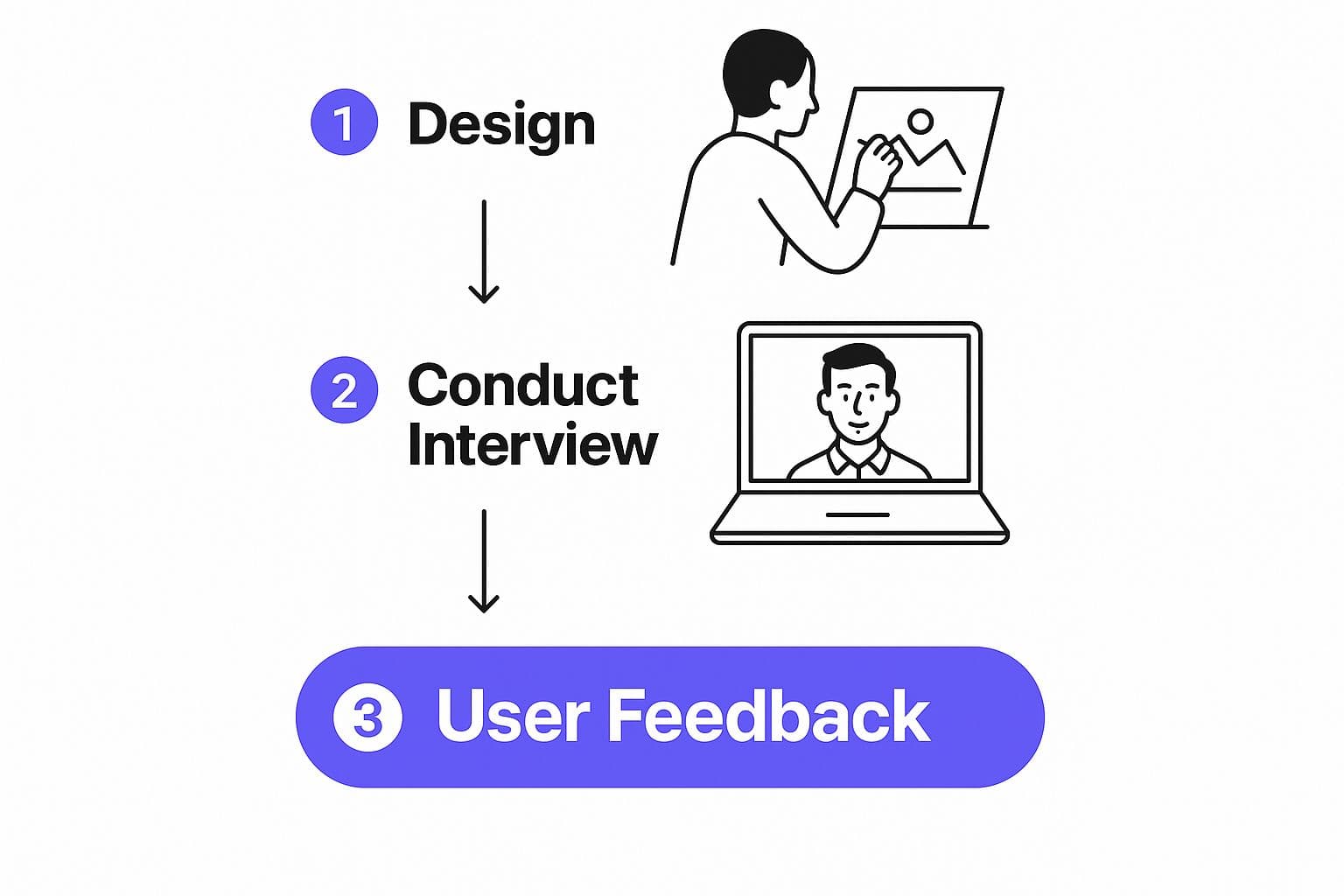
Getting this direct feedback is the only way to know if you're building something people actually need.
Brutal Prioritization with the MoSCoW Method
With a clear user journey in hand, you can finally start talking about features. This is where discipline is key. It’s so easy to let "nice-to-have" ideas water down your focus. You need a ruthless system to keep you honest.
One of the best tools I've seen for this is the MoSCoW method. It’s a simple framework that forces you to sort every potential feature into four buckets:
- Must-have: These are the absolute deal-breakers. The product literally cannot launch or solve the core problem without them.
- Should-have: Important, but not critical for day one. They add a lot of value, but the product can still work and be tested without them.
- Could-have: These are the "if we have time" features. Small improvements that are easy to add later but aren’t essential now.
- Won't-have (this time): Features that are explicitly kicked out of this version. Naming them helps manage everyone's expectations and stops them from creeping back in.
Let’s look at our portfolio builder again through this lens:
| Category | Feature Examples | Justification |
|---|---|---|
| Must-have | User Account Creation, Image Uploader, Single Page Template, Publish Button | Without these, the core journey of creating and sharing a portfolio is broken. |
| Should-have | Basic Text Editor, Option to Reorder Images, Mobile-Responsive View | These make the experience better but aren't needed to prove the basic concept. |
| Could-have | Multiple Template Choices, Simple Contact Form | Nice additions that can easily wait until after you know people want the core product. |
| Won't-have | Custom Domain Integration, Blog Functionality, Advanced SEO Tools | These are big, complex features for a future release, far beyond the MVP. |
This process turns a messy wish list into a crystal-clear roadmap. Your MVP is built only from the "Must-have" list. That intense focus is what makes sure you're building the 'minimum' product needed to be 'viable'.
Building Your MVP: Moving Fast Without Breaking Things

Alright, you've mapped out the user journey and pinpointed the absolute "must-have" features. Now comes the exciting part: turning those blueprints into a real, tangible product. This is where the rubber meets the road, and the decisions you make will have a direct impact on your launch timeline, your budget, and the quality of feedback you get from those first crucial users.
The build phase is a classic balancing act. You have to be quick, but you can't be careless. The entire point is to create a working, dependable product that lets you test your core business idea. Every choice, from the technology you use to how you manage your team, needs to serve that one clear goal.
Choosing Your Development Path
One of the first big questions you'll face is how to actually build this thing. Broadly speaking, you have two main options, and the right one depends entirely on your specific goals, budget, and technical comfort level.
- No-Code/Low-Code Platforms: This is the fast track. Tools like Bubble, Webflow, or Adalo let you build surprisingly powerful apps using visual, drag-and-drop interfaces. It's a fantastic way to get a clickable, interactive product into users' hands in weeks—or even days—to validate an idea before sinking serious cash into custom engineering.
- Custom Code Development: This is the traditional route of building from scratch with programming languages. It takes more time and money upfront, but it gives you complete control and infinite flexibility. If your MVP needs complex business logic, unique integrations, or a special algorithm that a no-code tool just can't handle, this is the path you'll need to take.
There's no wrong answer here. I've seen many smart founders start with a no-code MVP to prove there’s real demand. Once they have that validation, they can confidently invest in a more robust, custom-coded version.
Why Agile Is Your Best Friend for an MVP
No matter which path you choose, you need to think agile. Agile isn't just a trendy project management term; it's a philosophy that's perfectly built for the inherent uncertainty of creating something new. It takes the massive, intimidating task of "building an app" and breaks it down into small, digestible chunks.
This works through sprints—short, focused work periods, usually lasting one or two weeks. In each sprint, your team focuses on completing a handful of features. We define these features as user stories, which keeps the focus squarely on the customer's needs.
For example, instead of a dry technical task, a user story sounds like this:
- "As a new user, I want to sign up with my Google account so I can get started quickly."
- "As a logged-in user, I want to see my dashboard so I can view my recent activity."
This approach means you're always making visible progress. At the end of every sprint, you have a slightly better, more complete version of your product that you can actually test and react to. It's this cycle of build-test-learn that lets you pivot without derailing the whole project.
Keeping Your Build Team on Track
Your development team is the engine driving this entire process. Whether you're working with a freelancer, an agency partner, or an in-house team, crystal-clear communication is absolutely essential.
Daily stand-ups or frequent check-ins are your best tool for this. The goal isn't to micromanage; it's to create a tight feedback loop to spot problems early and make sure everyone is pulling in the same direction. Make sure your developers understand the 'why' behind each feature, not just the 'what'. When they know the core hypothesis you’re testing, they can often suggest smarter, faster ways to get there.
This iterative development is the heart and soul of the MVP method. For a deeper dive into the nuts and bolts of managing this phase, check out our complete guide on MVP development for startups.
A ‘Minimum’ Viable Product Is Not a Sloppy Product
Let's be clear on one final, critical point: "minimum" does not mean "low quality." An MVP riddled with bugs, a confusing interface, or constant crashes will give you garbage feedback. You’ll have no idea if people rejected your idea or just the broken product you gave them.
Your MVP must, at a minimum, deliver a clean, reliable, and intuitive experience for its core features. That means:
- Intuitive Design: A user should be able to figure out the main function without needing a manual.
- Rock-Solid Performance: The key features have to work. Every single time.
- Professional Polish: It needs to look and feel credible enough for users to trust it.
Spending time on solid design and quality assurance for your core functionality isn't an unnecessary luxury. It’s a basic requirement for getting the honest, actionable feedback you need to build a successful business.
Launching Your MVP and Measuring What Matters
Getting your MVP into the hands of real users is the moment of truth. This isn't the finish line; it’s the starting gun for the most important part of building your product: learning. A successful launch has nothing to do with a huge marketing splash. Instead, it’s a controlled, strategic release designed to get clean, honest feedback.
The entire point is to move from assumptions to actual evidence. You need to find out if the problem you think exists is real and if your solution actually clicks with the people you built it for. That takes a smart launch strategy and an obsession with the right kind of data.
The Power of a Controlled Soft Launch
Whatever you do, resist the urge to shout about your new product from the rooftops. A "big bang" launch at this stage is a terrible idea. You'll just get swamped with noisy, unfocused feedback from people who aren't your target audience, making it impossible to see what's actually working.
Instead, go for a soft launch. This just means releasing your MVP to a small, hand-picked group of early adopters. These should be the exact people you identified during your initial research—the ones who feel the problem most deeply. Your goal is to find somewhere between 10 to 50 initial users who will give you brutally honest insights.
Finding this first group is simpler than you think:
- Your Interview List: Start with the people you already spoke to when you were exploring the problem. They’re already invested.
- Niche Online Communities: Find the forums, Slack channels, or subreddits where your target users live. Offer them early, free access in exchange for their thoughts.
- Your Personal Network: Just ask for introductions to people who match your ideal user profile.
By keeping the group small and targeted, you create a feedback loop you can actually manage. You can have real conversations, watch how they behave, and get the high-quality insights you need to make smart decisions.
Moving Beyond Vanity Metrics
Once people are using the product, the next challenge is to measure what actually matters. It's incredibly easy to get distracted by vanity metrics—numbers that look great on a slide deck but tell you absolutely nothing about the health of your product.
| Vanity Metrics (What to Ignore) | Actionable Metrics (What to Track) |
|---|---|
| Total Sign-ups or Downloads | Weekly Active Users (WAU) |
| Social Media Likes | Feature Adoption Rate |
| Page Views | User Retention Rate (Cohort Analysis) |
| Time on Site (in general) | Core Action Completion Rate |
Chasing numbers like total downloads will only fool you into thinking you have traction when you really don't. You need to focus on metrics that reveal how users are behaving and whether they’re getting value.
The KPIs That Reveal the Truth
To truly understand if your MVP is on the right track, you have to track specific Key Performance Indicators (KPIs) that connect directly to your core assumptions.
Here are the essential KPIs for any MVP:
- User Engagement: Are people actively using the product? Look at daily or weekly active users. More importantly, are they performing the one key action your MVP was built for? If you made a simple invoicing tool, the most important metric isn't logins; it's the number of invoices created per user.
- Feature Adoption Rate: This tells you which parts of your product people actually find valuable. If your MVP has three core features, track how many users are engaging with each one. A low adoption rate on a feature you thought was a "must-have" is a giant red flag that you've misunderstood the user's needs.
- User Retention: This is probably the most critical MVP metric. Do people come back? A cohort analysis, where you group users by the week they signed up, is the best way to visualize this. If users from "Week 1" are still active in "Week 4," you're building something sticky. High churn is a clear signal that your product isn't delivering enough value to hold their interest.
Measuring an MVP’s success hinges on these kinds of metrics to validate interest and test for market fit. KPIs like retention, engagement, and direct customer feedback are what count. Industry research confirms that successful MVPs prioritize data collection above all else. You can find more practical advice on measuring MVP success from evnedev.com.
Blending Data with Human Stories
Quantitative data—the numbers—tell you what is happening. But to understand why it's happening, you have to talk to your users. This is where qualitative feedback becomes indispensable.
Set up quick, 15-minute feedback calls with your most active users. Just as importantly, talk to the users who signed up and then disappeared. Ask open-ended questions to get to their real experience.
This combination of hard data and human stories gives you the complete picture. It provides the evidence you need to make your next big decision: whether to persevere, pivot, or double down on what’s working.
Common MVP Mistakes That Sink Startups
Building a Minimum Viable Product is a smart move, but it’s no guarantee of success. I’ve seen far too many teams go through the motions of creating an MVP, only to watch their startup fizzle out anyway. Why? It almost always comes down to a few common, costly traps that completely undermine the point of the MVP in the first place.
Think of what follows as a pre-mortem for your project. By understanding these classic blunders now, you can learn from the hard-won lessons of others and make sure your hard work actually moves the needle.
The Lure of 'Gold-Plating'
One of the most tempting and dangerous mistakes is "gold-plating." It always starts small—just one little "nice-to-have" feature that seems quick to add. Then another. Before you know it, your lean, focused MVP has bloated into a slow, expensive project, a classic victim of feature creep.
- What this looks like: A team building a simple task management app decides to add "just one more thing"—a complex reporting dashboard with custom charts. They burn an extra month building it, convinced it will wow users. The launch gets delayed, the budget is shot, and the core idea still hasn't been tested.
- What to do instead: Stick to your "must-have" feature list like glue. Whenever the urge to add something new pops up, ask a simple question: "Does this feature directly help us test our core hypothesis?" If the answer is no, it goes on the "someday/maybe" list. The goal is validated learning, not a perfect product on day one.
Casting a Net That's Too Wide
Another fatal error is trying to build a product for everyone. The moment you define your target audience as "small businesses" or "college students," you've already lost. An MVP can't be a one-size-fits-all solution; it has to solve a specific, painful problem for a very specific group of people.
When you try to please everyone, you end up pleasing no one. Your messaging gets watered down, your features become generic, and your feedback becomes a noisy, contradictory mess. You absolutely have to find your niche.
Ignoring Early User Feedback
This one is perhaps the most tragic mistake. You do everything right—you build a lean product, you launch it to a targeted group, and the feedback starts rolling in. And then... you ignore it. Maybe the feedback clashes with your original vision, or maybe it’s just tough to hear.
- What this looks like: Early users of a new social app complain that the sign-up process is confusing. The founder dismisses it, thinking, "They just don't get it yet." He plows ahead with marketing instead of fixing a fundamental usability flaw.
- What to do instead: Treat every piece of feedback, especially the negative kind, as a gift. It's a direct roadmap telling you exactly what to fix. When you spot a pattern, act on it immediately. Remember, the whole reason you're building an MVP is to learn and adapt. Ignoring that data is like flying a plane with your eyes closed.
Of course, a product that simply works isn't enough; it has to be dependable. Skimping on testing is a surefire way to get unreliable feedback, as users won't know if they disliked your idea or just your buggy execution. To get this right, it's worth learning about the various quality assurance testing methods that ensure your product is stable.
The Risk of Not Building an MVP
Given these potential pitfalls, it's worth noting just how widespread this strategy has become. About 72% of startups now use an MVP approach to test and refine their products. This isn't just a trend; it's a globally recognized way to mitigate risk. Considering that around 50% of businesses fail by their fifth year, the MVP methodology helps lower those odds by validating assumptions with real user data before you go all-in. You can explore more insights on MVP development and startup survival rates from SDH.Global.
Frequently Asked Questions About Building an MVP
Even with the best roadmap, building an MVP is full of tough calls. It’s incredibly easy to get bogged down, endlessly debating minor features while your momentum grinds to a halt. I’ve seen it happen countless times.
Let’s cut through the noise. Here are the real questions we hear from founders every day—and the straightforward answers we’ve developed after guiding over 100 startups through this exact process. The goal here isn't theory; it's to give you the clarity to build, launch, and learn.
How ‘Minimum’ Should My MVP Actually Be?
This is the big one, isn't it? The million-dollar question. The answer is all about finding that delicate balance between "minimum" and "viable." Your MVP needs to be lean enough to launch fast, but not so lean that it fails to solve a real, specific problem for your first group of users.
Think of it this way: you're not building a flimsy skeleton of your final product. You're building one perfect, polished feature that proves your core idea.
- What it is: A tool that does one job exceptionally well. For a new food delivery app, that might mean a user can find one type of restaurant and successfully place an order. That’s it.
- What it isn't: A watered-down version of your grand vision, packed with half-finished features. Resist the urge to include a little bit of everything.
If a feature doesn't directly contribute to validating that single, critical user journey, it has to go. Be ruthless. Park it in the "maybe later" list and focus on what you need to learn right now.
Should I Use No-Code Tools or Custom Development?
How you build your MVP is just as critical as what you build. The choice between a no-code platform and writing custom code really boils down to your immediate goals, the complexity of your idea, and where you see this going long-term.
Choose no-code tools like Bubble or Adalo when your primary goal is speed and idea validation. If you just need to test a user flow or get a functional prototype in front of potential customers to see if they'll bite, no-code is your best friend. I’ve seen founders ship impressive no-code MVPs in less than two weeks for a tiny fraction of the cost of custom development.
Go with custom development when your MVP has to do heavy lifting from the start. This is the right path if your product relies on complex backend logic, unique API integrations, or needs to manage significant amounts of data securely. While it requires a bigger up-front investment, it gives you total freedom and a solid foundation to scale on.
How Do I Know if My MVP Is Successful?
Success for an MVP has nothing to do with vanity metrics like downloads or page views. An MVP is a success if it gives you a clear, data-backed answer to your core hypothesis. It tells you whether to pivot, persevere, or pull the plug.
You'll know it's working when you see these signals:
- Real Engagement: People aren't just signing up and leaving. They are actively and repeatedly using the one core feature you built.
- Sticky Users: A good chunk of your initial users keep coming back on their own, week after week. High retention is one of the strongest indicators that you're solving a painful problem.
- Clear, Unprompted Feedback: You start hearing things like, "This saved me so much time," or "I've been looking for something exactly like this!" When users can articulate the value without you feeding them lines, you've struck gold.
- Willingness to Pay: This is the ultimate form of validation. Even if only a handful of early adopters upgrade to a paid plan, it proves your solution has tangible economic value.
A successful MVP doesn't mean you're done. It means you have the clarity and confidence to know exactly what to build next.
Ready to stop planning and start building? At Iglu Digital, we specialize in turning your idea into a market-ready MVP with the scope and the price agreed before we start. We’ll help you define your core features, build a high-quality product, and start gathering the user feedback that truly matters. Transform your concept into a tangible product at https://iglu.dev.