

MVP Software Development Services Your Essential Guide
Table of Contents
MVP software development services are all about launching a new product with just its most essential features. The whole point is to get a working version out the door quickly, see what actual users think, and prove your big idea is solid before you pour a ton of time and money into building out every last bell and whistle.
What Are MVP Software Development Services, Really?
Think about building a new car. You could spend years perfecting the engine, designing a plush interior, and engineering a suspension system that feels like you're floating on a cloud. After all that work and a mountain of cash, you finally launch it... only to find out that your customers just wanted a cheaper, more fuel-efficient way to get to work. You've built a technical marvel, but you solved the wrong problem.
This is exactly the kind of costly mistake that MVP software development services help you sidestep. The Minimum Viable Product (MVP) philosophy completely flips that old-school process around. Instead of building the fully-loaded luxury car from day one, you start with a skateboard. No, it's not a car, but it gets the core job done: moving someone from point A to point B. It's a simple, low-cost solution you can put in front of users almost immediately.
From Skateboard to Sedan
Once people are actually using the skateboard, they'll give you feedback you could never get from a focus group. They might say, "This is cool, but I really need handlebars to feel more stable." Great! Your next step is to iterate and build a scooter. The scooter still isn't a car, but it's a direct response to a real user need you've just confirmed.
This feedback loop is the engine of MVP development. You go from scooter to bicycle, then maybe to a motorcycle, and eventually to a basic, functional car. Every single step is guided by hard data and user behavior, not just your team's assumptions in a conference room.
The MVP approach isn't about shipping a buggy or unfinished product. It’s about being smart and strategic. You identify the single most important problem your software solves and then build the leanest, simplest version possible to solve that one problem brilliantly.
The Core Ideas Behind the MVP Approach
The magic of MVP software development services comes from a few core principles that put learning and speed ahead of a feature-packed launch. Getting this mindset right is a game-changer for any founder or product manager.
- Laser-Focus on Core Functionality: The main goal is to build only what’s absolutely essential for the product to be "viable." This means being ruthless about cutting features that are just "nice to have" and pouring all your energy into the one or two things that give your first users immediate value.
- Get to Market, Fast: In the software world, speed is your unfair advantage. By launching a simpler product, you can start collecting user data months—or even years—before competitors who are bogged down in endless development cycles. That early feedback is pure gold for your long-term success.
- Validated Learning is Everything: Think of every feature in your MVP as an experiment designed to answer a question. You're testing a hypothesis, like "Will people actually pay for this?" or "Is this checkout process easy to use?" The feedback you get—from watching how people click, reading survey responses, or doing direct interviews—is the validated data you need to make smart decisions about what to build next.
Key Business Benefits of an MVP Strategy

Adopting an MVP strategy is about much more than just launching your product faster. It’s a fundamental shift in thinking that brings some serious business advantages, turning guesswork into a data-backed process. This approach acts as a crucial safety net in the often-unpredictable world of new product launches.
Instead of sinking a massive budget into a feature-packed product built on pure speculation, you zero in on a tight set of core functions. This minimalist approach doesn't just cut down on initial development costs; it stops you from wasting money on features your audience might not even care about.
Reduce Upfront Investment and Risk
The most obvious win with an MVP is just how much financial sense it makes. Going all-in on a full-featured product is a high-stakes gamble. An MVP, on the other hand, requires far less capital upfront because you’re only building the absolute must-have features.
This laser-focused approach lets you dip your toes in the market without betting the farm on an unproven idea. If it turns out your core concept doesn't resonate, you’ve learned an incredibly valuable lesson for a fraction of the potential cost. That leaves you with capital to pivot or pursue a new venture.
This strategic risk management is precisely why so many businesses now rely on mvp software development services. For startups especially, where every dollar is precious, this lean method can mean the difference between shutting down and living to fight another day. You can read more about how this works for new ventures in our guide on MVP development for startups.
Accelerate Your Time to Market
In a crowded market, being first can give you a huge, lasting advantage. An MVP is built for speed. By cutting the feature list down to the essentials, development cycles shrink from years or many months to just a few.
This ability to launch quickly allows you to:
- Capture an Early Adopter Base: Getting your product into users' hands fast helps you build a community and establish your brand before competitors even show up.
- Establish Market Position: Often, the first solution to a problem becomes the benchmark that all others are measured against.
- Begin the Learning Cycle Sooner: The faster you launch, the faster you can start gathering real-world feedback. That data is the fuel for smart iterations and growth.
Validate Your Idea with Real Users
Ultimately, the biggest benefit of an MVP is that it takes your idea out of the theoretical and into the real world, where it can generate actual data. It’s the ultimate reality check. Instead of relying on focus groups, you’re getting direct insights from people who are actually using your product.
This "validated learning" is gold when you need to prove your concept's potential to stakeholders like co-founders, your team, and investors. Showing them real user engagement metrics and positive feedback is infinitely more powerful than a business plan on its own. It's no wonder the global market for MVP tools and services is exploding, growing from USD 1.2 billion in 2023 to a projected USD 3.8 billion by 2032. You can dig into the data behind this trend in this detailed market report. This growth shows a clear global shift toward building products based on evidence, not assumptions.
The MVP Development Process: From Idea to Launch
Taking a brilliant idea and turning it into a real, functioning product can seem overwhelming. But building an MVP isn't about one giant leap; it's a methodical journey that turns abstract concepts into a clear, step-by-step plan. Think of it less as a "big bang" launch and more as a disciplined process focused on learning and adapting.
This structured approach ensures every decision is deliberate, from the initial discovery phase all the way to collecting that first piece of user feedback. The entire cycle is designed to be transparent and manageable, giving founders a clear roadmap to follow.
Phase 1: Rigorous Discovery and Market Research
Before you even think about writing a single line of code, a successful MVP begins with a deep dive into research. This isn’t just a quick look at your competitors. It's about making absolutely sure a real problem exists and that your solution is something people would genuinely use.
It’s a hard truth, but a surprising number of products fail not because they were built poorly, but because they solved a problem nobody actually had.
During this phase, your team will zero in on:
- Problem Validation: Conducting user interviews and surveys to hear firsthand about the pain points you want to solve.
- Market Analysis: Sizing up potential competitors to see how they're tackling the market and finding the gaps where you can shine.
- User Persona Definition: Crafting detailed profiles of your ideal early adopters. These profiles become your north star for design and feature decisions.
This groundwork is non-negotiable. It’s the foundation for your entire product strategy, saving you from wasting time and money building something for an audience that doesn't exist.
Phase 2: Strategic Feature Prioritization
Once you've confirmed you're solving a real problem, the temptation is to brainstorm an endless list of cool features. The MVP process forces you to resist that urge. Instead, you have to be ruthless about prioritizing. The goal is to identify the one or two core features that deliver the most value with the least amount of effort.
This is where expert MVP software development services really prove their worth by guiding you through proven frameworks.
A fantastic tool for this is the MoSCoW technique:
- Must-Have: These are the non-negotiable features. Without them, the product simply doesn't work.
- Should-Have: Important features that aren't critical for the first launch but should be included if time and resources allow.
- Could-Have: These are the "nice-to-haves"—desirable but not essential.
- Won't-Have (This Time): Features that are explicitly kicked out of the current scope to prevent "feature creep" and keep the project focused.
Using a framework like this forces you to have tough but necessary conversations, keeping the scope lean and centered on the core user journey. You're trying to define the smallest possible product that still solves the user's main problem.
Phase 3: The Build-Measure-Learn Feedback Loop
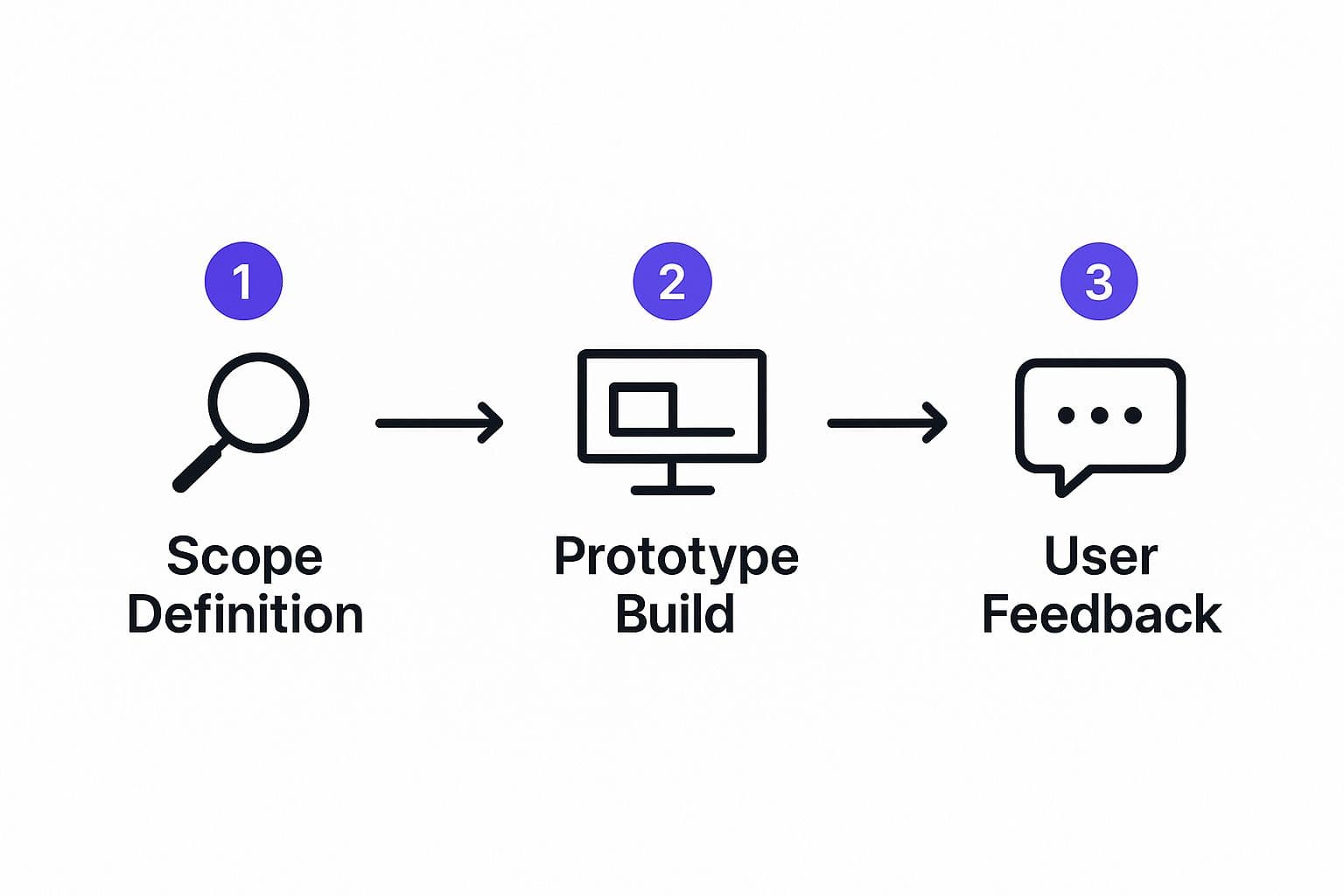
This is the engine that drives MVP development. Made famous by Eric Ries's book The Lean Startup, the Build-Measure-Learn loop is a cycle for turning ideas into products, measuring how real customers react, and then learning whether you need to pivot or stick with the plan.
This isn't a straight line from start to finish; it's a continuous cycle that fuels improvement. The whole point is to speed up your learning and stop wasting effort on things that don't actually matter to your users.
Here’s how the loop works in practice:
- Build: You develop the smallest possible piece of your product—the MVP—based on your prioritized feature list.
- Measure: You release it to your early adopters and collect data. This is both quantitative (How many people clicked this button?) and qualitative (What did users say in feedback forms?).
- Learn: You analyze all that data to find real insights. Did your hypothesis hold up? Did the feature actually solve the problem? This new knowledge directly informs what you build in the next cycle.
By repeating this process, you steadily move away from just assuming what people want and toward validated learning. It’s how you create a product that truly evolves to meet the needs of the market.
Breaking Down MVP Development Costs
Let's get straight to the big question on every founder's mind: "How much will this actually cost?" Budgeting for your product's first iteration can feel like a shot in the dark, but that final price tag isn't just a random number. It’s a direct reflection of your project's scope, the complexity of its features, and the team you bring on board to build it.
To move past fuzzy estimates and get to a real number, you need to understand the ingredients that go into the total bill. The investment in MVP software development services is ultimately shaped by a few core factors, and each one plays a major part in your financial planning.
Core Factors Influencing Your MVP Budget
The cost of an MVP isn't a single, fixed price. Think of it more like a recipe where the final cost depends on the ingredients you choose. Getting a handle on these key drivers is the first step toward building a realistic budget.
- Feature Complexity: This is almost always the biggest driver of cost. An app with a simple user login and one core function is worlds away from one that needs complex backend calculations, third-party API connections, or real-time data feeds. Every feature you add brings more development and testing hours with it.
- UI/UX Design Needs: A stunning, custom-built interface with slick animations and a deeply researched user journey will naturally require more resources than a clean, functional design using standard building blocks. Great design is non-negotiable, but the level of custom work directly shapes the budget.
- Technology Stack: Your choice of programming languages, frameworks, and cloud services absolutely matters. Some technologies allow for quicker development, while others might demand specialized developers who command higher rates. The key is finding a balance between performance and development efficiency.
- Team Composition and Location: The size, seniority, and location of your development team have a huge impact on cost. A senior-level team in North America will have a very different price point than a skilled mid-level team in Eastern Europe or Southeast Asia.
To put some real numbers on this, MVP development costs can swing wildly. A very basic product might come in around 10,000**, while a feature-rich, highly customized solution could easily surpass **150,000. Getting a precise quote always requires a detailed discussion about your specific project.
Estimated MVP Development Costs by Complexity
To give you a clearer picture, let's break down typical MVP costs into three general tiers. This framework can help you match your project's scope with a realistic financial plan. For a more detailed look at how these numbers are calculated, take a look at our complete guide on understanding software development cost estimates.
The table below gives you a general idea of what to expect at each level.
| Complexity Level | Estimated Cost Range | Typical Features & Scope |
|---|---|---|
| Simple MVP | 10,000 - 30,000 | Focuses on a single core problem with a limited feature set. Includes basic UI, manual processes, and only the most essential functionality. |
| Mid-Range MVP | 30,000 - 75,000 | Involves multiple core features, integrations with a few third-party APIs, and a more polished, custom UI/UX. The backend is more robust. |
| Complex MVP | $75,000+ | Requires advanced features like real-time data, complex algorithms, machine learning, high-level security, and multiple integrations. |
Ultimately, keeping your MVP cost in check comes down to discipline. You have to be ruthless in prioritizing your core value proposition and fight the temptation of "feature creep" at every turn. This focused approach ensures your initial capital is spent on validating your big idea, not just on building software for the sake of it.
How to Choose the Right MVP Development Partner
Picking a partner for your MVP is one of the most important calls you'll make. This isn't just about hiring a team to write code. You're bringing on a strategic ally who will help steer your product's first steps in the market. The best firms don't just build what you tell them to; they push back, question your assumptions, offer invaluable feedback, and guide you toward a smart launch.
Think of it like choosing a co-pilot for a tricky flight. You don't just want someone who knows the controls. You need a partner with the experience to handle unexpected turbulence, interpret the data correctly, and get you to your destination safely. The entire success of your MVP really hangs on this relationship.
Look Beyond the Polished Portfolio
Every development agency will show you a portfolio packed with their shiniest work. That's a starting point, but you have to dig much deeper to find the right fit. A slick user interface for a lifestyle app says very little about their ability to build a complex B2B SaaS platform.
Your mission is to find relevant experience. Look for teams that have built products in your industry or for your specific type of user. A team that's already navigated the maze of healthcare compliance or fintech regulations is going to be far more valuable than a generalist agency, no matter how impressive their other projects look.
When you're looking at their past work, ask yourself:
- Have they tackled problems that look like mine?
- Do their case studies talk about business goals and outcomes, or just technical details?
- Can they show how their work produced real results, like user growth or market validation, for their past clients?
This kind of scrutiny helps you separate the agencies that just build pretty things from the true partners who provide strategic mvp software development services.
Evaluate Their Process and Communication Style
The best partners are open, communicative, and work with a clear, well-defined process. You aren't just buying a finished product; you're stepping into a close collaboration that needs everyone to be on the same page. If a potential partner can't explain their methodology, that's a huge red flag.
Ask them to walk you through their development process. Do they use an agile framework? How do they run sprint planning, decide on feature priority, and handle feedback? A partner who can clearly lay out their step-by-step approach is one who values discipline and predictability—which is exactly what you need to stay on schedule and budget.
Communication is the glue that holds a project together. You should expect:
- A Dedicated Point of Contact: One person—a project manager or product owner—who is your go-to for everything.
- Regular, Scheduled Check-ins: Think daily stand-ups or weekly demos. You should always know what’s going on.
- Proactive Problem Solving: A good team will spot potential issues and bring them to you with proposed solutions, not wait for things to catch fire.
Assess Their Technical and Strategic Expertise
A top-tier partner does more than just write code; they bring strategic insight to the table. They should be able to have an intelligent conversation about your technology stack and offer solid advice. Their confidence here is a great sign of their technical depth. For a deeper dive into this critical choice, check out our guide on how to choose the right technology stack for your project.
During your early conversations, throw them some questions that test their strategic thinking.
- "Based on what you know about our goals, what are some potential roadblocks you see?"
- "How would you suggest we prioritize these features for the biggest impact?"
- "What key metrics should we be tracking right after launch to see if our idea is working?"
A team that only asks, "What do you want us to build?" is just a code factory. The partner you want is the one who asks, "What problem are we truly trying to solve for the user?" The quality of their questions is often far more revealing than the answers in their sales pitch. Choosing a partner with this mindset is how you turn a simple idea into a genuinely viable and successful product.
The Future of MVPs: Integrating AI from the Start

The concept of a minimum viable product is getting a serious upgrade. It’s no longer enough to build something that just works. The next generation of MVPs is being built to be intelligent right out of the gate. We're talking about embedding Artificial Intelligence (AI) and Machine Learning (ML) into the core fabric of a product from day one.
This isn't just a gimmick. It fundamentally changes the product from a static tool into a dynamic system that can learn and adapt. Instead of bolting on "smart" features down the road, savvy teams are weaving them in from the very beginning. The result? A product that makes a powerful first impression and actually gets better with every user interaction.
Making Your MVP Intelligent From Day One
Tacking on intelligence as an afterthought is a losing strategy. Today's users expect smarter, more personalized experiences, and the market rewards products that deliver. Building AI into your MVP’s foundation gives you an immediate and powerful edge over competitors still offering a one-size-fits-all solution.
This shift means even the leanest products can pack a sophisticated punch. Think about a new e-commerce app that doesn't just display items but starts learning a user’s style from their very first click to offer surprisingly good recommendations. That’s not a feature for version 3.0 anymore—it's the new standard for a successful launch.
This approach is becoming a core part of mvp software development services. Startups are now building adaptive products that learn from user behavior in real time, which drastically improves personalization and shortens the feedback loop. You can get a deeper look at how AI is influencing the startup world in this 2025 outlook from Molfar.io.
Practical Examples of AI in Early-Stage Products
The ways AI can enhance an MVP aren't just theoretical; they're delivering real results right now. By focusing on one high-impact use case, you can create a core product that feels lightyears ahead of anything else on the market.
Here are a few concrete examples:
- Predictive Analytics for User Behavior: Imagine a SaaS tool’s MVP using ML to analyze how early users interact with the platform. It could flag accounts at high risk of churning, allowing the team to step in with proactive support or a special offer to improve retention from the very start.
- Automated Content Curation: A new media platform could use AI to automatically tag and categorize articles based on their content and tone. This turns a slow, manual chore into an automated process, letting a small team manage a massive amount of content with ease.
- Enhanced Personalization: A fitness app MVP could analyze workout data to suggest small, personalized tweaks to a user's routine. The app starts to feel less like a simple tracker and more like a personal coach, creating a sticky experience that builds long-term loyalty.
When you build these kinds of intelligent features directly into the core of your product, you deliver immediate, obvious value. This sets a much higher bar for what an MVP can be—transforming it from a simple test into a powerful, self-improving machine.
Got Questions About MVP Development? We've Got Answers.
Jumping into the world of MVP software development can feel a bit confusing at first. Let's clear up some of the most common questions people have, so you can get a better handle on how it all works.
What’s the Real Difference Between an MVP and a Prototype?
This is a big one. Think of a prototype as a movie set—it looks like a real town from the front, but there's nothing behind the facade. It’s perfect for showing off your visual ideas and letting people click through a simulated user journey, but it isn't functional. A prototype asks, "Does this look right?"
An MVP, however, is more like the first, fully livable tiny home on a new plot of land. It might be small and basic, but it has running water, electricity, and a door that locks. It's a real, working product that early users can actually move into. An MVP asks a much more important question: "Will people actually use this?"
How Long Does It Realistically Take to Build an MVP?
There's no single magic number, but a well-scoped MVP project typically takes anywhere from 3 to 6 months to get from the drawing board to a live launch.
The key factor dictating that timeline isn't the number of developers you have; it's your discipline in sticking to the absolute core features. The whole idea is to get into the market quickly to start learning, not to build a perfect, feature-packed product based on guesswork.
Can I Add More Features After the MVP Is Launched?
Absolutely! In fact, you should. Thinking of the MVP launch as the finish line is a common mistake—it’s actually the starting gun. The primary goal of launching your MVP is to get it into the hands of real people and see how they use it.
This user feedback is pure gold. It guides your product roadmap, helping you decide what to build next. Instead of wasting money on features you think people want, you can confidently invest in the ones they're actually asking for.
Ready to turn your idea into a tangible product in record time? Iglu Digital specializes in building and launching market-ready MVPs on a fixed price, agreed up front. Start building your vision today.