

Accurate Software Development Cost Estimate Guide

Table of Contents
A reliable software development cost estimate isn't a single, fixed number. Instead, think of it as a strategic range—often falling somewhere between 70,000 and over 250,000 for custom projects. It’s a living tool for planning and managing risk, not a crystal ball. Getting into this mindset from the start is the best way to build a realistic budget and sidestep the common pitfalls that can derail a project before it even gets going.
Why Is An Accurate Cost Estimate So Hard to Pin Down?

Let's be honest: trying to get a single, fixed number for a software project is a frustrating exercise. Why? Because software isn’t a commodity. You’re not buying a pre-made product off a shelf; you’re funding a creative, problem-solving process.
That process is, by its very nature, dynamic. The journey from a great idea to a fully launched product is almost never a straight line. New insights, critical user feedback, and unforeseen technical hurdles will pop up and continuously reshape the final product.
The Problem of Evolving Requirements
One of the biggest culprits behind blown budgets is scope creep. An idea that starts out as "a simple booking app" can quickly balloon. Suddenly, stakeholders realize they also need user profiles, a payment gateway, an admin dashboard, and automated email notifications.
Each of these "small additions" introduces new layers of complexity and, consequently, cost. What looks like a minor tweak on the surface can send ripples across the entire application, demanding significant hours for development, integration, and testing.
Beyond Code: The Human and Technical Factors
Another layer of unpredictability stems from the team itself and the technology they're working with. A seasoned senior developer might knock out a complex problem in a day, while the same task could take a junior developer a week. The team's communication habits, individual skill levels, and overall collaborative chemistry play a massive role in the project’s timeline and final cost.
Then there's the silent budget killer: technical debt. This is the hidden cost of rework you incur by choosing a quick, easy fix now instead of the better, more sustainable approach that would take longer. Those shortcuts pile up over time, making future updates slower, buggier, and much more expensive to implement.
The market data backs this up. Forecasts for 2025 show the average price for custom software development landing somewhere between 70,000 and 250,000, heavily influenced by these very factors. This massive variability is precisely why nailing down a rigid, upfront estimate is so tough. You can discover more about the factors driving software market growth and pricing on CleverDev Software's blog.
To help you get a handle on all these moving parts, here's a quick breakdown of the primary variables that can drive your software development costs up or down.
Key Factors That Influence Your Software Cost Estimate
| Factor | Description | Impact on Cost |
|---|---|---|
| Project Scope & Complexity | The number and intricacy of features, integrations, and platforms (web, mobile, etc.). | High. More features and complexity directly increase development time and cost. |
| Team Composition & Location | The experience level of developers (senior vs. junior) and their geographic location (e.g., US vs. Eastern Europe). | High. Senior developers cost more per hour but can be more efficient. Rates vary significantly by region. |
| Technology Stack | The programming languages, frameworks, and databases used. Some technologies require specialized, more expensive talent. | Medium. Niche or complex stacks can increase costs due to a smaller talent pool. |
| UI/UX Design | The level of polish, custom animations, and user research required to create the user interface and experience. | Medium. A basic design is cheaper; a highly customized, user-tested design requires more investment. |
| Third-Party Integrations | Connecting your software to other systems like payment gateways (Stripe), CRMs (Salesforce), or analytics tools. | Medium. Each integration adds complexity and requires dedicated development and testing hours. |
| Post-Launch Support | Ongoing maintenance, bug fixes, server costs, and feature updates after the initial release. | Ongoing. This is a recurring cost that should be factored into the total cost of ownership, not just the initial build. |
Thinking through each of these factors is the first step toward moving from a vague idea to a more grounded, realistic budget for your project.
Translating Your Big Idea Into a Clear Project Scope

So, you have an idea for an app. Maybe it’s "a customer booking app." That sounds straightforward, but in reality, that simple phrase could describe a dozen different products, each with a wildly different price tag.
This is why the first, most critical step in getting a real software development cost estimate is pinning down exactly what you're building. You have to translate that brilliant, high-level concept into a detailed project scope.
Without it, you’re just guessing. A vague idea leaves far too much open to interpretation, and from my experience, that's a direct path to budget overruns and blown deadlines. The goal here is to get specific and document everything.
From Vague Ideas to Actionable User Stories
A great way to start is by shifting your perspective. Instead of just listing features like "user login," think about it from your customer's point of view. User stories are a fantastic tool for this. They’re a simple but surprisingly effective way to frame every bit of functionality as a goal for a real person.
The classic user story format looks like this: "As a [type of user], I want to [perform an action] so that I can [achieve a goal]."
Let's apply this to our "user login" example. It breaks down into much clearer tasks:
- "As a new user, I want to create an account with my email and password so that I can access the app's features."
- "As a returning user, I want to log in with my saved credentials so that I can quickly get back into my account."
See the difference? This simple shift in framing provides immediate clarity. It tells developers who the feature is for and why they need it, which is essential for accurate effort estimation and helps you prioritize what actually matters to your users.
Defining Your Minimum Viable Product
Here’s a secret: you don’t need to build every feature from day one. In fact, you absolutely shouldn't. The smartest, most cost-effective approach is to define a Minimum Viable Product (MVP).
To zero in on your MVP, you need to get ruthless with prioritization. The MoSCoW method is a battle-tested framework that I recommend all the time for this:
- Must-Have: These are the non-negotiable, core features. Without them, the product simply doesn't work or serve its primary purpose.
- Should-Have: Important features that add a lot of value but aren't critical for the first launch. Think of these as top priorities for the next update.
- Could-Have: These are the "nice-to-have" features. They’re desirable but have a smaller impact. You might tackle them if the budget and timeline allow.
- Won't-Have (This Time): Features you explicitly decide to leave out of this release. This is just as important as deciding what's in, as it prevents scope creep.
Going through this exercise forces you to make tough but necessary decisions, focusing your budget on what delivers immediate value. If you're building a startup, this concept is so vital that we wrote a dedicated guide on MVP development for startups that walks you through it.
Don't Forget Non-Functional Requirements
Finally, a complete scope isn't just about what the user sees and does. Non-functional requirements—the qualities that define how the system operates—are just as important. Forgetting these is a classic, costly mistake I see all the time.
Think about things like:
- Performance: How fast does the app need to be? A page load under 2 seconds?
- Security: What level of data protection is needed? Do you need end-to-end encryption?
- Scalability: How many people should be able to use the app at once without it crashing?
- Compliance: Does your app handle sensitive data that falls under regulations like GDPR or HIPAA?
Documenting these details is non-negotiable. A system built for high security and massive scale requires a completely different architecture—and a much bigger budget—than a simple proof-of-concept. A solid scope that combines user stories, MVP priorities, and these non-functional requirements is your single best defense against ambiguity and the bedrock of an accurate cost estimate.
How Your Choice of Team Impacts The Bottom Line

Once you’ve nailed down what you're building, the very next thing that will swing your software development cost estimate is who is going to build it. It’s no exaggeration to say that the "who" and "where" can easily double—or halve—your project’s final price tag.
But here’s a lesson many learn the hard way: the cheapest option is rarely the best value.
To make a smart decision, you have to look beyond the sticker price. You need to think about the true cost, which includes things like communication overhead, quality control headaches, timezone gymnastics, and what it will take to maintain the software down the road.
Breaking Down Your Sourcing Options
You really have three main paths for finding talent, and each one comes with its own financial and operational baggage. The right choice for you depends entirely on your project's complexity, your budget, and frankly, how much time you have for hands-on management.
- In-House Team: Hiring your own full-time employees gives you unparalleled control and deep, long-term product knowledge. The downside? It’s by far the most expensive route upfront. You're not just paying salaries; you’re covering benefits, recruitment fees, equipment, and office space. This is the gold standard for core, long-term business products.
- Freelancers: For smaller, well-defined tasks, hiring individual contractors can be a great, cost-effective move. You get flexibility, but you also take on 100% of the project management. Juggling multiple freelancers, coordinating their work, and ensuring quality on a complex project can quickly turn into a full-time job you didn't sign up for.
- Development Agency (Partner): This is often the sweet spot, offering a balance of expertise and cost-efficiency. A good agency hands you a pre-built team with proven processes for management and quality assurance, which dramatically cuts down on your own management burden. They can be onshore (in your country), nearshore (in a nearby country with a similar timezone), or offshore (anywhere else in the world).
The Global Rate Reality
Location, location, location. It’s not just for real estate. Where your team is based is a massive cost driver. Developer hourly rates are all over the map, driven by local cost of living and what the market will bear in that region.
Let’s look at the numbers. Data on hourly rates for 2025 shows a huge range. Top-tier enterprise firms can bill over 400 per hour**, while a seasoned freelancer might charge between 50 and 300. Fly to a different part of the world, and you’ll find offshore agencies in regions like South Asia charging between **27 and $82 per hour, a direct reflection of their lower operating costs. If you're curious, you can check out a detailed comparison of global software development rates to see how different regions stack up.
At the end of the day, picking your team isn't just a budget line item; it's a strategic decision that directly influences your project's risk, quality, and timeline. To build a realistic cost estimate, you have to weigh the upfront price against the hidden costs of management, communication friction, and potential rework.
Practical Techniques for Estimating Development Work
With a clear scope and your team composition in mind, it's time to roll up your sleeves and get into the actual math of your software development cost estimate. Don’t worry, this isn’t about advanced calculus. It’s about applying battle-tested techniques to translate your project's vision into a realistic timeline and budget. The real skill is knowing which method to use at which stage of your project.
This simple diagram shows how gathering solid requirements is the foundation for everything that follows. That flows into the effort estimation we're about to cover, which is then protected by a much-needed contingency buffer.
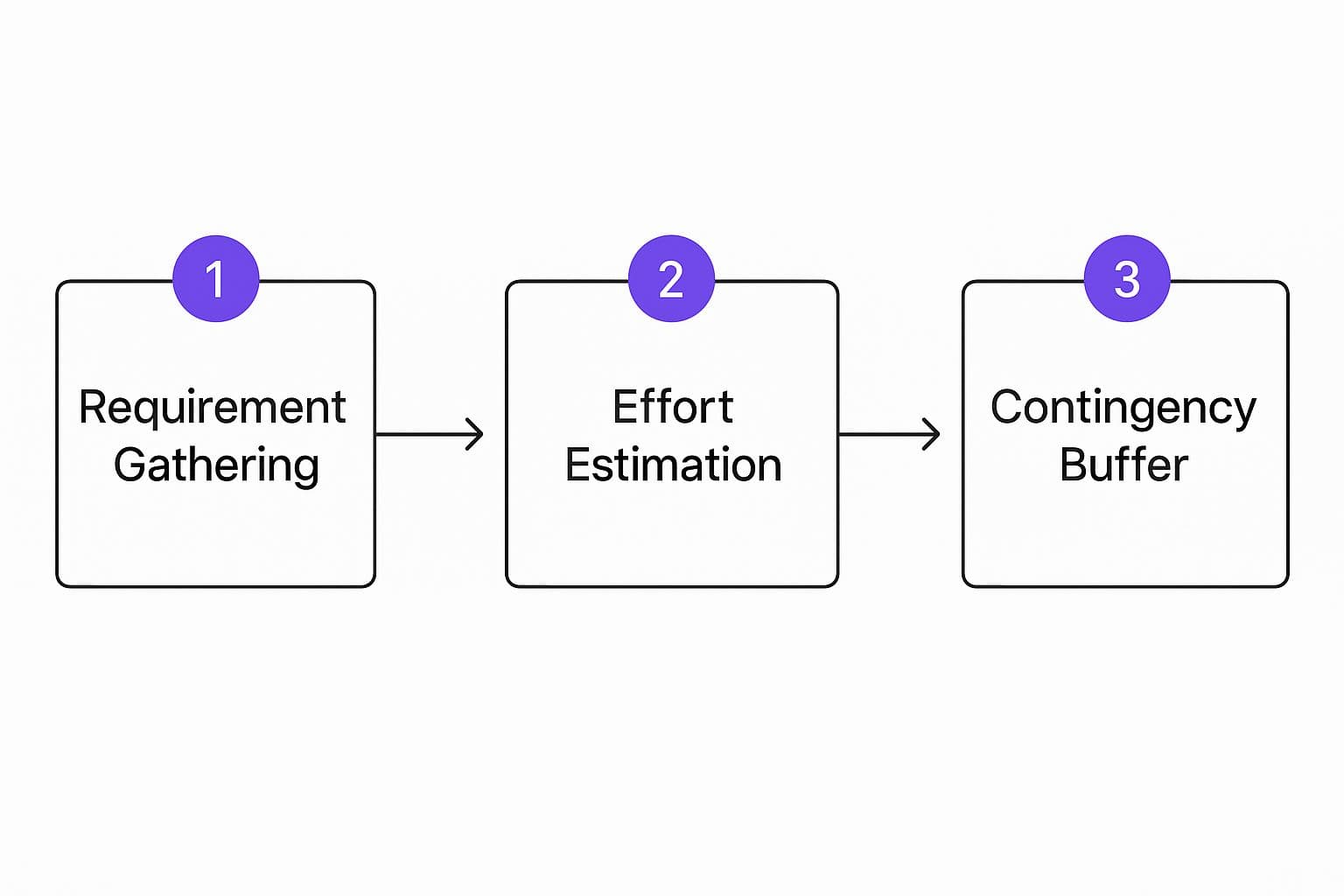
As you can see, a reliable estimate is built on a solid foundation of clear requirements and always includes a plan for the unexpected.
Analogous Estimation for a Quick Ballpark
Early in a project, when the details are still taking shape, Analogous Estimation is your best friend. This is a classic top-down approach where you anchor your new project's cost to a similar one you've successfully completed in the past.
Let’s say you built a basic e-commerce app last year for 80,000**. Your new idea is a very similar app, but you want to add a customer loyalty program. You'd start with that 80,000 baseline and then make an educated guess for the new feature, maybe tacking on another 15,000. Your rough, back-of-the-napkin estimate is now **95,000.
It's fast and requires very little detail, which makes it perfect for those initial "is this even feasible?" conversations. Just remember, its accuracy is only as good as the comparison project. It's a fantastic starting point, but it's not the final word.
Bottom-Up Estimation for Greater Accuracy
When you need a much more reliable and detailed estimate, you’ll want to flip the script and use Bottom-Up Estimation. It's the exact opposite of the analogous method. Instead of starting big, you start small. Very small.
You break down the entire project scope—every single feature, screen, and user story—into the smallest possible tasks. From there, your development team estimates the hours needed for each tiny piece of work.
For instance, a seemingly simple "user profile" feature might be deconstructed into:
- Designing the profile UI (10 hours)
- Building the front-end components (16 hours)
- Developing the back-end API to handle the data (20 hours)
- Writing the automated tests to ensure it works (8 hours)
By adding up all these micro-tasks across the entire project, you arrive at a far more accurate total. This method is definitely more labor-intensive upfront, but it produces a detailed, defensible estimate that's much easier to track against once development starts.
Agile Estimation with Story Points and Planning Poker
Modern software teams, particularly those working in Agile frameworks, often sidestep estimating in exact hours. Why? Because estimating creative, problem-solving work down to the hour is notoriously difficult and can create a false sense of precision. Instead, they estimate relative effort using Story Points.
A Story Point is a simple, unitless number that represents a task's complexity, risk, and overall effort. A tiny task like "change a button's color" might be a 1-point story. A major undertaking like "integrate a new payment gateway" could be an 8-point story. What matters isn't the number itself, but how the numbers relate to each other.
This process keeps the team focused on a shared understanding of the work instead of getting bogged down in hour-by-hour debates. Over a few sprints, the team establishes its "velocity"—the average number of story points they complete. This metric is gold for making future planning much more predictable.
The complexity of these tasks can also be influenced by your choice of technologies. That's why it's wise to have a good handle on your stack before estimating. If you're still deciding, our guide on how to choose a technology stack can help you navigate that decision.
Thinking Beyond the Code: The Real Costs of Building Software
One of the biggest blunders I see people make when budgeting for a new app is getting tunnel vision. They fixate on the hours spent coding and forget everything else. That’s like planning a road trip and only budgeting for gas—what about food, lodging, and that unexpected flat tire? A real-world software development cost estimate has to cover the entire journey, not just the time you're cruising on the highway.
The reality is, development is just one slice of the pie. To get a financial picture that won’t bite you later, you have to think in terms of the complete software development lifecycle. These aren't just technical buzzwords; they are distinct phases of work, and each one needs its own budget.
Breaking Down the Full Lifecycle Costs
A smart budget doesn't just have one big number. It allocates funds across several critical stages. Skipping any of these is a recipe for surprise bills down the road.
- Discovery and Design: This is where you figure out the "why" and "how" before a single line of code is written. It’s all about market research, user interviews, defining your scope, and, critically, the UI/UX design work. This isn't fluff; it's the foundation that prevents you from having to tear down walls and rebuild later. A solid discovery phase is also your first step toward achieving product-market fit.
- Development: This is the phase everyone thinks of—the actual construction where your designs and features become a tangible product. While it's often the largest single expense, its efficiency is almost entirely dictated by the quality of the discovery and design work that came before it.
- Quality Assurance (QA) and Testing: A feature isn't finished just because the code is complete. It's finished when it's been hammered on, pushed to its limits, and proven to work flawlessly without breaking anything else. This means manual testing, automated scripts, and performance checks. Trying to save money here is a classic mistake that always backfires with a buggy product and angry users.
The Hidden Costs That Sink Budgets
Your spending doesn’t magically stop the day you launch. In fact, a huge chunk of your total cost of ownership comes after the app is in the hands of users. This is where so many projects get into financial trouble.
Ongoing maintenance is a non-negotiable, recurring expense. The rule of thumb is that software maintenance will cost you 15-20% of the initial development budget every single year. This covers:
- Squashing bugs that pop up
- Applying security patches
- Making minor updates
- Ensuring compatibility with new OS versions and devices
For example, increased focus on digital security has driven quality assurance and testing costs up by roughly 26% in recent years. You can read more about these software development statistics to see how trends like this are shaping project budgets.
On top of maintenance, you have the monthly operational bills that keep the lights on:
- Server Hosting: Your app needs a place to live.
- Third-Party Services: Fees for APIs, payment gateways, or analytics tools.
- Monitoring and Support: The tools and people needed to watch for problems and help users.
Ignoring these post-launch costs turns predictable expenses into a series of panicked fire drills. A truly accurate software development cost estimate plans for the product’s entire life, not just its birth.
Plan for What You Can’t Predict: Building a Smart Contingency
Let's be honest: no software project ever goes exactly as planned. No matter how meticulously you map out every detail, something unexpected will pop up. It’s not a matter of if, but when.
Thinking your initial estimate is a money-back guarantee is a rookie mistake. A new competitor might launch a killer feature you have to match, a third-party API might suddenly be deprecated, or your team might uncover a technical challenge buried deep in the legacy code. This is the reality of building software, and it’s precisely why a contingency plan isn’t just a good idea—it’s your project’s lifeline.
Budget for the Inevitable Bumps
So, how do you prepare for the unknown? You build a contingency buffer right into your budget from day one. This isn't about hiding money or inflating the costs; it's a transparent, professional way of managing risk.
The industry standard is to add a buffer of 15% to 25% on top of your total estimated project cost. For instance, if your project estimate comes out to 100,000**, you’d add another **15,000 to $25,000 specifically for contingency.
When you present this to stakeholders, don't treat it like an optional add-on. Frame it as what it is: a strategic risk management fund. This is the money that will absorb the impact of unforeseen issues, preventing every small hiccup from turning into a full-blown budget crisis where you have to go back, hat in hand, asking for more funding.
Keep Scope Creep in a Headlock
One of the sneakiest budget-killers out there is scope creep. It often starts with a "small" request or a "quick" addition, but these little changes pile up, slowly bleeding your timeline and budget dry.
The best way to fight this isn't by rejecting every new idea. Instead, you need a formal change request process. This system ensures that every single new request, no matter how small, is properly evaluated.
Here’s what that process should look like:
- Document it: Every request gets written down. What is it, and what's the business case for it?
- Analyze the impact: How will this affect the project’s cost, timeline, and resources? Put a real number to it.
- Get formal approval: The stakeholders who want the change must officially sign off on the extra time and cost.
This simple structure creates a powerful check and balance. It forces a conscious, deliberate conversation about trade-offs and makes the true cost of every "small" change visible to everyone. By pairing this process with regular budget reviews and open communication, you can keep your project on track and ensure your estimate remains a reliable guide, not just a forgotten document.
Frequently Asked Questions About Estimating Software Costs
Even after you've mapped out your project, some common questions always seem to surface. Having been in these conversations countless times, I've gathered the most frequent queries from business leaders trying to nail down their software development budget.
"Can I get a fixed-price quote for my project?"
Honestly, a true fixed-price quote only works for tiny, predictable projects where the scope is set in stone and will absolutely, positively not change. In the real world of software development, that's almost never the case. Things change, you learn as you go, and user feedback is gold.
That's why most successful projects run on a Time & Materials model. It gives you the wiggle room you need to refine features and react to new information. While it might feel a bit uncertain at the start, this flexibility is what allows you to build a product people actually want to use, rather than being stuck with a rigid plan that became outdated a month into development.
"Does my choice of tech, like React vs. Angular, really change the cost?"
Yes, but probably not in the way you're thinking. The cost isn't really about the framework itself—it's about the people who know how to use it. If you choose a brand-new or niche technology, you're fishing from a much smaller (and usually more expensive) talent pool.
"What's the single biggest mistake people make with cost estimates?"
Hands down, the most common and damaging mistake is underestimating everything that isn't coding. It's easy to get tunnel vision and only budget for developer hours, but that's a recipe for disaster. You're forgetting the critical work that actually makes the software usable, stable, and successful.
These are the non-negotiable phases that often get overlooked:
- Discovery: The initial deep dive, including research, strategy sessions, and talking to actual users.
- UI/UX Design: The craft of making the software look good and feel intuitive.
- Quality Assurance (QA): The exhaustive testing needed to hunt down and squash bugs before they reach your customers.
- Project Management: The crucial work of keeping the train on the tracks, managing communication, and coordinating all the moving parts.
A realistic budget treats these activities as essential. They aren't "extra"—they are fundamental to launching a product that works, doesn't crash, and that people will actually pay for.
Ready to turn your idea into a tangible product without the guesswork? Iglu Digital specializes in building market-ready MVPs on a fixed price, agreed up front. We combine strategic planning and rapid development to get your vision into the hands of real users, fast.