

How to Conduct Market Research: A Step-by-Step Guide

Table of Contents
Alright, let's get into the nitty-gritty of market research. Before you even think about building your Minimum Viable Product (MVP), you need to figure out who you're building it for. This isn't just a simple checklist. It's a hands-on process of digging in, asking the right questions, and truly understanding your audience.
You'll start by sketching out your ideal customer, your buyer persona. From there, you'll find a small group of these exact people to talk to, arm yourself with insightful questions, size up the competition, and then pull everything together into a solid game plan.
Why Market Research Is Your Business Compass

Before we jump into the "how," let's talk about the "why." Market research is so much more than a corporate buzzword or a box-checking exercise. It’s the compass that keeps your business from getting lost. It replaces gut feelings and internal biases with cold, hard facts about what your customers actually want and need.
Relying on intuition alone is a huge gamble in today's market. Good research gives you the proof you need to confirm a product idea is solid, zero in on your ideal customer, and spot the gaps your competitors are completely missing.
The Foundation of Smart Decisions
Think of market research as the foundation of any successful product. Without it, you’re just guessing. You risk building something nobody wants, marketing to the wrong people, or crafting a message that just falls flat. It’s the difference between launching to the sound of crickets and launching a solution that people are lining up to buy.
This process is absolutely essential, whether you're a brand-new startup or a well-established company. Here’s why:
- It lowers your risk. You get to test your big ideas early, which dramatically reduces the financial hit and reputation damage of a failed launch.
- It reveals hidden opportunities. When you really listen to customers, you uncover pain points and needs you never would have thought of. That’s where real innovation happens.
- It validates your big idea. Research provides objective proof that a real market exists for what you're building. This is gold when you're trying to get investors or your own team on board.
- It gives you a competitive edge. By understanding your competition's strengths and weaknesses from a customer’s point of view, you can position your own product to win.
The explosive growth of the market research industry itself tells you everything you need to know. It ballooned from about 39.47 billion** in 2012 to roughly **82 billion by 2022. This isn't a fluke. It's because businesses have realized that deep customer knowledge isn't a nice-to-have; it's a must-have. You can dive deeper into these market research industry trends to see what's driving this change.
A Skill Every Business Pro Needs
Ultimately, knowing how to do effective market research is a core business skill, not just a task for one department. If you're an entrepreneur, it brings the clarity needed to build a viable MVP. If you're a product manager, it ensures your team is building features that people will actually use. And for marketers, it provides the exact words and insights needed to create campaigns that connect.
As we walk through the steps in this guide, remember that each one builds on the last. Starting with a solid "why" ensures that all the effort you're about to put into the "how" will pay off with real, actionable results that point your business toward its true north.
Setting Clear Goals for Your Research

Diving into market research without a clear direction is like setting sail without a map. You’ll end up with a lot of data, but none of it will get you where you need to go. It’s the classic trap of asking, "So, do people like our app idea?" instead of asking something sharp and actionable, like, "What are the top three pain points our target audience experiences with their current workflow tools?"
This first step is everything. It dictates your entire approach, ensuring you gather insights that actually help you make smart decisions, not just collect interesting but ultimately useless facts. Your goal isn't just to gather information; it's to find the right information to solve a real business problem.
From Vague Questions to Sharp Objectives
One of the most common mistakes I see founders make is keeping their research goals way too high-level. This almost always leads to research that’s a mile wide and an inch deep—you learn a little about a lot, but not enough about any one thing to take decisive action.
Let's make this tangible. Say you've got an idea for a new meal-planning app. The vague, gut-check question is, "Will people pay for this?"
A much stronger approach is to break that down. Your specific objectives could look more like this:
- Find out what our target users spend on food delivery vs. home cooking each month.
- Identify the top three frustrations people have when trying to plan their weekly meals.
- Pinpoint which features in competing apps are most loved and, just as importantly, most hated by their users.
See the difference? These objectives give you a concrete roadmap. They tell you exactly what you need to learn, helping you cut through the noise and focus on data that will directly shape your MVP’s features, pricing, and messaging.
Aligning Research with Business Outcomes
Every research goal you set should tie directly to a business outcome. You're not doing this for fun; you're doing it to make better decisions about your product. When you're on a tight MVP timeline, this focus isn't just nice to have—it's absolutely critical.
So, how do you reframe those big, nebulous business questions into research objectives that actually drive results? It's about translating ambiguity into specifics.
Here’s a quick look at how you can make that translation.
Translating Business Questions into Research Objectives
| Vague Business Question | Specific Research Objective |
|---|---|
| Is our idea any good? | What are the top 3 unsolved problems our target audience faces that our idea could address? |
| How should we price our product? | At what price point does our target audience perceive our product as a "great value"? |
| Who are our competitors? | What are the primary strengths and weaknesses of the top two direct competitors, according to their customers? |
| What features should our MVP have? | Which single feature would provide the most immediate value to our ideal customer and solve their biggest frustration? |
This structured thinking doesn't just clear up your own path; it makes it much easier to explain the "why" behind your research to stakeholders or team members. It also builds the foundation for everything that comes next.
Once you have these sharp objectives, you can move forward with confidence. This is the first, crucial part of the validation process. If you want to go deeper on this, you can learn more about how to validate a business idea before you sink major resources into it.
By taking the time upfront to define exactly what you need to learn, you guarantee that every minute and dollar you spend on research is efficient, targeted, and valuable.
Choosing the Right Research Methods
Once you know what you need to find out, it's time to decide how you're going to find it. The research methods you pick will steer your entire project. They dictate the kind of data you'll collect, the quality of your insights, and the resources you'll burn through. It’s a bit like a detective arriving at a crime scene—do you start dusting for fingerprints or interviewing eyewitnesses? Each technique uncovers a different kind of clue.
In the world of market research, your main options fall into two camps: Primary Research and Secondary Research. Getting a firm grip on the difference is the first step to designing a study that’s both smart and efficient.
Uncovering New Information with Primary Research
Primary research is all about rolling up your sleeves and gathering brand-new data directly from your target market. You're essentially creating information that didn't exist before. This is where you get to hear the unvarnished truth straight from the mouths of your potential customers.
The biggest win here is control. You write the questions, you pick the people, and the insights are yours alone—your competitors can't just go download them. This is how you discover the "why" behind what people do.
Of course, there's a trade-off. Primary research can be a serious investment of time and money. You might spend weeks hunting for the right people to interview or sifting through hundreds of survey responses.
Here are the go-to methods I've seen deliver the best results:
- Interviews: There’s nothing quite like a one-on-one conversation for getting deep, qualitative insights. They let you ask "why?" and follow unexpected threads. You can find out why a user quit a competitor's app in frustration, not just that they did.
- Surveys and Questionnaires: When you need numbers to back up your hunches, surveys are your best bet. They’re fantastic for collecting quantitative data at scale, like discovering that 65% of your target audience would rather pay a monthly fee than a one-time price.
- Focus Groups: Getting 6-8 potential customers in a room together can be magic. A moderated discussion can highlight group dynamics and shared beliefs that you’d miss in individual chats. Watching them interact with a prototype can spark incredible “aha!” moments.
Leveraging Existing Data with Secondary Research
Secondary research, on the other hand, is about working with information that someone else has already done the heavy lifting to collect. Think industry reports, competitor teardowns, government statistics, or academic papers. Honestly, this is the best place for anyone to start. It gives you the 30,000-foot view before you start zeroing in.
The main advantage? Speed and cost. You can often dig up incredibly valuable data in just a few hours without spending a dime. It's the perfect way to quickly understand market size, major trends, and who your main rivals are.
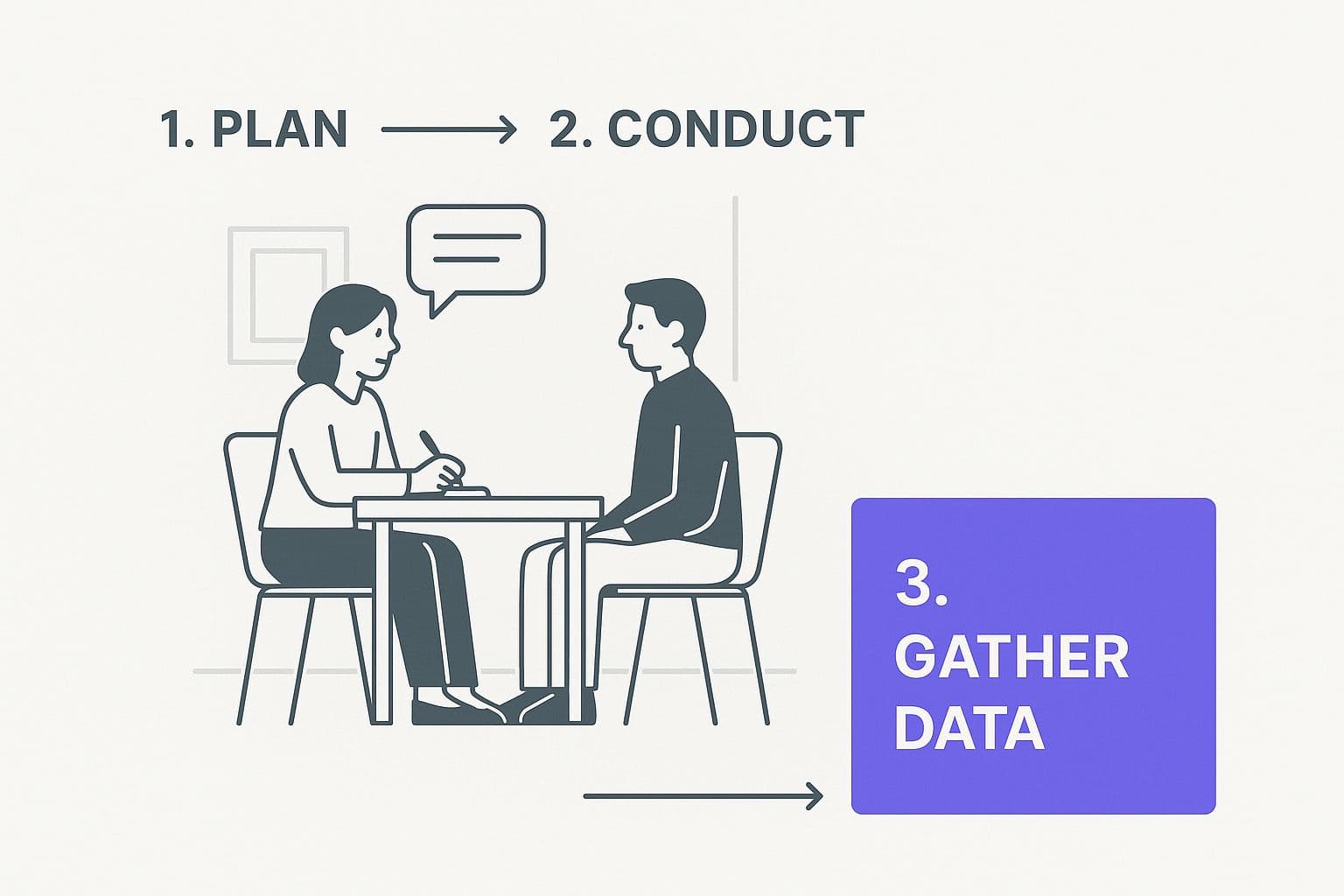
As this shows, the act of gathering information—whether you're talking to someone directly or analyzing existing sources—is the foundation of the whole process. This is the fuel for your decision-making engine.
The catch with secondary data is that it wasn't made just for you. It might be a little dated or not a perfect match for your niche. You have to take it with a grain of salt.
Common sources I always check include:
- Industry Reports: Companies like Gartner, Forrester, and Statista publish deep dives into nearly every industry imaginable.
- Competitor Analysis: Systematically combing through competitor websites, customer reviews, and social media feeds can tell you a lot about their game plan.
- Government Data: Don't sleep on free, reliable sources like the U.S. Census Bureau. It’s a goldmine for demographic and economic data to help you size up your market.
Blending Methods for a Complete Picture
The smartest teams I’ve worked with don't pick one method over the other—they use both. Start broad with secondary research to map out the terrain. Then, deploy primary research to explore the most promising areas and get answers to your specific questions.
This hybrid approach is a natural fit for lean and agile teams. If you want to dive deeper into that philosophy, you can read our guide on the agile product development process.
Here’s a real-world example: You might read a secondary report that says the market for remote work software is growing 15% year-over-year. Great start. But that doesn't tell you what to build. So you follow up with interviews (primary research) to learn about the daily frustrations remote workers face that current tools don't solve.
It's this blend of big-picture data and on-the-ground human insight that turns a good idea into a great product.
Getting Your Hands on High-Quality Data
You've set your goals and picked your methods. Now comes the moment of truth: collecting the actual data. This is where all your planning pays off, and frankly, it's the part of the process you absolutely can't afford to mess up.
Think of it this way: even the most brilliant analysis is useless if it's based on bad information. The aim here isn't just to accumulate answers; it's to gather clean, honest, and reliable feedback that genuinely represents your target audience. This is where theory hits the pavement, and you need a solid plan for both your surveys and your one-on-one interviews.
Designing Surveys That Uncover the Truth
It’s surprisingly easy to write a bad survey. The most common pitfall I see is writing questions that nudge people toward the answer you want to hear. This is leading bias, and it's a silent killer of good research.
For example, never ask, "How much do you love our convenient new feature?" That question is loaded with positive assumptions. A much better, neutral approach is, "How would you describe your experience using this new feature?" See the difference? One begs for validation; the other asks for an honest opinion.
You also have to be ruthless about challenging your own confirmation bias. We all have it—the natural tendency to look for evidence that proves us right. Fight it. Actively ask questions that could disprove your core beliefs. That's where real learning happens.
A few more tips from the trenches:
- Mix up your questions. Don't just rely on multiple-choice. Sure, they provide great quantitative data, but the real gold is often in the qualitative stuff. Always add an open-ended "Why?" or "Anything else you'd like to share?" to capture rich context.
- Keep it short and sweet. Respect your users' time. No one enjoys a 30-minute survey. A shorter, more focused questionnaire will get you higher completion rates and, more importantly, more thoughtful responses.
- Fish in the right pond. Don't just spray your survey across the internet. Go where your ideal customers hang out. Think niche social media groups, industry-specific forums, or even specialized survey panels to find people who truly match your buyer persona.
Conducting Interviews That Yield Rich Insights
Surveys give you the "what." Interviews are where you find the "why." A truly great interview feels like a natural, flowing conversation, not a robotic Q&A session.
Your role isn't to be an interrogator; it's to be a guide. You're there to steer the discussion, but the goal is to let the participant do 80% of the talking. I always create a detailed discussion guide beforehand to keep me on track, but I'm never afraid to throw it out the window if the conversation takes an interesting and unexpected turn. That's often where the best insights are hiding.
Here’s how to make sure your interviews are genuinely productive:
- Build rapport first. Don't jump straight into the heavy questions. Start with some easy, general chit-chat to make the person feel comfortable.
- Ask open-ended questions. Avoid anything that can be answered with a simple "yes" or "no." Instead of, "Is this feature useful?" try, "Can you walk me through how you might use a feature like this in your day-to-day work?"
- Listen more than you talk. This is the big one. Your job is to understand their world, their problems, and their motivations. Use active listening cues like "uh-huh" and "tell me more about that" to encourage them to dig deeper.
This qualitative feedback provides the human context that raw numbers simply can't. You'll uncover emotions, frustrations, and workarounds that are absolutely crucial for building a product that people will actually want to use.
The Growing Role of AI in Data Collection
The tools of our trade are evolving fast, especially with the rise of artificial intelligence. AI is no longer just a shiny add-on; it's becoming a core part of the modern research workflow.
These tools can help you find qualified respondents faster, analyze mountains of open-ended feedback in minutes, and even spot market trends with surprising accuracy. In fact, a global survey from 2025 showed that AI is significantly boosting efficiency and helping researchers refine their strategies. You can get a deeper look at these evolving market research trends on Qualtrics.com.
By blending timeless techniques—like unbiased questioning—with modern technology, you can be confident that the data you're collecting is both high-quality and comprehensive. This clean data is the rock-solid foundation for everything that comes next.
Turning Raw Data Into Actionable Insights
Collecting data is just the beginning. Let's be honest, a mountain of survey responses and interview notes isn't insight—it's noise. I've seen countless entrepreneurs get to this stage and just freeze, staring at a spreadsheet and wondering, "Okay, now what?" The real magic happens when you transform that raw data into a clear story that tells you exactly what to do next.
You don't need to be a data scientist to pull this off. It’s about spotting patterns, connecting what people say with what they actually do, and translating all of it into concrete next steps for your MVP. This is where your research investment truly pays off.
Finding Patterns in Your Quantitative Data
When you're dealing with quantitative data from surveys, a simple spreadsheet is your best friend. Seriously, you can get a ton of value from tools like Google Sheets or Excel without needing to pay for complex software.
Start by just organizing your responses. From there, you can filter, sort, and look for the obvious wins. What are the most common answers? What are the simple percentages? Where do things get interesting?
For example, you might discover that 75% of respondents who said price was their biggest pain point also happen to be using a specific competitor's product. That's not just a random statistic; it’s a glaring opportunity. It's a signal that there's a hungry market segment waiting for a more affordable alternative.
Be a detective and look for these kinds of clues:
- Frequency: Which answers pop up over and over? This points you directly to the most common frustrations or desires.
- Cross-Tabulation: This is just a fancy way of asking how different answers relate to each other. For instance, "Do users in the 25-34 age group care more about Feature A than Feature B?"
- Segmentation: Are your customer segments behaving differently? You might find that younger users have a completely different set of needs than your older demographic.
Think of it as looking for the story hidden within the numbers.
Grouping Feedback with Thematic Analysis
The rich, qualitative data you get from interviews requires a different touch. You can’t exactly put a heartfelt conversation into a pie chart. Instead, you group the feedback into powerful themes using a method called thematic analysis. It sounds academic, but it's actually pretty intuitive.
As you read through your interview notes or transcripts, just start highlighting anything that jumps out at you—a strong opinion, a frustration you hear more than once, or a surprisingly brilliant idea. As you go, you’ll start to see patterns. Group these highlights into buckets, or "themes."
By the time you're done, you'll have a handful of core themes that capture the essence of what your target market is telling you. Back these themes up with some punchy, direct quotes, and you’ll have a narrative that’s impossible for your team to ignore.
Synthesizing Findings into a Compelling Story
Analysis isn't finished until you've woven everything together into a clear, compelling story. This is where you merge the "what" from your quantitative data with the "why" from your qualitative themes. Your mission is to build a narrative that doesn't just present facts but actually inspires your team to take action.
This synthesis is the entire point. It's why the global market research industry hit a valuation of about $84 billion by the end of 2023. Companies know that turning data into a strategic roadmap is what separates the winners from the losers. The U.S. alone accounts for over 53% of this market, which tells you just how vital this skill is. You can see more details about these key market research statistics on Similarweb.com.
A great summary that drives action usually has these parts:
- Key Findings: Lead with your biggest "aha!" moments. Use bold stats and powerful customer quotes to make them hit hard.
- The Evidence: Briefly show your work. How did you get here? Point to your survey data and the interview themes you identified.
- The Implications: This is the most important part. So what? What does this all mean for the business? If users despise a competitor’s onboarding, the implication is that a ridiculously smooth onboarding experience could be your secret weapon.
- Recommendations: Based on those implications, what are the exact, concrete steps you should take next? No vague suggestions—clear marching orders.
This approach ensures your research becomes the blueprint for smart, evidence-based decisions, not just another report that sits in a folder. When you can confidently explain what you learned and what it means for your product, you're well on your way to success. For a more detailed look at the next phase, check out our guide on how to approach product-market fit validation.
Your Top Market Research Questions, Answered
Even with the best plan laid out, you're going to have questions as you dive into the nitty-gritty of market research. That’s perfectly normal. Let's tackle some of the most common ones I hear from founders so you can move forward with a clear head.
"So, What's This Going to Cost Me?"
Ah, the million-dollar question—or hopefully, not. The honest answer is that market research costs can swing from practically zero to tens of thousands of dollars. It really boils down to the methods you choose and how scrappy you're willing to be.
- Bootstrapping (Basically Free): You can get surprisingly far without spending a dime. Digging into public government data, combing through competitor reviews, and listening in on social media conversations only costs you your time. A simple survey blasted out to your email list or social media followers is another killer, low-cost tactic.
- A Modest Investment: Got a few hundred to a couple of thousand dollars to play with? Now you can tap into paid survey platforms to find very specific groups of people. You can also offer small incentives—think 25-50 gift cards—to get people on a 30-minute call for an interview. For most early-stage MVPs, this is the sweet spot.
- The Big Guns: If you're looking at hiring a dedicated research firm, running formal focus groups, or getting access to premium industry reports from places like Gartner, you’re easily in the $10,000+ territory. This is usually the playground for well-funded companies navigating major strategic shifts.
"How Long Does This Actually Take?"
Time is money, especially when you’re trying to get an MVP out the door. The good news is that research doesn't have to be a six-month academic study. It should be fast and flexible.
I'm a huge fan of the focused research "sprint." You can uncover game-changing insights in just one to two weeks if you're all-in. Imagine a weekend spent on deep secondary research, immediately followed by a week dedicated to scheduling and conducting 5-8 potent customer interviews.
The goal isn't to answer every question about your market for all time. It's about learning just enough to make your next move with confidence.
"How Many People Do I Really Need to Talk To?"
This is a huge source of anxiety for founders, but you probably need to talk to fewer people than you think, especially for qualitative feedback.
When it comes to one-on-one interviews, a clear and powerful pattern almost always starts to emerge after just 5 to 8 conversations with people from the same customer segment. By that eighth interview, you’ll start hearing the same problems, using the same language. That's your signal that you've struck gold.
Surveys are a different beast because they're about numbers. For a survey to have real statistical weight, you should aim for at least 100 responses. But even with just 30-50, you can still spot early trends that can point you in the right direction.
"What If the Research Says My Idea Sucks?"
First, take a breath. Hearing that your brilliant idea has a fatal flaw can feel like a punch to the gut. But honestly, it's a gift. Uncovering that flaw before you sink months of your life and thousands of dollars into building it is a massive win.
Think about it: market research isn't about getting a pat on the back. It's about finding the truth.
If the truth is that your initial concept is a non-starter, that's fine! The very same research that poked holes in your idea almost certainly shined a light on other, more painful problems that people are desperate to pay to solve. This isn't a failure; it's a strategic pivot. The insights you just gathered are now a treasure map leading you to a better, more viable business.
Ready to stop guessing and start building? At Iglu Digital, we specialize in turning validated ideas into market-ready MVPs for a price agreed before a line of code is written. Let us help you transform your research into a real, functional product. Learn more about our MVP process.