

How to Validate Business Idea Quickly & Effectively

Table of Contents
So, you have a business idea. It feels brilliant, maybe even world-changing. But before you drain your savings account and spend countless nights building it out, let's talk about one of the most crucial steps most founders skip: validation.
Think of it as the bridge between "I think this will work" and "I know people will pay for this." It's the process of gathering hard evidence to confirm your idea has real potential, before you go all-in.
Why So Many Startups Fail (And How You Can Avoid It)
It’s easy to get swept up in the excitement of a new venture. The vision is clear, the motivation is high, and the late nights feel like progress. But passion can be a double-edged sword. The brutal truth is that building something nobody wants is the fastest way to burn through your cash and your spirit.
This is exactly where business idea validation becomes your secret weapon. It’s not just some MBA-speak; it's your best defense against a completely preventable failure. Consider it a series of small, smart experiments designed to answer one question: does my idea actually solve a painful problem for people who are willing to pay me to make it go away?
The Staggering Cost of Guessing
Far too many entrepreneurs fall in love with their solution long before they ever truly understand the problem. They'll toil away for months, sometimes years, perfecting a product in a vacuum. Then comes launch day, and... crickets. This classic mistake is a massive contributor to some pretty scary startup statistics.
That number isn't meant to scare you off. It’s meant to light a fire under you. By mastering how to validate your idea, you can flip the odds dramatically in your favor.
To help you get started, here's a quick overview of what the validation process looks like. We'll dive into the specifics of each stage, but this table gives you a roadmap for the journey ahead.
Core Stages of Business Idea Validation
| Validation Stage | Objective | Key Activities |
|---|---|---|
| Market Research | Understand the landscape and identify a real problem. | Competitor analysis, keyword research, trend spotting. |
| Customer Discovery | Get inside your target customer's head. | Conducting interviews, creating customer personas. |
| Solution Validation | Test if your proposed solution actually resonates. | Presenting mockups, running surveys, gauging interest. |
| Pre-Launch Testing | Get tangible proof people will commit. | Building a landing page, creating a waitlist, running pre-sale campaigns. |
| MVP Launch | Test the core functionality with real users. | Building a minimal version, collecting user feedback, measuring engagement. |
This structured approach takes the guesswork out of building a business. It’s about being methodical, listening to the market, and letting the evidence guide your next move.
A Better Way to Build
True validation isn’t about looking for people to tell you your idea is great. It's about a relentless search for the truth, even when it’s not what you want to hear. This mindset shift forces you to do things differently.
- You'll listen to customers before you write a single line of code.
- You'll test your biggest assumptions with cheap experiments, not expensive products.
- You'll collect real data that tells you whether to keep going, change direction, or stop.
When you adopt this approach, building a startup stops feeling like a high-stakes gamble and starts feeling like a strategic search for a business model that can actually work. The following sections will walk you through exactly how to do it.
Digging for Gold: Low-Cost Market Research That Actually Works

Before you spend a single dollar on development, you need to put on your detective hat. Forget about expensive market reports for now. The most valuable clues for your business idea are often hiding in plain sight, free for anyone with a Wi-fi connection and a bit of curiosity.
Your goal here is simple: confirm that the problem you think exists is a real, painful issue for a specific group of people. This early-stage digging transforms a gut feeling into a data-backed hypothesis. It's the foundation for everything that comes next.
Become a Digital Anthropologist
To really see if your idea has legs, you have to go where your potential customers live online and listen in on their conversations. Think of yourself as an anthropologist studying a digital tribe—you're there to observe, listen, and understand their world.
Online communities are absolute goldmines for this.
- Reddit: Find the subreddits where your people hang out. Search for keywords related to the problem you're trying to solve. Look for the posts with tons of comments and upvotes. The real magic is in the exact words they use to describe their frustrations.
- Facebook Groups: Jump into groups dedicated to your niche. Pay close attention to the questions people ask and the solutions they recommend to each other. This is a direct window into their current struggles and workarounds.
- Quora: Search for questions about the problem you want to fix. The answers often spill the beans on common hacks, frustrations with the tools they already use, and what they wish they had.
Scope Out the Competition and See Who Cares
Once you've found a recurring pain point, it's time to see who else is trying to solve it and how much people care. Again, you can do this without opening your wallet.
Start with Google Trends. Is the interest in your problem area growing, shrinking, or just flat? For instance, if you're building a tool for remote teams, you can track search interest for "remote project management" or "virtual team software" over the last few years. You want to ride a rising wave, not a dying one.
Next, do a quick and dirty competitor analysis. Find 3 to 5 companies already in the space and go straight to their customer reviews on sites like G2, Capterra, or Trustpilot.
- 5-star reviews show you what people absolutely love—what the competition is nailing.
- 1-star reviews are your treasure map. They point directly to unmet needs, glaring feature gaps, and frustrations you can solve.
This research doesn't just shape your product; it shapes your marketing. The insights you gather here are what you'll use to build a prototype or MVP that truly connects with users—a cornerstone of the agile product development process which is all about learning and adapting as you go.
Using Digital Smoke Tests to Gauge Real Interest

Talking to people is one thing, but getting them to take action is another. After all the interviews and market research, you need to see if your idea has legs in the real world. This is where a smoke test becomes your best friend.
Think of it as putting up a "Coming Soon" sign for a product that doesn't exist yet. The goal is simple: measure genuine interest by seeing if people will give you a small commitment, like their email address, in exchange for being kept in the loop. This moves you beyond people saying they’d use your product to getting hard data that proves they’re interested. It's a classic, powerful way to validate a business idea before you sink a ton of time and money into it.
Crafting Your Digital Storefront
Your smoke test revolves around a simple landing page. I’m not talking about a full-blown website. This is a single, focused page with one job: to capture signups. You can spin one up in an afternoon using tools like Carrd, Leadpages, or Webflow.
The key to a great landing page is nailing your unique value proposition (UVP). It’s a sharp, clear statement explaining what you do, who you do it for, and why it matters.
Here’s a simple formula I’ve seen work time and time again:
- A Compelling Headline: Hook them immediately by hitting on their biggest frustration.
- A Clear Sub-headline: Quickly explain how you make that frustration disappear.
- Key Benefits (3-5 Bullet Points): Don't list features; list outcomes. What's in it for them?
- A Powerful Call-to-Action (CTA): This is where the magic happens. Ditch "Submit" and use something motivating like "Get Early Access" or "Join the Waitlist."
Driving Traffic and Reading the Signs
Okay, your page is live. Now you need to get the right eyeballs on it. You don't need a massive ad budget. A small, targeted spend on Facebook, Instagram, or Google Ads can work wonders.
Let's say your idea is a SaaS tool for freelance photographers. You can target ads directly at people with that job title or who follow popular photography blogs and influencers. It's about precision, not volume.
This is where you start gathering quantitative proof. The data tells a story. A key metric to watch is your Ad Click-Through Rate (CTR). Are people even curious enough to click? Generally, a CTR between 2% and 5% is a good sign you're onto something. If 1,000 people see your ad and 50 click it, that 5% CTR is a solid green light.
But the real moment of truth is your landing page conversion rate. Of the people who landed on your page, how many actually signed up? Hitting a conversion rate of 5% to 15% is fantastic. It’s a strong signal that you've identified a real-world problem and your proposed solution is hitting the mark. This is the kind of data that gives you the confidence to take the next step.
If you want to dig deeper, you can explore more startup validation metrics to get an even clearer picture.
Learning From Real-World Validation Success Stories
The theory is a great starting point, but the real lessons are found in the trenches. Seeing how successful founders navigated the wilderness of uncertainty can teach you more than any textbook. When you look at real-world case studies, you start to see the clever, often scrappy, tactics that separate a good idea from a great business.
Take Dollar Shave Club. They famously validated their subscription razor model with a single, hilarious, low-budget viral video. The outcome was staggering: 12,000 orders in just 48 hours. This masterstroke proved there was massive demand before they ever had to scale operations, saving them from sinking a fortune into an unproven concept. It’s these kinds of strategic validation wins that make all the difference.
But these stories aren't just about explosive launches. They're about the fundamental, and sometimes quiet, work of confirming your core assumptions.
Figma’s Obsession with Problem-Solution Fit
Before Figma became the giant of the design world, its founders spent years in a surprisingly quiet, focused validation phase. Instead of pushing a feature-packed tool out to the masses, they did the opposite: they worked intimately with a tiny group of early-adopter designers.
Their method was straightforward but incredibly powerful:
- Deep Collaboration: They essentially embedded themselves with their first users to witness their collaborative workflow headaches firsthand.
- Constant Iteration: They built and refined features based directly on what this core group told them, ensuring every update solved a real, painful problem.
- Patience Over Hype: They completely resisted the pressure to scale, choosing instead to absolutely nail the problem-solution fit first.
This relentless focus on a small, passionate user set allowed Figma to prove that its core idea—browser-based collaborative design—wasn't just a "nice-to-have," but an essential tool.
The Power of a Single, Bold Test
What both Dollar Shave Club and Figma show us is that validation doesn’t have to be a drawn-out, complex ordeal. Often, it comes down to running one smart, decisive test that answers your single biggest question.
For Dollar Shave Club, that question was, "Will people actually sign up for a razor subscription online?" For Figma, it was, "Can we build a tool that makes collaborative design fundamentally better for professionals?"
Both companies found their answers not by sitting in a boardroom and speculating, but by getting out there and running targeted, real-world experiments.
Alright, you've done your homework. You’ve crunched the numbers, talked to potential customers, and maybe even seen some promising clicks on a landing page. The signals are looking good.
Now for the exciting part: building something real. This is where the Minimum Viable Product, or MVP, comes into play. But let’s get one thing straight. An MVP isn't just a half-baked, glitchy version of your dream product. Think of it less as a product and more as a scientific experiment. Its sole purpose is to learn.
The real challenge is to build the absolute smallest thing you can create to test your biggest, scariest assumption. Will people actually use this thing to solve their problem? It's a question that demands ruthless focus.
Look at the data you've gathered so far. It tells a story.
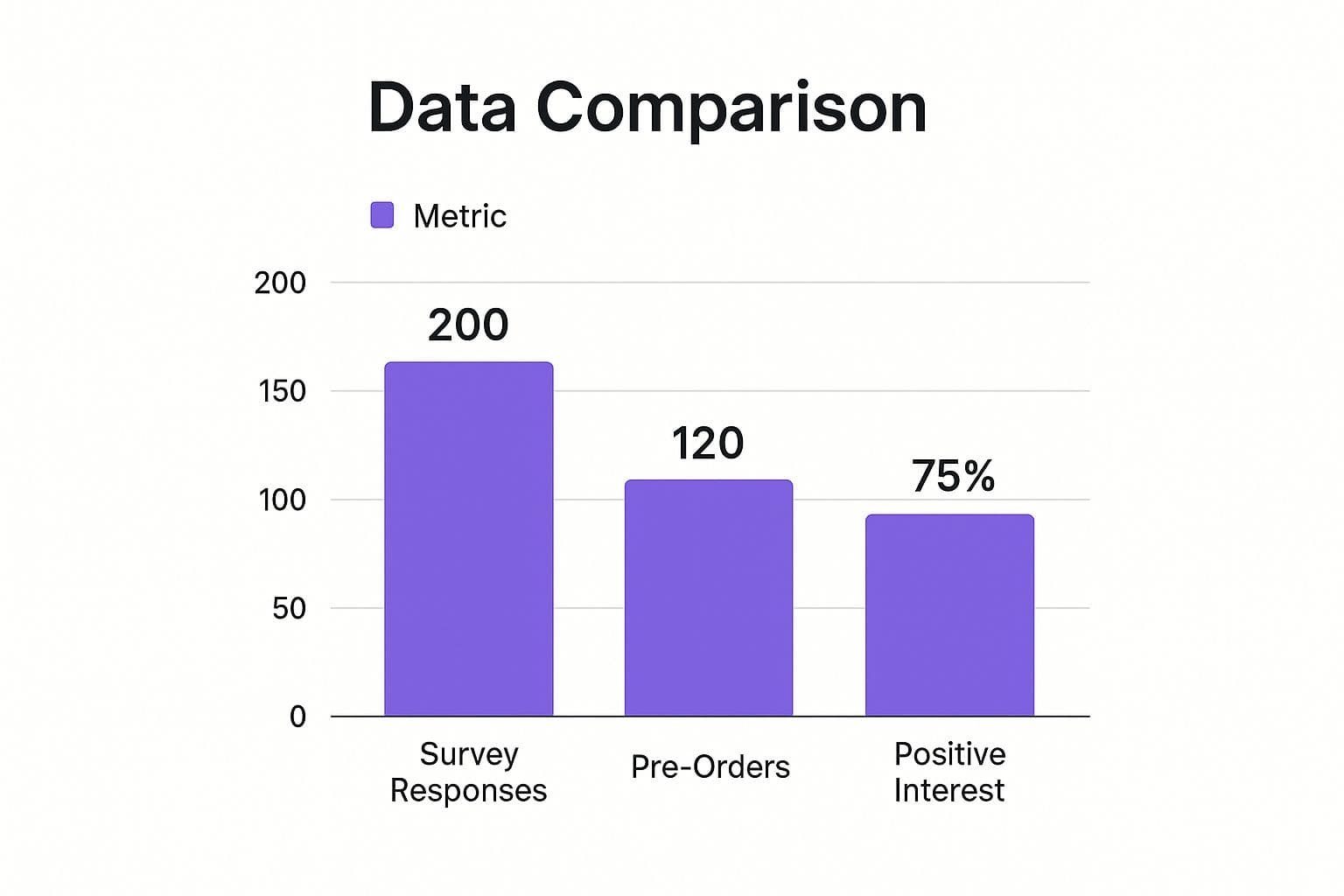
When you see a progression from casual interest in a survey to someone putting down cash for a pre-order, you have the justification you need to start building.
Find Your One Core Feature
The biggest mistake I see founders make at this stage is feature creep. The temptation to add "just one more little thing" is powerful, but you have to resist. Your MVP must do one thing, and one thing only, exceptionally well.
Ask yourself this: what is the single most important action a user must take to get value from my idea? That's your North Star. That's your MVP.
For instance, if you're building a meal-planning app, the core isn't social sharing or fancy grocery integrations. It's simply generating a basic seven-day meal plan. Everything else is a distraction right now.
Pick the Right Kind of MVP
Building an MVP doesn't always mean hiring a team of developers. In fact, some of the smartest ways to test your idea involve almost no code at all. You're trying to validate your core promise before you spend a fortune on development.
Different ideas call for different types of MVPs. It's crucial to pick the right approach for what you're trying to learn.
The table below breaks down a few common MVP types to help you decide which one makes the most sense for you.
Choosing the Right MVP Type
| MVP Type | Description | Best For Validating | Example |
|---|---|---|---|
| Wizard of Oz | The user sees a slick, automated front-end, but you're behind the curtain manually doing all the work. | Complex services or algorithm-based ideas without the heavy engineering lift. | Zappos started with the founder buying shoes from local stores to fulfill online orders. |
| Concierge | You provide a completely manual, high-touch service to your first users, personally guiding them through the solution. | Deeply understanding user needs and pain points to shape the final product. | A personal stylist service where the founder manually curates outfits for the first clients. |
| Piecemeal | You connect existing third-party tools (like Airtable, Zapier, and Stripe) to create a functional product. | Testing a full user journey, from signup to payment, with minimal custom code. | A subscription box service managed entirely through a form, a spreadsheet, and a payment processor. |
Choosing and building the right MVP is a cornerstone of modern product development. It’s an iterative process that requires a certain mindset.
To really nail this, it helps to understand the philosophy behind it. I'd recommend diving into some agile development best practices. This approach is all about making progress in small steps and using feedback to guide your next move—ensuring your MVP truly does its job of helping you learn and adapt on the fly.
Got Questions? We’ve Got Answers on Business Idea Validation
Even with the best plan, trying to validate a new business idea can feel like navigating in the dark. Doubts creep in, you hit roadblocks, and it's easy to wonder if you're even on the right track. It happens to every founder.
Let's walk through some of the most common questions that pop up during this phase. Getting clear, straightforward answers can give you the confidence you need to keep moving forward.
When Is "Enough" Validation, Actually Enough?
This is the big one, isn't it? The truth is, there's no magic number of "yes" votes that suddenly means your idea is a winner. Instead of chasing a specific number, you should be looking for patterns of conviction.
Validation isn’t a single finish line you cross. It’s a growing body of evidence that all points to the same conclusion: you’ve found a real, painful problem that people want solved.
You're probably in a good spot when you can honestly say yes to these:
- You've Nailed Problem-Solution Fit: Potential customers don't just politely nod when you describe your solution. They get excited. They use the same words you do to describe their frustrations, and their reaction is less "that's a neat idea" and more "how soon can I have this?"
- They're Willing to Commit: You have more than just positive conversations. People are taking action. This could be putting down money for a pre-order, signing up for a waitlist and actually opening your emails, or successfully completing a manual, "Wizard of Oz" version of your service.
- Your Target Customer Is Crystal Clear: You're not just guessing about demographics anymore. You know their job title, what their biggest daily headaches are, and where they spend their time online—because you've actually talked to them.
What Do I Do with Negative Feedback?
First things first: don't panic. Negative feedback isn’t a sign of failure; it’s a gift dressed in ugly wrapping paper. When someone tells you they wouldn't use your product or don't think your idea will work, they are giving you incredibly valuable information.
This kind of feedback is what helps you avoid becoming one of the 42% of businesses that fail because they built something nobody wanted.
The trick is to sort the feedback. Is someone pointing out a fundamental flaw in your whole concept, or are they just hung up on a minor feature?
If you hear over and over that people don't really have the problem you're trying to solve, that's a massive red flag. You might need to go back to the drawing board. But if they love the core idea and just hate your pricing model? That’s a much smaller, fixable problem. Look for the themes, thank people for their brutal honesty, and use what you learn to make your idea stronger.
How Do I Know When It’s Time to Pivot?
Pivoting isn't admitting defeat. It's making a smart, strategic change based on real-world evidence. You should start seriously thinking about a pivot when the warning signs are too big to ignore.
Here are some classic signs that your current path might be a dead end:
- You’re Met with Apathy: During interviews, people are just… polite. They aren't excited. They don’t seem to feel the pain of the problem you’re describing.
- Your Numbers Are Consistently Low: Your landing pages or ads get clicks, but almost no one signs up. This is a clear signal that your core message just isn't landing.
- You Stumble Upon a Better Opportunity: Sometimes, your research for one idea uncovers a completely different—and much bigger—problem that you're perfectly positioned to solve.
Making the call to pivot takes guts, but sticking with a failing idea burns through far more time and money. This is a tough spot for any founder. Getting an outside perspective from services built for startups can provide the strategic clarity you need to make the right move with confidence.
Ready to stop guessing and start building something people will actually pay for? Iglu Digital specializes in taking promising ideas and turning them into market-ready MVPs with the price fixed before we start. We’ll help you validate your core assumptions and launch a product that gets real traction. Learn how we can accelerate your vision today.