

How to Protect Intellectual Property: Tips & Strategies

Table of Contents
When people talk about protecting intellectual property, they're really talking about a two-step process. First, you figure out what you've actually created—your secret sauce, your brand, your code. Then, you use legal tools like patents, trademarks, and copyrights to build a fence around those creations. Getting ahead of this is how you stop others from running off with your best ideas.
Mapping Your Intellectual Property Assets
You can't protect what you don't know you have. That's why the very first thing you need to do is a full-blown internal audit. Sit down and identify every single valuable, intangible asset your startup owns. I see so many founders skip this step. They're laser-focused on the shiny finished product and completely miss the goldmine of valuable components they built to get there.
For a software company, these assets are usually hiding in plain sight.
That clever algorithm your lead dev spent months perfecting? That could be a patent or a trade secret. Your company name, the logo you sketched on a napkin, and your catchy tagline are all potential trademarks that will eventually define your brand. Even the source code for your website and the content on your blog are automatically protected by copyright from the moment you hit "publish."
Know Your Core IP Types
To build an effective IP strategy, you have to know the difference between the tools in your toolbox. Each type of IP protects something different, and using the wrong one is like bringing a hammer to a software bug.
- Patents: These protect inventions and truly unique processes. Think of it as a 20-year government-granted monopoly on your invention.
- Trademarks: This is all about your brand. Trademarks protect your logos, company name, product names, and slogans—anything that tells a customer, "this is from us."
- Copyrights: This is for original creative works. For a tech company, that means software code, website design, articles, white papers, and marketing videos.
- Trade Secrets: This is the stuff you never want anyone to know. It’s confidential information that gives you a competitive edge, like the formula for Coke or a highly sensitive customer list.
This next image breaks down the protection timelines for the big three registered IP types.
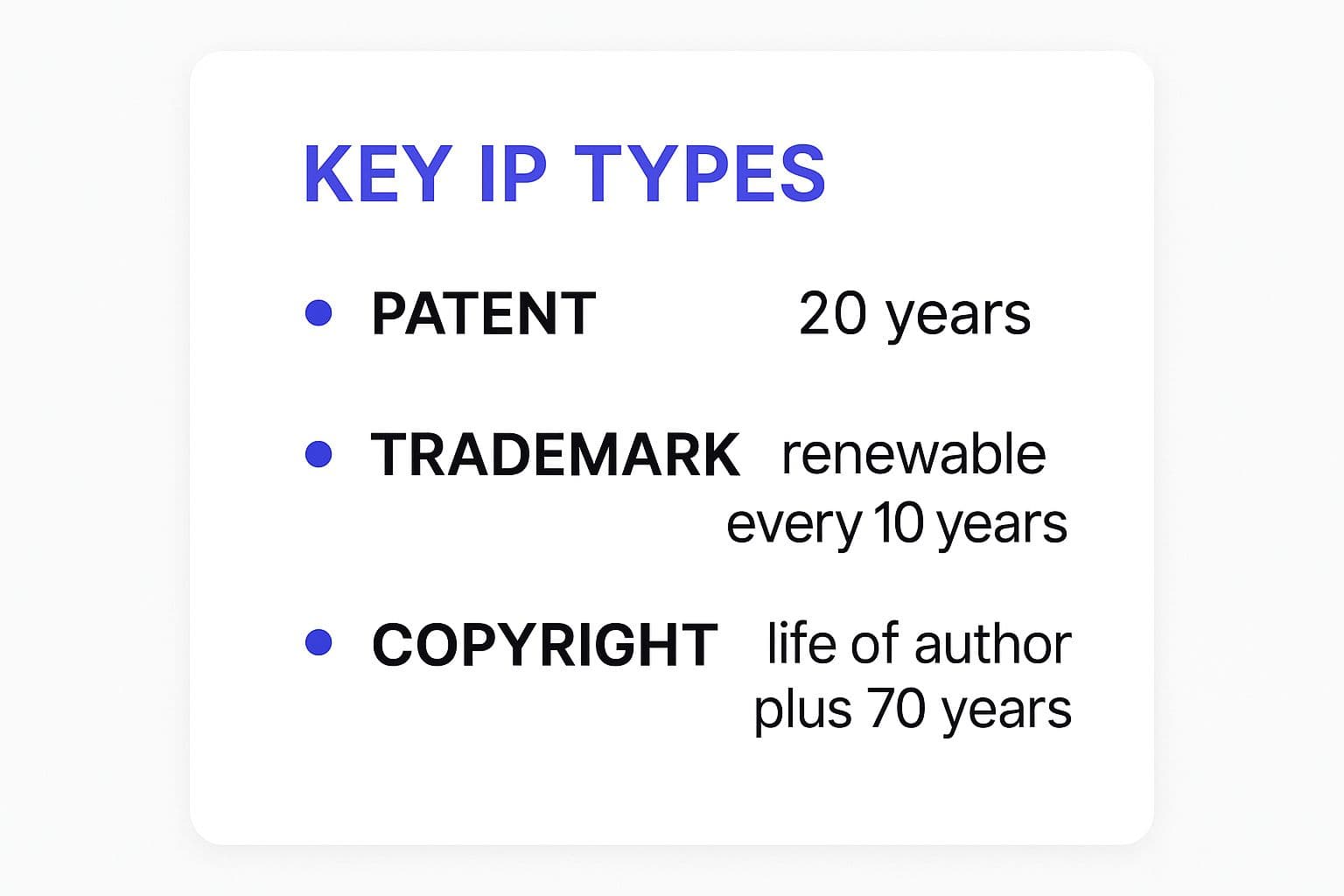
As you can see, the lifecycles are wildly different. A patent has a hard stop, while a trademark can theoretically last forever as long as you keep using it and renewing it.
To make this even clearer, let's break down what these assets look like in the real world.
A Quick Guide to Your IP Assets
Here's a simple table to help you distinguish between the four main types of IP and what they actually cover in a modern business.
| IP Type | What It Actually Protects | Real-World Business Example |
|---|---|---|
| Patent | A novel invention, process, or technical solution. | Google's original PageRank algorithm was a foundational patent that defined its search dominance. |
| Trademark | A brand identifier that distinguishes your goods or services. | The iconic Nike "swoosh" is a trademark instantly recognizable worldwide. |
| Copyright | An original work of authorship fixed in a tangible medium. | The entire source code for a software application like Adobe Photoshop. |
| Trade Secret | Confidential information that provides a competitive advantage. | The closely guarded recipe for KFC's original blend of 11 herbs and spices. |
Thinking about your business through this lens helps you spot opportunities and risks you might have otherwise missed.
Pinpointing these assets is absolutely essential in the beginning. For example, knowing what IP you have is a crucial part of a smart strategy for MVP development. It helps you decide which core features contain proprietary logic that needs to be locked down from day one. By mapping everything out, you’re not just doing a legal exercise; you’re building a strategic foundation that prevents expensive legal fights down the road and massively boosts your company's long-term value.
Securing Your Inventions with Patents
When you've created something genuinely new, a patent is the strongest shield you can have. It grants you an exclusive right to make, use, and sell your invention for a specific period—think of it as building a fortress around your core technical innovation. Getting there, however, isn't a simple A-to-B journey; it demands a strategic approach right from the very beginning.
Before you even think about spending money on lawyers, your first job is to conduct a meticulous prior art search. This is your reconnaissance mission to make sure your idea is actually as novel and non-obvious as you think it is. You'll need to dig through existing patents, academic papers, and any public information to see if someone else beat you to the punch. It’s a gut punch to find out your "brilliant" idea has been done before, but it's far better to learn that now than after you've sunk thousands into the application process.
Your First Strategic Move: Provisional vs. Non-Provisional
So, you’ve done your homework and you're confident your idea is unique. Now you’ve got a choice to make: file a provisional patent application (PPA) or jump straight into the deep end with a full non-provisional application?
For most startups, the PPA is the smart play. It's a faster, less formal, and much cheaper way to plant your flag in the ground and secure an early filing date. This gives you "patent pending" status for one year, a critical window where you can safely talk to investors, refine your product, and test the market without losing your rights.
That one-year grace period is pure gold for a new venture. It’s the time when you're turning a rough idea into something tangible. To really get a handle on what that evolution looks like, it helps to understand the difference between a proof of concept vs a prototype—that’s exactly the kind of progress this PPA window is designed for.
The global innovation race is no joke. In 2023 alone, global patent applications surged past 3.9 million. This isn't just a number; it's a clear signal that if you don't have a solid plan to protect your work, you risk getting lost in a very crowded field. For a deeper dive into these global trends, the World Intellectual Property Organization is the definitive source.
Document Everything: The Inventor's Notebook
One of the most effective tools in this process is also one of the most overlooked: a detailed inventor's notebook. This isn't just a quaint, old-school practice; it’s a living legal document that can save your skin. By rigorously documenting every single step of your R&D journey, you're creating an undeniable, timestamped record of your invention's birth and evolution.
So, what should you be recording with near-obsessive detail?
- Dates and Descriptions: Log every experiment, code change, and breakthrough with the exact date it happened.
- Sketches and Diagrams: A picture is worth a thousand words. Include drawings, UI mockups, and flowcharts of your algorithms.
- Failures and Successes: Documenting what didn't work is just as important as what did. It proves you went through a complete inventive process.
- Witness Signatures: Every so often, have a trusted colleague who understands the work (but isn't a co-inventor) sign and date your entries. This adds a crucial layer of third-party validation.
This disciplined record-keeping does more than just protect you; it becomes the foundation of a rock-solid patent application. When you hand this detailed history to your patent attorney, you're giving them the ammunition they need to draft strong, defensible claims that protect your core algorithms and unique software features.
Building a Defensible Brand with Trademarks
Your brand is so much more than a sharp logo or a clever name. It’s the feeling people get when they use your product, the reputation you build with every interaction. Protecting that identity with a trademark isn’t some stuffy legal chore—it's one of the smartest strategic moves you can make to carve out your space in a noisy market.
Think of your trademark as a beacon. It signals to the world, "This is us. This quality, this experience—it comes from our team." It could be your company name, that logo you sketched on a napkin, or even a unique sound. The whole point is to build an identity so distinct that customers instantly connect it with the trust you've worked so hard to earn.
Without that legal shield, a competitor could swoop in with a similar name, causing confusion and leeching off the goodwill you’ve painstakingly built.
The Critical First Step: A Trademark Search
Before you drop a dime on designers, order swag, or even file the paperwork, you absolutely must run a comprehensive trademark search. I can't stress this enough. So many founders get attached to a name, only to find out it's already taken. That discovery forces a painful and expensive rebrand nobody has time for.
And I don't mean just a quick Google search. You need to dive into the U.S. Patent and Trademark Office (USPTO) database. You're looking for registered and pending marks that sound similar, look similar, or have a similar meaning—especially if they're in your industry. Skipping this step is an invitation for a cease-and-desist letter or a legal fight you're not ready for.
Getting Your Symbols Straight: ™ vs. ®
You've seen them everywhere, but the ™ and ® symbols are not interchangeable. They represent two very different levels of legal muscle, and knowing which to use is crucial.
- The ™ Symbol (Trademark): Think of this as planting your flag. You can start using the ™ symbol the moment you start using your name or logo in business. It shows the world you're claiming "common law" rights to that mark. The catch? It offers very limited geographic protection and is much harder to defend if someone challenges you.
- The ® Symbol (Registered): This is the holy grail. You can only use the ® symbol after the USPTO has officially approved and registered your trademark. It gives you a legal presumption of ownership nationwide and the power to sue for infringement in federal court. It’s a powerful deterrent that tells everyone else to back off.
Filing with the USPTO elevates your brand from a local project to a nationally protected asset. That registration puts your ownership on the public record, giving you the exclusive right to use your mark for your specific goods or services across the country. This is how you stop just having a "brand" and start building a truly defensible moat around your business.
Protecting Your Creative Assets with Copyrights
Your business is a content factory. Think about it: from the very source code that powers your app to the UI design, marketing copy, and blog posts you publish—you're constantly creating valuable assets. These are your creative works, and copyright is the legal tool built to protect them.
It's a common myth that you don't need to do anything to be protected. And technically, it's sort of true. Copyright protection kicks in the moment you create something and "fix" it in a tangible form, like hitting 'save' on a document or publishing a webpage. But relying on that automatic protection alone is a massive mistake for any serious startup.
Why Formal Registration Is a Game Changer
Relying on automatic copyright gives you a shield, but it’s a flimsy one. If someone steals your work, you have very limited power to fight back. To get real legal muscle, you have to formally register your work with the U.S. Copyright Office.
Registration is what truly unlocks your ability to defend your assets. Most importantly, it's a prerequisite to suing for statutory damages and attorney’s fees. This is a huge deal. It means you could recover significant compensation without the nearly impossible (and expensive) task of proving the exact dollar amount of financial harm you suffered.
You can start the process right on the official government portal.

This is your go-to resource for all the forms, fees, and information you'll need to get your work officially on the books.
Understanding What You Can and Cannot Copyright
In the software world, it’s absolutely critical to know what copyright does—and doesn't—cover. It’s not a magic shield for every idea that pops into your head. Copyright protects the expression of an idea, not the idea itself.
Let’s break that down for a typical software company:
- What you CAN copyright: Your application's source code, the specific graphical elements of your user interface (UI), your website's visual design, promotional videos, and all that written content like white papers and user manuals.
- What you CAN'T copyright: The functional purpose of your UI, the core concepts or algorithms driving your software, your database schemas, or simple, short phrases. For instance, a basic button design probably isn't protectable, but an entire, artfully designed dashboard layout very well could be.
One last word of warning: be incredibly careful with open-source software. Using components without fully understanding their licenses can be catastrophic. Some licenses can force you to make your own proprietary code public, completely gutting your copyright protection. Always, always review licenses like MIT, Apache 2.0, or GPL to make sure they align with your business strategy and won't put your IP at risk.
Guarding Your Competitive Edge with Trade Secrets

Not everything you create can be filed away at a government office. Some of your most valuable assets are your 'secret sauce'—the stuff that really gives you an edge. This is the realm of trade secrets, and it covers everything from your customer lists and internal processes to proprietary algorithms.
Unlike patents, a trade secret can last forever, as long as it stays, well, secret. The flip side is that the responsibility for protecting it is entirely on you. If your secret gets out, your competitive advantage can vanish in an instant. This is why having a robust defense strategy is absolutely essential.
Laying the Legal Groundwork
The first step in protecting your secrets is putting up legal fences. This might sound like boring paperwork, but these documents are your first and most critical line of defense against leaks, whether they're accidental or malicious.
Your most powerful tool here is the Non-Disclosure Agreement (NDA). Anyone who gets a glimpse of your sensitive information needs to sign one. I'm not just talking about employees—this includes contractors, beta testers, potential investors, and partners. A solid NDA spells out exactly what's confidential and what happens if someone breaks that trust.
Beyond NDAs, make sure your standard employment and contractor agreements have strong confidentiality clauses and IP assignment provisions. This is crucial because it ensures that any intellectual property your team creates for your company legally belongs to the company, right from the start.
Building an Internal Fortress
Legal agreements are only half the battle. You need to back them up with strong internal security practices. It's about creating a culture where secrecy is taken seriously and reinforced through your day-to-day operations. The goal is to make it hard for secrets to just walk out the door.
Think of it as a mix of technical and procedural shields:
- Control Access: Not everyone on your team needs the keys to the kingdom. Operate on a "need-to-know" basis, restricting access to data and systems to only what's necessary for someone's specific role.
- Encrypt Everything: Any sensitive data, whether it's sitting on a server or moving across a network, should be encrypted. If someone gets their hands on it without authorization, the information will be useless to them.
- Train Your Team: Don't assume people know what a trade secret is or why it matters. Regularly train your staff on the importance of confidentiality and what their personal responsibility is in protecting the company's most valuable information.
The legal world is always evolving to address new threats, especially as cybersecurity becomes a bigger concern for every business. Sectors like biotech and pharma are constantly raising the bar on how they protect their data. To get a better sense of where things are heading, you can learn more about the future of intellectual property law on iipla.org.
Ultimately, a strong trade secret strategy is a two-pronged attack. You need the ironclad legal agreements to define the rules and the vigilant, security-first culture to enforce them. Get both right, and you’ll have built a formidable defense around the very things that make your business unique.
Enforcing Your IP Rights in a Global Market
So, you've done the hard work of securing your IP with registrations and putting solid internal policies in place. That’s a huge step, but it's really just the first half of the game. The real test comes when you find someone stepping on your rights. How you defend your assets is what truly separates a protected business from an exposed one, and a smart, measured response can save you from a legal war you can't afford.
It’s a gut-wrenching feeling to discover someone has ripped off your product or is using your trademark. The knee-jerk reaction is to go on the attack, but trust me, the smarter first move is almost always a carefully written cease and desist letter.
This isn't just an angry email. It's a formal notice, ideally sent by your lawyer, that puts the other party on notice. It clearly states you know what they're doing, outlines your IP rights, and demands they stop. It’s a surprisingly powerful and cost-effective first move that very often resolves the problem without anyone ever seeing the inside of a courtroom. More importantly, it signals you’re serious and won't hesitate to take legal action.
Taking Your Protection International
In today's market, your business is global from day one, whether you planned it that way or not. That means your IP protection needs to be, too. This gets tricky because IP rights are almost always territorial. A U.S. patent, for instance, is completely useless in Germany or Japan. You have to file for protection in every key market where you want to do business.
Thankfully, you don't have to start from scratch in every single country. A few international treaties were created to make this a lot less painful:
- The Patent Cooperation Treaty (PCT): This lets you file a single international patent application that acts as a placeholder, giving you the option to seek protection in a huge number of countries later on.
- The Madrid Protocol: This does the exact same thing but for trademarks. You can file one application and designate multiple member countries for registration.
These treaties are a lifesaver for startups aiming to scale. They save a massive amount of time and paperwork and let you delay the big-ticket national filing fees while you figure out which markets are actually worth the investment. And for tech companies building with remote talent, it's also smart to think about the platforms you use. You can learn more about cloud-based development services that help keep IP secure when your team is spread across the globe.
The Reality of Global Enforcement
Here's where we get real. Enforcing your rights in another country can be a bureaucratic nightmare. Not every country gives IP protection the same respect. Time and again, data shows that countries with strong enforcement frameworks are the ones that see the most innovation.
Take the United States Trade Representative's (USTR) 2025 Special 301 Report as an example. It’s an annual review that calls out countries for their IP practices. You’ll find major trading partners, like Mexico, still on the Priority Watch List because they consistently fail to enforce IP laws effectively. That's a huge red flag for any business operating there. For a deeper dive, you can discover more insights from Dentons about this global report.
At the end of the day, defending your IP requires a clear-eyed view of the costs and the commitment involved. Think of it as a crucial investment in your company’s long-term value and your ability to compete.
Ready to turn your protected idea into a market-ready product? At Iglu Digital, we specialize in building MVPs for a price agreed before a line of code is written, helping you launch quickly and securely. https://iglu.dev