

How to Turn Idea Into Product: Your Step-by-Step Guide
Table of Contents
Turning an idea into a tangible product isn't a single "aha!" moment. It’s a deliberate journey, a process that moves from a raw concept to something people will actually use and pay for. This journey has four distinct phases: validating your idea, defining the problem you're solving, building a Minimum Viable Product (MVP), and then iterating based on what real users tell you.
Your Idea Is Just the Starting Point
That initial spark of inspiration is exciting, but let’s be real—it’s just the first step. The real work, and where most great ideas fall apart, is in the execution. So, forget the myth of the overnight success. Creating a product people love is a structured process built on a foundation of smart, intentional actions.
Where do most founders go wrong? They try to build everything at once. They have a grand vision for a perfect, feature-packed product and get lost in the details from day one. This approach is not just a drain on your bank account; it's incredibly risky. You can easily waste months, or even years, building something based on pure assumption, only to find out nobody actually wants it.
A Framework for Success
A much smarter way to approach this is to think of the entire process as a series of well-designed experiments. Your primary goal isn't to build a perfect product right away—it's to learn as quickly and cheaply as possible. This mental shift is what separates successful founders from those who run out of steam and cash.
This guide lays out a proven framework that I’ve seen work time and time again. It breaks the journey into manageable stages, prioritizing evidence over guesswork.
- User Validation: Before you write a single line of code, you need to confirm that a real, painful problem exists for a specific group of people.
- Problem Definition: Once validated, you have to get laser-focused on the one core problem you are solving. Not ten problems, just one.
- Lean MVP Build: Now, you build the most basic version of your product that delivers on the core value proposition and solves that one problem. Nothing more.
- Iterative Improvement: Finally, you get your MVP into the hands of early adopters, listen intently to their feedback, and start the cycle of continuous improvement.
This sequence is your foundation. The graphic below illustrates how this initial phase works: you start with broad market research, which fuels brainstorming, and from there, you narrow down to the strongest concept to move forward with.
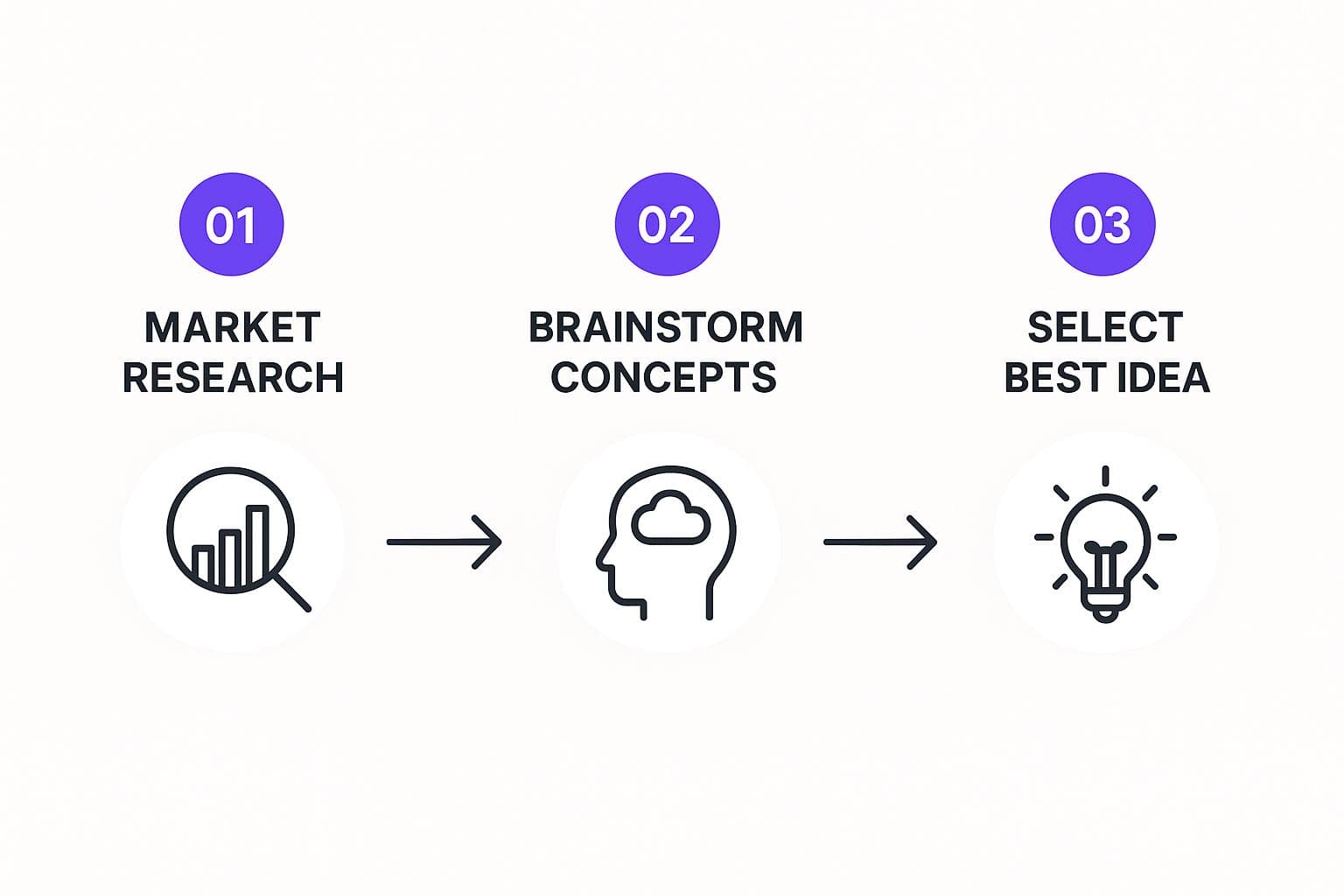
As the infographic shows, a successful product doesn’t start with building. It starts with listening, observing, and analyzing the market. By following this path, you ensure that every ounce of effort is aligned with genuine customer needs, which dramatically increases your chances of building something that actually succeeds.
Here's a quick look at how these stages fit together.
The Four Core Phases of Product Development
This table provides a quick summary of the essential stages in transforming an idea into a market-ready product.
| Phase | Primary Goal | Key Activity |
|---|---|---|
| Idea Validation | Confirm a real market need | Customer interviews, surveys, market research |
| Problem Definition | Isolate the core problem to solve | Creating user personas, defining a value proposition |
| MVP Build | Create the simplest functional version | Feature prioritization, rapid prototyping, development |
| Iteration & Launch | Gather feedback and improve | Beta testing, user feedback analysis, feature updates |
Each phase builds on the last, creating a solid foundation for a product that has a real chance of thriving in the market.
Validate Your Idea Before You Build Anything
Before you write a single line of code or spend a dollar on design, you have to answer one brutal question: does anyone actually want this? It's easy to fall in love with your own idea. That excitement creates a massive blind spot, tricking founders into building things based on gut feelings instead of hard evidence. Honestly, this is the number one startup killer.
Skipping this validation step is like setting out on a road trip with no map. You can have a great car and a full tank of gas, but you're probably going to end up lost. The mission here is simple: get proof that you're solving a real, nagging problem for a specific group of people.
Identify and Interview Your Target Customer
Your first move isn't building a website or designing a logo. It’s talking to people. You need to get out of your own head and into the world of your potential customers.
The best way to start is by sketching out a quick user persona—a semi-fictional character who represents your ideal customer. Give them a name, a job, and most importantly, a problem that keeps them up at night.
Let's say your idea is a project management tool for small marketing agencies. Your persona could be "Alex, an agency owner who’s constantly overwhelmed trying to track billable hours across a dozen different client projects." Your next job is to find the real-life Alexes.
- Where do they hang out? Go where they already are. Think LinkedIn groups for agency owners, marketing subreddits, or even local business networking events.
- How do you approach them? Don't pitch. Nobody likes being sold to. Instead, ask for their help and expertise. A message like, "Hi Alex, I'm doing some research on the biggest workflow headaches for agency owners and saw you're an expert. Would you be open to a 15-minute chat about your experiences?" works wonders.
- What should you ask? Dig into their current problems and habits. Use open-ended questions like, "Can you walk me through how you currently handle project tracking?" or "What's the most frustrating part of your week?" You're mining for pain points.
Create a Simple Validation Engine
Okay, you've had a few conversations and confirmed the problem is real. Now what? You need to see if people will take a small action to solve it. This is where you can use a few simple tools to gauge interest without a product.
One of the most effective tools in the shed is a validation landing page. This is just a single webpage with one job: clearly explain what you're offering and ask people to sign up if they're interested.
Here's what it needs:
- A Killer Headline: Get straight to the point. State the problem you solve and for whom. Something like, "The Easiest Way for Marketing Agencies to Track Time and Boost Profitability."
- Benefit-Driven Bullets: List 3-5 key outcomes. Forget features; talk about benefits. Think "Stop leaking billable hours" or "Generate client reports in seconds."
- A Clear Call-to-Action (CTA): A simple email sign-up form is perfect. The button should have a compelling label like "Request Early Access" or "Get Notified at Launch."
Run Micro-Ad Campaigns to Test Your Message
With your landing page up, it's time to send a little traffic its way. We're not trying to get thousands of sign-ups here; we're just testing the message. A tiny budget of 50-100 on a platform like LinkedIn or Facebook Ads is plenty to get the data you need.
Target the ads straight at your user persona (e.g., people with "Marketing Agency Owner" in their job title). The number you're watching is the conversion rate—what percentage of people who visit the page actually sign up.
If you see a conversion rate of 5-10% or higher, that's a fantastic signal. It's tangible proof that your message is resonating. If the numbers are low, it's not a failure; it's a cheap warning sign that you need to tweak your value proposition before you've invested thousands of dollars and months of your life.
Crafting a Lean MVP Strategy
After you’ve confirmed there's a real problem to solve, the big temptation is to jump straight into building a feature-packed, bells-and-whistles solution. This is a classic trap. The next move isn't about building everything; it’s about embracing a Minimum Viable Product (MVP) strategy.
An MVP isn't just a cheap or rushed version of your final product. Think of it as a strategic experiment. Its only job is to deliver the absolute core value to your very first users. In exchange, you get the feedback you need to build what people actually want and will pay for. This requires a ruthless focus. The goal isn't to launch your dream product from day one—it's to build the version that teaches you the most, as quickly as possible.
Defining Your Core Problem
Before you can even think about features, you need crystal clarity on the single, most important problem your MVP will solve. Not five problems—one.
Let's say your validated idea is a project management tool for marketing agencies. The core problem you've identified might be "inaccurate and time-consuming client billing." Your MVP needs to solve that one problem and do it brilliantly. Everything else is just noise.
This focus is your best defense against "feature creep"—that slow, insidious addition of non-essential functions that blows up your budget, pushes back your timeline, and muddies the user experience.
Your MVP for the agency tool, for instance, might only let users create a project, log time against it, and export a simple report. It won't have team collaboration tools, fancy dashboards, or third-party integrations. Those can come later, but only if users tell you they need them.
Prioritizing Features with the MoSCoW Method
Once your core problem is nailed down, you need a system for deciding what makes the cut. A simple and incredibly effective framework for this is the MoSCoW method. It helps you sort all your great ideas into four practical buckets:
- Must-Have: These are non-negotiable. Without them, your product doesn't solve the core problem. For our agency tool, that’s creating projects and logging time.
- Should-Have: These are important features that add real value but aren't vital for the first release. A basic dashboard showing total hours logged for the week might land here.
- Could-Have: Nice-to-have features that would be great if time and resources magically appeared. Think of things like color-coding projects or adding client logos to reports.
- Won't-Have (This Time): Features that are explicitly out of scope for this version. This is where you park complex ideas like tiered user permissions or direct invoicing capabilities.
Sorting your feature list this way gives you a clear, defensible roadmap for your MVP. You're committing to building only the "Must-Haves" to start, which keeps your team focused and the initial build lean.
The Financial Reality of a Lean Approach
This lean strategy isn’t just a development philosophy; it’s a financial lifesaver. Building a full-featured product right out of the gate is outrageously expensive and risky.
According to industry data from Studiored.com, product design and development agencies charge between 10,000 and 49,999 per project on average. That’s a serious amount of capital for an initial build.
The MVP approach dramatically slashes that initial financial risk. By focusing only on the essentials, you cut down development hours and get your product into the hands of real users faster and with a much smaller investment. This lets you test your core assumptions in the market before you even think about committing to a bigger budget. You can learn more about the benefits of a Minimum Viable Product in our detailed guide.
Ultimately, this strategy transforms product development from a massive upfront gamble into a series of smaller, smarter bets guided by real-world data. It's the most effective way to manage risk while actively moving your idea toward a successful launch.
Building Your Product and Gathering Feedback
Alright, your idea is validated and you’ve trimmed your MVP down to the essentials. Now for the fun part: turning that concept into something tangible. This is where the rubber meets the road, where your plans become a real product that your first users can actually touch and feel.
How you get there is a critical choice. You essentially have two main paths—build it yourself or hire someone to do it for you. Your decision will come down to your own technical chops, your budget, and how quickly you need to move.
Choosing Your Development Path
If you're a non-technical founder, you’re in luck. The rise of no-code platforms has completely changed the game. Tools like Bubble, Webflow, and Adalo let you build surprisingly sophisticated apps with visual, drag-and-drop editors. This path puts you in the driver’s seat, allowing you to make quick changes based on what you learn.
The other route is to bring in outside help. You could hire a freelance developer on a platform like Upwork or Toptal, or partner with a specialized development agency. If you go this route, doing your homework is non-negotiable.
- Look at their portfolio: Don't just look for pretty designs. Look for projects that are similar to yours in scope or industry.
- Talk to past clients: Get on the phone with their references. Ask about communication, deadlines, and whether they truly understood the business goals.
- Start with a small, paid test: Before you sign a contract for the whole MVP, give them a tiny, well-defined task. It’s the single best way to see how they actually work.
No matter which path you take, some things are universally true. A study on product development found five key factors for success: commitment from the top, a crystal-clear product concept, cross-functional team involvement, talented people with the right experience, and clear goals with milestones. Nail these, and you're building on solid ground. You can dig into the specifics in the full study on successful product development on pmc.ncbi.nlm.nih.gov.
Building Your Feedback Loop
Look, building the product is only half the battle. If you build it in a vacuum, you're just guessing. The real magic happens when you create a tight, continuous feedback loop from the very beginning.
Think of your MVP as a learning machine. Its main job is to get into the hands of real people so you can see what they do, not just what they say.
To do this right, you need a system. You have to be intentional about how you gather, organize, and act on user feedback. Otherwise, those golden nuggets of insight will just get lost in the shuffle.
How to Gather Actionable User Feedback
Getting honest feedback means going beyond a simple, "So, what do you think?" You need to create structured channels for people to share their experiences.
- Watch them use it. Seriously. Get a handful of target users on a video call and just watch them use your product for the first time. Give them a task, then shut up and observe. Where do they get stuck? What confuses them? What makes them smile? This is the purest feedback you'll ever get.
- Make feedback easy. Integrate simple tools that let users report a bug or suggest an idea without friction. Tools like Userback or Hotjar let people leave visual feedback right on the page. To keep it all organized, a simple Trello board or Airtable base works beautifully.
- Analyze what they do. Words are one thing, but actions are another. Analytics tools like Google Analytics or Mixpanel show you the story in the data. Are users abandoning a certain page? Are they completely ignoring that "killer feature" you were so proud of? This quantitative data is the perfect counterpart to your qualitative interviews.
This structured approach is a key part of the process for developing an app that actually solves problems. By blending direct observation with smart tools and data, you start to see patterns. Raw comments turn into a prioritized roadmap, and that iterative cycle of building, measuring, and learning is what turns a basic MVP into a product people can't live without.
So, You've Launched. Now What? Iterating Your Way to Success
Your MVP is officially out in the wild. You’re collecting real data and hearing from actual users. It’s a huge milestone, but this isn't the finish line—it’s the starting gun for the most important race you’ll run. This is where you stop guessing and start knowing.
The post-launch phase is all about turning raw feedback and analytics into a product people can't live without. It’s a delicate balance of listening intently, adapting quickly, and building a smart roadmap that fuels real growth.
Turning User Feedback into a Real Product Roadmap
Let's be clear: not all feedback is created equal. Your early adopters will come at you with a firehose of ideas, bug reports, and opinions. The real skill isn’t just collecting this stuff; it’s knowing what to ignore. If you build every feature people ask for, you'll end up with a bloated, confusing mess.
Your job is to play detective. Look for the problem behind the suggestion. A user asking for a Google Calendar integration might not actually need a calendar. The real pain point could be that they're struggling to track deadlines within your app. Seeing that distinction is everything.
You need a system. Get all that feedback into one place—a Trello board, a spreadsheet, whatever works for you. Then, start sorting it into themes.
- Usability Snags: Where are people getting tripped up or confused?
- Feature Gaps: What essential tasks can't they complete?
- The "Why": What bigger goal are they really trying to achieve with your product?
Once you group the feedback, patterns will jump out at you. You might realize five different feature requests all point back to one core, unmet need. Prioritizing that underlying need—not the five individual requests—is how you build a roadmap that actually moves the needle.
Tracking Metrics That Actually Matter
User stories and qualitative feedback are gold, but you need the hard numbers to see the whole picture. Analytics tell you what people do, not just what they say. Don't get lost in a sea of data; focus on a few key performance indicators (KPIs) to monitor your product's health.
For any early-stage product, these three metrics are your north star:
- User Retention: What percentage of users come back after day one? Week one? This is the single most important sign of product-market fit. If you have a "leaky bucket" where users sign up and never return, you have a core value problem.
- User Engagement: How are your active users really using the product? Are they interacting with the core features you bet the farm on? If a key feature is a ghost town, it either doesn't solve the problem well or it wasn't as important as you assumed.
- Conversion Rate: This is all about the one key action you want users to take. For a SaaS product, it's likely upgrading to a paid plan. For a social app, maybe it's creating their first post. Tracking this shows you how well your product delivers on its core promise.
These metrics bring clarity to your chaos. If retention is tanking, you know to focus on the onboarding experience, not on building niche features for power users. This data-driven thinking is also crucial when you need to present your progress and future plans to investors.
Keeping Your Foot on the Gas in a Fast-Moving Market
The pressure to ship is relentless. A Protolabs.com survey of over 700 product developers found that 62% feel consumer demand is forcing faster turnarounds, and 65% are speeding up their cycles just to keep up with competitors.
This pressure isn't going away. To survive without burning out, you need a sustainable rhythm. Forget those massive, six-month development cycles. Instead, get into a tight, iterative loop:
- Plan: Use your feedback and data to pick a small batch of high-impact improvements.
- Build: Knock them out in a short sprint, like two weeks.
- Launch: Get the updates out to your users.
- Measure: Watch your KPIs and collect the next round of feedback.
This continuous cycle of learning and shipping is the engine of growth. It’s how you evolve your MVP from a rough idea into a product that matters, letting you stay ahead of the market and build a business that lasts.
Common Questions About Product Development

As you start to map out how to turn your idea into a real product, a few big questions always seem to surface. These are the practical, sometimes intimidating, hurdles that every founder runs into.
Let's cut through the noise and tackle those questions head-on. Getting clear, direct answers to these common concerns will give you the confidence to push forward and avoid some critical early mistakes.
How Much Money Do I Need to Start?
There's no single price tag. The cost completely depends on the path you choose.
If you go the no-code route, a simple MVP might only set you back a few hundred dollars for software subscriptions and some small ad tests. This is a fantastic way to validate an idea without taking a huge financial gamble.
On the other end of the spectrum, hiring a development agency to build a custom-coded product can easily run anywhere from 10,000 to over 50,000. The smartest move you can make is to keep your initial spending as low as humanly possible. Your first real budget should be just enough to build the absolute leanest version of your product that solves one core problem.
This approach massively reduces the risk of burning through cash to build something nobody wants. Your financial commitment should only grow as you get more and more positive signals from the market.
What if Someone Steals My Idea?
This fear paralyzes so many entrepreneurs before they even get started. But here’s the reality: ideas are a dime a dozen. What's truly rare is exceptional execution.
Your real competitive advantage isn't the idea itself; it's how you build it, your deep understanding of your customers, and how fast you can move.
Sure, you can use Non-Disclosure Agreements (NDAs) with developers if it makes you feel more comfortable. But don't let the fear of theft stop you from getting that all-important customer feedback. The risk of building a product in a vacuum that nobody needs is far greater than the risk of someone stealing your concept. Focus on out-building and out-learning everyone else.
Do I Need a Technical Co-Founder?
Not necessarily, and definitely not right away. The game has changed.
The rise of incredibly powerful no-code and low-code platforms like Bubble and Webflow means non-technical founders can now build surprisingly robust MVPs all by themselves. This gives you total control and a direct line to user feedback when it matters most.
If your idea is more complex, you still have options before you give away a chunk of your company:
- Hire a freelance developer to get the initial build off the ground.
- Partner with a small agency that focuses on rapid MVP development.
- Stitch together a few no-code tools to prototype the core functionality.
A technical co-founder becomes a huge asset once you start to scale and hit more complex engineering roadblocks. But needing one is no longer a barrier to getting your product into the market and proving it has legs.
How Do I Know if My MVP Is Good Enough?
It's simpler than you think. Your MVP is "good enough" if it does one thing well: it solves one specific problem for your target user and allows you to collect meaningful feedback. That's the bar. It doesn't need to be polished or packed with features.
Just ask yourself this: "Can a user achieve the main goal I promised with this version?" If the answer is a solid yes, it's ready to ship.
For instance, an MVP for a meal-planning app might just let users find recipes based on ingredients and create a simple shopping list. Nothing more. No calorie tracking, no fancy user accounts, no social sharing. Viability is all about delivering that one core piece of value, not being an all-in-one solution from the start.
Ready to stop wondering and start building? At Iglu Digital, we specialize in transforming your vision into a market-ready MVP with the scope and the price agreed before we start. Let us help you take the next step with confidence and speed. Turn your idea into a product today.