

What Is Lean Startup Methodology? Learn Key Principles to Innovate
Table of Contents
The Lean Startup isn't just another business buzzword; it's a completely different way of thinking about building something new. At its heart, it's about ditching the old-school, rigid business plan in favor of speed, customer feedback, and real-world learning. It swaps the "build it and they will come" fantasy for a scientific method of constant, rapid experimentation.
Decoding the Lean Startup Mindset

Think of a traditional business plan like a painstakingly detailed, turn-by-turn roadmap for a long journey. It's built on the assumption that every road will be clear and every planned stop will go off without a hitch. The Lean Startup, on the other hand, is like having a reliable compass and a general destination. It gives you the tools to navigate the unknown, find your true north (a repeatable, scalable business model), and avoid burning through your resources on dead ends.
So, what is the Lean Startup methodology, really? It's a framework designed to cut through the chaos and uncertainty of launching a new product. Instead of sinking months or even years into building a "perfect" product behind closed doors, this approach pushes you to get your core ideas in front of real customers as fast and cheaply as possible.
The Origins of a New Approach
This way of thinking was popularized by Eric Ries back in 2008. He brilliantly adapted lean manufacturing principles—originally designed to eliminate waste on factory floors in the 1990s—for the unpredictable world of tech startups. His work stands on the shoulders of giants like Steve Blank, who pioneered the concept of "customer development," and also borrows heavily from Agile software development.
This powerful blend of ideas created a system for entrepreneurs to answer the most important question of all: will people actually pay for this? And the goal is to answer it long before the bank account runs dry.
The 3 Key Pillars of Lean Startup
The entire philosophy is propped up by a few core ideas that work together to keep you moving forward. We’ll dive deeper into each, but it helps to get a quick feel for them now.
- The Build-Measure-Learn Loop: This is the engine that drives everything. It’s a simple but powerful cycle: you build a small experiment, measure how real users react, and use what you learn to decide what to build next.
- The Minimum Viable Product (MVP): An MVP isn't a buggy or incomplete product. It's the absolute smallest thing you can build to start the Build-Measure-Learn loop. Its only job is to test your biggest, riskiest assumption with the least amount of effort.
- Validated Learning: This is how you measure progress. Forget about vanity metrics that make you feel good but tell you nothing. Validated learning is about gaining concrete proof—through real-world experiments—that you're on the right track with your customers and your business model.
By zeroing in on these elements, founders can navigate the treacherous early days of a new venture much more effectively. For anyone sitting on a great concept, understanding how to turn an idea into a product using these principles is the single most important first step.
To truly grasp the shift in thinking, it helps to see the two approaches side-by-side.
Traditional Business Model vs Lean Startup Approach
| Aspect | Traditional Business Model | Lean Startup Methodology |
|---|---|---|
| Initial Plan | Create a comprehensive, multi-year business plan based on market research and assumptions. | Formulate a series of testable hypotheses about the business model. |
| Product Development | Develop the full product in "stealth mode" over a long period. Launch when "perfect." | Build a Minimum Viable Product (MVP) quickly to test the core hypothesis. |
| Customer Interaction | Limited customer contact until the final product launch. | Continuous customer feedback and interaction from day one. |
| Measure of Progress | Hitting milestones in the business plan (e.g., product features completed). | Validated learning—proving hypotheses with real-world data. |
| Handling Failure | Failure is a major setback, often resulting in the business closing. | Failure is an expected part of the learning process. "Fail fast" to find what works. |
| Funding | Seeks large, upfront funding to execute the entire business plan. | Seeks smaller, incremental funding to get to the next learning milestone. |
This table highlights the fundamental difference: one is about executing a fixed plan, while the other is about searching for a viable one. The Lean Startup embraces uncertainty as a given and provides a roadmap for navigating it successfully.
The Build-Measure-Learn Feedback Loop
At the very heart of the Lean Startup methodology is its engine: the Build-Measure-Learn feedback loop. This isn’t just a one-and-done process. It’s a rapid, continuous cycle designed to turn assumptions and uncertainty into hard knowledge. Think of it as applying the scientific method to building a business.
Instead of spending months or years on a long, linear development path, this loop breaks the journey down into quick, manageable sprints. Each trip around the loop is a chance to refine your product, tweak your strategy, and get one step closer to what customers actually want. It’s the core mechanism that makes validated learning possible.
Stage 1: Build The Experiment
The first step, "Build," is probably the most misunderstood part of the whole process. In the Lean Startup world, "Build" doesn't mean you go off and create the final, feature-packed product you've been dreaming of. Not even close.
It means building the smallest, simplest thing you possibly can to test a specific guess you have about your business. This initial experiment is your Minimum Viable Product (MVP). The whole point of an MVP is to kickstart the learning process with the least amount of effort, not to wow the world with a polished design.
Let's say you have an idea for a subscription box for artisanal coffee beans.
- Your Hypothesis: You believe coffee fanatics are willing to pay a monthly fee to discover new, high-quality beans from small roasters.
- The "Build" (Your MVP): Forget about building a fancy e-commerce site, sourcing tons of inventory, or designing custom packaging. Instead, you could just create a simple landing page. This page would briefly describe the service, show a few sample beans, and include a form asking people to sign up with their email for a "pilot program."
That landing page is your built product. It's fast, it's cheap, and it’s perfectly designed to test your core assumption: does anyone even care about this idea?
Stage 2: Measure The Results
Once your experiment is live, it's time to "Measure." This is where you step back and collect real-world data on how people are interacting with your MVP. The trick here is to focus on actionable metrics, not vanity metrics.
- Vanity Metrics: These are the numbers that look great in a presentation but don't actually tell you anything useful about your business. Think total website visitors or social media likes. They might make you feel good, but they don't help you make smart decisions.
- Actionable Metrics: These are the numbers that connect a specific cause to an effect. They give you real insight. Think conversion rates, customer acquisition cost, or how many users stick around.
Back to our coffee box example. The key metric you'd measure is the percentage of visitors who actually submit their email address. If 1,000 people land on your page and only two sign up, that’s a very loud signal. On the other hand, if 300 people sign up, you’ve just gathered some powerful evidence that you might be onto something.
Stage 3: Learn and Decide
The final stage, "Learn," is the moment of truth. You take the data you just collected and figure out what it all means. This isn’t just about staring at a spreadsheet; it's about translating those numbers into real insights about your customers and the market.
This stage forces you to make a critical choice: persevere or pivot.
- Persevere: If the data backs up your hypothesis (like a high sign-up rate for the coffee box), you persevere. You stick with the current strategy and move on to the next loop, maybe building a slightly more detailed MVP.
- Pivot: If the data shoots down your hypothesis, it’s time to pivot. A pivot isn't a failure—it's a strategic, structured course correction. You use what you learned to test a new core hypothesis about your product, your customers, or your growth strategy.
This simple visual captures the continuous flow of this entire process.
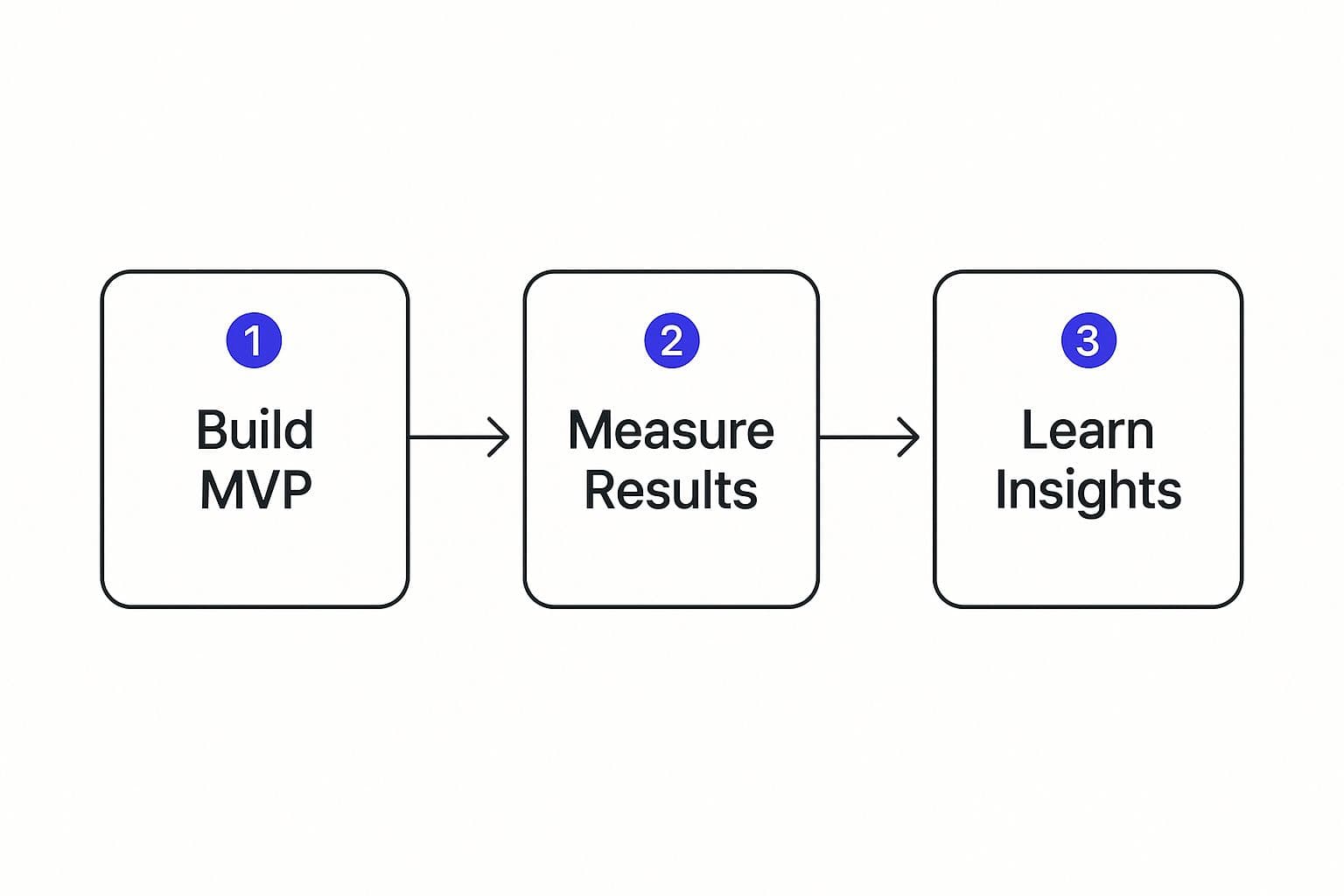
As you can see, each step flows directly into the next, creating a repeatable system for turning raw ideas into a viable business. The Lean Startup methodology is built entirely on this feedback loop—getting a bare-bones product in front of real people to collect data, test ideas, and learn as quickly as possible. You can explore more of these foundational principles and find additional insights from related educational resources on study.com.
This cycle is the heartbeat of a lean startup. By repeating it again and again, you replace "I think" with "I know," building your business one validated step at a time.
Understanding the Minimum Viable Product
The term Minimum Viable Product, or MVP, sits at the very heart of the Lean Startup methodology, but it's one of the most misunderstood concepts out there. Let's clear something up right away: an MVP isn't just a buggy or stripped-down version of your final product. Think of it more like a scientific tool, built with one specific goal in mind: learning.
Imagine you have a grand vision to build a revolutionary new car. The old way of doing things would involve spending years and millions of dollars in a garage, perfecting every detail, only to roll it out and discover people actually wanted a motorcycle. The Lean Startup approach flips this on its head and starts with a much simpler question: "Do people even need a better way to get from A to B?"
To test that fundamental idea, you don't start welding a car chassis. You build a skateboard.
The skateboard is your MVP. It's not a car, not even close. But it solves the core problem—personal transportation—and lets you test your biggest, riskiest assumption with the least possible effort. That's the essence of an MVP: delivering just enough value to a handful of early users to see if you're even on the right track.
Defining Your Smallest Viable Experiment
The whole point of an MVP is to fire up the Build-Measure-Learn feedback loop as fast and as cheaply as you can. It’s the absolute bare minimum you need to create to get honest, actionable feedback from real people. The emphasis on "minimum" is about slashing wasted time and resources, not about shipping something sloppy.
An MVP can take a surprising number of forms—it doesn't have to be a piece of software. The real trick is to pinpoint the one single assumption your entire business idea hangs on and then design the smallest possible experiment to test it.
Some of the most famous MVP stories show just how creative you can get:
- Dropbox: Before their engineers wrote a single line of complex file-syncing code, the founders just made a video. It was a simple explainer showing how the product would work. They posted it online to see if anyone cared enough to sign up for a product that didn't even exist yet. The sign-up list exploded, validating their core belief that people were desperate for a better way to share files.
- Zappos: Founder Nick Swinmurn had a hunch people would buy shoes online, an idea that was pretty radical at the time. Did he build a giant e-commerce site and stock a warehouse full of inventory? Nope. He went to local shoe stores, took pictures of their shoes, and put them on a super basic website. When an order came through, he’d literally run to the store, buy the shoes, and mail them himself. This "Concierge MVP" proved his business model worked with almost zero upfront investment.
These examples nail it: the best MVPs aren't products at all. They're clever, low-effort tests designed for maximum learning.
A Simple Framework for Your MVP
You don't need a complicated blueprint to map out your own MVP. The whole journey is just a series of educated guesses (hypotheses) followed by experiments to see if you were right. Your MVP is simply the first and most critical experiment.
This is the bedrock principle. You're not trying to launch your dream product out of the gate. You're trying to find the quickest route to hard data from the real world. This mindset is the key to successful MVP development, because it puts learning before building.
So, where do you begin?
- Identify Your Riskiest Assumption: What is the one belief that, if wrong, would cause your entire business to fail? Is it that customers will pay for your solution? That you can acquire users through a specific channel? Get it down on paper as a clear, testable statement.
- Define Success Metrics: How will you know if you were right? You need to decide on specific, measurable metrics before you start. For Dropbox, it was the number of email sign-ups. For Zappos, it was getting that very first sale.
- Design the Smallest Experiment: Now, what is the absolute minimum you can create to test that assumption and measure your metric? It might be a landing page, a video, a spreadsheet, or a single-feature app. That's your MVP.
Following this simple framework keeps your MVP focused on its true purpose. You're not launching a product; you're launching a process of discovery. It’s a strategic move that helps you dodge the number one startup killer: building something nobody wants.
Validated Learning and the Strategic Pivot
In a traditional business, progress might be measured by how many features you’ve built or how many lines of code your team has written. But in the Lean Startup world, those are just vanity metrics. The only thing that truly matters is validated learning.
This is all about getting cold, hard proof that you're on the right track to building a real, sustainable business. Every new idea starts as a pile of assumptions—guesses about who your customers are, what they need, and how your product will help. Validated learning is the discipline of turning those guesses into facts, one experiment at a time, using the Build-Measure-Learn loop.
Turning Guesses into Facts
The central idea is a game-changer: progress isn't about making stuff, it's about learning what to make. It's the concrete evidence that you're discovering something valuable about your customers and your market. Each spin through the feedback loop gives you a new piece of the puzzle, either confirming your assumptions or telling you they’re dead wrong.
This shift in focus is what separates the startups that make it from those that burn out. It stops you from wasting months, or even years, building something nobody wants based on a flawed idea. By putting learning first, you ensure every ounce of effort is spent finding a business model that actually works.
This data-first mindset brings a scientific method to the chaos of a startup. It’s about being brutally honest with yourself and letting the data guide your next move.
The Pivot: A Strategic Course Correction
So, what do you do when the data screams that your big idea is a dud? This is where the pivot comes in. A pivot isn't admitting defeat; it’s a smart, structured course correction. It’s a deliberate decision to test a new core hypothesis about your product, your customers, or your growth strategy.
Think of it as recognizing your current path leads to a cliff, but you’ve learned enough from the journey to spot a better route. The history of business is littered with stories of legendary pivots that snatched victory from the jaws of defeat. Many of these ideas overlap with other modern frameworks, and you can see the parallels by exploring the fundamentals of mastering agile methodology terms.
Here are a couple of classics:
- Slack: The communication platform we all know started as a video game company called Tiny Speck. Their game, Glitch, was a flop. But the founders realized the internal messaging tool they built for their own team was the real prize. They pivoted, and Slack was born.
- YouTube: Believe it or not, YouTube was originally a video dating site with the slogan "Tune in, Hook up." It was a ghost town. The founders noticed, however, that the few users they had were ignoring the dating part and just uploading random videos. They pivoted to a general video-sharing platform, and the rest is history.
These examples drive home a key point: a pivot isn't a panic move. It's a strategic shift based entirely on validated learning.
Common Types of Pivots
Pivoting doesn’t always mean throwing everything out and starting over. Often, it’s a more targeted change to one part of your business model. Here are a few common forms it can take:
- Zoom-in Pivot: This happens when you realize one small feature of your product is what everyone loves. It becomes the entire product. Instagram started as a messy check-in app called Burbn, but people were obsessed with its photo filters. The team wisely zoomed in on that one feature.
- Customer Segment Pivot: You built the right product, but for the wrong people. This pivot happens when you discover your solution resonates powerfully with a completely different customer group than you first targeted.
- Technology Pivot: Sometimes you realize there’s a much better way to deliver the same solution. This pivot involves switching to a new technology that offers a significant advantage, like better performance, scalability, or lower costs.
Knowing when and how to pivot is one of the most vital skills in the Lean Startup playbook. It demands that founders stay objective, kill their darlings, and follow the data wherever it leads. Every "failed" experiment isn't a loss—it's an investment in learning what doesn't work, which gets you one step closer to what will.
The Real-World Payoffs of a Lean Startup Mindset
Adopting the Lean Startup method isn't just about following a trendy new playbook; it's about generating real, tangible results for your business. When you're facing the massive uncertainty of launching something new, its principles give you a clear framework for innovating smarter, faster, and with a relentless focus on the customer. It fundamentally changes the game from "executing a plan" to "searching for a viable business model."
This shift completely redefines what "progress" looks like. Instead of patting yourself on the back for shipping more features, you start measuring success by how much you've learned and validated. This focus on learning creates a data-backed roadmap, helping you find your way even when the initial idea hits a dead end.
Stop Wasting Time and Money
Let's be blunt: the biggest win here is cutting down on waste. And I'm not just talking about money—I'm talking about the immense time and emotional energy your team pours into a project. The old way of doing things often meant spending months, or even years, building a "perfect" product, only to launch to the sound of crickets. That's the ultimate business tragedy.
The Lean Startup tackles this problem head-on by championing small, quick experiments. By launching a Minimum Viable Product (MVP), you can test your biggest assumptions with just a fraction of the resources. It’s no surprise that a CB Insights report found the #1 reason startups fail—in a staggering 38% of cases—is that they built something nobody wanted. This methodology is designed to snuff out that risk from day one.
Build a Faster, More Adaptable Team
By its very nature, the Lean Startup model makes you incredibly nimble. The rapid cycles of the Build-Measure-Learn loop mean your team can react to what the market is telling you almost instantly. While your slow-moving competitors are stuck following a rigid 12-month roadmap, a lean company can pivot its entire strategy in a few weeks based on hard data from actual customers.
This speed isn't about being reckless; it's about learning faster than everyone else. Each iteration brings fresh insights, letting you quickly kill what isn't resonating and pour gas on what is. In any market, that kind of responsiveness is a massive competitive advantage.
Put the Customer at the Center of Everything
Plenty of companies talk about being customer-centric, but the Lean Startup forces you to actually live it. The entire framework is engineered to create a constant conversation with your target audience. You're not just building a product for your customers; you're building it with them.
This deep connection is what leads to products that people genuinely love and are happy to pay for. You stop guessing and start developing a crystal-clear understanding of user pain points and desires, which is the secret to driving better engagement and long-term loyalty.
When you look at the core benefits, the direct business impact becomes incredibly clear.
Lean Startup Benefits and Business Impact
This table summarizes the core advantages of the Lean Startup methodology and connects them to specific, measurable business outcomes.
| Core Benefit | Description | Direct Business Impact |
|---|---|---|
| Reduced Waste | Minimizes time and capital spent on building unwanted features or products. | Lower development costs, extended financial runway, and higher ROI on effort. |
| Increased Agility | Enables rapid adaptation to changing market conditions and customer feedback. | Faster time-to-market and the ability to outmaneuver slower competitors. |
| Customer-Focused | Builds the product based on direct, continuous feedback from real users. | Higher product-market fit, increased customer satisfaction, and improved loyalty. |
| Data-Driven Culture | Replaces intuition and assumptions with evidence-based decision-making. | Reduced risk of failure and a more predictable path to a sustainable business model. |
Ultimately, these benefits work together to create a more resilient, intelligent, and successful organization.
Common Lean Startup Misconceptions to Avoid
When you first dive into the Lean Startup methodology, it's easy to get tangled in some common myths. Like any popular framework, its core ideas can get twisted, leading teams down a frustrating path. Getting it right means steering clear of these pitfalls from the get-go.
One of the biggest misunderstandings is that "lean" means cheap. This isn't about pinching every penny or starving your project of resources. It’s about being smart and eliminating waste—investing your time and money only in what gets you the most valuable feedback. The goal is maximum learning for every dollar spent, not just spending less.
Another myth that trips people up is the idea that Lean Startup means you can just wing it without a plan. The opposite is true. You absolutely need a strong vision. Think of it as your North Star; it’s the constant that guides you, even when you have to make a sharp turn or pivot based on customer feedback.
Misinterpreting Core Principles
Even when teams embrace the philosophy, they can stumble by misapplying its core concepts. This is where a lot of the real trouble starts.
- Falling for Vanity Metrics: It's so tempting to get excited about big, flashy numbers like total sign-ups or page views. They look great in a presentation, but they often tell you very little about the health of your business. The real gold is in actionable metrics—things like daily active users, conversion rates, or customer lifetime value. These are the numbers that help you make real decisions.
- Forgetting to 'Get Out of the Building': The entire framework hinges on direct customer insight. It’s a classic mistake to stay cooped up in the office, staring at spreadsheets and analytics, convinced you know what customers want. You have to go talk to them. Nothing replaces a real conversation with a real person about their real problems.
If you're not careful, you can find yourself moving fast but going nowhere. You might be busy, but if you’re measuring the wrong things or hiding from customers, you're just accelerating in the wrong direction.
This is a crucial mindset shift. Too many founders see a pivot as an admission of defeat. In reality, it’s the methodology working exactly as it should. It means you’ve learned something so important that it would be foolish not to change course, saving you from wasting years on a dead end.
Building the Right Team and Mindset
Finally, remember that Lean Startup isn't just a set of tactics; it's a culture. Trying to bolt it onto a team that isn’t ready is a recipe for disaster.
You need people who are comfortable with uncertainty and can thrive in the fast-paced build-measure-learn cycle. This means hiring for adaptability and creating a space where experimenting is the norm and failure is just another word for learning. Without that cultural foundation, the whole process just falls apart.
A Few Common Questions
Even after getting the hang of the core ideas, some practical questions always pop up when you're first digging into the Lean Startup methodology. Let's tackle a few of the most common ones to clear things up.
How Is Lean Startup Different From Agile?
This one trips a lot of people up, but the difference is actually pretty straightforward. Think of the Lean Startup as your strategic roadmap—it’s the "why" and the "what" behind your business idea. It's all about finding a real problem and a viable market by constantly testing your assumptions.
Agile is the "how." It's a set of development practices that let you build the product itself in a flexible and efficient way. They aren't competing ideas; they're partners. You use Agile methods to quickly build the MVP that your Lean Startup strategy tells you to build.
Can Big Companies Actually Use This?
Absolutely. While the methodology was born out of the startup scene, its principles are now widely used by large corporations looking to innovate from within—a practice sometimes called "intrapreneurship." Big companies use it to launch new products or explore new ventures without putting their main business at risk.
They do this by setting up small, almost independent teams that act like internal startups. This lets them test out disruptive ideas and explore new markets with the speed of a startup but with the resources of a major enterprise. The trick is to give these teams the freedom to experiment, fail, and learn without getting bogged down by the usual corporate red tape.
What’s the Very First Step I Should Take?
This is the most important part. Before you write a single line of code or design a single screen, you need to identify your biggest, scariest assumption. Step back and ask yourself this one critical question: What is the one belief that, if I’m wrong about it, will make my entire business idea fall apart?
Maybe it's the assumption that people will actually pay for your solution. Or that you can find customers through a specific channel. Whatever it is, write it down as a clear, testable hypothesis. Your real first step is to figure out the smallest, fastest, and cheapest way to test that single assumption. That's where the Lean Startup journey truly begins.
Ready to stop guessing and start building? At Iglu Digital, we specialize in transforming your vision into a market-ready MVP on a fixed price, agreed up front. Let us help you launch your first experiment and accelerate your path to validated learning. Learn more at https://iglu.dev.