

Your Guide to Agile Methodology Roles and Responsibilities

Table of Contents
To really get a handle on agile methodology roles and responsibilities, it helps to think of the team as a finely tuned, self-contained system. At its heart, an agile team is a cross-functional group built from the ground up for speed and flexibility. This entire structure is built around three specific roles: the Product Owner, the Scrum Master, and the Development Team.
The Three Core Agile Roles Your Team Needs
Think about a high-performance racing crew getting ready for a big race. Every single person has a unique and critical job, but they all move together in perfect harmony with one goal in mind: winning. An Agile team works with that same kind of synchronized focus, built on what's often called the 'three-legged stool' of Agile. If you're new to the concept, our complete guide on the Agile development methodology offers a great starting point.
This setup creates a collaborative environment where every role is essential. The three core roles are:
- The Product Owner: This is the team's strategist, the one who defines the "what" and the "why." They are the voice of the customer, laser-focused on prioritizing features to make sure the team is building the most valuable product possible.
- The Scrum Master: This person is the facilitator and coach, concentrating on the "how." They act as a servant-leader, clearing roadblocks and ensuring the team has everything it needs to perform at its best.
- The Development Team: These are the builders, the hands-on experts who bring the product to life. This is a cross-functional group of professionals with all the skills needed to turn the product vision into a working reality.
The diagram below shows how these three roles come together to form the bedrock of an Agile team.
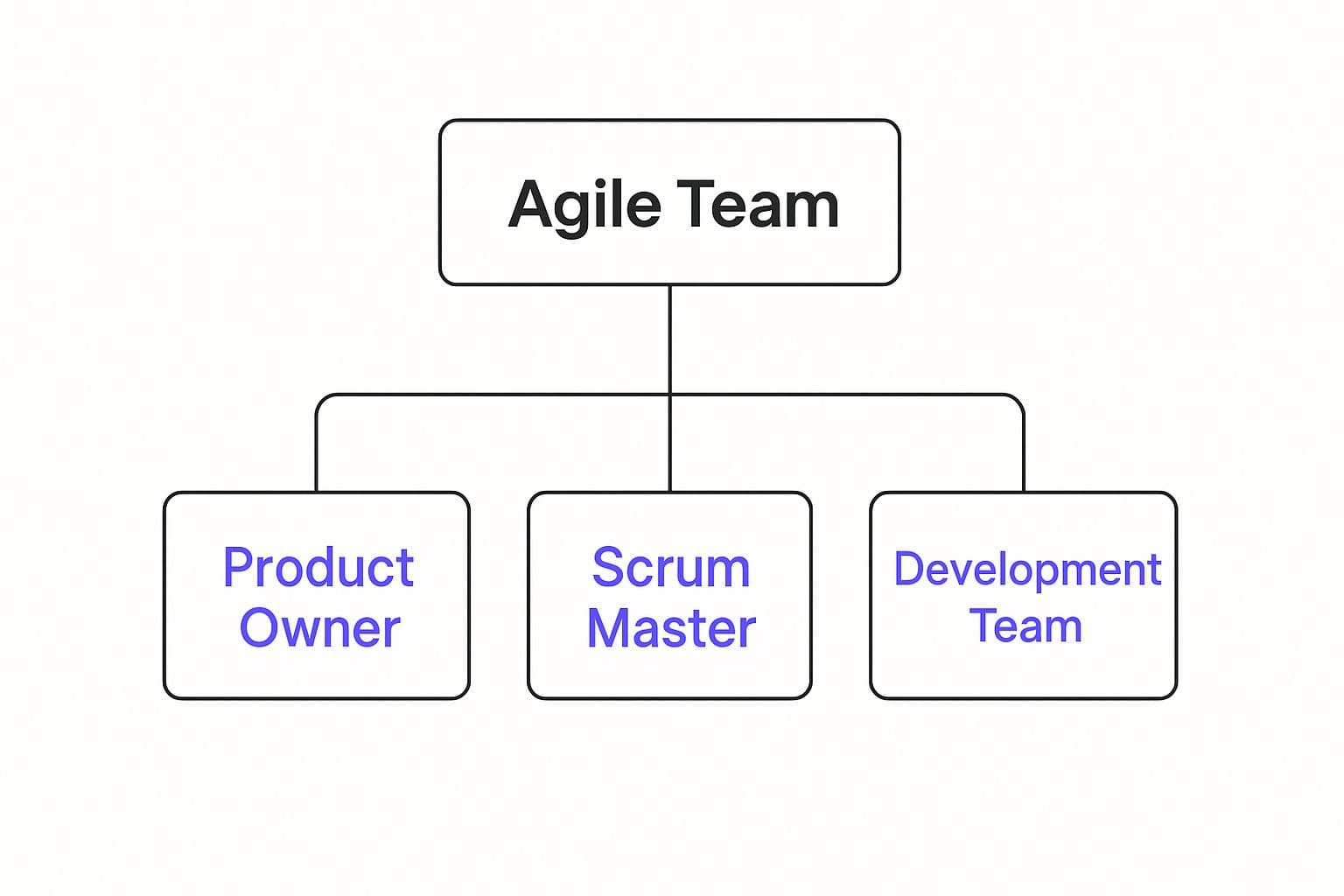
As you can see, the Agile Team isn't just a collection of individuals; it's a single, cohesive unit made of three distinct but interconnected parts. It’s this smart separation of concerns—value (the PO), process (the Scrum Master), and execution (the Dev Team)—that gives Agile its real power.
To make this even clearer, let's break down how these roles operate at a glance. The table below summarizes each role's primary focus and contribution to the project.
At-a-Glance Agile Roles and Core Focus
| Agile Role | Primary Focus (The 'What') | Primary Function (The 'How') | Key Contribution |
|---|---|---|---|
| Product Owner | Product Value & Vision | Manages the Product Backlog | Ensures the team builds the right thing by representing customer and business needs. |
| Scrum Master | Process & Team Health | Facilitates Agile Events | Ensures the team works effectively by removing impediments and coaching Agile practices. |
| Development Team | Product Delivery & Quality | Builds the Product Increment | Ensures the thing gets built right by applying their technical expertise to deliver a working product. |
This high-level overview gives you a solid foundation for understanding how these key players work together to push the entire Agile process forward. Each role is a pillar, and together they create a structure that's both stable and incredibly dynamic.
The Product Owner: Steering the Product Vision

If you think of the Development Team as the powerful engine of an Agile project, then the Product Owner (PO) is the captain at the ship's wheel. They're the one holding the map, setting the course, and making sure the entire crew is heading toward the right destination. This role is the single source of truth for everything the product should be and do.
At its core, the Product Owner's job is to maximize the value the team produces. Every decision they make is aimed at boosting the product's return on investment (ROI). They aren't just a project manager or a task-lister; they are the ultimate decision-maker for the product backlog—the master to-do list for the entire product.
To do this well, a Product Owner acts as the voice for every stakeholder. They represent the needs of customers, the goals of business leaders, and the expectations of end-users. Their real talent lies in translating all those diverse needs into a clear, actionable plan that the development team can actually build. This requires a sharp mind for business and some serious communication skills.
Core Responsibilities of the Product Owner
A great Product Owner is the glue that keeps the team focused on what truly matters. Without one, a team can easily get lost, building features that look cool but don't actually solve a customer's problem or meet a business objective. Their most critical duty is managing the product backlog.
This isn't just about making a list and checking it twice. It's a living, breathing process that involves constant refinement and re-prioritization. A PO is always:
- Setting the Product Goal: They are responsible for creating and clearly communicating the long-term vision. Everyone on the team needs to know why they are building what they're building.
- Creating and Ordering Backlog Items: The PO writes clear user stories with specific acceptance criteria. Then, they strategically order these items based on business value, customer impact, and risk.
- Keeping the Backlog Transparent: The product backlog must be a public, well-understood artifact. Anyone, from a developer to a CEO, should be able to look at it and understand the team's direction.
- Accepting or Rejecting Work: When the team says a feature is "done," the Product Owner is the final judge. They review the work and officially accept it only if it meets all the predefined criteria.
The Decisive Voice for the Product
Ultimately, the buck stops with the Product Owner. They are accountable for the product’s success or failure in the market. While they work hand-in-glove with the team every day, the PO has the final authority on what gets built and when.
This authority is real and has major implications. For example, if a sudden market shift makes the current sprint's goal irrelevant, the Product Owner has the power to cancel the sprint entirely.
Of all the agile methodology roles and responsibilities, the Product Owner's is perhaps the most focused on the outside world. They must be decisive, deeply knowledgeable about their market, and an exceptional communicator, bridging the gap between high-level business strategy and day-to-day technical work.
The Scrum Master: The Team's Performance Coach

If the Product Owner is the team’s strategist, then the Scrum Master is its performance coach. It's a common mistake to see them as just another project manager, but that couldn’t be further from the truth. Forget about someone who just assigns tasks and chases deadlines. The Scrum Master has a completely different mission: they are a servant-leader, obsessed with helping the team perform at its absolute best.
Think of them less like a boss and more like a personal trainer for a pro athlete. They aren't there to lift the weights for the team. Instead, they focus on improving the team’s form, clearing distractions out of the way, and cultivating an environment where everyone can get into a state of flow. A great Scrum Master is all about the how, not just the what.
Their job is to shield the team from outside noise and internal friction, allowing developers to focus completely on hitting the sprint goal. You don't measure a Scrum Master's success by their personal output, but by the team's growing self-sufficiency and its ability to consistently ship high-quality work.
Facilitating Success and Removing Roadblocks
One of the most critical jobs of the Scrum Master is to hunt down and eliminate impediments. An impediment is anything—and I mean anything—that slows the team down. It could be something technical, like a missing software license. It could be a process problem, like an approval that's stuck in another department. It could even be a conflict between team members that’s creating tension.
The Scrum Master is the team’s designated problem-solver, taking these issues off the Development Team's plate so they can keep coding. They are also masters of facilitation, making sure the key Scrum events are genuinely productive and not just meetings for the sake of meetings.
- Daily Stand-ups: They keep these quick and focused, steering the conversation back to the sprint goal when it drifts.
- Sprint Planning: They guide the team in breaking down work and committing to a realistic plan they can actually achieve.
- Sprint Reviews: They help the team put its best foot forward when showing off their hard work to stakeholders.
- Sprint Retrospectives: Most importantly, they create a safe and open environment for the team to reflect, give honest feedback, and find ways to get better in the next sprint.
A Champion for Agile Across the Organization
A Scrum Master’s influence doesn't stop at the team's edge. They often serve as an Agile evangelist for the entire company. This means coaching the Product Owner, working with other departments, and helping senior leaders understand what it truly means to be Agile. This educational piece is vital for getting everyone on the same page and building a culture that supports, rather than resists, this way of working.
The evolution of agile methodology roles and responsibilities now reaches far beyond the tech department. As more companies adopt Agile as a business strategy, you'll find Scrum Masters in marketing, HR, and operations teams. In fact, the push is increasingly coming from the top. The 2025 State of Agile report highlighted that business leaders are the primary drivers of this change, with 32% of organizations reporting that their leaders are actively spearheading company-wide Agile initiatives.
At the end of the day, the Scrum Master is the guardian of the process. They make sure the core Agile values—transparency, inspection, and adaptation—are more than just words on a poster. They are principles the team lives by, every single day.
The Development Team: Turning Vision into Reality
So, the Product Owner figures out what to build, and the Scrum Master fine-tunes how the team works together. But who actually builds the thing? That's the Development Team. These are the people in the trenches, the true engine of any Agile project. They're the skilled pros who take the ideas in the product backlog and turn them into real, working software.
A common mistake is thinking the "Dev Team" is just a room full of coders. That couldn't be further from the truth. A genuine Agile Development Team is cross-functional, meaning it has all the different skills needed to take a feature from a simple idea to a finished piece of the product.
In practice, a single team will often have a mix of specialists like:
- Software Engineers
- QA Analysts and Testers
- UI/UX Designers
- Architects
- Data Analysts
The whole point is to avoid handoffs. When all the expertise sits with one team, they can get things done without waiting for someone from another department. This self-sufficiency is what makes them so fast and efficient.
Self-Organizing and Accountable
One of the most radical—and effective—ideas in Agile is that the Development Team is self-organizing. There isn't a traditional manager telling them who works on what or how they should do it. Instead, the team looks at the work they've committed to for the sprint and figures it out together. They break down the backlog items, estimate the work, and decide among themselves who is best suited for each task.
This freedom creates a powerful sense of ownership. When the team creates the plan, they're naturally invested in seeing it through. It’s their plan, after all. This shared responsibility is a fundamental part of how Agile roles work.
Core Duties and Responsibilities
The Development Team isn't just waiting for instructions. They are active, essential partners throughout every sprint, with a few crucial responsibilities.
Their main duties boil down to this:
- Executing the Sprint Backlog: This is their bread and butter—taking the selected user stories and transforming them into a valuable, potentially shippable part of the product.
- Ensuring Quality: Quality isn't someone else's job. The team builds it in from day one. This means following their agreed-upon "Definition of Done," writing solid code, running tests, and doing peer reviews.
- Participating in Planning: During Sprint Planning, they work directly with the Product Owner. They ask the tough questions, give realistic estimates, and help decide what can realistically be accomplished in the sprint.
- Adapting Daily: The Daily Stand-up is their huddle. It's where they check progress against the sprint goal and adjust their plan for the next 24 hours to overcome any roadblocks and stay on course.
At the end of the day, the Development Team is where the rubber meets the road. Their blend of technical skill, collaborative spirit, and shared accountability is what brings a product to life, one sprint at a time.
How These Agile Roles Work Together
The real magic of Agile isn't in any single role, but in how they all work together. It’s less like a typical corporate hierarchy and more like a tight-knit jazz trio. Each musician is a master of their instrument, but the incredible music comes from them listening to each other and improvising in sync. In Agile, a sprint is like a single song, and the team plays together to create something amazing.
This collaboration kicks off in Sprint Planning. The Product Owner, acting as the band leader, brings the sheet music—the highest-priority items from the product backlog. They set the tone, explaining what needs to be built and, more importantly, why it matters to the audience. The Development Team then chimes in, figuring out how to play that music, pulling the work into their Sprint Backlog. The Scrum Master is the sound engineer, making sure the acoustics are right and every musician has what they need to perform at their best.
Synchronizing Progress Daily
Once the sprint is underway, the Daily Stand-up is the team’s quick huddle. This is a fast, 15-minute check-in where the Development Team syncs up. It’s not a status report for a boss; it's a conversation between peers to make sure everyone is still playing the same tune and moving toward the sprint goal. The Scrum Master keeps things on track, but the conversation is owned entirely by the developers.
This daily rhythm is vital for catching problems before they throw the whole sprint off-key. If one developer hits a snag, the rest of the team can jump in to help. This constant communication and quick problem-solving keep small hiccups from turning into major roadblocks.
Demonstrating Value and Reflecting on Performance
At the end of the sprint, two key events put a spotlight on the team’s collaboration. First is the Sprint Review, where the team performs their "finished song" for stakeholders. The Product Owner may introduce the session, but it’s the Development Team who proudly shows off what they built, getting immediate feedback from the audience.
After the review comes the Sprint Retrospective. Think of this as the post-show debrief. It's a closed-door, honest chat led by the Scrum Master where the team talks about what went well, what could have been better, and how they can improve their performance for the next sprint. This commitment to getting better together is what separates a good team from a truly great one.
The results of this collaborative model speak for themselves. An impressive 70% of IT teams have embraced Agile, and so have nearly half of all product and R&D teams. Even more telling is that 47% of organizations say communication between their business and IT departments has improved—a clear sign that these roles successfully bridge old divides. This synergy, built on trust and open communication, is the engine that allows teams to deliver outstanding value, sprint after sprint.
Of course. Here is the rewritten section, designed to sound like it was written by an experienced human expert.
Key Stakeholders in the Agile Ecosystem
So, we've talked about the core trio: the Product Owner, the Scrum Master, and the Development Team. They're the engine of any Agile project. But they don't operate in a vacuum. To be truly successful, they need a whole ecosystem of stakeholders around them, providing the context, feedback, and resources that turn a good idea into a great product. Getting a handle on these other agile methodology roles and responsibilities is how you start to see the bigger picture.
Think of it this way: the core team is focused on building the product right, but these wider stakeholders make sure they're building the right product. Without their input, even the most efficient team can build something that completely misses the mark.
Essential Figures Outside the Core Team
Who are we talking about? It really boils down to the people who use the product and the people who pay for it. When managed well, their engagement provides the North Star for the entire team's effort.
- Customers and End-Users: These are the people whose problems you're trying to solve. Their feedback isn't just nice to have; it's pure gold. They are the ultimate judges of whether what you're building has any real value. The Product Owner's job is to channel this crucial input directly into the product backlog, shaping what gets built and when.
- Executive Sponsors: This is the person or group holding the purse strings. They’re focused on the project's return on investment (ROI) and how it fits into the company's bigger strategy. They don't need the nitty-gritty details, but they do need high-level updates on progress and often show up for major Sprint Reviews to see the results for themselves.
Bringing these extended roles into the process isn't just a side project anymore—it's a massive business priority. We see this reflected in the numbers. The market for enterprise Agile transformation services is expected to surge at a CAGR of 19.5% through 2026. Why? Because companies are realizing the strategic advantage, with 83% stating that getting products to customers faster is a top driver for going Agile. You can discover more about these Agile market trends and how they’re shaping modern business.
The Role of an Agile Coach
As organizations start to scale Agile beyond a single team, another role often comes into play: the Agile Coach.
The easiest way to think of an Agile Coach is as a Scrum Master for multiple teams, or even for the entire organization. While a Scrum Master is embedded with one team, focusing on their health and process, the Agile Coach takes a bird's-eye view. They work across the organization to lift everyone's Agile game.
Their real goal is to create a self-sufficient Agile culture. They mentor other Scrum Masters, guide leadership on how to think and act in more agile ways, and help clear away the big, thorny organizational roadblocks that no single team could ever solve on its own.
By recognizing who the key stakeholders are and setting up clear communication channels, a company empowers its Agile teams to do what they do best: deliver fantastic, high-quality products without getting pulled in a million different directions.
Answering Common Questions About Agile Roles
When teams first dip their toes into Agile, a few common questions always seem to pop up, especially when they're used to more traditional ways of working. Let's tackle some of the most frequent ones to clear up the confusion and help you build a solid, effective team from day one.
Can One Person Be Both the Scrum Master and the Product Owner?
This is a really common question, and the short answer is: you shouldn't do it. While it might seem efficient on paper, especially in a tiny startup, mashing these two roles together creates a massive conflict of interest.
Think of it this way: the Product Owner is always pushing to maximize the product's value, which often means wanting more features and a faster delivery. On the other hand, the Scrum Master is the team's guardian, focused on protecting their ability to work at a healthy, sustainable pace and ensuring the process runs smoothly. When one person tries to wear both hats, one of those critical responsibilities will inevitably suffer. You simply can't champion the product's scope and protect the team from burnout at the same time.
Where Does the Project Manager Fit into an Agile Team?
In a true Agile or Scrum setup, the traditional role of a "Project Manager" doesn't really exist. It's not that the responsibilities disappear; instead, they get smartly distributed among the three core Agile roles.
- The Product Owner takes on the "what" and "why," owning the product vision and prioritizing the backlog to deliver the most value.
- The Development Team figures out the "how." They are self-organizing and manage their own work during a sprint, deciding how best to tackle the tasks at hand.
- The Scrum Master acts as a facilitator, focusing on the team's process and removing any obstacles that get in their way.
This approach empowers the team by putting decision-making right where the work is happening, which cuts down on bureaucracy and speeds things up. You can learn more about how this dynamic works by exploring some Agile development best practices.
Ready to turn your idea into a market-ready product with a team that has mastered these Agile roles? Iglu Digital specializes in building MVPs on a fixed price, agreed up front. Transform your concept into a tangible product today.