

7 Minimum viable product examples You Should Know
Table of Contents
Launching a new product idea can feel overwhelming, but it doesn't have to be. The Minimum Viable Product (MVP) approach is a proven strategy for validating your concept with real users, gathering crucial feedback, and avoiding costly mistakes before committing to a full-scale build. An MVP isn't about creating a stripped-down, low-quality product; it's about strategically delivering the core value of your idea to early adopters as quickly as possible. This method allows you to test your most critical assumptions and ensure you're building something people actually want and will pay for.
This guide moves beyond theory and dives straight into actionable analysis. We will explore a curated list of minimum viable product examples and the development platforms that built them. You'll see precisely how successful companies identified their core features, launched with a minimal yet effective product, and iterated based on user data.
Each entry provides a detailed strategic breakdown, offering a behind-the-scenes look at the specific tactics used. We'll examine the problem each MVP solved, the key features included in the initial launch, and the replicable strategies you can apply to your own project. Get ready to learn from real-world case studies, complete with screenshots and direct links, to help you build and launch your own successful MVP.
1. Antler Academy
For founders and product teams seeking a masterclass in modern product strategy, Antler Academy is an indispensable resource. Rather than just being an example, it's a library of minimum viable product examples, offering deep-dive articles and case studies that dissect how successful startups navigated the crucial early stages of development. It’s an educational platform first, providing the strategic blueprints behind some of today's most well-known companies.
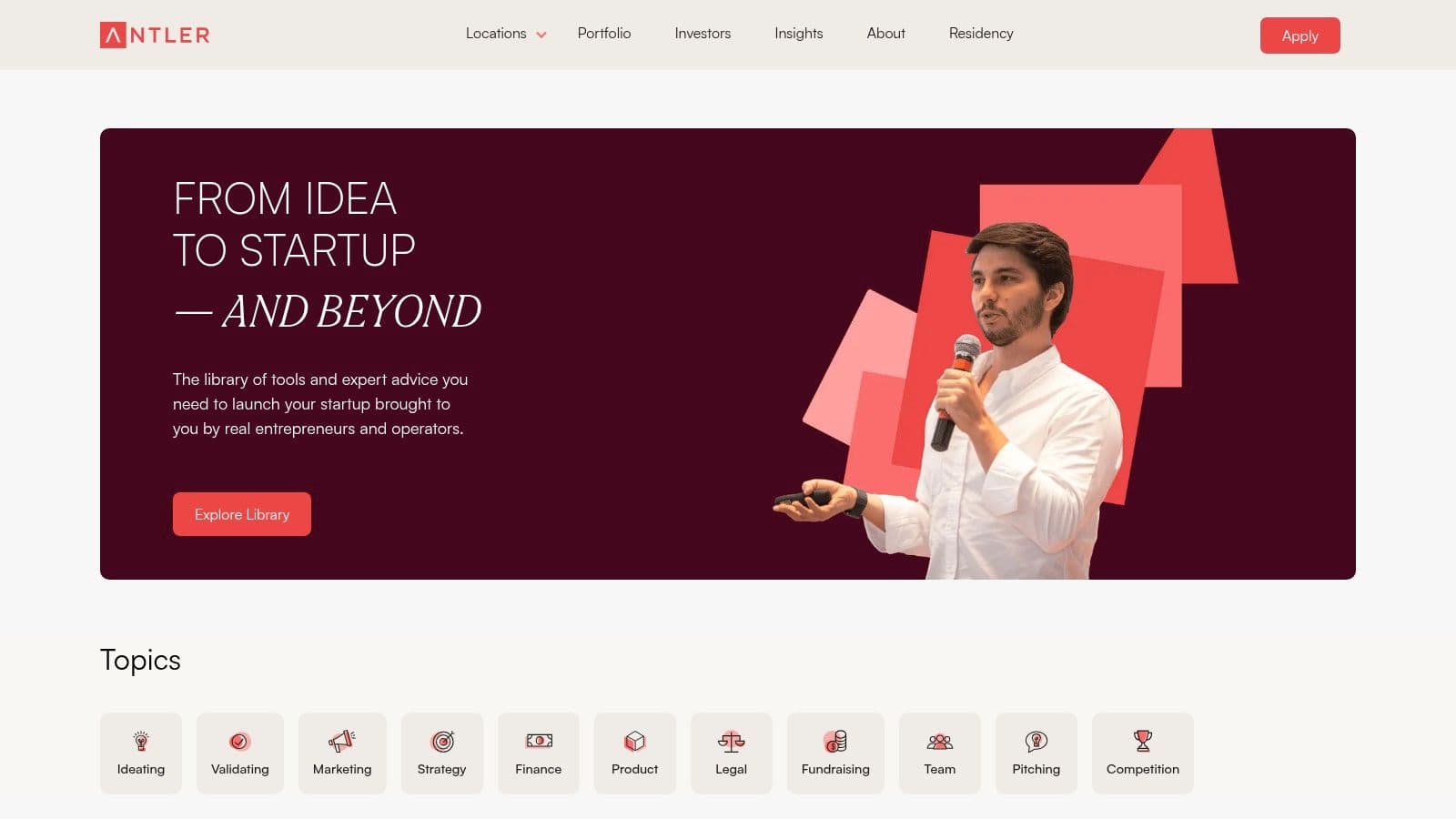
What makes Antler Academy stand out is its laser focus on actionable, real-world application. Backed by the global venture capital firm Antler, the content is grounded in the realities of what it takes to secure funding and achieve product-market fit. The platform moves beyond surface-level success stories to provide granular insights into the specific MVP methodologies used.
Strategic Insights & Key Offerings
The core value of Antler Academy lies in its high-quality, free educational content. The user experience is straightforward and article-driven, prioritizing readability and information absorption over interactive bells and whistles.
- Content Quality: Articles are well-researched, often featuring insights directly from founders or early team members. They break down complex decisions into understandable strategic steps.
- Unique Focus: Unlike generic business blogs, the entire platform is dedicated to the startup journey, with a significant emphasis on building, testing, and iterating on MVPs.
- Accessibility: All content is completely free, removing any barrier to entry for aspiring entrepreneurs.
How to Use Antler Academy Effectively
To get the most out of this resource, don't just read passively. Approach it as a research tool. Filter articles by industry or business model to find case studies relevant to your own venture. Analyze the pivots and initial feature sets of companies you admire. This focused approach will help you extract replicable strategies for your own minimum viable product. While it lacks interactive features, its depth of content on real-world MVP examples is unparalleled.
| Feature Analysis | Details |
|---|---|
| Primary Offering | In-depth case studies and articles on startup strategy, with a strong focus on MVP development and execution. |
| Access/Pricing | 100% free. No sign-up is required to access the core library of articles. |
| Unique Value | Provides venture-capital-backed insights into what makes an MVP successful from both a product and an investment perspective. |
| User Experience | Clean, minimalist, and article-focused interface. Easy to navigate and read, though it lacks community or interactive elements. |
| Website | https://www.antler.co/academy |
2. Gravitywell
For founders looking for a concise, agency-level perspective on MVPs, Gravitywell's blog provides a potent dose of clarity. As a digital product agency, their insights are rooted in the practical experience of building products for clients. This makes their content less academic and more of a direct-to-the-point guide, featuring well-known minimum viable product examples to illustrate core principles. It’s a valuable stop for anyone who wants to understand how an experienced development team approaches the MVP process.
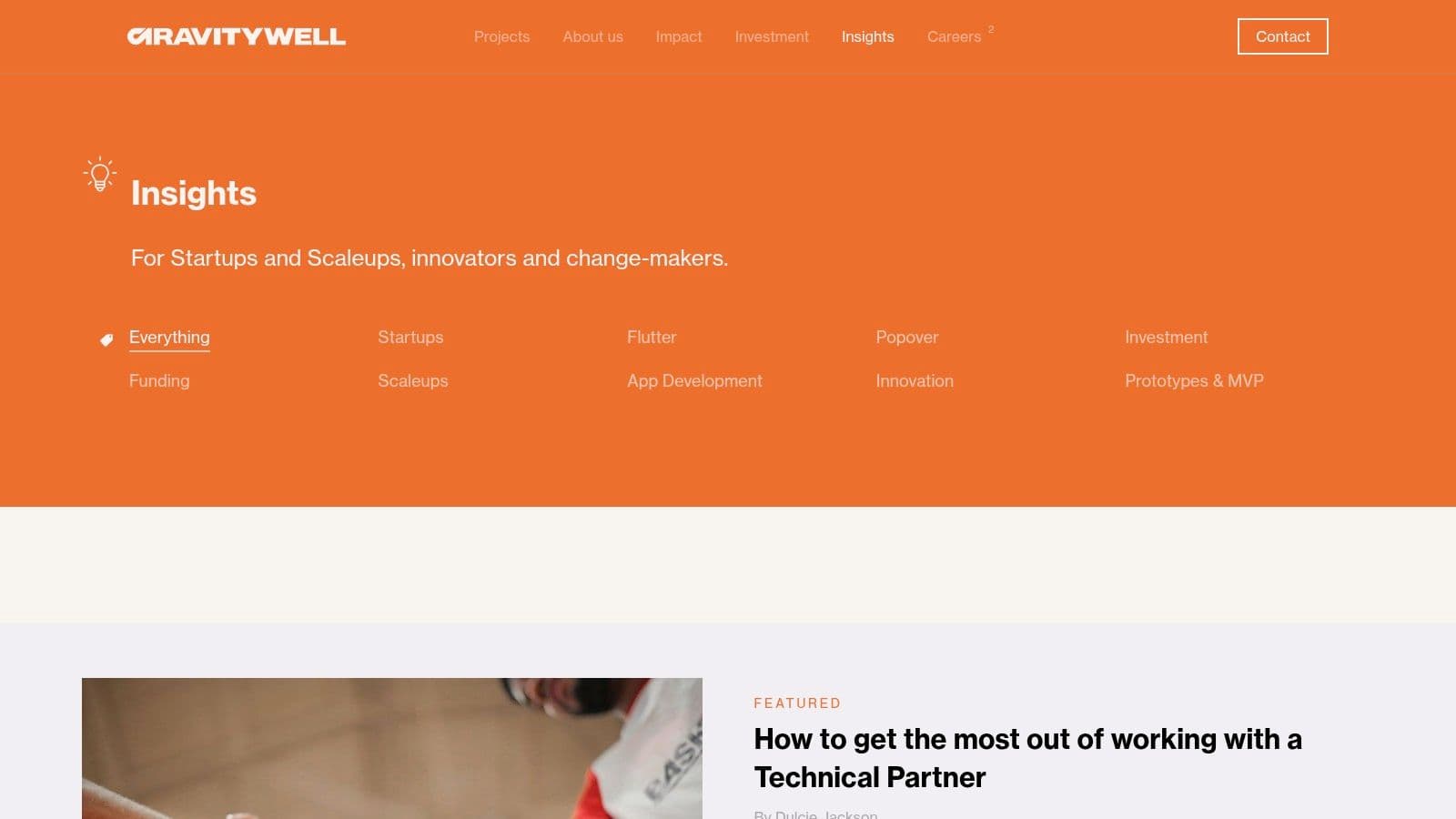
What sets Gravitywell apart is its emphasis on clear and actionable advice. The writing is intentionally straightforward, cutting through jargon to deliver easily digestible takeaways. Instead of dense theory, the focus is on breaking down the strategies of companies like Airbnb, Dropbox, and Foursquare into simple, replicable lessons for today’s startups. This approach makes their content particularly useful for non-technical founders or teams needing to align on a shared product vision.
Strategic Insights & Key Offerings
Gravitywell’s core offering is a collection of high-impact blog posts that serve as quick-reference guides. The user experience is clean and focused on readability, allowing entrepreneurs to quickly absorb key information without distraction.
- Content Quality: Articles distill the MVP journeys of major tech companies into foundational lessons, focusing on the initial problem and the simplest possible solution.
- Unique Focus: The content is framed from the perspective of a product agency, offering practical advice on what it takes to actually build and launch a functional first version.
- Accessibility: All of their blog content, including the MVP examples, is available for free, making it an accessible resource for early-stage founders on a budget.
How to Use Gravitywell Effectively
To get the most from Gravitywell, use their blog as a strategic sharpener. Read through their case studies not just for inspiration, but to challenge your own feature list. Ask yourself: "Is this feature as critical as the core function Dropbox launched with?" This focused self-interrogation, guided by their concise examples, can save you months of unnecessary development. While the selection of case studies is more limited than larger platforms, the clarity of each analysis is its greatest strength.
| Feature Analysis | Details |
|---|---|
| Primary Offering | Blog articles that dissect famous MVP case studies, providing clear, practical advice for startups from a product agency perspective. |
| Access/Pricing | 100% free. All blog content is openly accessible without a paywall or sign-up. |
| Unique Value | Clear, concise writing that translates complex product strategies into easily applicable, foundational knowledge for any founder. |
| User Experience | The website offers a standard blog layout that is clean and easy to navigate, prioritizing content consumption. |
| Website | https://gravitywell.co.uk/blog/minimum-viable-product-examples |
3. Minimum Code
For founders and developers who want to get straight to the point, Minimum Code offers a highly curated list of impactful minimum viable product examples. Unlike broader business strategy platforms, this resource is a lean, focused repository designed to inspire action. It cuts through the noise, presenting clear-cut case studies of how well-known companies launched with a core, stripped-down offering before scaling to what they are today.
What makes Minimum Code particularly effective is its simplicity and developer-centric perspective. The examples chosen often highlight not just the strategic 'what' but also hint at the technical 'how', emphasizing efficiency in development. It serves as a practical reminder that a successful MVP is about solving one problem exceptionally well, a principle that resonates strongly with technical founders and product teams.
Strategic Insights & Key Offerings
Minimum Code’s value is its directness. It operates as a single, powerful blog post that gets updated with new examples, making it an easy-to-digest resource. The user experience is zero-friction, loading a single page with all the case studies you need, from Airbnb to Foursquare.
- Curated Examples: The platform features a handpicked selection of classic and modern MVP stories, ensuring each one provides a distinct lesson in product strategy.
- Developer Focus: While not overly technical, the insights are geared toward an audience that appreciates development efficiency and smart scoping. The underlying message is about building less to learn more.
- High Accessibility: The content is completely free and presented on a single, easy-to-bookmark page, making it a go-to reference.
How to Use Minimum Code Effectively
Treat this site as a quick-reference guide during your brainstorming and scoping phases. When you feel the pressure of feature creep, revisit the page to see how giants like Uber and Spotify started with a single core function. The lessons here are less about complex business frameworks and more about the raw, practical application of the MVP philosophy. For those looking to build on these insights, understanding the technical foundation is a crucial next step. Explore how to choose the right technology stack to ensure your MVP is built for efficient learning and future scaling.
| Feature Analysis | Details |
|---|---|
| Primary Offering | A curated list of well-known minimum viable product examples, presented in a straightforward, digestible format. |
| Access/Pricing | 100% free. All content is available on a single page with no registration required. |
| Unique Value | Its simplicity and focus on classic MVP cases provide a clear, no-fluff resource for inspiration and strategic discipline. |
| User Experience | Extremely minimalist and fast. The single-page layout is easy to navigate, though it lacks the depth of a multi-article platform. |
| Website | https://minimumcode.co/minimum-viable-product-examples |
4. SoftSuave
For entrepreneurs and product managers looking for a quick, high-level overview of MVP strategies across different markets, SoftSuave offers a valuable collection of case studies. Rather than deep-diving into a single startup's journey, this resource provides a broad survey of minimum viable product examples from various industries. It functions as a rapid-fire idea generator, showcasing how core MVP principles are adapted to fit sectors ranging from social media to on-demand services.
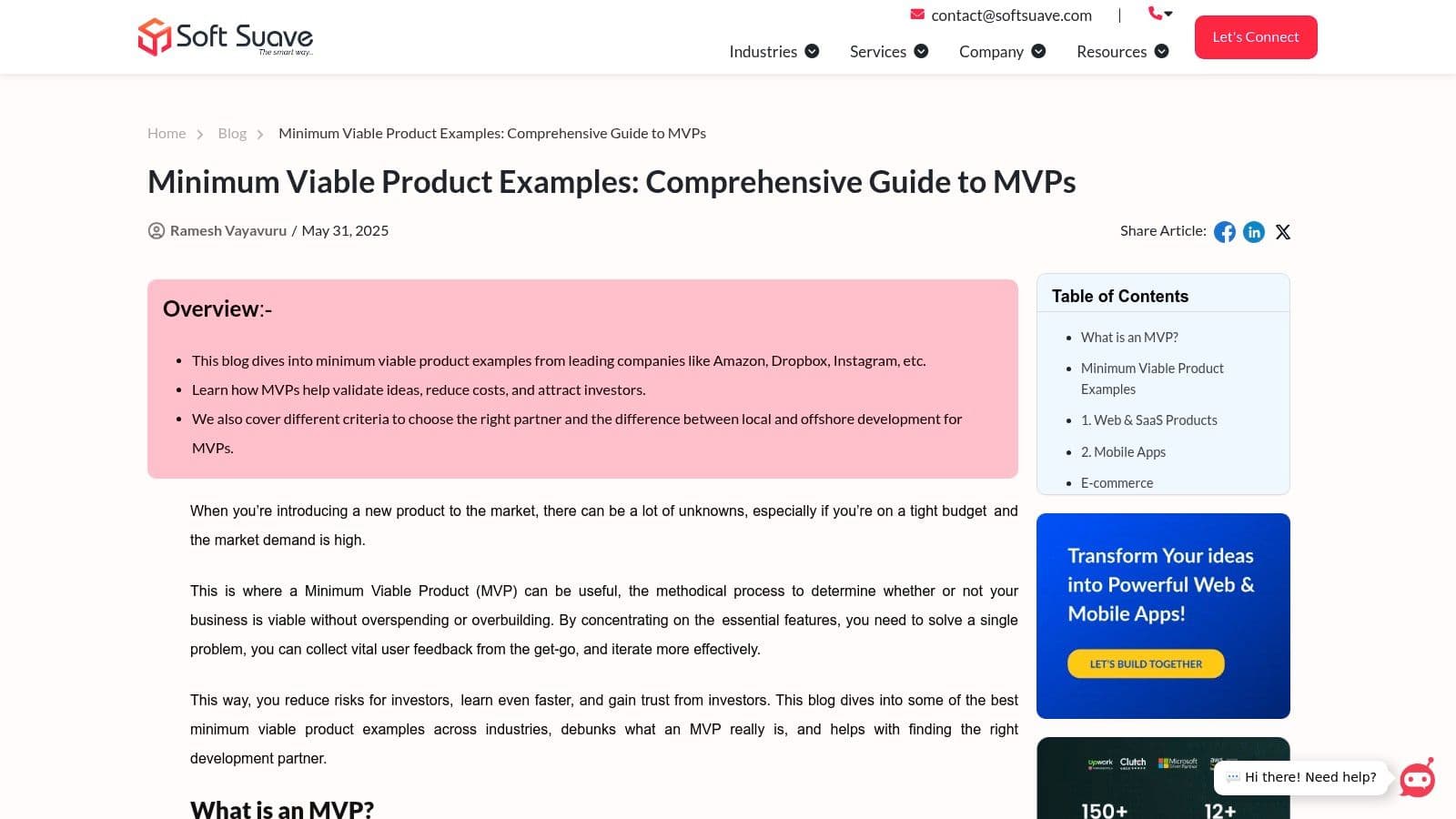
What makes SoftSuave a useful starting point is its emphasis on efficiency and sectoral differences. The platform, a blog from a software development company, frames its examples through the lens of building an MVP quickly and cost-effectively. This practical approach is ideal for founders who are less concerned with complex theory and more focused on seeing a variety of real-world applications to inspire their own product roadmap.
Strategic Insights & Key Offerings
The core value of SoftSuave is its industry-specific categorization, allowing users to find relevant examples without sifting through unrelated case studies. The user experience is straightforward, presenting information in a clear, blog-post format that is easy to skim and digest.
- Industry-Specific Examples: The content is organized to highlight how MVPs are tailored for different market needs, from e-commerce to fintech.
- Focus on Efficiency: Each example implicitly underscores the goal of building a functional product with minimal features to test a core hypothesis quickly.
- Accessibility: As a blog post, the content is completely free and requires no sign-up, making it an easily accessible resource for initial research.
How to Use SoftSuave Effectively
To maximize value from SoftSuave, use it as a brainstorming tool. Scan the examples within your target sector and identify the recurring "must-have" features that form the backbone of their MVPs. Note the problems these products aimed to solve and the simple solutions they offered. While the analysis isn't as deep as other resources, it provides an excellent high-level summary that can help you define the scope of your own minimum viable product.
| Feature Analysis | Details |
|---|---|
| Primary Offering | A blog post compiling short case studies of MVPs across multiple industries, including social media, rentals, and on-demand services. |
| Access/Pricing | 100% free. The content is available within a single blog article. |
| Unique Value | Its strength lies in providing a broad, industry-categorized overview of MVP concepts, perfect for initial ideation and research. |
| User Experience | Simple blog layout that is easy to read and navigate. The content is concise, though it lacks the depth of dedicated case-study platforms. |
| Website | https://www.softsuave.com/blog/minimum-viable-product-examples |
5. ArticleCube
For entrepreneurs in the early stages of brainstorming, ArticleCube serves as a valuable source of inspiration. It functions less like a deep-dive academic resource and more like a curated gallery of minimum viable product examples. Its primary purpose is to showcase a diverse range of successful MVPs, providing a quick, high-level overview of how different companies began their journey. This makes it an excellent starting point for those looking to understand the breadth of what's possible with an MVP strategy.
What makes ArticleCube useful is its focus on breadth over depth. While other platforms provide granular analysis of a few select cases, ArticleCube presents a wider collection of examples from various industries. This approach helps founders see patterns across different markets and business models, sparking ideas for their own products. It’s the perfect place to go when you need a quick dose of motivation and a reminder that even the biggest tech giants often started with something incredibly simple.
Strategic Insights & Key Offerings
ArticleCube’s value is in its simplicity and directness. The user experience is that of a straightforward blog post, listing notable MVP examples one after another, making it easy to scan for relevant ideas and case studies.
- Diverse Examples: The list includes well-known names like Dropbox, Zappos, and Airbnb, providing a foundational understanding of classic MVP stories.
- Focus on Inspiration: The content is designed to be motivational, showing how minimal initial offerings can evolve into successful businesses. It's less about tactical execution and more about conceptual possibilities.
- Accessibility: As a simple blog article, the content is free and instantly accessible without any registration or paywall.
How to Use ArticleCube Effectively
To maximize value from this resource, use it as a launchpad for further research. Scan the list for companies in your target industry or with a business model similar to yours. Once you identify a compelling example, use that name as a keyword to find more in-depth case studies on other platforms. While the article itself lacks deep analysis, its concise summaries are a great starting point. Combining these examples with a structured development plan, such as the one outlined in this product launch checklist template, can help turn inspiration into an actionable strategy.
| Feature Analysis | Details |
|---|---|
| Primary Offering | A curated blog-style list of well-known and successful minimum viable product examples for inspiration. |
| Access/Pricing | 100% free. No sign-up is required to read the article. |
| Unique Value | Offers a broad, diverse collection of MVP examples in a single, easily scannable format, perfect for initial brainstorming. |
| User Experience | A simple, single-page article layout. Easy to read and navigate but lacks interactive features or deeper analytical tools. |
| Website | https://www.articlecube.com/minimum-viable-product-examples |
6. Tameta Tech
Tameta Tech offers a focused collection of minimum viable product examples, functioning as a strategic resource for entrepreneurs looking to learn from both the successes and failures of others. Instead of being a broad business blog, its content zeroes in on the crucial lessons learned during the MVP phase, making it a valuable stop for founders deep in the validation stage. It presents a curated look at the strategic thinking behind well-known products.
What distinguishes Tameta Tech is its emphasis on actionable takeaways. The platform dissects various startup journeys to extract core strategies and pivotal moments. It's designed for founders who need to understand not just what to build, but how to approach the entire process of testing an idea in the market with minimal resources, making it a practical guide for early-stage decision-making.
Strategic Insights & Key Offerings
The main value of Tameta Tech comes from its clear, concise breakdowns of different MVP approaches. The user experience is simple and direct, prioritizing the delivery of key information over elaborate design, ensuring that readers can quickly grasp the core lessons from each case study.
- Strategic Focus: The content is dedicated to analyzing the "why" behind an MVP's success, highlighting the specific strategies and lessons learned that can be applied to other ventures.
- Diverse Examples: It covers a range of well-known startups, providing different models and approaches to building and launching a minimum viable product.
- Free Access: All the case studies and strategic insights are available for free, making it an accessible resource for founders at any stage.
How to Use Tameta Tech Effectively
To maximize the value of Tameta Tech, use it as a source of strategic inspiration. Read through the different examples to identify patterns in how successful companies validated their core assumptions. Pay close attention to the "lessons learned" sections, as these often contain the most potent advice. While the selection of case studies is more limited than on larger platforms, each one is packed with relevant insights for building your own MVP.
| Feature Analysis | Details |
|---|---|
| Primary Offering | Curated case studies of successful MVPs, with a clear focus on the strategies and key lessons learned from each example. |
| Access/Pricing | 100% free. No registration is needed to access the content. |
| Unique Value | Its concise format delivers actionable strategic lessons, making it ideal for founders seeking quick, high-impact takeaways. |
| User Experience | A straightforward, article-based layout that is easy to navigate. It prioritizes content clarity but is less interactive. |
| Website | https://www.tametatech.com/minimum-viable-product-examples |
7. Venture Validator
For entrepreneurs obsessed with the critical step of validation, Venture Validator serves as a specialized toolkit. It moves beyond simply listing minimum viable product examples and instead provides a focused lens on the validation process itself. This platform is built for founders who understand that an MVP is not just a product, but a scientific tool for testing a hypothesis with real users.
What sets Venture Validator apart is its emphasis on the how of validation. While other resources might detail a product's final MVP features, this site digs into the specific experiments, metrics, and user feedback loops that confirmed a startup was on the right track. It’s an essential resource for de-risking a new idea before committing significant time and capital.
Strategic Insights & Key Offerings
Venture Validator's core strength is its library of case studies, each dissected to reveal the validation strategy at its heart. The user experience is clean and direct, designed to get founders to the core insights quickly without unnecessary distractions.
- Validation Focus: The platform’s primary differentiator is its deep focus on validation techniques, from smoke tests and landing page MVPs to early user interviews.
- Detailed Case Studies: Each example is broken down to highlight the initial hypothesis, the MVP built to test it, and the results that guided the next steps.
- Actionable Frameworks: It provides clear, replicable frameworks for early-stage product development, making complex validation theory accessible.
How to Use Venture Validator Effectively
To maximize its value, treat Venture Validator as a pre-development resource. Before writing a single line of code, browse its case studies to find a company that faced a similar market assumption. Analyze how they structured their test and what metrics they tracked. This will help you design a more effective business idea validation strategy for your own project. While its content library is more niche than broader business blogs, its depth on the topic of validation is its greatest asset.
| Feature Analysis | Details |
|---|---|
| Primary Offering | A curated collection of case studies focusing specifically on the validation process within MVP development. |
| Access/Pricing | Free access to all case studies and articles without requiring a subscription or sign-up. |
| Unique Value | Its specialized focus on validation provides practical, step-by-step guidance on how to test and prove a business idea effectively. |
| User Experience | Simple, content-first layout that prioritizes readability and quick access to information, though it has limited content variety. |
| Website | https://venturevalidator.com/minimum-viable-product-examples |
Minimum Viable Product Examples Comparison
| Platform | Implementation Complexity 🔄 | Resource Requirements ⚡ | Expected Outcomes 📊 | Ideal Use Cases 💡 | Key Advantages ⭐ |
|---|---|---|---|---|---|
| Antler Academy | Medium - detailed case studies | Low - primarily reading | High - actionable startup strategies | Entrepreneurs, developers seeking deep MVP insights | Comprehensive, real-world focused content |
| Gravitywell | Low - concise advice | Low - easy to digest | Medium - practical MVP tips | Startups needing clear, practical guidance | Clear writing, practical applicability |
| Minimum Code | Medium - coding strategy focused | Medium - developer oriented | High - efficient and effective MVPs | Developers focused on coding and efficiency | Developer-centric, efficiency emphasis |
| SoftSuave | Low to Medium - broad examples | Low - industry insights | Medium - sector-specific MVP approaches | Users needing industry-specific strategies | Diverse industry examples, efficiency focus |
| ArticleCube | Low - curated list format | Low - inspiration based | Medium - practical MVP inspiration | Entrepreneurs seeking varied MVP examples | Diverse examples, practical orientation |
| Tameta Tech | Medium - strategy focused | Low - startup strategy insights | Medium - validation and learning focus | Entrepreneurs validating MVP strategies | Strategic lessons, startup examples |
| Venture Validator | Medium - case study intensive | Medium - validation focused | High - strong validation guidance | Early-stage startups validating products | Detailed validation process insights |
Final Thoughts
Our journey through these diverse minimum viable product examples reveals a powerful, unifying truth: success isn't about building a perfect, all-encompassing product from day one. It's about launching a focused, value-driven solution that effectively solves a core problem for a specific audience. From Antler Academy's community-first approach to Venture Validator's data-driven validation, each case study underscores the strategic power of starting small, learning fast, and iterating relentlessly.
The examples provided by firms like Gravitywell and SoftSuave demonstrate that an MVP is not a crude or unfinished product. Instead, it is a highly strategic instrument designed for maximum learning with minimum investment. It’s a scientific process of testing hypotheses in the real world, where user feedback is the most valuable currency.
Your Path to a Successful MVP
As you move from idea to execution, the lessons from these case studies provide a clear roadmap. The most crucial takeaway is that your initial goal isn't just to build; it's to validate. The tools and agencies we've explored, from Minimum Code's rapid no-code development to Tameta Tech's specialized expertise, are facilitators of this validation process.
When selecting a partner or tool for your own MVP, consider these critical factors:
- Core Problem: Which tool or team is best equipped to build a solution that directly addresses the single most important pain point you've identified? A simple, elegant solution to a major problem will always outperform a complex solution to a minor one.
- Speed to Market: How quickly can you get a functional version into the hands of early adopters? The faster you can start the feedback loop, the faster you can find product-market fit.
- Feedback Mechanisms: What systems will you have in place to collect, analyze, and act on user feedback? This is the engine of your iteration cycle.
- Scalability: While your MVP is minimal, your chosen technology stack or platform should not corner you. Ensure there's a viable path to scale your product as you validate your assumptions and grow your user base.
From Examples to Execution
Ultimately, the power of studying minimum viable product examples lies in turning inspiration into action. Your idea, no matter how ambitious, can be distilled into a core value proposition. Your vision, no matter how grand, can begin with a single, well-executed feature.
Embrace the MVP mindset not as a shortcut, but as the smartest path forward. It's about mitigating risk, conserving resources, and building what customers truly want. Let these examples be your guide, but let your unique customer insights be your compass. The world is waiting for the problem you're meant to solve. Start building.
Ready to move from idea to a tangible, market-ready MVP without the massive overhead? Iglu Digital specializes in leveraging powerful no-code and low-code platforms to build and launch robust minimum viable products faster than traditional development. Transform your vision into a reality by visiting Iglu Digital and discover how we can help you validate your concept with real users.