

Choosing a Software Development Team Structure

Table of Contents
A software development team structure is how you organize your engineers—who reports to whom, how they talk to each other, and who’s responsible for what. It’s the blueprint for how your team gets work done, and it has a massive impact on your project's speed, quality, and ultimate success.
Think of it like setting up a professional kitchen. You wouldn't have all the chefs working on just one dish at a time in a chaotic mess. You'd have stations—one for prep, one for grilling, one for plating—all coordinated to get meals out the door efficiently. The right team structure does the same for your code.
Why Your Team Structure Dictates Project Success
Deciding how to arrange your software team is far more than just a box-ticking exercise for HR; it's the very foundation of your project. A well-designed structure makes communication feel effortless, clarifies who owns what, and gives developers the freedom to do their best work.
On the flip side, the wrong model creates bottlenecks, slows down every decision, and can quickly lead to frustrated developers and blown deadlines.
The consequences of this choice are real, and they hit the bottom line hard.
This isn't just about drawing a neat org chart. It's a strategic decision that directly affects your budget and your ability to compete. The right setup can help you deliver faster, write better code, and keep your team happy and engaged. The trick is to understand what you gain and lose with each model and pick the one that fits your company’s goals, size, and the complexity of what you're building.
Core Team Models to Consider
We’re going to get practical and look at the most common frameworks used in modern tech companies. These three structures are the building blocks for most engineering organizations you'll encounter today:
- Functional Teams: The traditional approach. You group people by their specialty, so all the backend engineers are in one department, all the QA testers in another, and so on.
- Cross-Functional Squads: Think of these as mini-startups within your company. They're small, independent teams that have every skill needed—backend, frontend, design, QA—to ship a feature all on their own.
- Matrix Organizations: This is a hybrid model where people have two bosses. A developer might report to a "backend engineering manager" for career growth and skill development, but also to a "project manager" for their day-to-day tasks.
Before we dive deep into each one, here is a quick table to give you a high-level overview.
Quick Guide to Common Team Structures
This table summarizes the core ideas behind each structure and where they tend to shine. Think of it as your cheat sheet for matching the right model to your needs.
| Team Structure | Core Principle | Best For |
|---|---|---|
| Functional | Grouping by expertise (e.g., all backend developers together). | Companies focused on deep technical specialization and building foundational components. |
| Cross-Functional | Small, autonomous teams with all skills needed for a feature. | Agile environments where speed and product ownership are critical; product-led companies. |
| Matrix | Dual reporting to a functional manager and a project/product manager. | Large, complex organizations that need to balance skill development with project delivery. |
Understanding how these different models operate in the real world will give you the foundation you need to build a high-performing engineering team that consistently delivers great work.
The Traditional Functional Team Model

This is the classic, top-down approach to building a software team. Think of it like a traditional manufacturing line where you have separate departments for design, assembly, and quality control. Each group is a silo of experts in one specific discipline, all reporting up to a manager who is also a master of that same craft.
In the software world, this means all your frontend developers are on one team, reporting to a frontend lead. All the backend developers are on another team with their own manager, and the same goes for QA engineers, designers, and so on. Each group becomes its own center of excellence.
The entire model is built on the idea of specialization. When you put all your experts together, they can easily share knowledge, hash out best practices, and mentor junior members. It creates a very clear, straightforward ladder for career growth within a single skillset.
Strengths of a Functional Structure
The biggest win with this model is the sheer depth of expertise it creates. When all your specialists are in one place, it's much easier to maintain high technical standards and tackle really thorny problems within that domain.
This structure really shines in environments where stability and predictability are the name of the game, more so than rapid, cross-functional innovation.
Here’s where it excels:
- Deep Skill Development: Engineers are surrounded by people who speak their language. Their manager and peers understand their work intimately, which makes for powerful mentorship and faster skill growth.
- Clear Career Paths: The hierarchy is simple and easy to follow. A junior developer can see a direct path to becoming a senior developer or even a functional manager.
- High Technical Standards: With a dedicated manager overseeing a specific function, enforcing consistent coding standards, tooling, and best practices across every project becomes much simpler.
The Downsides: Communication Silos and Bottlenecks
For all its strengths, the functional model can really stumble in today's fast-paced development cycles. The very structure that builds such deep expertise also throws up massive walls between teams, hindering communication and collaboration.
Imagine a single feature that needs work from the frontend, backend, and QA teams. The handoffs between these siloed groups can be painfully slow and often lead to misunderstandings. Each team has its own set of priorities and its own backlog, which means work often ends up sitting in a queue, waiting for the next team to pick it up.
On top of that, the functional manager can quickly become a major bottleneck. Since all communication and key decisions have to flow through them, their availability sets the pace for the entire team. This centralization slows everything down and strips individual developers of their autonomy.
For early-stage companies that need to move fast, this rigidity can be a killer. Our guide on custom software development for startups digs into more agile approaches that are often a better fit. This traditional structure is just too inflexible for businesses that need the ability to pivot on a dime.
The Agile Cross-Functional Squad Model
While the traditional functional model builds walls between departments, the agile cross-functional squad model is all about tearing them down. Pioneered by companies like Spotify, this approach completely reimagines how a software development team is put together. It shifts the focus away from individual specializations and toward a shared, collective mission.

Think of each squad as a tiny, self-contained startup. Instead of having separate teams for coding, design, and testing, a single squad has every person it needs to get the job done. This usually means a mix of frontend and backend engineers, a QA specialist, a designer, and a product owner, all working in lockstep on the same project.
This all-in-one structure is built for one thing above all else: speed. By cutting out the time-consuming handoffs between siloed teams, squads can go from concept to launch with way less friction. Communication is direct and constant, which tightens up feedback loops and helps everyone make decisions faster.
The Power of Autonomy and Ownership
The real magic of the squad model is the autonomy it gives to the team. These groups are empowered to figure out the best way to solve their assigned business problem, giving them a powerful sense of ownership over their piece of the product.
This structure is the perfect partner for agile methodologies, which have pretty much become the industry standard. In fact, around 80% of software teams now use agile frameworks that rely on this kind of tight-knit, cross-functional collaboration. Squads are intentionally kept small—typically four to ten people—so they can stay nimble and adapt to changes on the fly. You can find more insights on modern development structures from ITREX Group.
This sense of empowerment brings some major wins:
- Faster Delivery: With all the necessary skills in-house, squads can build, test, and release features on their own schedule, without waiting on other departments.
- More Innovation: When a team owns a problem from start to finish, they’re far more likely to come up with creative and effective solutions.
- Higher Morale: Nothing motivates people like seeing their work make a real impact. Autonomy keeps developers engaged and invested in the product's success.
Addressing the Challenges of Decentralization
Of course, this decentralized approach isn't a silver bullet. Giving squads so much independence can lead to problems like inconsistent code or duplicated effort if you're not careful. Without a formal way for specialists to connect, engineering practices can drift apart, and one squad might spend a week solving a problem that another team already figured out.
To prevent this, many companies create "Chapters" or "Guilds." These are essentially communities of practice that bring together specialists from different squads—for example, all the backend engineers or all the UX designers. These groups share knowledge, set technical standards, and help each other grow, providing the glue that keeps the organization aligned without killing the squads' autonomy.
Strong sprint planning is another key piece of the puzzle for keeping everyone on track. For a deeper dive, check out our guide on building an effective agile sprint planning template.
The Hybrid Matrix Organization Model
What if you could get the deep technical oversight of a functional team and the focused speed of a cross-functional squad? That’s the promise of the matrix organization. It's a hybrid software development team structure that tries to give you the best of both worlds, blending elements from different models to create a more flexible, resource-efficient system.
Think of a university professor. They answer to their department head (like a functional manager) for things like academic standards, research funding, and their career path. At the same time, they report to a specific research project lead (the project manager) for their day-to-day work and hitting project milestones.
That dual-reporting system is the heart of the matrix model. In this setup, a developer essentially has two managers: a functional lead who guides their technical growth and upholds best practices, and a project manager who directs their efforts on a specific initiative.
Blending Expertise with Project Focus
The whole point of a matrix structure is to share valuable, specialized talent across multiple projects without constantly reshuffling the org chart. Instead of being locked into one squad, a specialist can be assigned to different projects as the need arises.
For large companies juggling a ton of complex initiatives, this fluid approach to talent is a massive advantage.
This setup brings a few key benefits to the table:
- Flexible Resource Allocation: Need your top database expert on two different projects this quarter? In a matrix structure, they can split their time without ever leaving their functional "home."
- Enhanced Knowledge Sharing: Because specialists stay connected to their functional departments, a breakthrough or lesson learned on one project can quickly spread across the entire organization.
- Balanced Skill and Project Goals: Developers get consistent, high-quality technical mentorship from their functional lead while staying tightly aligned with the immediate goals of their project team.
Navigating the Complexity of Two Bosses
For all its power, the matrix model can be a beast to manage. The dual-reporting structure that makes it so flexible is also its biggest potential downfall. When a developer gets conflicting directions from their two managers, you can end up with confusion, divided loyalties, and a nosedive in productivity.
This structure demands a lot of administrative overhead to run smoothly. You need crystal-clear definitions of roles and responsibilities to avoid turf wars between managers.
Because of this, you’ll typically see the matrix organization in large, mature companies that have the resources and established processes to handle its built-in complexity. For smaller or more agile organizations, the operational burden can easily outweigh the benefits.
How to Choose the Right Team Structure
Picking the right software development team structure isn't about finding a single "best" option. It's about finding the best fit for your specific situation. A model that works wonders for a five-person startup racing to build an MVP would likely cripple a large enterprise maintaining complex legacy systems. The right choice hinges on things like your company's size, the complexity of your project, and how fast you need to move.
For instance, a small, nimble team trying to get to market quickly will thrive in a cross-functional squad. The tight feedback loops and shared ownership are perfect for iterating at speed. On the other hand, a larger organization might need the specialized oversight of a functional or matrix model to keep quality and consistency high across multiple product lines.
Evaluate Your Core Needs
Before you settle on a structure, take a moment to analyze your biggest constraints and most important goals. Each model is optimized for something different, so figuring out your priorities is the most critical first step. Is your main goal raw speed, deep technical expertise, or efficiently sharing resources across many projects?
Start by asking a few honest questions:
- Project Complexity: Are you building a straightforward app with a well-defined scope, or a complex system with tons of moving, interdependent parts? More complexity often calls for the deep, specialized knowledge you find in functional or matrix structures.
- Speed vs. Stability: What's more important right now—shipping features as fast as possible, or building a stable, scalable foundation with meticulous technical standards? Squads are built for speed; functional teams are built for stability.
- Company Size and Scale: How many developers are on your team? A handful of engineers can easily operate as one cross-functional unit, but a company with hundreds of them needs a more defined structure to prevent total chaos.
- Product Strategy Alignment: Your team structure should be a direct enabler of your business goals. A clear understanding of your objectives, like those defined in a solid product strategy framework, will make it obvious which model best supports your long-term vision.
This decision tree gives you a quick visual guide for mapping team size and project complexity to a suitable structure.
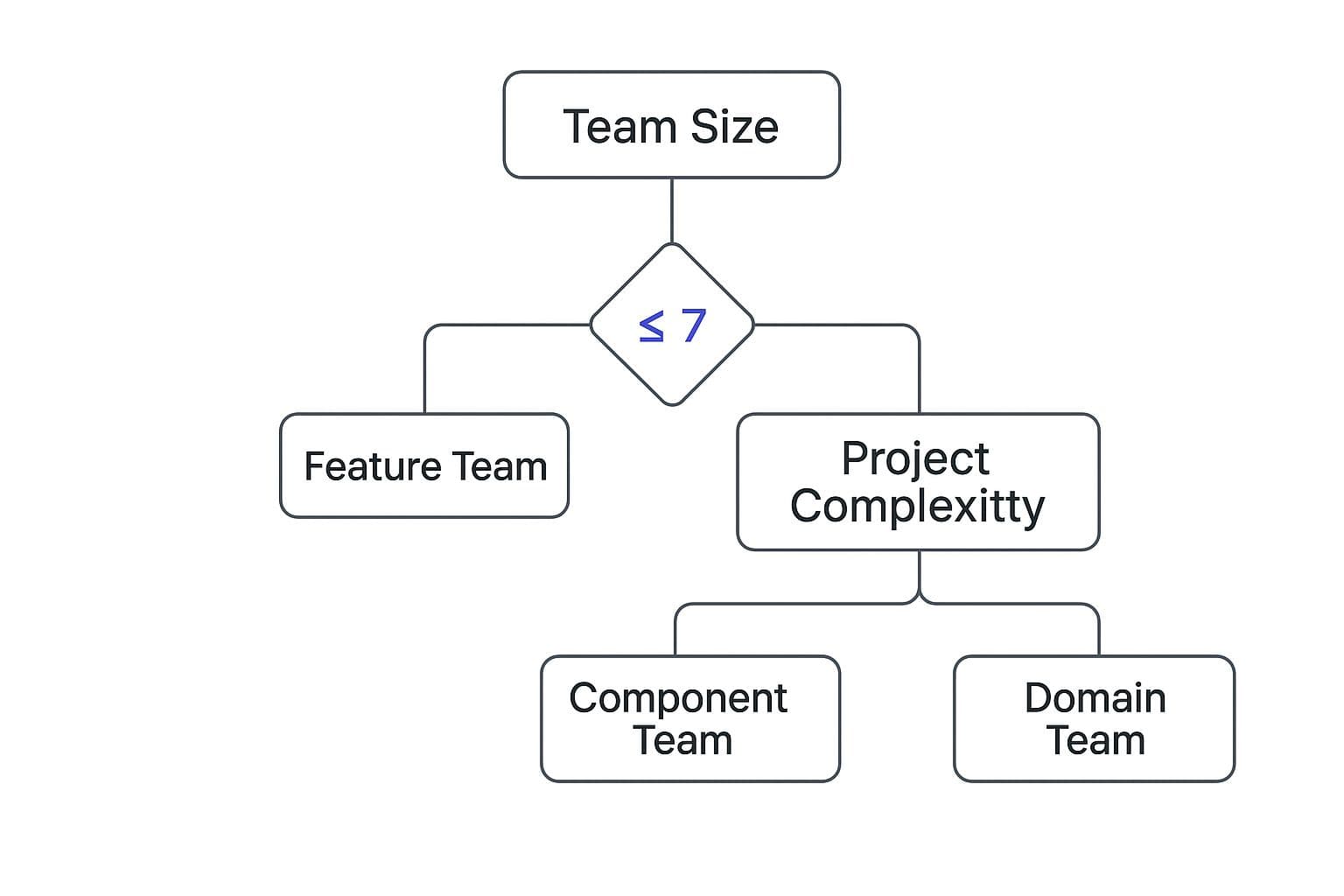
As you can see, smaller teams often do well when focused on features, but as teams grow, they need to get more intentional about their structure based on how complex their work is.
Software Team Structure Comparison Matrix
To make a truly informed choice, you need to see how these models stack up against each other on the factors that matter most. No structure is perfect; they all come with trade-offs. The trick is to pick the one whose strengths align with your needs and whose weaknesses you can live with.
The following table breaks down the core differences in communication, developer autonomy, and scalability to give you a clearer picture of what you're signing up for with each model.
| Attribute | Functional Team | Cross-Functional Squad | Matrix Organization |
|---|---|---|---|
| Primary Goal | Deep technical expertise and quality standards. | Speed of delivery and product ownership. | Flexible resource allocation across projects. |
| Communication | Strong within the function (e.g., all backend devs), weaker across functions. | Excellent within the squad, focused on a single product/feature. | Complex; requires communication with both functional and project managers. |
| Autonomy | Low for individuals, high for the functional group. | High; the squad has end-to-end ownership. | Moderate; balanced between project needs and functional standards. |
| Best For | Companies where deep specialization and technical excellence are paramount. | Startups and product-led companies focused on rapid iteration and market fit. | Large organizations with multiple projects that require shared specialists. |
| Biggest Risk | Silos, slow hand-offs between teams, and a lack of product focus. | Inconsistent technical standards across squads, potential for knowledge silos. | Conflicting priorities, confusion from reporting to two managers, high overhead. |
Ultimately, choosing a team structure is a deliberate act. The right one acts as a force multiplier, amplifying your team's strengths. The wrong one creates constant friction, turning simple tasks into organizational nightmares.
How to Structure Remote and Distributed Teams
The days of everyone huddled in the same office are fading. As development teams spread out across cities, countries, and time zones, our old ways of structuring them need to catch up. If you stick with the wrong model, you're setting yourself up for painful communication breakdowns and a team that feels more like a collection of strangers than a cohesive unit.
Think about the classic Functional team. This model can be a real headache in a remote setting. Imagine your frontend developers are in New York and your backend team is in Berlin. That eight-hour time difference turns a simple question into a 24-hour waiting game, bringing progress to a screeching halt. The handoffs that were a bit slow in the office become absolute killers.
On the other hand, the Cross-Functional Squad often thrives when teams go remote. These squads are designed to be self-sufficient, packing all the skills needed to get a feature out the door. They don't need to constantly check in with other departments, which is a huge win when you can't just walk over to someone's desk. That autonomy is their superpower.
Making It Work From Anywhere
No matter which org chart you hang on the virtual wall, a few things become absolutely essential for any distributed team. Success is less about the structure itself and more about building deliberate, intentional systems for how you communicate and share information. Good documentation, for example, stops being a "nice-to-have" and becomes the single source of truth that keeps everyone on the same page.
To make any remote structure successful, you have to nail these fundamentals:
- Master Asynchronous Communication: You can't run a global team on back-to-back Zoom calls. It's just not sustainable. You need a solid async-first approach, using tools like Slack for ongoing chats and written daily updates to keep everyone in the loop without forcing them to be online at the same time.
- Default to Transparency: When you're not in the same room, you have to over-communicate. Project discussions should happen in public channels, not DMs. Big decisions and the reasoning behind them need to be visible to all. This is how you stop information silos from quietly killing your team's momentum.
- Build a Great Digital Toolkit: Your tech stack is your new office. Project management tools like Jira, collaborative whiteboards like Miro, and design platforms like Figma create the shared spaces where the work actually gets done.
At the end of the day, a great distributed team is built on a bedrock of trust and clarity. The right structure helps, but it’s the processes and tools you put in place that truly make it all click.
Still Have Questions? Let's Clear Things Up
It's one thing to understand these models on paper, but it's another to apply them in the real world. Let's tackle a couple of the most common questions that come up when leaders start thinking about their team's design.
What’s the Best Team Structure for a Startup?
For most startups, the Cross-Functional Squad model is the way to go. Why? Because startups live and die by their ability to move fast, learn, and adapt. This model gives a small, dedicated team everything they need to own a feature from the first sketch to the final launch.
You get incredible focus and speed without the bureaucratic hurdles of a traditional functional team or the coordination headaches that can come with a matrix structure. It’s all about getting a great product into the hands of users, and this model is built for that exact purpose.
How Do You Stop Squads From Becoming Silos?
This is a great question and a real risk. When squads are laser-focused on their own goals, how do you make sure they're not reinventing the wheel or drifting apart in their practices?
That's where "Chapters" and "Guilds" come in. Think of a Chapter as a way to connect all the specialists of a certain type—say, all the backend engineers—across different squads. They meet regularly to share what they're learning, set standards, and solve common problems. It keeps the quality bar high everywhere.
Guilds are a bit more informal. They're like clubs for people who share a passion for a specific topic, like performance optimization or user accessibility. Anyone from any squad can join, making it a fantastic way to spread knowledge and innovation organically throughout the organization.
Ready to build your product with a team that’s built for speed? Iglu Digital has mastered the art of turning great ideas into market-ready MVPs on a fixed price, agreed up front.
Find out how we can help you launch faster.