

Time and Material vs Fixed Price A Complete Guide
Table of Contents
The fundamental difference between Time and Material vs Fixed Price models boils down to a classic trade-off: flexibility versus predictability. A Time and Material (T&M) contract is your best bet when the project path is winding and the requirements are likely to change. You simply pay for the actual hours logged and the materials used. On the other hand, a Fixed Price contract gives you absolute cost certainty, but only for projects where the scope is crystal clear and set in stone from day one.
Choosing Your Project Pricing Model
Picking the right pricing model is one of those foundational decisions that can make or break a project. It sets the tone for everything that follows, from your budget and timeline to the final quality of the work. This isn't just a financial footnote; it's about aligning the payment structure with the reality of your project's goals. Get it wrong, and you could be looking at budget blowouts, missed deadlines, or a strained relationship with your vendor.
But when you get it right, the model creates a foundation of trust and collaboration. It helps manage risk intelligently and ensures everyone is focused on delivering real value. To make that happen, you first need to understand the core trade-offs.

Defining the Core Concepts
Before we get into the nitty-gritty, let's make sure we're on the same page.
A Time and Material contract is exactly what it sounds like. The client is billed for the actual time developers, designers, and managers spend on the project, plus the cost of any materials or third-party services. This model is the go-to for Agile development because it embraces change and iteration.
A Fixed Price contract is a much more rigid arrangement. You agree on a single, total cost for a very specific scope of work before anything begins. If you need to change something down the line, it usually requires a formal change request and, more often than not, more money. It’s built for projects where you know every last detail upfront.
The Financial Trade-Off
Predictability almost always costs extra. With Fixed Price contracts, it’s common for vendors to bake in a risk premium—often adding 15-30% to the total cost. This buffer protects them from unexpected issues or scope creep that wasn't accounted for initially.
So while you get the peace of mind of a fixed number, a T&M contract often provides better value and can lead to lower overall costs if the project runs smoothly. To dig deeper into how these models affect the bottom line, check out these contract type insights from Tateeda.com.
Here’s a quick breakdown of how they stack up:
| Feature | Time and Material (T&M) | Fixed Price |
|---|---|---|
| Best For | Complex projects with an evolving scope. | Clearly defined projects with zero ambiguity. |
| Budget | Flexible and based on the actual work done. | Locked in and determined upfront. |
| Flexibility | High. Pivoting is part of the process. | Low. Changes are difficult and expensive. |
| Risk Allocation | Shared. Both client and vendor have skin in the game. | Mostly on the vendor (who charges a premium for it). |
Ultimately, the time and material vs fixed price decision comes down to what you value more: the ability to adapt as you go, or the security of a predictable budget.
Comparing T&M and Fixed Price Models
To make the right call between a Time and Material vs. a Fixed Price model, you need to look past the basic definitions. The best choice really boils down to how each approach handles budget, scope, risk, and your own involvement. These factors aren't just details—they directly shape your project's final outcome.
Let's break down how these two models stack up against the criteria that truly matter for a project's success. This comparison will shed light on the fundamental trade-offs you'll be making.
Scope Flexibility and Project Control
The single biggest difference between these two models is how they handle change.
A Fixed Price contract is, by its very nature, rigid. The scope is hammered out and locked in from day one. Any deviation, no matter how small or sensible, has to go through a formal—and often expensive—change request process. While this structure offers predictability, it can easily stifle creativity and stop teams from acting on valuable insights they discover along the way.
On the other hand, a Time and Material (T&M) model is built for exactly this kind of evolution. It’s designed to let requirements grow and adapt as the project moves forward, which makes it a perfect fit for Agile development. You have the direct control to reprioritize features, pivot based on fresh user feedback, or explore new ideas without getting bogged down in contract renegotiations. This adaptability is priceless for projects where innovation is the name of the game.
Budget Management and Cost Predictability
For clients who need absolute certainty on the final price tag, the Fixed Price model can feel like the only safe option. You know the exact cost before a single line of code is written, which makes financial planning feel straightforward. But that predictability comes at a cost—vendors almost always bake in a significant risk premium to cover their bases against any unexpected hurdles.
The T&M model gives you a different kind of financial control. While the final cost isn't set in stone, you get complete transparency into where every dollar is going. You’re only paying for the actual work being done, which can often result in a lower total cost if the project is managed well. To keep spending in check, T&M contracts frequently include budget caps or require regular progress reviews, giving you a firm grip on the finances without sacrificing flexibility.
This visual helps illustrate the core trade-offs in flexibility, risk, and predictability between the two models.
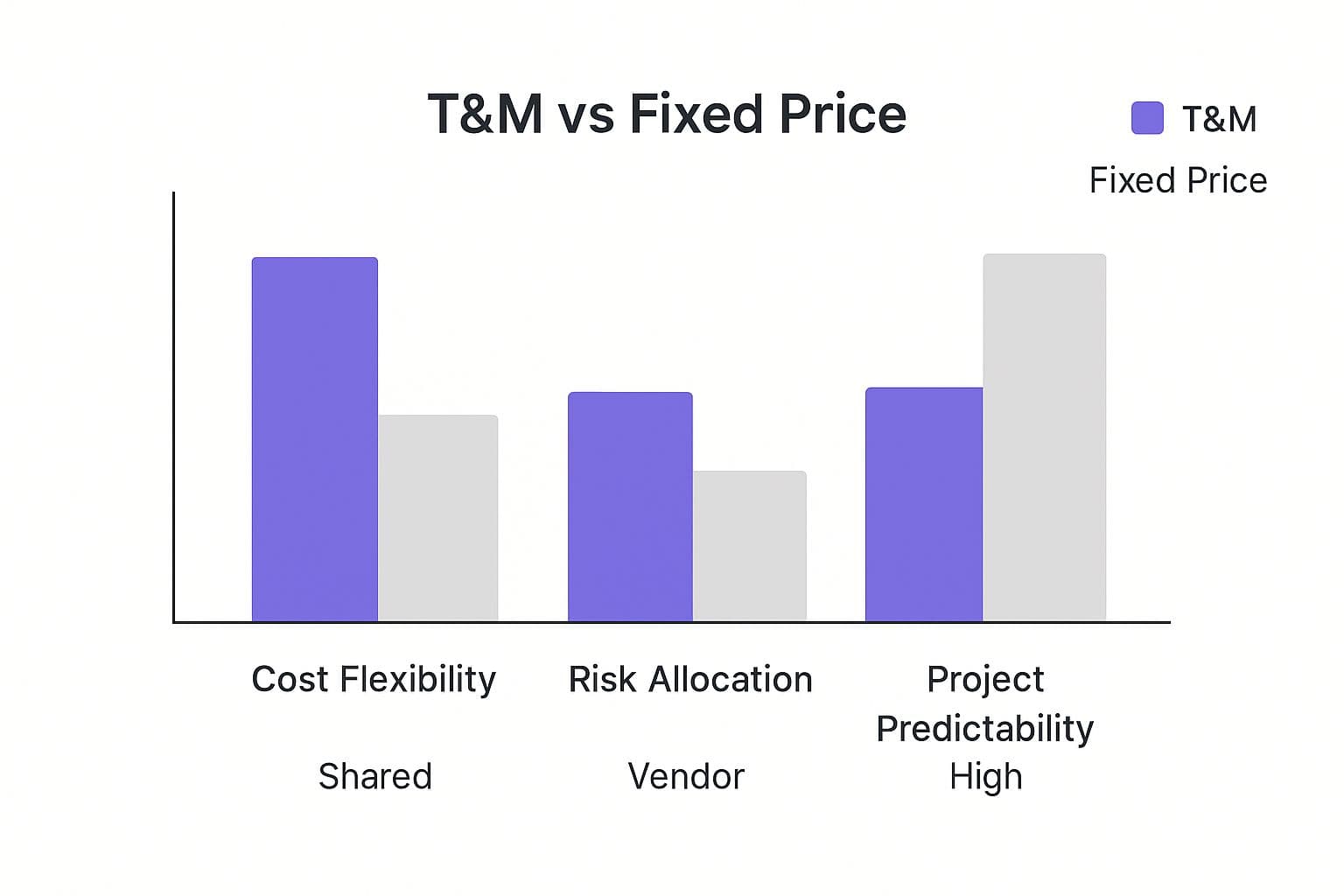
As you can see, T&M is the clear winner on flexibility, while Fixed Price delivers on predictability. How risk is handled is the key factor that separates them.
Risk Allocation and Responsibility
Every project has risks, and how those risks are distributed is a core function of the pricing model you choose.
With a Fixed Price contract, the vast majority of the risk is shifted onto the vendor. They're on the hook to deliver the agreed-upon scope within the set budget, no matter what challenges pop up. This protection is a huge selling point for clients, but it also explains the higher upfront cost and why vendors are so resistant to scope changes.
A T&M agreement, however, creates a shared-risk environment. Both you and your vendor are invested in executing the project efficiently. If the scope needs to grow or priorities change, everyone collaborates to adjust the plan. This shared responsibility builds a foundation of transparency and leads to a much stronger partnership, since you’re all working toward the same goal.
Client Involvement and Collaboration
The level of engagement required from you as the client is dramatically different between these two approaches.
- Fixed Price: This model demands a massive amount of your time and effort during the initial planning phase. You'll need to provide exhaustive documentation and define every last requirement. After kickoff, however, your involvement can become quite minimal, often just checking in for milestone reviews.
- Time and Material: This approach is all about continuous collaboration. Your active participation in regular meetings, feedback sessions, and sprint planning is absolutely essential for the project to succeed. This high-touch engagement ensures the final product is perfectly aligned with your vision and the needs of the market.
Key Differences Between T&M and Fixed Price
To help you see the contrasts more clearly in the time and material vs fixed price debate, here's a side-by-side comparison table. It offers a quick, at-a-glance look at the core attributes of each model.
| Attribute | Time and Material (T&M) | Fixed Price |
|---|---|---|
| Scope Flexibility | High. Changes are expected and easily managed. | Low. Scope is rigid; changes are difficult and costly. |
| Budget Structure | Variable. Based on actual time and resources used. | Predetermined. One total cost agreed upon upfront. |
| Risk Allocation | Shared. Both client and vendor are invested in efficiency. | Vendor-focused. Vendor absorbs risk for a premium. |
| Client Involvement | High. Requires continuous collaboration and feedback. | Low. Minimal involvement needed after initial planning. |
| Best For | Evolving, complex, or long-term projects. | Simple, well-defined projects with no ambiguity. |
Ultimately, there is no single "best" model—it all comes down to the nature of your project. If you have a crystal-clear understanding of your requirements and they are unlikely to change, a Fixed Price contract gives you valuable predictability. But if your project needs room to adapt, innovate, and respond to new information, a Time and Material model provides the flexibility you need to build something truly great.
Analyzing the Real Cost and Risk
When you’re weighing Time & Material vs Fixed Price, it’s tempting to just look at the initial quote. But the real financial impact and the risks involved run much deeper. The number on the proposal rarely tells the whole story. A seemingly safe Fixed Price contract can be loaded with hidden costs, while a flexible T&M agreement can spiral out of control if you don’t manage it properly.
To make the right call, you have to look past the surface and understand how each model distributes the financial and project risks. Getting a handle on these hidden factors is the key to protecting your budget and actually building something successful.

The Hidden Cost of Fixed Price: The Risk Premium
The big draw of a Fixed Price contract is predictability. You get a single number, and that’s supposedly what you'll pay. Simple, right? The catch is that this certainty comes with a built-in—and often significant—hidden cost called the risk premium.
Your vendor isn't just absorbing the risk of unexpected problems for free. To shield themselves from scope creep, unforeseen technical roadblocks, or just plain bad estimates, they bake a buffer into their quote. This premium isn't a secret; it's standard practice, but it means you're paying for problems that might never even happen.
This "risk tax" often inflates the total cost by 15-30% or more as a hedge against the unknown. It's built right into the price you pay, no matter how smoothly the project actually goes.
This means that even in a perfect scenario where everything goes right, you've already overpaid. That "certainty" you bought was really just an insurance policy—one you have to pay for whether you file a claim or not.
The Financial Risk of T&M: Budget Overruns
On the flip side, the main financial fear with a Time and Material model is the very real possibility of budget overruns. With no hard ceiling, costs can absolutely escalate if the project isn't managed with a firm hand. This is a legitimate concern and the number one reason some people shy away from T&M.
But this risk is far from uncontrollable. A well-run T&M project isn't a blank check; it's a partnership governed by strict financial controls and total transparency.
There are several practical strategies you can put in place to keep a T&M budget on a tight leash, turning a potential liability into a manageable variable.
- Budget Caps and Estimates: Set a "not-to-exceed" budget from the outset. You can also work with the vendor to create detailed estimates for each phase, giving you a clear financial ceiling while keeping things flexible within that limit.
- Transparent Reporting: Demand regular, detailed reports showing hours logged, tasks completed, and where you stand against the budget. This kind of transparency helps you spot potential overages long before they become a problem.
- A Prioritized Backlog: Always maintain a clear, prioritized list of what needs to be done. This ensures the team is always working on the most valuable features, so every dollar you spend is delivering the maximum impact.
By putting these controls in place, you can get all the benefits of T&M's flexibility without exposing yourself to runaway costs. The trick is to stay actively involved and insist on clear communication. For a more detailed breakdown, it's worth exploring our guide on the true software development cost and what goes into it.
The Overlooked Risk of Project Failure
Beyond budgets and timelines lies a much bigger risk: the risk of building the wrong product. This is where the rigidity of a Fixed Price contract can become its greatest weakness.
Because the scope is locked in from day one, a Fixed Price project leaves almost no room to adapt to new market insights, user feedback, or shifting business needs. You're stuck building what was defined months ago, even if you’ve since discovered it’s not what your customers actually want. This inflexibility can lead to a project that's delivered perfectly on time and on budget but fails completely in the market—a total waste of money.
The T&M model is designed to mitigate this exact risk. Its agile nature lets you test your assumptions, get real-world feedback, and pivot your strategy based on what you learn. You can tweak features, shuffle priorities, and ultimately build a product that finds a genuine product-market fit.
In the time and material vs fixed price debate, the danger of building a useless product is often far greater than the risk of going over budget. T&M's adaptability is a powerful tool for making sure the final product doesn't just meet the original spec sheet—it actually succeeds.
How Each Model Impacts Timelines and Quality
Choosing between a Time & Material and a Fixed Price model is about more than just money. It's a decision that will ripple through your entire project, directly shaping deadlines, team dynamics, and the quality of what you build. In many cases, these operational impacts have a much bigger effect on success than the initial budget.
A Fixed Price contract might feel like the safe bet, but it can unintentionally push the team to prioritize speed over substance. On the flip side, a flexible T&M agreement, when managed with discipline, can lead to a far superior product. You have to understand how each model influences the day-to-day work to make sure your project’s structure actually helps you reach your goals.
The Fixed Price Effect on Deadlines and Innovation
The biggest selling point of a Fixed Price contract is predictability. You have a clearly defined scope and a firm deadline, which generally makes timelines reliable. The project plan becomes a rigid roadmap, and the team’s main job is to get from A to B as efficiently as possible, hitting every milestone on schedule.
But that rigidity comes at a cost. Because the scope is locked in from day one, there’s a powerful disincentive to innovate or act on smart improvements discovered mid-project. A developer might see a better way to build a feature, but if it wasn't in the original plan, it often gets shot down to avoid scope creep and protect the vendor's profit margin.
This can put you in a tough spot. The team might deliver exactly what was asked for, on time and on budget, but the final product feels dated or fails to incorporate valuable lessons learned along the way. The focus stays squarely on fulfilling the contract, which can easily stifle the creative problem-solving that leads to truly exceptional results.
How T&M Influences Quality and Agility
A Time and Material (T&M) contract completely changes the project's vibe. Instead of following a rigid plan, the project is guided by a prioritized backlog and a spirit of collaboration. This approach has a huge impact on both the timeline and the quality of the final product.
With T&M, timelines are naturally more fluid. Of course, you’ll still have target dates and release schedules, but the model’s flexibility allows the team to adapt to new information. If user feedback uncovers a critical flaw or a new market opportunity pops up, the team can pivot without having to go through a painful contract renegotiation. This kind of agility is a massive advantage when you’re trying to build something that people will actually want to use.
Quality control can also get squeezed under Fixed Price agreements, as vendors are bound to the contract and hesitant to do any work that falls outside the scope. In contrast, T&M contracts encourage quicker decisions and more flexibility, which often leads to a better development process. You can find more insights on project control in this Cprime article.
Collaboration and Timeline Management
The number one risk in a T&M project is timeline creep. Without the hard guardrails of a fixed scope, it’s easy for projects to lose focus and drag on past their intended deadlines. This is precisely why active client involvement and rock-solid project management are non-negotiable.
Well-run T&M projects rely on a few key practices to keep things on track:
- A Prioritized Backlog: The team is always working on the most valuable features first. This ensures that every hour billed contributes directly to the project's most important goals.
- Regular Check-ins: Frequent sprint reviews and planning sessions keep everyone—both the client and the development team—on the same page about priorities and progress.
- Transparent Reporting: You should be seeing detailed timesheets and progress reports. This gives you a clear view of where resources are going and prevents any nasty surprises.
Managing this kind of project requires a much deeper level of collaboration from the client than a Fixed Price project does. However, this hands-on involvement is what ensures the team's efforts are always aligned with the evolving business vision. To learn more about this, check out our guide on effective resource allocation in project management. Ultimately, T&M turns you from a spectator into a co-creator, and that is often the secret to building a high-quality product that actually succeeds.
When to Use the Time and Material Model
The Time and Material (T&M) model really shines when a project's path is uncertain. Think of it as the go-to choice for any initiative where learning and adapting on the fly are more important than sticking to a rigid, predetermined plan. When you opt for T&M, you're essentially choosing flexibility and collaborative problem-solving over the false sense of security a fixed scope can provide.
It's tailor-made for projects where you know the destination but the exact route to get there is still hazy. T&M is built for complexity, innovation, and, frankly, for building strong, long-term partnerships.

For Projects With an Evolving Scope
The clearest sign you need a T&M contract is an undefined project scope. This happens all the time, especially when you're building something genuinely new or complex where the requirements are guaranteed to change as the work gets underway.
Imagine you're developing a new mobile app with a unique user experience. You have the core concept down, but the specific features and how users will navigate them will almost certainly be tweaked after you see the first prototypes and get real feedback. A T&M contract gives you the breathing room to make those necessary adjustments without getting hit with expensive change orders.
This flexible approach is the heart and soul of modern development. To get a better handle on the concepts that make this possible, you can dive into our guide on agile software development terminology.
For Long-Term and Complex Initiatives
For big, sprawling projects that will last for months or even years, T&M is almost always the better choice. It's just not realistic to map out every single requirement perfectly from day one on these massive initiatives. The market will change, new tech will pop up, and your own business priorities will likely shift.
Real-World Scenario: A company decides to build a massive logistics management platform from scratch.
- Initial Phase: They start with the basics, like shipment tracking and inventory management.
- Later Phases: Once the platform is in use, they realize they desperately need advanced route optimization, automated carrier selection, and predictive analytics to stay competitive.
A T&M model handles this kind of natural evolution perfectly. It allows the team to add and refine features based on real-world needs, and the client simply pays for the work as it happens. The result is a far more robust and useful final product.
When Agility Is a Core Requirement
The T&M model and Agile methodologies like Scrum and Kanban go hand-in-hand. Agile is all about iterative development, constant feedback, and being able to pivot quickly. A Fixed Price contract, with its locked-in scope, is the natural enemy of these principles.
You should lean toward T&M when:
- You're building a Minimum Viable Product (MVP) and need to test your assumptions with actual users before going all-in on a feature set.
- You need the ability to react quickly to what your competitors are doing or what your customers are asking for.
- Your project has a heavy research and development (R&D) component, meaning the outcomes are inherently unpredictable.
When it comes down to the time and material vs fixed price debate, T&M is the undisputed champion for any project where learning and adapting are the keys to success. It moves the relationship from a simple client-vendor transaction to a true partnership focused on one thing: delivering the best possible outcome.
When a Fixed Price Contract Makes Sense
While flexibility is a huge plus for many projects, sometimes what you really need is predictability. That’s where a Fixed Price contract shines. It provides a solid, stable framework for projects where the scope isn't just understood—it's locked down, documented, and unlikely to budge.
Think of it as the go-to choice when your main goal is knowing the exact cost and deadline from day one. This model is perfect for anyone who's absolutely certain their project requirements are set in stone. For it to work, every single feature, design choice, and technical detail has to be ironed out before a single line of code is written. This initial effort cuts out any guesswork and builds a firm foundation for the entire engagement.
When the Scope Is Fully Defined
A Fixed Price contract is your best bet when there’s absolutely zero room for interpretation in the project scope. The requirements aren’t just known; they're exhaustive and stable. This level of detail guarantees that you and the development team are on the exact same page about what the final product will be.
Here are a few classic examples where a Fixed Price model is the clear winner:
- Standard Marketing Websites: You need a simple, five-page informational website with a contact form and a blog. The pages, content layout, and design are all agreed upon beforehand.
- Well-Established MVPs: You're building a Minimum Viable Product where the core features are non-negotiable and have already been thoroughly validated. The mission is all about execution, not exploration.
- Government Contracts: Many government or public sector projects operate under strict, pre-approved budgets. They demand detailed upfront planning and leave no room for financial surprises.
In every one of these cases, the "what" is completely locked in. The only thing left to do is build it, which is precisely what this model is designed for.
The Value of Predictability
For any organization working with a rigid budget or needing to secure funding based on a concrete number, the certainty of a Fixed Price contract is a lifesaver. You know the total cost before the project even begins, which makes financial planning a breeze and wipes out the risk of surprise invoices.
This approach is ideal for clients who need that level of cost and timeline security and are okay with the trade-offs. The biggest downside is its rigidity. Trying to shoehorn a complex or evolving project into this structure is a recipe for frustration. If you foresee any need to pivot, incorporate user feedback, or change the scope mid-stream, a Fixed Price model will feel more like a roadblock than a safety net in the time and material vs fixed price debate.
Common Questions About Pricing Models
When you're deep in the time and material vs fixed price debate, the theory is one thing, but how it all plays out in the real world is another. Let's tackle some of the most common questions that pop up when it's time to sign on the dotted line.
Can You Combine T&M and Fixed Price Models?
You absolutely can, and frankly, it's often the smartest move. A hybrid approach gives you a powerful combination of flexibility where you need it and predictability where it counts.
Think of it this way: kick off the project with a T&M model for the initial discovery and research phase. This is when ideas are fluid and the scope isn't fully nailed down. Once that initial work brings clarity, you can pivot to a Fixed Price agreement for the main development sprint. It’s the perfect strategy for getting the best of both worlds.
How Do You Control Costs in a T&M Project?
This is a big one. Many people hear T&M and think "blank check," but that’s a misconception. Real cost control in a T&M project comes down to active management and radical transparency, not a fixed number.
Here’s how experienced teams keep things on track:
- Set a Budget Cap: Agree on a "not-to-exceed" budget. This creates a hard ceiling and forces conversations if the project is approaching its limit.
- Review Everything, Often: Don't wait for a monthly invoice. Conduct weekly check-ins on timesheets and progress to catch any budget drift early.
- Keep the Backlog Ruthlessly Prioritized: A well-managed backlog is your best friend. It ensures the team is always spending time and money on the features that deliver the most value.
Is a Fixed Price Contract Always Cheaper?
It's a common assumption, but the answer is a firm no. A Fixed Price contract always has a risk premium baked in—vendors typically add 15-30% to the total cost to protect themselves from unexpected roadblocks.
Plus, any change you need—and there are always changes—will get hit with a change order, often at a premium rate. In many cases, a well-run T&M project can actually come in cheaper, especially if you end up simplifying the scope along the way.
Ready to turn your idea into a market-ready product without the guesswork? Iglu Digital specializes in building high-quality MVPs with the scope and the price agreed before we start. Let us help you launch faster. Learn more at https://iglu.dev.